From the free course AP Physics 1 on Lykke
5.4 Rotational Inertia
Key concepts: Rotational inertia · Moment of inertia of disks and hoops · Dependence of rotational inertia on mass and radius · Torque produced by a tangential force · Relationship between torque, rotational inertia, and angular acceleration · Angular momentum and equal torque applied for equal time · Rotational kinetic energy and work · Rolling objects and acceleration down an incline · Experimental effects of wheel rotational inertia on measured acceleration and g_exp · Using physical models to explain observable rotational motion
A wheel does not resist changes in rotation merely because it has mass; it resists them according to where its mass is located relative to the axis.
5.4 Rotational Inertia
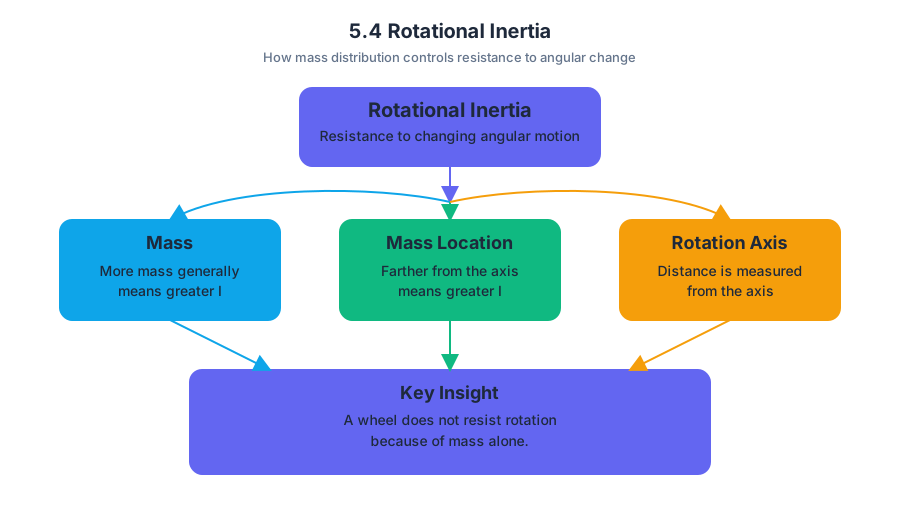
A wheel does not resist changes in rotation merely because it has mass; it resists them according to where its mass is located relative to the axis. That rotational resistance is called rotational inertia, or moment of inertia, and is represented by $I$.
Rotational inertia measures how difficult it is to change an object’s angular motion. More mass, or mass located farther from the rotation axis, generally means greater $I$.
Mass distribution determines rotational inertia
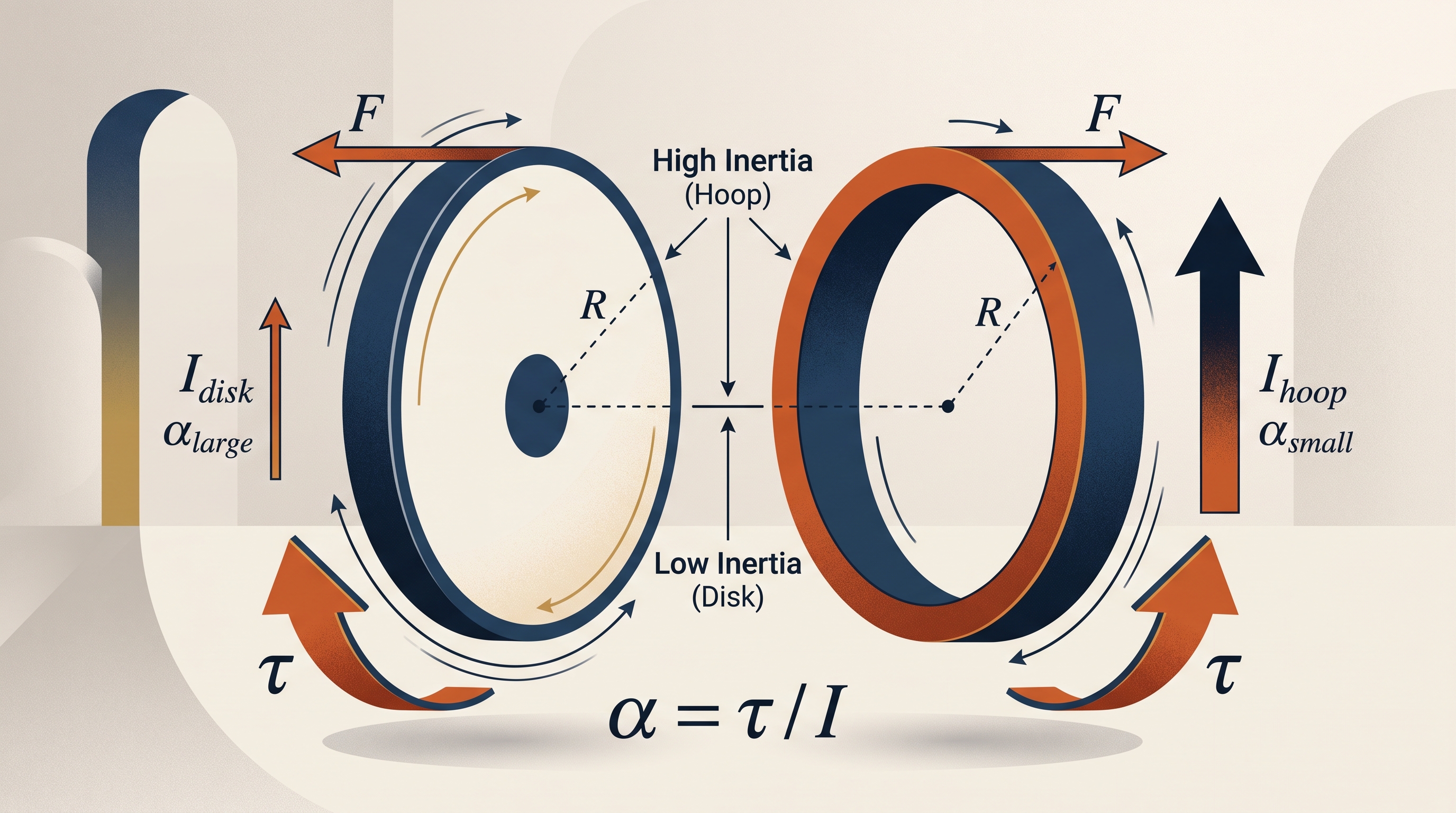
Imagine releasing a solid disk and a thin hoop from the same incline. Both have the same mass $M$ and radius $R$, but the hoop places nearly all of its mass at distance $R$ from the axis, while the disk distributes mass from the center outward. The hoop therefore has greater rotational inertia.
For a disk or pulley modeled as a uniform disk,
$$ I_{\text{disk}}=\frac{1}{2}MR^2 $$
For a thin hoop,
$$ I_{\text{hoop}}=MR^2 $$
Thus, for equal $M$ and $R$,
$$ I_{\text{hoop}}=2I_{\text{disk}} $$
The hoop is harder to spin up because more of its mass lies far from the axis. This is why cans with different contents can reach the bottom of an incline at different times even when their diameters are identical.
The rotational motion model
A complete model identifies the object’s mass $M$, radius $R$, applied tangential force or tension $F_T$, torque $\tau$, rotational inertia $I$, and angular acceleration $\alpha$.
A tension applied tangent to a disk acts at right angles to the radius. Therefore, using the torque relationship from the preceding topic,
$$ \tau=RF_T $$
The rotational form of Newton’s second law connects torque to angular acceleration:
$$ \alpha=\frac{\tau}{I} $$
This equation contains the central idea: the same torque produces less angular acceleration when rotational inertia is larger.
Worked example: disk versus hoop
A disk and a hoop each have mass $M=0.40\ \text{kg}$ and radius $R=0.10\ \text{m}$. A tangential force $F_T=0.20\ \text{N}$ acts on each for $0.50\ \text{s}$.
For the disk,
$$ I_d=\frac{1}{2}(0.40)(0.10)^2=0.0020\ \text{kg}\cdot\text{m}^2 $$
For the hoop,
$$ I_h=(0.40)(0.10)^2=0.0040\ \text{kg}\cdot\text{m}^2 $$
The torque on either object is
$$ \tau=RF_T=(0.10)(0.20)=0.020\ \text{N}\cdot\text{m} $$
Therefore,
$$ \alpha_d=\frac{0.020}{0.0020}=10\ \text{rad/s}^2 $$
and
$$ \alpha_h=\frac{0.020}{0.0040}=5\ \text{rad/s}^2 $$
Starting from rest, $\omega=\alpha t$. After $0.50\ \text{s}$,
$$ \omega_d=(10)(0.50)=5.0\ \text{rad/s} $$
$$ \omega_h=(5)(0.50)=2.5\ \text{rad/s} $$
The hoop rotates more slowly because its rotational inertia is greater.
Equal torque, equal time: angular momentum
Angular momentum is
$$ L=I\omega $$
Torque changes angular momentum according to
$$ \tau=\frac{\Delta L}{\Delta t} $$
So if the same torque acts for the same time on the disk and hoop,
$$ \Delta L=\tau\Delta t $$
is the same for both objects. The hoop nevertheless has the smaller angular speed because its larger $I$ requires a smaller $\omega$ to produce the same angular momentum change:
$$ \omega=\frac{L}{I} $$
This is a crucial distinction: equal torque-time products give equal changes in angular momentum, not equal angular speeds.
Energy connection
When a constant torque turns an object through angular displacement $\Delta\theta$, the work done is
$$ W=\tau\Delta\theta $$
That work becomes rotational kinetic energy:
$$ W=\Delta K_{\text{rot}} $$
with
$$ K_{\text{rot}}=\frac{1}{2}I\omega^2 $$
The disk in the worked example turns through a greater angle because it has greater $\alpha$. Consequently, the same applied torque can do more work on the disk during the same time interval, giving it greater rotational kinetic energy.
Experimental reality: wheels matter
In a cart experiment, treating the wheels as massless can make the predicted translational acceleration too large. Some gravitational energy or work is diverted into rotating the wheels, so the cart’s measured acceleration is smaller; a calculation based on that acceleration can produce a value of $g_{\text{exp}}$ smaller than the accepted gravitational field strength.
Other physical factors include a bumpy or non-level ramp, wobbly or non-round wheels, motion of the surrounding room, and errors in measuring time, position, or angle. “Human error” alone is too vague: a strong experimental explanation names the specific factor and states how it changes the measured result.
Misconception check
Misconception: “The object with greater mass always has greater rotational inertia.” Not necessarily. Rotational inertia depends on both mass and mass distribution. A light hoop can have greater $I$ than a heavier disk if enough of the hoop’s mass lies farther from the axis.
AP skills in action
This topic most directly exercises Science Practice 1—Creating Representations through a rotational-motion diagram; Science Practice 2—Mathematical Routines through using $I$, $\tau$, $\alpha$, $L$, and energy equations; and Science Practice 3—Scientific Questioning and Argumentation when explaining the can race or defending an experimental claim. It also uses Translation Between Representations, Experimental Design and Analysis, and Qualitative/Quantitative Translation: students must move between a physical model, equations, numerical results, and a written explanation.
Retrieval check
A disk and hoop have equal $M$ and $R$. The same tangential force acts on each. Which has the larger angular acceleration, and why? If the force acts for equal times, which quantity changes by the same amount for both objects?
Answer: The disk has the larger angular acceleration because $I_{\text{disk}}<I_{\text{hoop}}$ and $\alpha=\tau/I$. The change in angular momentum is the same because $\Delta L=\tau\Delta t$.