From the free course AP Physics 1 on Lykke
6.4 Conservation of Angular Momentum
Key concepts: Angular momentum conservation · Net external torque and its role in conservation · System boundaries and the environment · Transfer of angular momentum · Angular momentum of orbiting objects · Relationship between orbital radius and tangential speed · Torque versus force in rotational dynamics · Block-spring systems involving rotation and energy
Angular momentum stays constant only when the chosen system experiences zero net external torque over the interval being analyzed.
6.4 Conservation of Angular Momentum
Angular momentum stays constant only when the chosen system experiences zero net external torque over the interval being analyzed.
Learning Objective 6.4.B: Make predictions about the angular momentum of a selected object or rigid system by identifying the system boundary and evaluating the external torque acting on it.
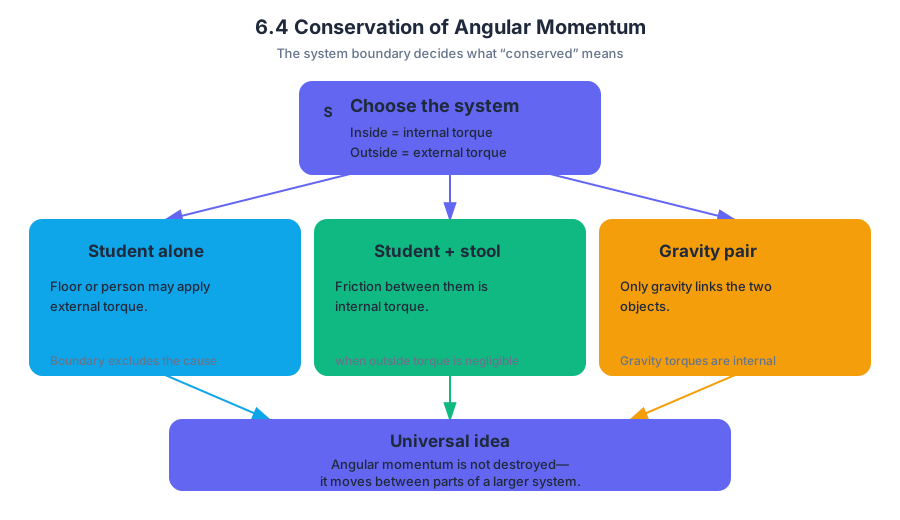
The system boundary decides what “conserved” means
A system is the object or collection of objects you choose to analyze. Everything not included is the environment. A torque caused by an object inside the system is internal; a torque caused by something outside it is external.
| System choice | Torque classification | What can be conserved? |
|---|---|---|
| A spinning student alone | The floor or another person may exert external torque | The student’s angular momentum can change |
| Student plus rotating stool | Friction between them is internal | Their combined angular momentum can remain constant if outside torque is negligible |
| Two objects interacting only through gravity | Gravitational torques are internal | The pair’s total angular momentum is conserved |
Essential Knowledge 6.4.B.1 expresses the universal conservation idea: angular momentum is not destroyed. It can move between parts of a larger system. Whether the angular momentum of your selected system remains constant depends on whether the environment transfers angular momentum into or out of it.
Torque determines the change
Essential Knowledge 6.4.B.2 gives the conservation condition. For a selected object or rigid system,
$$ \frac{dL}{dt}=\tau_{\text{net, external}}. $$
If the net external torque is zero at every instant, then the angular momentum remains constant. More generally, the change during a finite time interval depends on the net external angular impulse:
$$ \Delta L=\int_{t_i}^{t_f}\tau_{\text{net, external}},dt. $$
Thus, a nonzero external torque means that angular momentum is changing instantaneously at that moment. It does not guarantee a nonzero final change over an entire interval: positive and negative torques can cancel, giving zero net angular impulse and therefore $\Delta L=0$.
Essential Knowledge 6.4.B.3: If the net external torque on a selected object or rigid system is nonzero, angular momentum is transferred between the system and the environment.
Misconception check — “Any torque means angular momentum is permanently lost.” Torque is not a loss mechanism. It is the mechanism by which angular momentum crosses the system boundary. If the environment exerts a positive torque, the system gains angular momentum; if it exerts a negative torque, the system gives angular momentum back.
Orbiting objects: radius and tangential speed
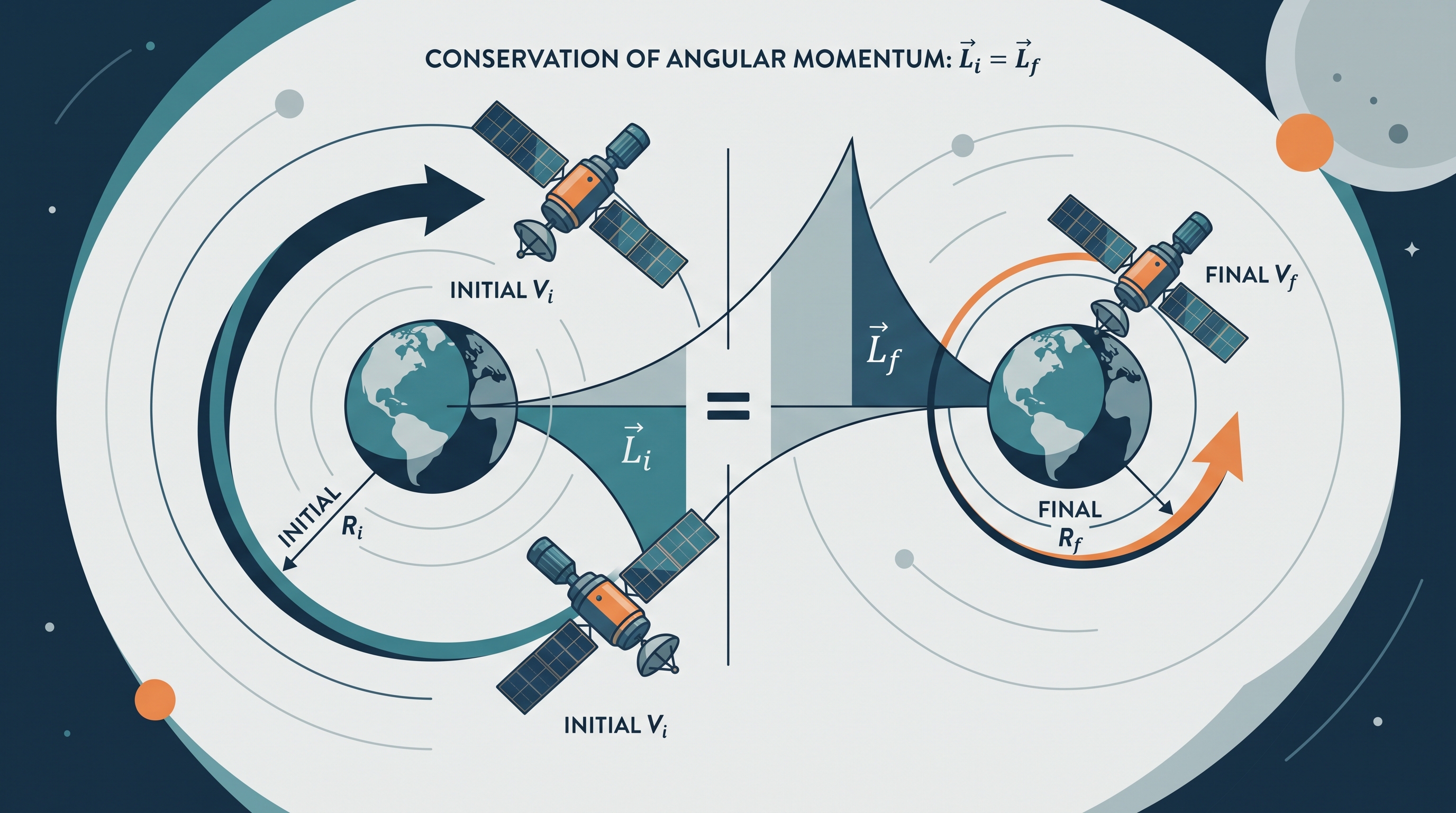
For an object moving perpendicular to its radius from the rotation axis, angular momentum can be written as
$$ L=rp, $$
where $r$ is the orbital radius and $p$ is linear momentum. Since $p=mv$,
$$ L=rmv. $$
For a fixed mass in an isolated system, conservation gives
$$ r_i m v_i=r_f m v_f, $$
so
$$ r_i v_i=r_f v_f. $$
If the orbital radius decreases, the tangential speed must increase. If the radius doubles, the tangential speed becomes half as large, provided the angular momentum remains constant.
A useful application is two objects interacting only through gravitational forces. If the two-object pair is the system, gravity is internal, so the pair’s total angular momentum can be conserved. If only one object is selected, the gravitational force from the other object is external, and that object’s angular momentum may change.
A torque calculation must use the actual applied force
For a rotating disk, the torque from a tangential force is determined by the force and its lever arm:
$$ \tau=rF_T, $$
when the force is perpendicular to the radius. The lever arm is the perpendicular distance from the axis to the force’s line of action.
If a string pulls the disk with force $F_T$, the disk’s torque is based on $F_T$, not directly on the gravitational force $m g$ acting on a hanging block. The block’s weight may help determine $F_T$ through a separate force analysis, but it is not automatically the torque-producing force on the disk.
Likewise, a spring’s energy can relate stretch distance to a block’s speed through conservation of energy, but that does not replace the correct angular-momentum or torque equation for the rotating disk.
AP reasoning in action
This topic develops Science Practice 1—Creating Representations when you draw the system boundary, identify the environment, and represent internal versus external torques. It develops Science Practice 2—Mathematical Routines when you apply $L=rp$, $\frac{dL}{dt}=\tau_{\text{net, external}}$, or $\Delta L=\int \tau,dt$. It develops Science Practice 3—Scientific Questioning and Argumentation when you use evidence from a diagram, graph, or experiment to justify a claim about conservation. The associated reasoning skill is Qualitative/Quantitative Translation: turn “smaller radius means faster tangential motion” into $r_i v_i=r_f v_f$.
Retrieval check: A satellite moves to a smaller orbital radius while its system’s angular momentum remains constant. What happens to its tangential speed, and what condition justifies your answer?
Answer: Its tangential speed increases because $r v$ is constant when the mass is fixed and the net external torque on the chosen system is zero.

Source Materials
- Review the Exam Updates (.pdf)
- AP Physics 1: Algebra-Based Course and Exam Description
- AP Physics 1 Course Overview
- AP Physics 1 Course at a Glance
- AP Physics 1 Course at a Glance Poster
- Adopt AP Physics 1: Algebra-Based
- AP Physics 1: Algebra-Based
- AP Physics 1: Algebra-Based
- Figure 1 shows the instants when the block is at x 0 = , x D 6 = , and x D 10 = , respectively.