From the free course AP Physics 1 on Lykke
2.1 Systems and Center of Mass
Key concepts: Center of mass of a system · Weighted-average position of mass · Center of mass along a given axis · Modeling a system as a single object located at its center of mass · Finding the center of mass by visual inspection of symmetrical objects
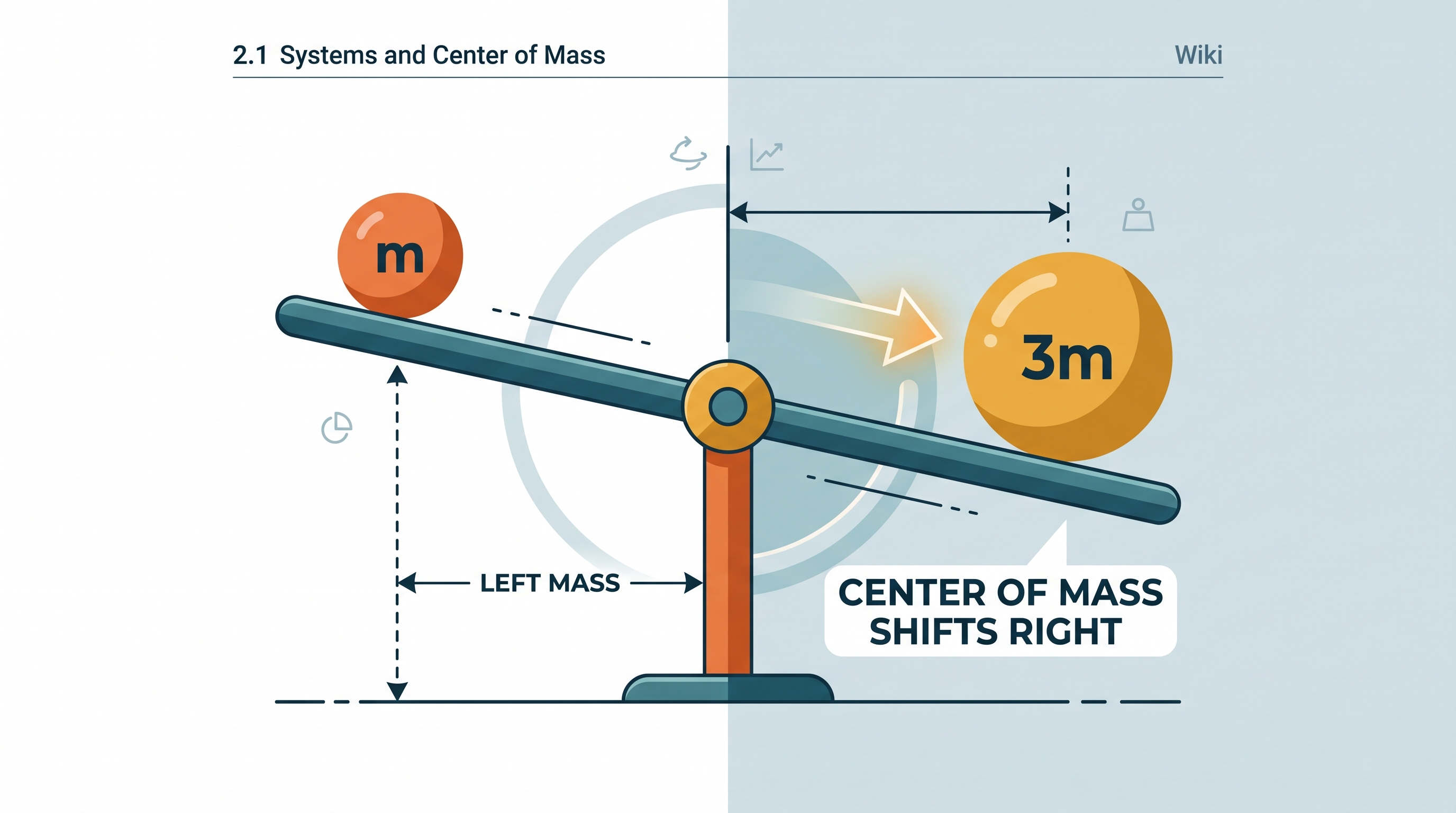
A balanced seesaw does not “care” about every particle separately; for many translational questions, it behaves as though all of its mass were concentrated at one representative location: its center of mass.
2.1 Systems and Center of Mass
A balanced seesaw does not “care” about every particle separately; for many translational questions, it behaves as though all of its mass were concentrated at one representative location: its center of mass. That location shifts toward the heavier side, even when the objects are separated and the system has no physical object at the center itself.
The center of mass as a representative location
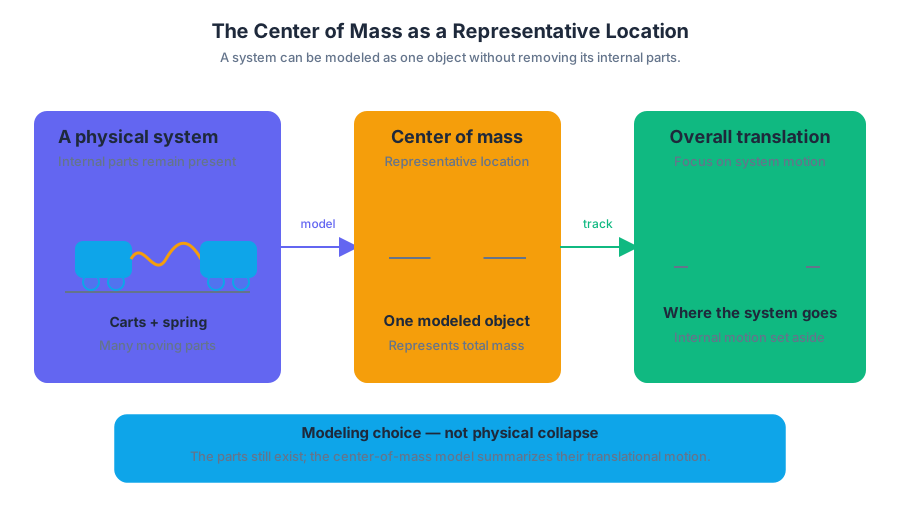
The center of mass is the representative location of a system’s mass. It is the position at which the entire system can be modeled, for certain purposes, as a single object.
Essential Knowledge 2.1.B.3: A system can be modeled as a singular object that is located at the system’s center of mass.
This is a modeling choice, not a claim that the system has physically collapsed. Two carts connected by a spring, several particles, or a lopsided object still contain internal parts. The center-of-mass model tracks the overall translational location of the system while temporarily ignoring the details of how the parts move relative to one another.
Why mass acts as a weight
The center of mass is a weighted average of the individual positions. A heavier mass contributes more strongly to the result than a lighter mass at the same distance.
For a system whose masses lie along a specified axis, the center-of-mass position is
$$ \vec{x}_{cm}=\frac{\sum m_i\vec{x}_i}{\sum m_i}. $$
Here, $m_i$ is the mass of particle $i$, $\vec{x}i$ is that particle’s position along the chosen axis, and $\vec{x}{cm}$ is the center-of-mass location along that axis. The denominator, $\sum m_i$, is the total mass of the system. The numerator adds each position after multiplying it by the mass associated with that position.
The arrows emphasize that position has direction. In a one-dimensional calculation, choose an origin and assign positive and negative coordinates. A mass to the left of the origin might have $x_i<0$, while a mass to the right has $x_i>0$.
Worked example: two unequal masses
A $2.0\ \text{kg}$ mass is at $x_1=0\ \text{m}$, and a $6.0\ \text{kg}$ mass is at $x_2=4.0\ \text{m}$. The center of mass is
$$ x_{cm}
\frac{(2.0\ \text{kg})(0\ \text{m})+(6.0\ \text{kg})(4.0\ \text{m})} {2.0\ \text{kg}+6.0\ \text{kg}}
\frac{24\ \text{kg}\cdot\text{m}}{8.0\ \text{kg}}
3.0\ \text{m}. $$
The result is $3.0\ \text{m}$ from the origin, closer to the $6.0\ \text{kg}$ mass at $4.0\ \text{m}$. That direction is physically sensible: the heavier mass pulls the weighted average toward itself.
Symmetry can reveal the answer immediately
Not every center of mass needs a calculation. For an object or arrangement with symmetrical mass, the center of mass can be found by visual inspection: it lies on the object’s symmetry line or at the intersection of its symmetry lines.
For example, the center of mass of a uniform rectangular plate is at the intersection of its diagonals. The center of mass of a uniform circular disk is at its geometric center. If equal masses are arranged symmetrically about an axis, their contributions on opposite sides balance.
Symmetry does not mean “the geometric center is always correct.” A geometric center gives the center of mass only when the mass distribution is symmetric in the relevant direction. Adding a heavy battery to one side of a robot shifts the center of mass toward the battery.
Scope and AP reasoning skills
Essential Knowledge 2.1.B.2 requires calculating the center-of-mass location along a given axis using the weighted-average equation. The AP boundary limits these calculations to systems of five or fewer particles arranged in two dimensions or to systems that are highly symmetrical; calculus-based continuous, nonuniform mass distributions are outside this expectation.
This topic develops Science Practice 1: Creating Representations, especially representing a system with a coordinate diagram and identifying symmetry. It also develops Science Practice 2: Mathematical Routines, because the solver must define an axis, assign signed positions, substitute masses and coordinates, and interpret the result physically. When a student explains why the answer must lie nearer the heavier mass, the student is using Science Practice 3: Scientific Questioning and Argumentation by supporting a claim with a physical reason.
Misconception check
Misconception: “The center of mass must be inside the material.” Not necessarily. For a ring, the center of mass is at the empty geometric center. The center of mass is a location defined by the mass distribution, not automatically a piece of matter.
Misconception: “Average the positions without using mass.” That works only for equal masses. In general, each position must be multiplied by its mass before the total is divided by the system’s total mass.
Retrieval check
Two equal masses are placed at $x=-2\ \text{m}$ and $x=+2\ \text{m}$. Where is the center of mass? If the mass at $x=+2\ \text{m}$ is made three times as large while the left mass stays unchanged, should $x_{cm}$ move left, move right, or remain at the origin?
For the equal-mass arrangement, symmetry gives $x_{cm}=0$. Making the right mass heavier moves the center of mass to the right, because the positive position now receives the greater weight in the average.
Source Materials
- Review the Exam Updates (.pdf)
- AP Physics 1: Algebra-Based Course and Exam Description
- AP Physics 1 Course Overview
- AP Physics 1 Course at a Glance
- AP Physics 1 Course at a Glance Poster
- Adopt AP Physics 1: Algebra-Based
- AP Physics 1: Algebra-Based
- AP Physics 1: Algebra-Based
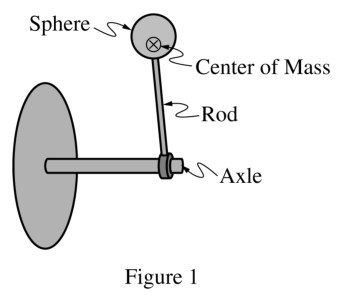
- A rod with a sphere attached to the end is connected to a horizontal mounted axle and carefully balanced so that it rests in a position vertically upward from the axle. The center of mass of the rod-s
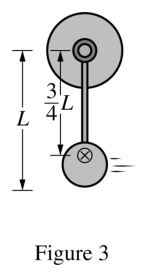
- (b) The rod-sphere system has mass M and length L, and the center of mass is located a distance 3 L 4 from the
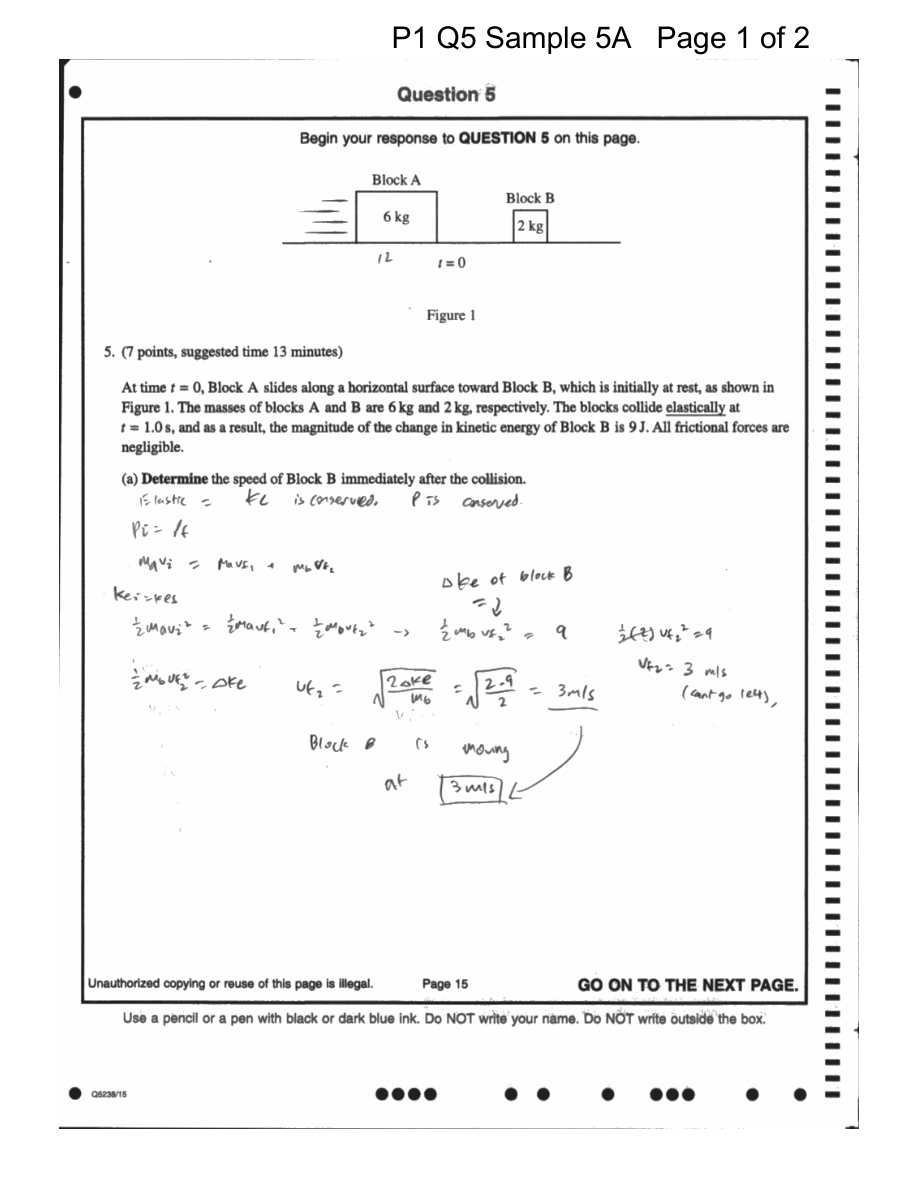
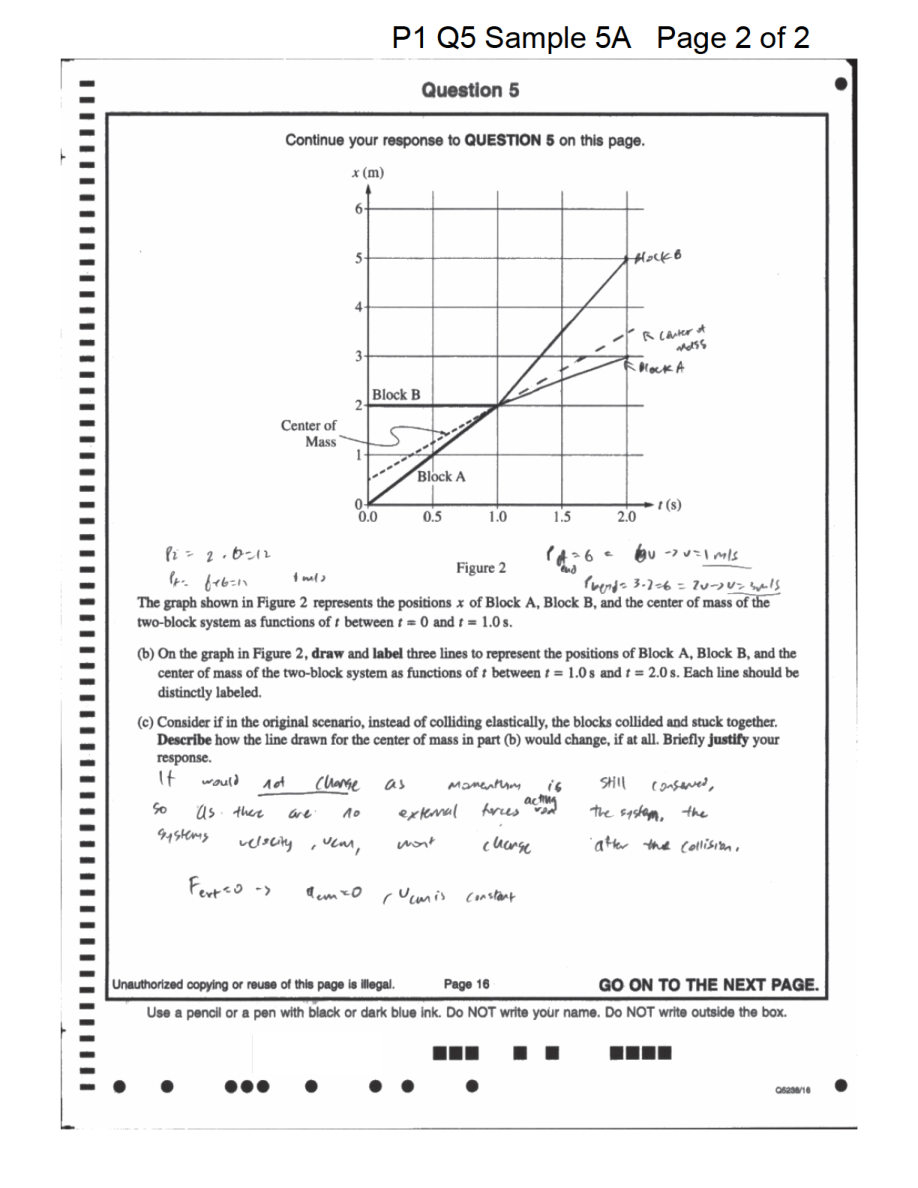
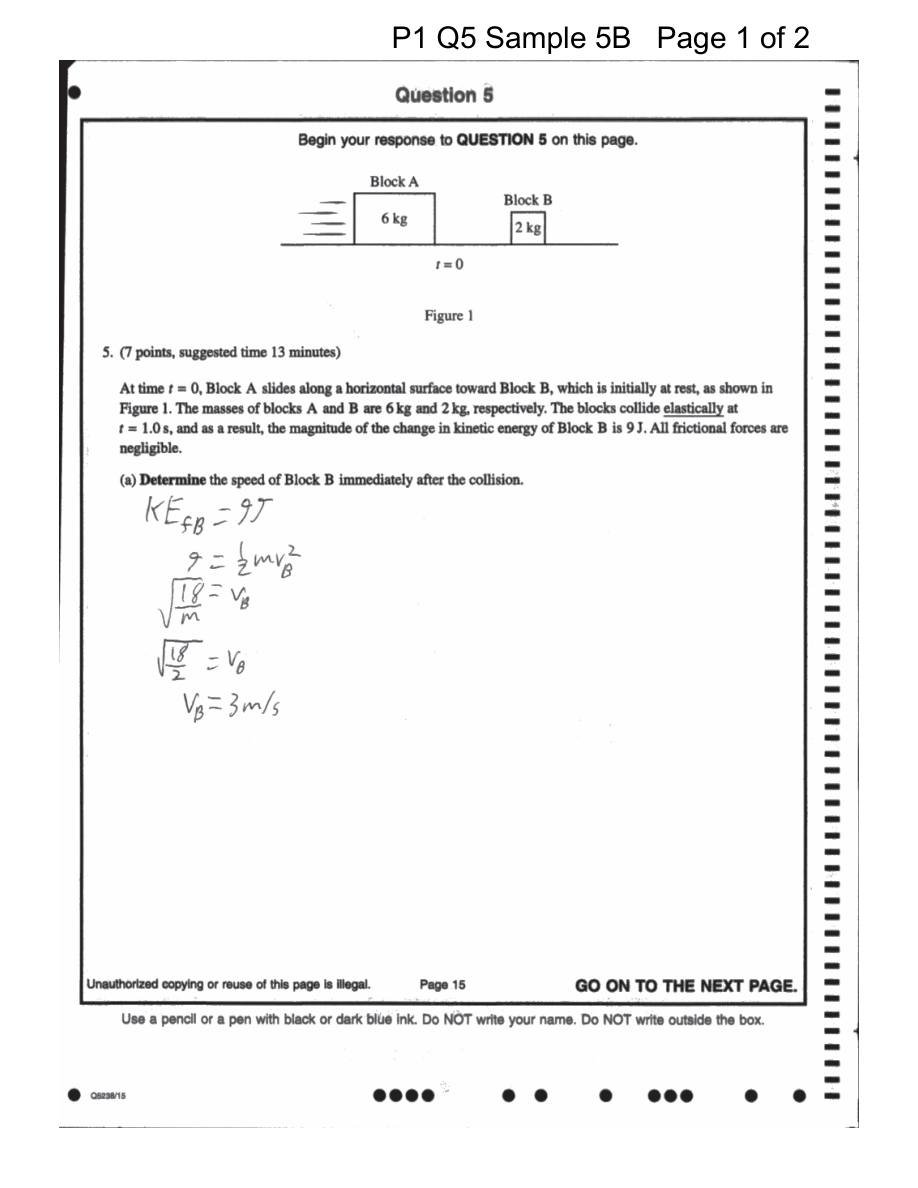
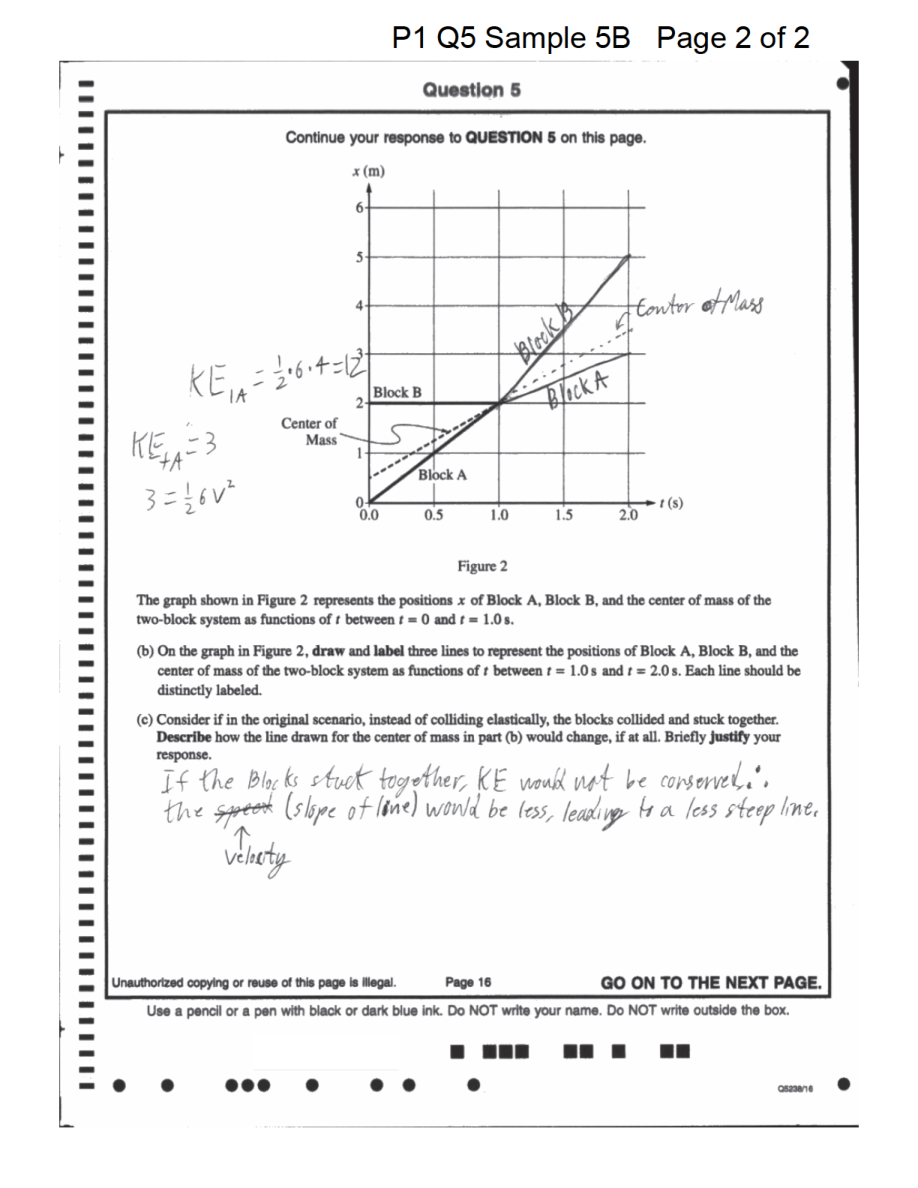
- Figure — Sample Responses Q5 (p. 4)
- Figure — Sample Responses Q5 (p. 5)