From the free course AP Physics 1 on Lykke
Course Framework, Skills and Reasoning Processes
Key concepts: AP Physics 1 course framework · Science practices and reasoning processes · Explaining relationships between physical quantities · Applying and justifying mathematical routines · Designing experiments and analyzing data · Making connections across course topics · Qualitative graph sketching · Selecting a logical computational pathway · Using functional dependence between variables · Supporting claims with evidence or reasoning
Physics becomes powerful when a moving object is more than a number in an equation: it becomes a physical system that can be represented, measured, modeled, tested, and explained.
Course Framework, Skills and Reasoning Processes
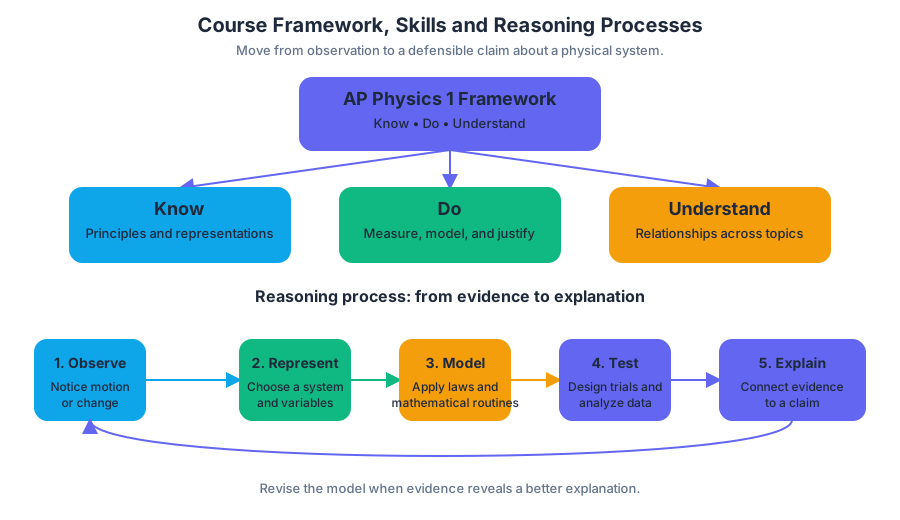
Physics becomes powerful when a moving object is more than a number in an equation: it becomes a physical system that can be represented, measured, modeled, tested, and explained. How can a physicist move from an observation—such as a cart speeding up—to a defensible claim about why its motion changes?
The AP Physics 1 course framework specifies what students must know, what they must be able to do, and what they must understand about foundational classical mechanics. Its central habits are explaining relationships, applying and justifying mathematical routines, designing experiments, analyzing data, and connecting ideas across multiple topics.
A course built around reasoning
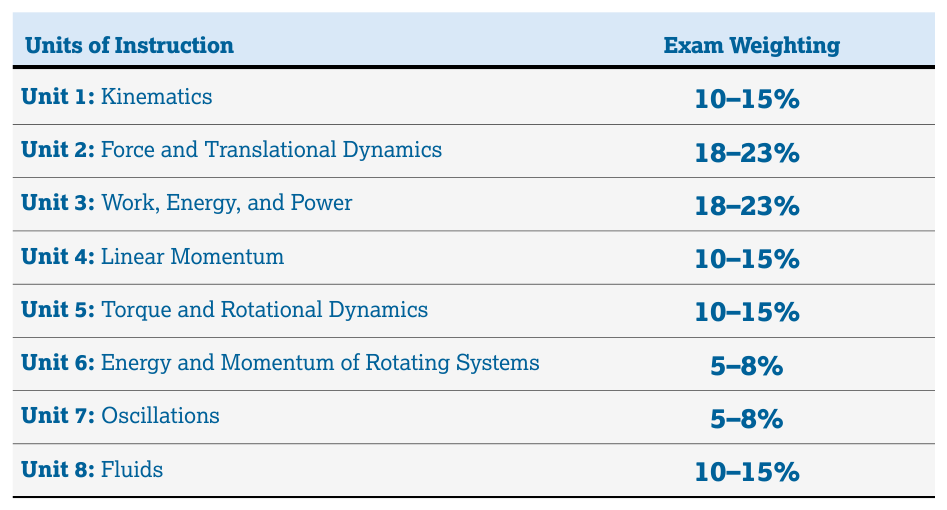
The content progresses through physical ideas that repeatedly interact:
- Kinematics describes motion.
- Force and Translational Dynamics explains changes in motion.
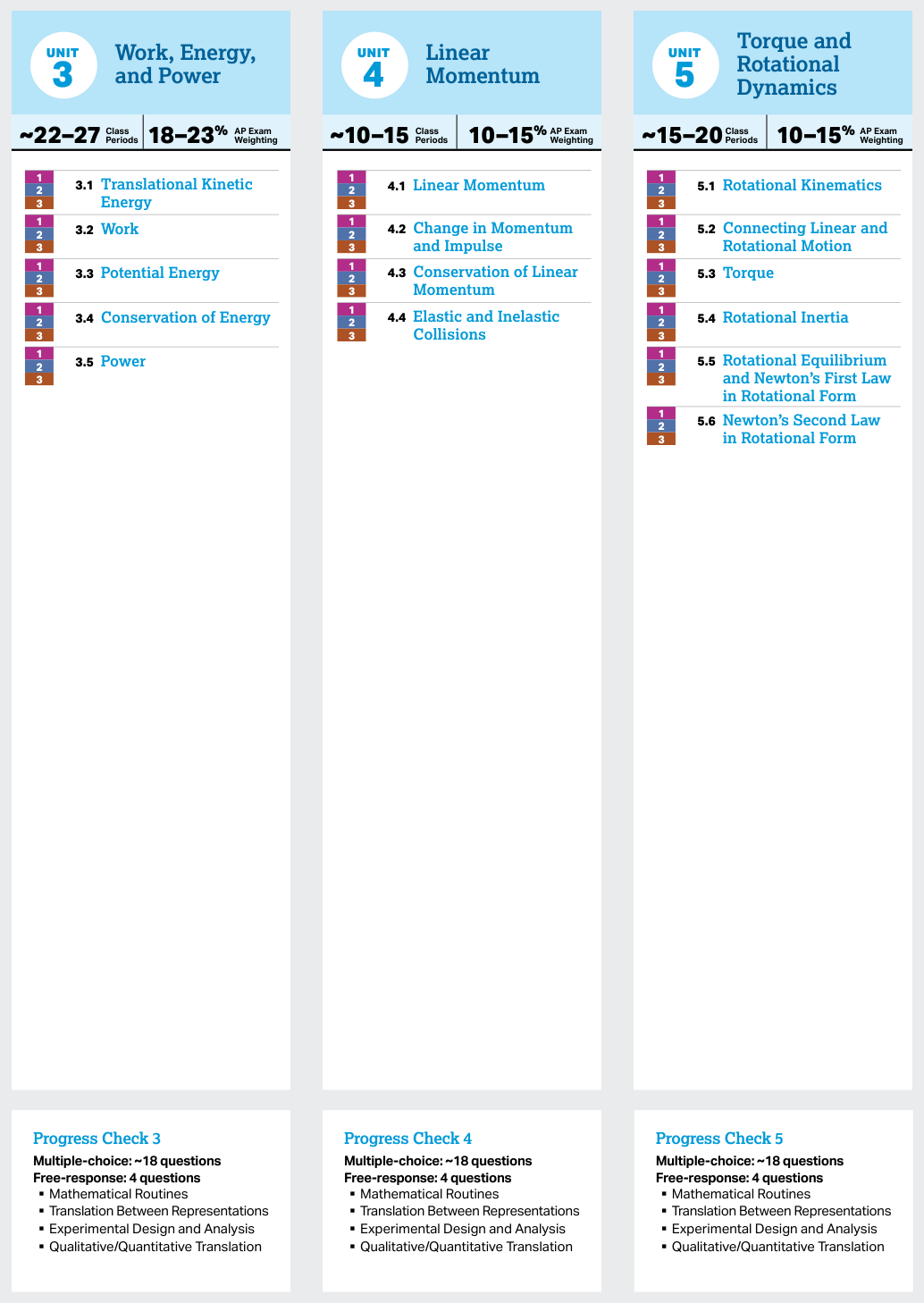
- Work, Energy, and Power and Linear Momentum provide conservation-based ways to analyze interactions.
- Torque and Rotational Dynamics extends force reasoning to rotation.
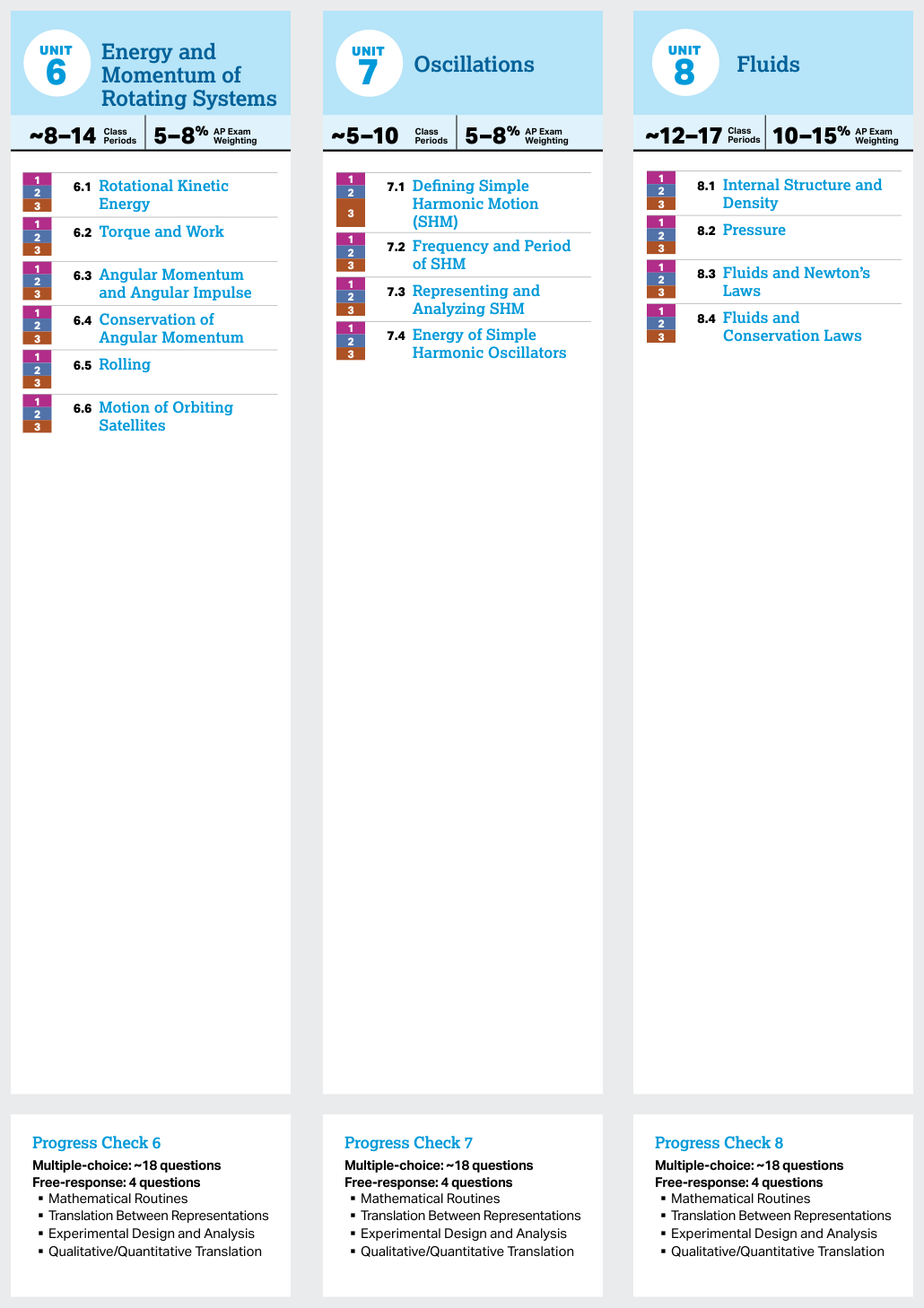
- Energy and Momentum of Rotating Systems connects rotational motion to conservation laws.
- Oscillations studies repeating motion.
- Fluids applies force, pressure, and conservation ideas to continuous matter.
The same science practices spiral through every topic. A problem about a satellite, a collision, a rotating wheel, or flowing water may require the same sequence: represent the situation, identify relationships, calculate or compare quantities, and support a claim with evidence or physical principles.
Science Practice 1: Creating Representations
Science Practice 1: Creating Representations means turning a physical situation into a useful diagram, table, chart, schematic, or graph. A representation is not decoration; it is a model that makes relevant relationships visible.
- 1.A. Create diagrams, tables, charts, or schematics to represent physical situations. Examples include free-body diagrams, system sketches, motion maps, circuit-like schematics for conceptual models, and data tables.
- 1.B. Create quantitative graphs with appropriate scales and units, including plotting data. A graph must identify variables, units, scale, and the measured or calculated relationship.
- 1.C. Create qualitative sketches of graphs that represent features of a model or the behavior of a physical system. A qualitative graph shows trends—such as increasing, decreasing, constant, or changing slope—even when no numerical data are supplied.
For example, if the net force on a cart increases while its mass remains constant, a qualitative sketch of acceleration versus force should rise proportionally. The sketch communicates the model before any numerical calculation begins.
Science Practice 2: Mathematical Routines
Science Practice 2: Mathematical Routines means conducting analyses to derive, calculate, estimate, or predict. The goal is not merely obtaining an answer; it is selecting a logical pathway that preserves the physical meaning of the quantities.
- 2.A. Derive a symbolic expression from known quantities by selecting and following a logical mathematical pathway. Begin with a physical law, substitute relationships, and simplify until the desired quantity is isolated.
- 2.B. Calculate or estimate an unknown quantity with units from known quantities, by selecting and following a logical computational pathway. Units act as a built-in error check.
- 2.C. Compare physical quantities between two or more scenarios or at different times and locations in a single scenario. Comparisons often require ratios rather than complete calculations.
- 2.D. Predict new values or factors of change of physical quantities using functional dependence between variables. If $F = ma$, then for fixed $m$, doubling $F$ doubles $a$; this is a prediction from functional dependence.
Worked example: A constant net force acts on two carts. Cart $A$ has mass $m$ and cart $B$ has mass $2m$. From Newton’s second law,
$$ a=\frac{F_{\text{net}}}{m}. $$
For cart $B$,
$$ a_B=\frac{F_{\text{net}}}{2m}=\frac{1}{2}a_A. $$
No numerical values are needed: 2.C compares the accelerations, while 2.D predicts the factor of change from the functional dependence.
Science Practice 3: Scientific Questioning and Argumentation
Science Practice 3: Scientific Questioning and Argumentation means describing experimental procedures, analyzing data, and supporting claims. Physics knowledge becomes stronger when a model survives measurement and criticism.
- 3.A. Create experimental procedures that are appropriate for a given scientific question. A valid procedure identifies what is changed, what is measured, what is controlled, and how repeated measurements or improved design can reduce uncertainty.
- 3.B. Apply an appropriate law, definition, theoretical relationship, or model to make a claim. For example, use conservation of momentum to claim that the total momentum of an isolated system remains constant.
- 3.C. Justify or support a claim using evidence from experimental data, physical representations, or physical principles or laws. A justification must connect evidence to the claim rather than simply repeat the result.
A strong experimental argument has the structure: claim → evidence → physical reasoning. If measured acceleration increases linearly with applied force, the data support a claim consistent with $F_{\text{net}}=ma$—provided the graph, units, uncertainty, and controlled variables are also considered.
How these skills appear in assessment
Multiple-choice questions commonly test representation interpretation, mathematical reasoning, comparisons, functional dependence, and qualitative-to-quantitative translation. Free-response questions make the reasoning visible through diagrams, symbolic derivations, calculations, experimental design, data analysis, and evidence-based explanations.
The listed weighting guidance emphasizes the importance of these practices: Creating Representations accounts for approximately $20%$–$35%$ of the free-response section; Mathematical Routines accounts for approximately $15%$–$20%$ of the multiple-choice section and $30%$–$40%$ of the free-response section. The exact task may change, but the underlying reasoning remains central.
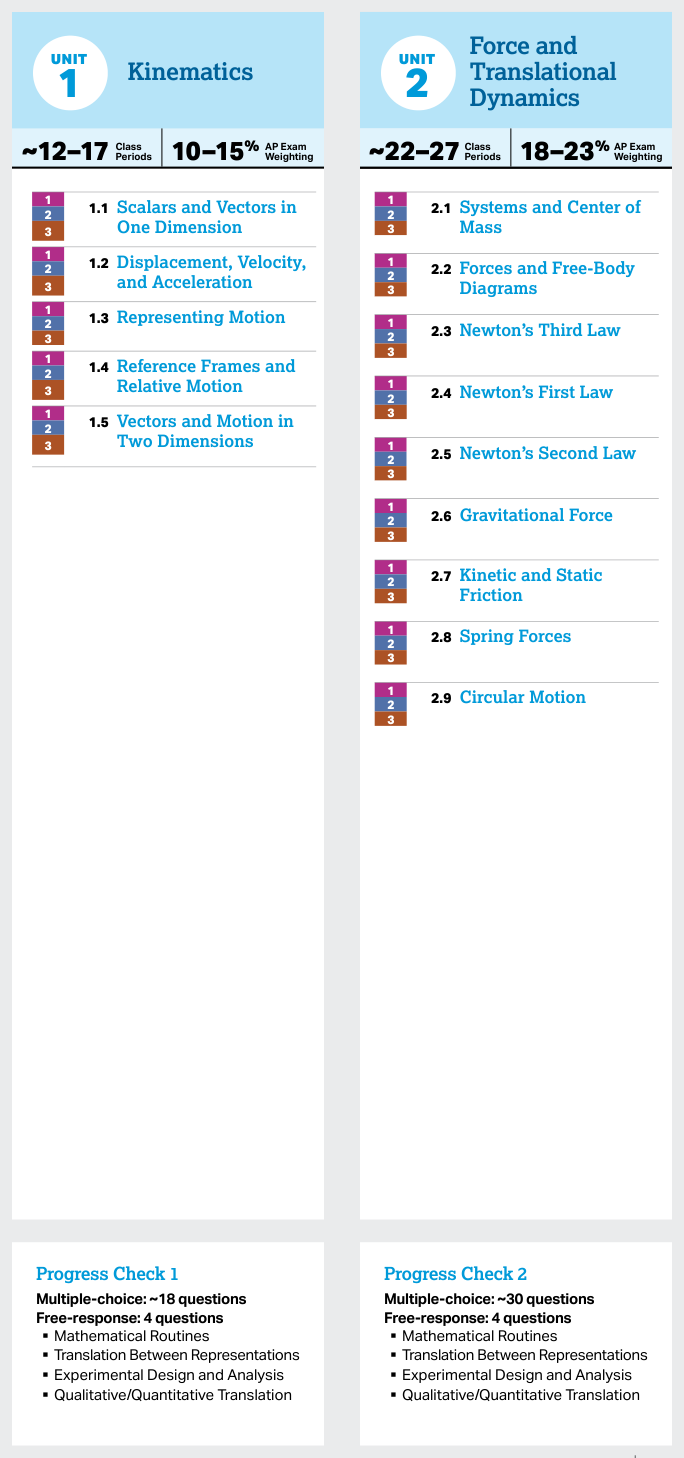
AP Classroom Progress Checks include multiple-choice questions with rationales and free-response questions with scoring information. Reports allow teachers to review results, locate patterns of difficulty, and identify where students struggle—for example, interpreting a graph, choosing a system, or justifying an experimental conclusion.
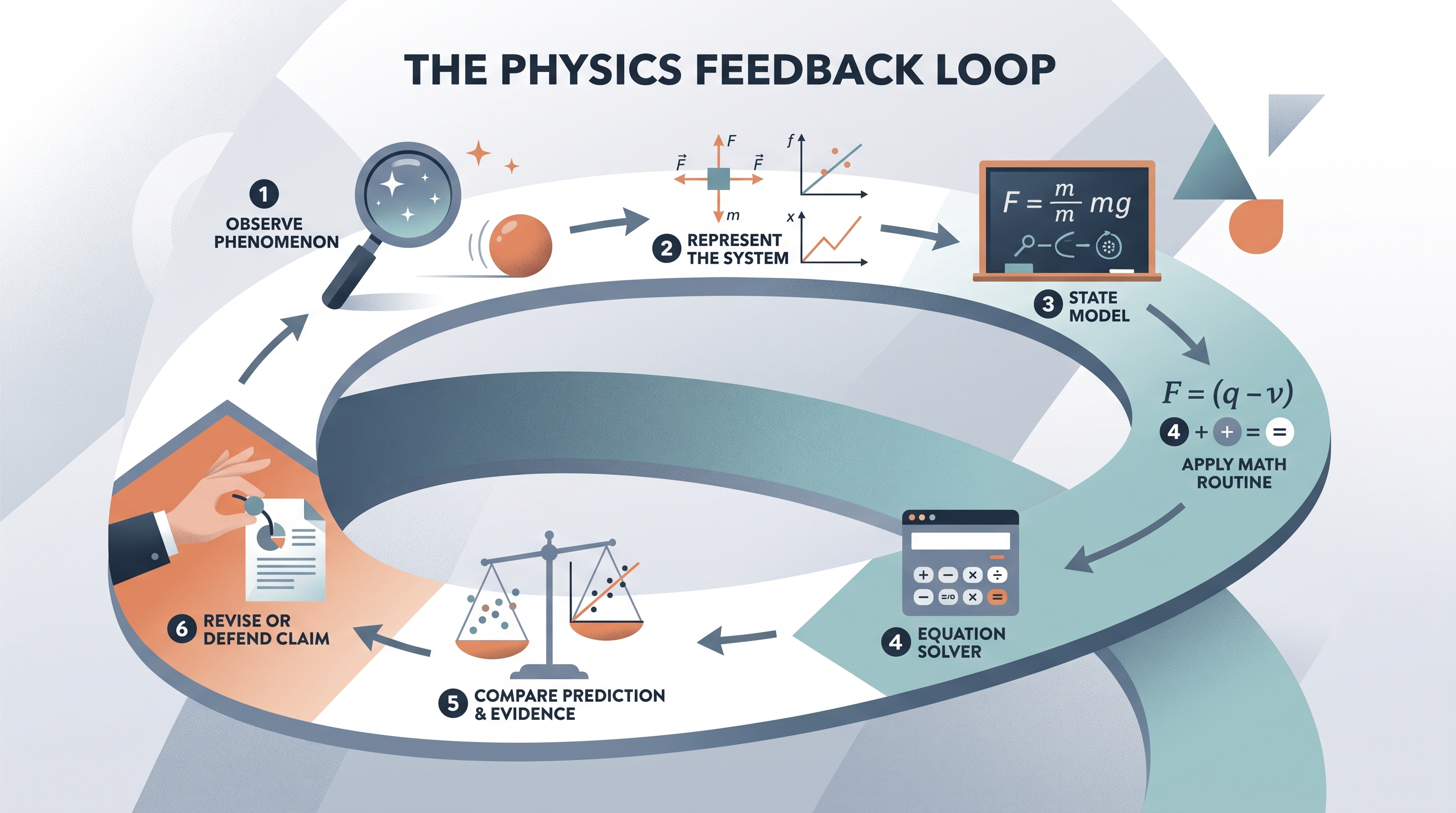
The feedback loop
Physics instruction works best as a continuous loop:
- Observe a phenomenon.
- Represent the system.
- State a relationship or model.
- Apply a mathematical routine.
- Compare the prediction with evidence.
- Revise or defend the claim.
Continuous checks of understanding and just-in-time feedback interrupt errors before they become habits. A student who writes an equation correctly but chooses the wrong system, graph, or sign convention needs conceptual feedback—not merely a corrected numerical answer.
Retrieval check: A graph’s slope changes while its measured variables remain the same. Which practice is most directly involved in interpreting that feature? A complete response should identify 1.C, then connect the changing slope to the physical model and, if appropriate, use 2.D to predict how another quantity changes.

Source Materials
- Review the Exam Updates (.pdf)
- AP Physics 1: Algebra-Based Course and Exam Description
- AP Physics 1 Course Overview
- AP Physics 1 Course at a Glance
- AP Physics 1 Course at a Glance Poster
- Adopt AP Physics 1: Algebra-Based
- AP Physics 1: Algebra-Based
- AP Physics 1: Algebra-Based
- Figure — AP Physics 1: Algebra-Based Course and Exam Description (p. 1)
- Figure — AP Physics 1: Algebra-Based Course and Exam Description (p. 14)
- TOPICS
- Framework V.1 | 13 13