From the free course AP Physics 1 on Lykke
2.3 Newton’s Third Law
Key concepts: Newton’s third law · Paired forces exerted on each object · Equal-and-opposite interaction forces · Momentum changes of interacting objects · Ideal strings and tension · Strings with nonnegligible mass · Ideal pulleys · Force representations and diagrams
When a skateboard pushes backward against the ground, the ground pushes the skateboard forward with exactly the same force. Newton’s third law is not a rule about one object’s net force; it is a rule about the paired interaction between two objects.
2.3 Newton’s Third Law
When a skateboard pushes backward against the ground, the ground pushes the skateboard forward with exactly the same force. Newton’s third law is not a rule about one object’s net force; it is a rule about the paired interaction between two objects.
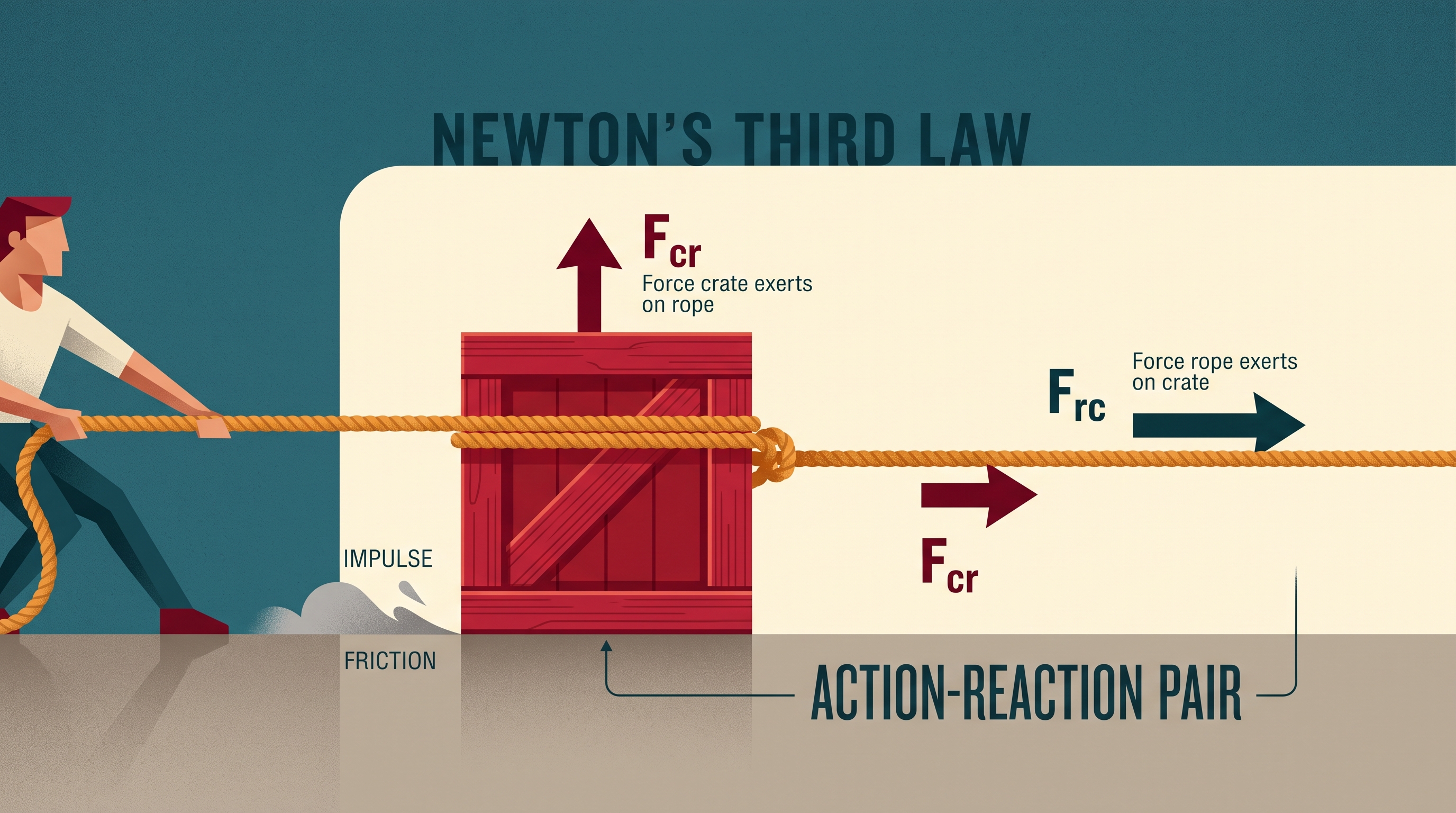
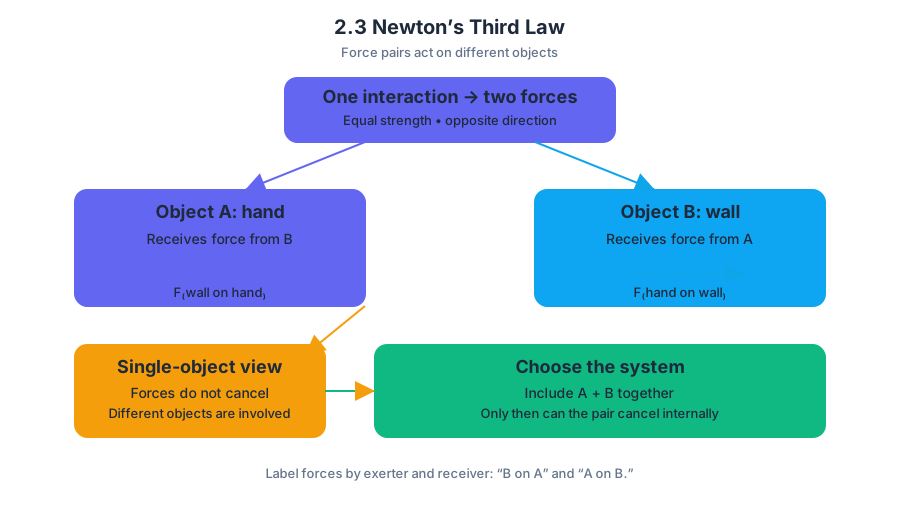
Newton’s third law: If object $A$ exerts a force on object $B$, then object $B$ exerts a force on object $A$ that has equal magnitude and opposite direction:
$$\vec{F}{\text{A on B}}=-\vec{F}{\text{B on A}}$$
Force pairs act on different objects
The two forces in a third-law pair never act on the same object. A hand pushes a wall; the wall pushes the hand. A planet pulls a satellite; the satellite pulls the planet. Because the forces act on different objects, they do not cancel on a single free-body diagram. They cancel only if both objects are included in the chosen system.
This distinction is the heart of Learning Objective 2.3.A: “Describe the interaction of two objects using Newton’s third law and a representation of paired forces exerted on each object.” A useful representation is a two-object interaction diagram:
- On object $A$: draw $\vec{F}_{\text{B on A}}$.
- On object $B$: draw $\vec{F}_{\text{A on B}}$.
- Give the arrows equal lengths and opposite directions.
- Label each force with both the object exerting it and the object receiving it.
Misconception check — “equal and opposite forces cancel.” They do not cancel when analyzing one object, because only one member of the pair acts on that object. A book resting on a table has an upward table-on-book force and a downward Earth-on-book force; these are not a third-law pair because they act on the same object. The third-law partners are table-on-book and book-on-table, or Earth-on-book and book-on-Earth.
Internal forces and momentum changes
Forces between objects inside a chosen system are internal forces. Internal forces can change the momenta of individual objects, but they do not influence the motion of the system’s center of mass, as stated in Essential Knowledge 2.3.A.2. The paired impulses are equal and opposite because impulse is force multiplied by the same interaction time:
$$\vec{J}{\text{A on B}}=\vec{F}{\text{A on B}}\Delta t=-\vec{F}{\text{B on A}}\Delta t=-\vec{J}{\text{B on A}}$$
If these paired interaction forces are the only forces contributing to the objects’ momentum changes during the same time interval, then
$$\Delta\vec{p}_A=-\Delta\vec{p}_B$$
If external forces also act, the statement must be made more carefully:
$$\Delta\vec{p}A=\vec{J}{\text{interaction on A}}+\vec{J}_{\text{external on A}}$$
and similarly for object $B$. Newton’s third law guarantees equal-and-opposite interaction impulse contributions, not necessarily equal-and-opposite total momentum changes when external impulses are present.
Worked example: a heavy block and a light block
Two blocks push apart on a nearly frictionless track. Block $1$ has much greater mass than Block $2$. During the brief interaction, assume horizontal external impulse is negligible.
Because the interaction forces are equal and opposite, the blocks receive equal and opposite impulse. Therefore,
$$\Delta\vec{p}_1=-\Delta\vec{p}_2$$
If Block $2$ has a very small change in momentum, Block $1$ also has a very small, equal-and-opposite change in momentum. Block $1$ may therefore continue traveling at approximately its original velocity. The forces are still equal; the unequal accelerations arise because
$$\vec{a}=\frac{\vec{F}_{\text{net}}}{m}$$
A small mass can undergo a large velocity change while a large mass undergoes a small velocity change under the same interaction force.
Skills in action: 1.A — Create representations, by drawing the paired-force diagram; 2.D — Predict new values or factors of change of physical quantities using functional dependence between variables, by reasoning from $\Delta v=\Delta p/m$; 3.B — Apply an appropriate law, definition, theoretical relationship, or model to make a claim, by applying Newton’s third law; and 3.C — Justify or support a claim using evidence from experimental data, physical representations, or physical principles or laws, by connecting the diagram and momentum evidence to the conclusion.
Tension in strings and cables
Tension is the macroscopic net result of forces that neighboring segments of a string, cable, chain, or similar system exert on one another in response to an external force. For an ideal string, the string has negligible mass and does not stretch under tension. Its tension is therefore the same at every point:
$$T_1=T_2=T_3=\cdots=T$$
A string with nonnegligible mass behaves differently: its tension may vary from point to point. In a hanging chain, the upper portion must support and accelerate more chain below it, so the tension is generally greater near the top. AP Physics 1 expects this variation qualitatively, not through a detailed mathematical model.
An ideal pulley has negligible mass, rotates about an axle through its center of mass, and experiences negligible friction at the axle. Under these assumptions, the pulley does not require a significant net torque to rotate, so a single ideal string passing over it has the same tension on both sides. A real massive pulley or a massive string can invalidate that shortcut.
Retrieval check
A rope pulls a crate to the right while the crate pulls the rope to the left. Are these forces a third-law pair? Yes: they act on different objects, have equal magnitude, and point in opposite directions. If the rope also experiences an external friction impulse from the floor, can you automatically conclude that the rope’s total momentum change is the negative of the crate’s? No: include that external impulse before comparing total momentum changes.