From the free course AP Physics 1 on Lykke
2.8 Spring Forces
Key concepts: Hooke’s law and spring force · Spring stretch and compression · Restoring force and equilibrium · Mass–spring oscillations · Force diagrams for a block attached to a spring · Centripetal force in circular motion · Radial direction of centripetal force · Relationship between spring stretch and speed · Negligible friction in spring systems · Conservation of energy in spring motion
A spring can pull a rapidly rotating block inward strongly enough to keep it moving in a circle—but only because the spring is stretched first.
2.8 Spring Forces
A spring can pull a rapidly rotating block inward strongly enough to keep it moving in a circle—but only because the spring is stretched first. The same force that points toward the center in circular motion also points back toward equilibrium when a cart oscillates.
Hooke’s law: force from displacement
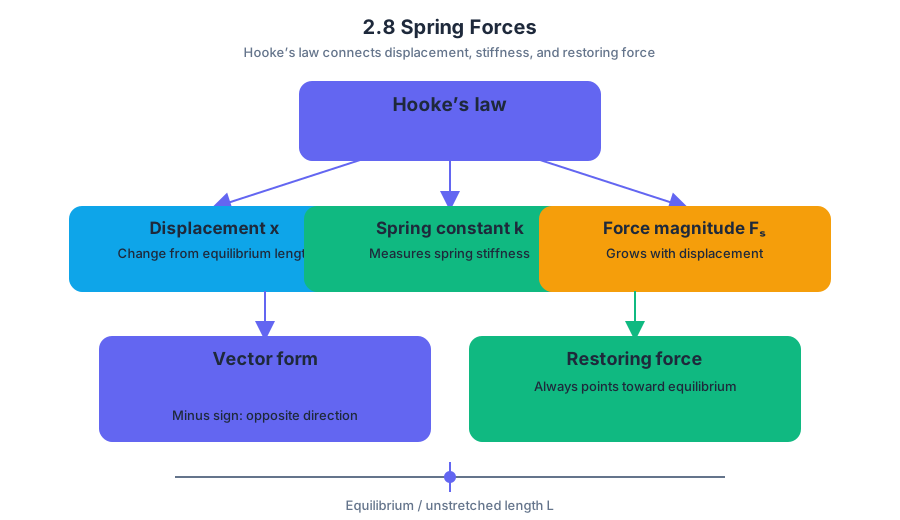
For an ideal spring, the spring constant $k$ measures how difficult the spring is to stretch or compress. If the spring’s length changes by a displacement $x$ from its equilibrium length, the spring-force magnitude is
$$F_s = kx.$$
The vector form is
$$\vec F_s=-k\vec x,$$
where the minus sign means that the force points opposite the displacement. Stretch the spring to the right, and it pulls left; compress it from the left, and it pushes right.
Key idea: A spring force is a restoring force: it points toward the spring’s unstretched or equilibrium position.
In the horizontal, frictionless system considered here, with no other unbalanced horizontal force, the equilibrium position is the spring’s unstretched length $L$. More generally, natural length and equilibrium position are not automatically identical: gravity, friction, or another applied force can shift the location where the net force is zero.
Stretch, compression, and force diagrams
A block attached to a spring on a horizontal table has vertical forces that cancel: the normal force and gravitational force have equal magnitudes. The horizontal spring force is the only unbalanced force in the described system, so a correct force diagram contains one horizontal arrow for the spring force.
If the block is displaced a distance $d$ from equilibrium, the spring force has magnitude $kd$. A larger stretch or compression produces a larger force, but the length of a force arrow represents force magnitude—not the physical stretch distance. Arrows must also point in the physically correct direction.
Misconception check: “The spring force points in the direction the block is moving.”
Not necessarily. At an extreme position, the block may momentarily have zero velocity while the spring force is greatest. Direction comes from displacement, not velocity.
Mass–spring oscillations
Release a cart from rest after pulling it to one side. The spring force accelerates it toward equilibrium. The cart passes through equilibrium with its greatest speed, continues beyond equilibrium, and is then pushed back by the spring. With negligible friction, the motion repeats between
$$x=+A \qquad \text{and} \qquad x=-A,$$
where $A$ is the amplitude, the maximum displacement from equilibrium. The symbol $L$ should remain reserved for the spring’s natural length; it is not generally the oscillation amplitude.
At either endpoint, the spring is most stretched or compressed, so the spring potential energy is greatest and the cart’s kinetic energy is zero. At equilibrium, spring potential energy is smallest and kinetic energy is greatest. Because frictional forces are negligible, conservation of mechanical energy gives
$$K+U_s=\text{constant},$$
with spring potential energy
$$U_s=\frac{1}{2}kx^2.$$
The cart can therefore exchange kinetic energy and spring potential energy without changing their total.
A rotating block: spring force as centripetal force
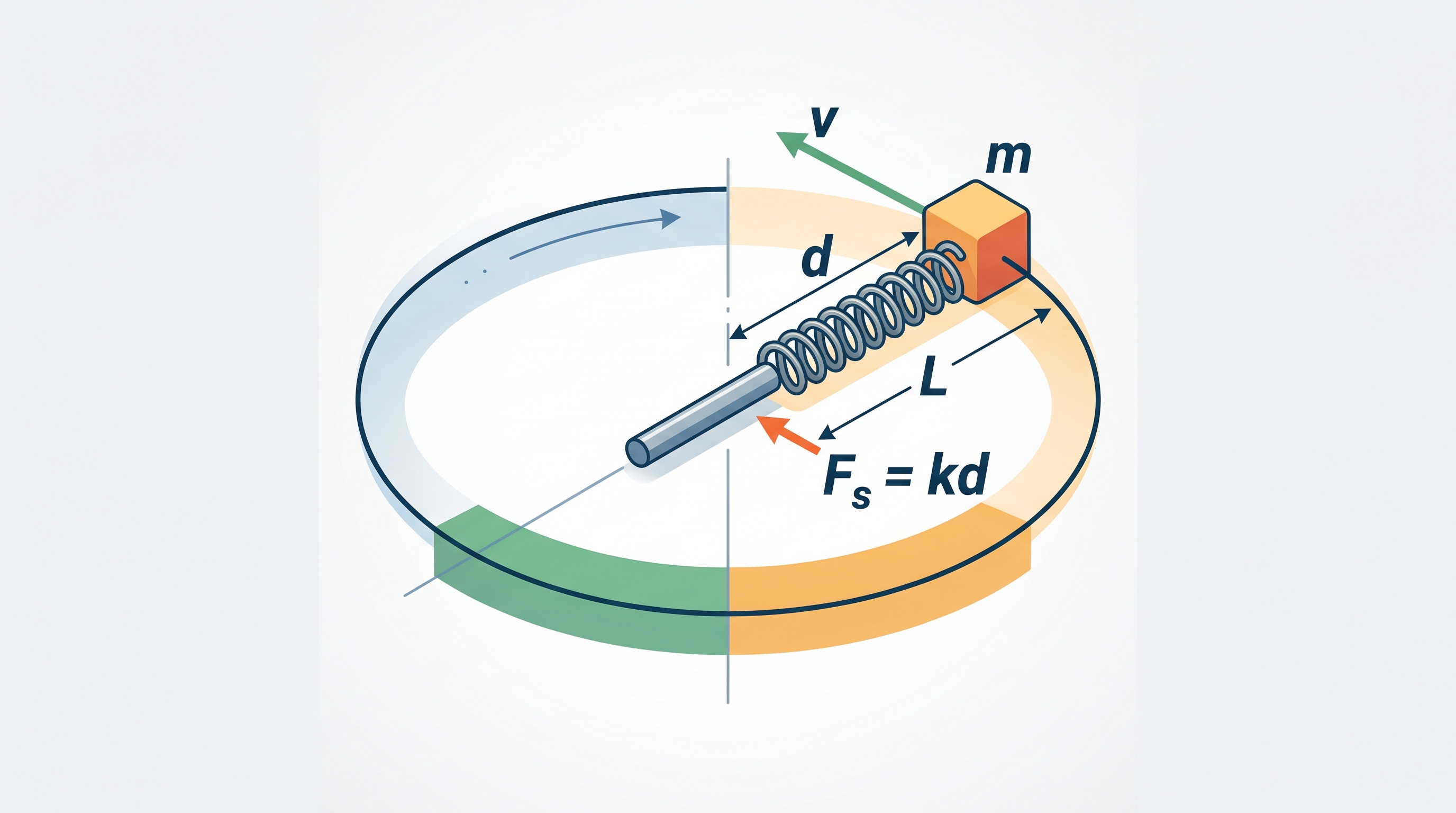
Now attach the spring to a rod on a horizontal table and rotate the rod about its axis. When the rod is stationary, the block rests at the spring’s natural length $L$. During rotation, the spring stretches an additional distance $d$, so the block’s circular-path radius is
$$r=L+d.$$
The stretched spring pulls inward, toward the rod. That inward spring force supplies the centripetal force required for circular motion:
$$F_s=F_c,$$
so
$$kd=\frac{mv^2}{L+d}.$$
Solving for the stretch is a physical-model problem: the force grows with $d$, while the required centripetal force depends on the radius $L+d$.
For example, if $m=0.50\ \text{kg}$, $k=200\ \text{N/m}$, $L=0.40\ \text{m}$, and $v=2.0\ \text{m/s}$, then
$$200d=\frac{(0.50)(2.0)^2}{0.40+d}.$$
Multiplying through,
$$200d(0.40+d)=2.0,$$
which gives
$$d^2+0.40d-0.010=0.$$
The physically meaningful root is approximately
$$d=0.024\ \text{m}.$$
Thus the radius is $r=L+d\approx0.424\ \text{m}$.
Centripetal force is not an additional force. It is the name for the net inward force required for circular motion. Here, the spring force provides it.
The stretch can also be related to speed through energy. If a rotating block is moved between configurations without friction, the change in spring potential energy can be compared with the change in kinetic energy. In every representation—force diagram, equation, or energy argument—identify the system and the direction of the spring force before substituting numbers.
Retrieval check
A block moves in a circle while attached to a spring. Explain why the spring force is radial, then solve symbolically for the speed in terms of $k$, $d$, $m$, and $L$.
Because the spring lies along the radius from the rod to the block, its force points directly toward the rod. From
$$kd=\frac{mv^2}{L+d},$$
the speed is
$$v=\sqrt{\frac{kd(L+d)}{m}}.$$