From the free course AP Physics 1 on Lykke
3.2 Work
Key concepts: Sphere · Tangent (tan) · Variable v representing speed
A force does work when it transfers energy to or from a system through a displacement. Pushing a motionless wall can feel exhausting, but if the wall does not move, the wall does not receive mechanical work from your push.
3.2 Work
A force does work when it transfers energy to or from a system through a displacement. Pushing a motionless wall can feel exhausting, but if the wall does not move, the wall does not receive mechanical work from your push.
The work done by a constant force
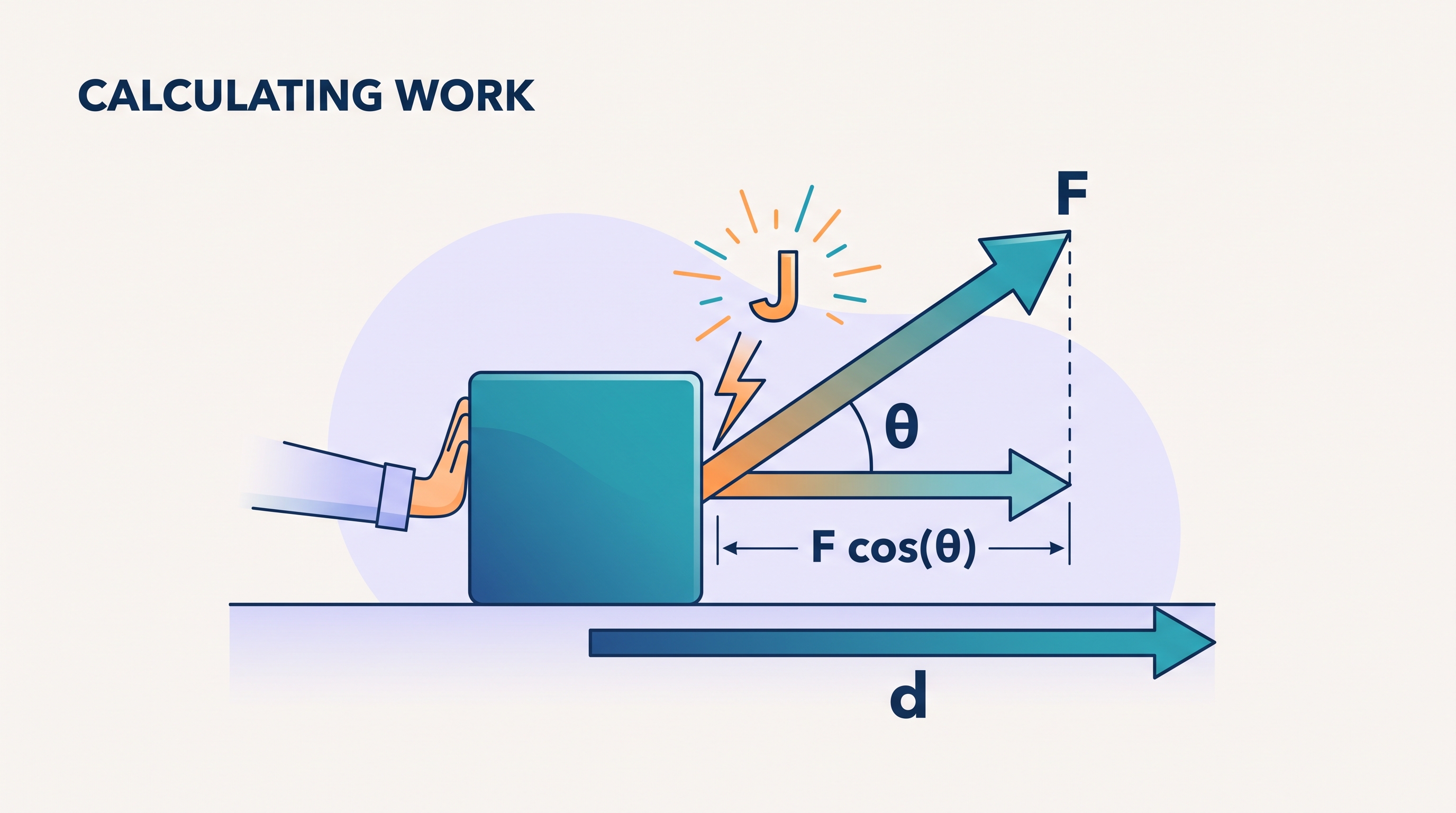
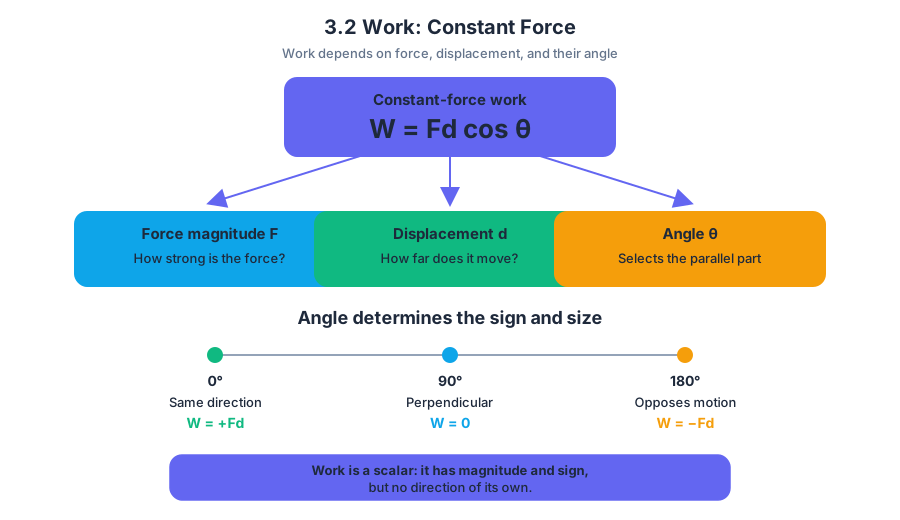
For a constant force, work depends on three ingredients: the force magnitude $F$, the displacement magnitude $d$, and the angle $\theta$ between them.
$$ W = Fd\cos\theta $$
The factor $\cos\theta$ selects the component of the force parallel to the displacement. A force pointing along the motion transfers the most energy; a force perpendicular to the motion transfers none.
| Force–displacement relationship | Angle $\theta$ | Work |
|---|---|---|
| Force and displacement point in the same direction | $0^\circ$ | $W=Fd$ |
| Force is perpendicular to displacement | $90^\circ$ | $W=0$ |
| Force opposes displacement | $180^\circ$ | $W=-Fd$ |
| Force acts at an arbitrary angle | $\theta$ | $W=Fd\cos\theta$ |
Work is a scalar, meaning it has magnitude and sign but no direction of its own. The sign matters: positive work transfers energy into the system’s motion, while negative work removes energy from it.
Key definition: Work is the product of the force component parallel to the displacement and the displacement itself.
Worked example: pulling a sphere
A student pulls a small sphere across a level table with a constant force of $12\ \mathrm{N}$ directed $30^\circ$ above the horizontal. The sphere moves $4.0\ \mathrm{m}$ horizontally. How much work does the pulling force do?
Only the horizontal component of the force contributes:
$$ F_{\parallel}=F\cos\theta $$
Therefore,
$$ W=Fd\cos\theta $$
$$ W=(12\ \mathrm{N})(4.0\ \mathrm{m})\cos(30^\circ) $$
$$ W\approx 41.6\ \mathrm{J} $$
The answer is approximately $42\ \mathrm{J}$. The upward component of the pull does no work because the sphere’s displacement is horizontal. The normal force and gravitational force are also perpendicular to the displacement, so each does zero work in this idealized motion.
Angles, components, and the tangent function
When a force direction is described using horizontal and vertical components, trigonometry identifies its angle. If the horizontal component is $a$ and the vertical component is $b$, then
$$ \tan\theta=\frac{b}{a} $$
or equivalently,
$$ a\tan\theta=b $$
This angle must be interpreted carefully: in the work equation, $\theta$ is the angle between the force and the displacement, not necessarily the angle between the force and the floor in every diagram. Drawing the force vector and displacement vector first prevents the most common angle error.
Work and changes in speed
The previously established kinetic-energy result connects work to motion through the work–energy theorem:
$$ W_{\text{net}}=\Delta K $$
Here, $v$ represents speed, the magnitude of velocity. Because translational kinetic energy depends on $v^2$, positive net work increases speed, negative net work decreases speed, and zero net work leaves speed unchanged—even if individual forces are present.
For example, if a pulling force does $42\ \mathrm{J}$ of positive work while friction does $18\ \mathrm{J}$ of negative work, the net work is
$$ W_{\text{net}}=42\ \mathrm{J}-18\ \mathrm{J}=24\ \mathrm{J} $$
The system therefore gains $24\ \mathrm{J}$ of kinetic energy. Notice that the work done by one force is not automatically the work responsible for the change in speed; the relevant quantity is the sum of the work done by all external forces.
Misconception check: “A force always does work”
Correction: A force does work only when it has a component along the displacement. Carrying a backpack at constant height while walking forward involves an upward force from your arms and a horizontal displacement, so that supporting force does approximately zero mechanical work on the backpack. In contrast, friction opposing the backpack’s motion would do negative work.
AP Science Practices in this topic
- Science Practice 1: Creating Representations — draw force and displacement vectors, identify $\theta$, and translate a physical situation into $W=Fd\cos\theta$.
- Science Practice 2: Mathematical Routines — resolve components, use $\cos\theta$ or $\tan\theta$, track signs, and report work in joules.
- Science Practice 3: Scientific Questioning and Argumentation — justify whether a force does positive, negative, or zero work using the force–displacement geometry and evidence from motion.
Retrieval check: A $20\ \mathrm{N}$ force acts at $60^\circ$ to a displacement of $3.0\ \mathrm{m}$. Calculate the work done by that force.
$$ W=(20)(3.0)\cos(60^\circ)=30\ \mathrm{J} $$