From the free course AP Physics 1 on Lykke
5.1 Rotational Kinematics
Key concepts: Angular speed as a function of time · Angular acceleration and the slope of an angular-speed–time graph · Rotation of a beam about a fixed hinge · Effect of cutting a string on rotational motion · Negligible-friction rotational dynamics · Qualitative interpretation of rotational graphs · Torque-dependent angular acceleration · Identifying and correcting discrepancies in prior work · Trigonometric dependence in tension equations
A beam released from a hinge does not generally spin with constant angular acceleration: gravity’s turning effect changes as the beam falls. That single fact determines the shape of its angular-speed graph.
5.1 Rotational Kinematics
A beam released from a hinge does not generally spin with constant angular acceleration: gravity’s turning effect changes as the beam falls. That single fact determines the shape of its angular-speed graph.
CED traceability: Topic 5.1 Rotational Kinematics; Learning Objective 5.A; Essential Knowledge 5.A.1 and 5.A.2. This topic applies Science Practice 1: Creating Representations, Science Practice 2: Mathematical Routines, and Science Practice 3: Scientific Questioning and Argumentation, especially the assessment skills Translation Between Representations and Qualitative/Quantitative Translation.
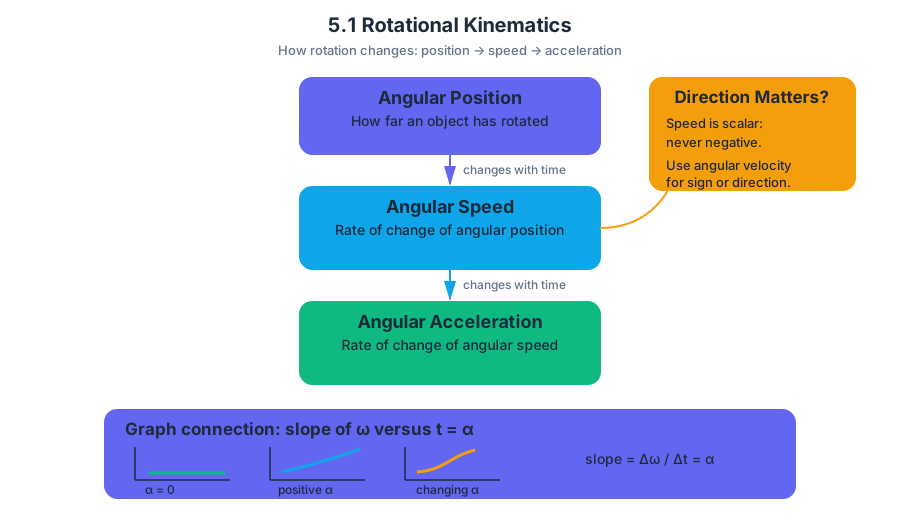
Angular position, angular speed, and angular acceleration
Angular position describes how far an object has rotated from a chosen reference direction. It is represented by $\theta$, measured in radians. Angular speed $\omega$ describes how rapidly the angular position changes:
$$ \omega = \frac{d\theta}{dt} $$
Angular speed is a scalar and is never negative. If direction matters, use angular velocity, which includes a sign or direction convention. Angular acceleration $\alpha$ describes how angular velocity changes with time:
$$ \alpha = \frac{d\omega}{dt} $$
The most important graph connection is:
The slope of an angular-speed-versus-time graph represents angular acceleration.
For a graph of $\omega$ against $t$,
$$ \text{slope}=\frac{\Delta \omega}{\Delta t}=\alpha $$
A horizontal line means $\alpha=0$; a rising line means positive angular acceleration; and a curve whose slope changes represents changing angular acceleration.
A hinged beam falling under gravity
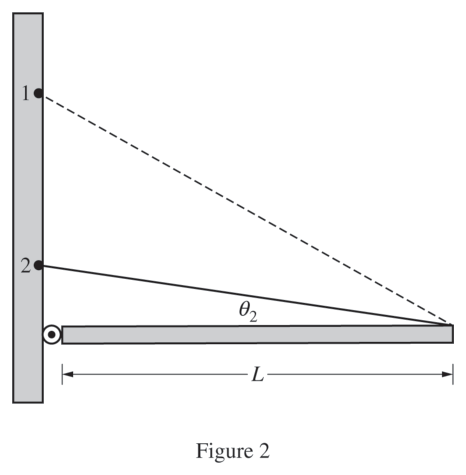
Imagine a uniform beam held nearly horizontal by a string attached away from its hinge. When the string is cut, the beam rotates about the hinge with negligible friction. Gravity acts at the beam’s center of mass, so the gravitational torque is
$$ \tau_g = r_\perp mg $$
where $r_\perp$ is the perpendicular lever arm from the hinge to the line of action of the weight.
As the beam changes orientation, the lever arm changes. If the beam makes angle $\theta$ with the horizontal, one useful form is
$$ \tau_g = mg\left(\frac{L}{2}\right)\cos\theta $$
for a uniform beam of length $L$. The rotational form of Newton’s second law gives
$$ \tau_{\text{net}}=I\alpha $$
so
$$ \alpha=\frac{\tau_g}{I} \propto \cos\theta $$
The exact trigonometric form depends on how $\theta$ is defined, but the physical conclusion is unchanged: the angular acceleration changes as the beam falls because the gravitational torque depends on orientation.
At the instant after release, the beam is often positioned so that gravity produces a large torque. As the beam approaches vertical, the line of action of its weight passes closer to the hinge, reducing the torque. Therefore, the beam continues speeding up, but its speed increases more slowly.
Worked example: predicting the graph
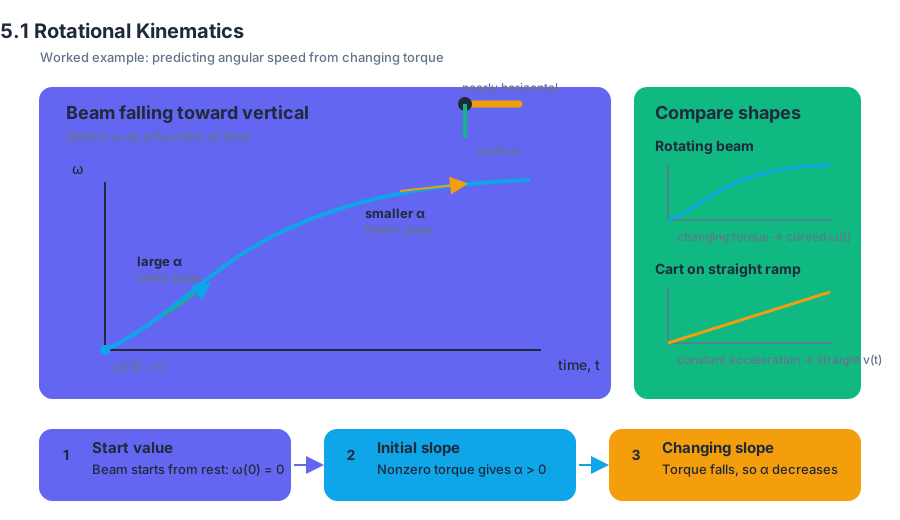
A uniform beam starts from rest and falls from a nearly horizontal position toward vertical. Sketch $\omega$ as a function of time.
Step 1: Determine the initial value. The beam begins from rest, so
$$ \omega(0)=0 $$
The graph must begin at the origin.
Step 2: Determine the initial slope. Initially, the gravitational torque is nonzero, so $\alpha>0$. Because the slope of the $\omega$–$t$ graph is $\alpha$, the graph initially rises.
Step 3: Track the changing slope. As the beam approaches vertical, $\tau_g$ decreases. Thus $\alpha$ decreases, and the slope of the graph becomes smaller.
The correct qualitative graph rises from zero and gradually flattens:
This is not the same shape as the graph for a cart accelerating down a straight ramp. In the cart problem, the component of gravity along the ramp can remain constant, producing constant acceleration and a straight-line velocity graph. For the rotating beam, the torque changes with orientation, so the angular-speed graph is curved.
A discrepancy worth catching
A common first attempt is a straight line sloping downward from a positive angular speed. That graph contains two errors: the beam begins from rest, and gravity makes its angular speed increase rather than decrease.
A graph is a physical claim. Its starting value, direction, slope, and curvature must all agree with the motion.
If an earlier graph or calculation predicts decreasing $\omega$ while the beam is falling, identify the discrepancy explicitly: the prediction contradicts the direction of the gravitational torque. If it predicts constant $\alpha$, it has treated the torque as constant even though the lever arm changes.
Connected reasoning: tension and trigonometry
In a related static or constrained-rotation calculation, balancing torques can produce a tension such as
$$ F_T=\frac{mg,r_g}{r_T\sin\phi} $$
where $\phi$ is the angle between the string and the beam. The trigonometric factor appears because only the perpendicular component of tension produces torque. As $\sin\phi$ becomes small, the required tension can become large; using the entire tension as a turning force is a modeling error.
Misconception check
Misconception: “Constant gravity means constant angular acceleration.” Gravity’s magnitude is approximately constant near Earth’s surface, but torque depends on the perpendicular lever arm. Since that lever arm changes during rotation, angular acceleration need not remain constant.
Retrieval check: A rotating object’s $\omega$–$t$ graph is increasing but concave down. What does that say about $\alpha$? The angular acceleration is positive but decreasing: $\omega$ is still increasing, while the slope of the graph is becoming smaller.


Source Materials
- Review the Exam Updates (.pdf)
- AP Physics 1: Algebra-Based Course and Exam Description
- AP Physics 1 Course Overview
- AP Physics 1 Course at a Glance
- AP Physics 1 Course at a Glance Poster
- Adopt AP Physics 1: Algebra-Based
- AP Physics 1: Algebra-Based
- AP Physics 1: Algebra-Based
- About the Advanced Placement Program® (AP®)
- Figure 2. The angle between the beam and the string is q q2 = . The dashed line represents the string shown in
- AP Physics 1 Past Exam Questions — AP Central
- Khan Academy — AP/College Physics 1