From the free course AP Physics 1 on Lykke
2.6 Gravitational Force
Key concepts: Gravitational field versus gravitational force · Weight as the gravitational force on an object · Apparent weightlessness · Gravitational force and circular motion · Direction of force vectors · Buoyant force versus gravitational force · Acceleration and density · Newton’s third law for internal friction forces · Gravitational potential-energy graphs · Repeated trials and reliability of measurements
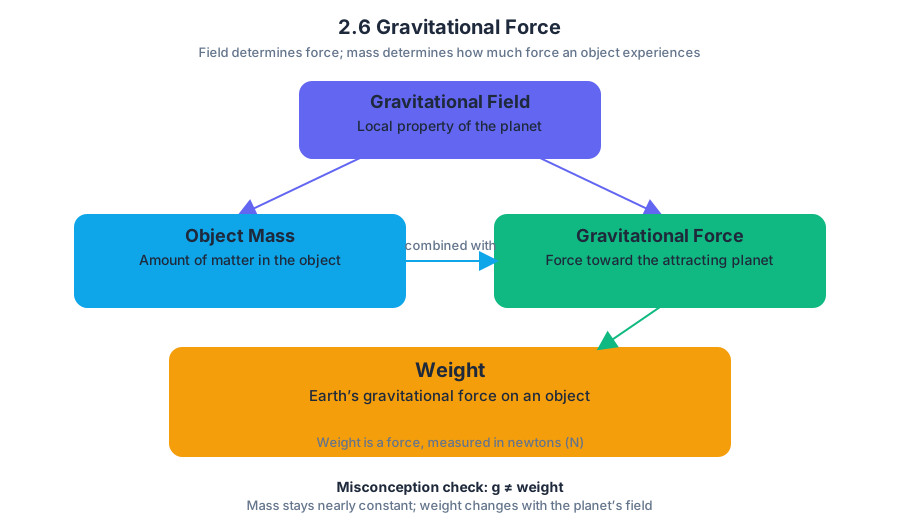
A gravitational field tells you what gravity could do at a location; a gravitational force tells you what gravity does to a particular object placed there.
2.6 Gravitational Force
A gravitational field tells you what gravity could do at a location; a gravitational force tells you what gravity does to a particular object placed there. That distinction prevents one of the most common errors in force problems.
Field, force, and weight
The gravitational field strength near Earth is approximately $g = 9.8\ \mathrm{N/kg}$ downward. It is a property of the planet’s surroundings, not of the object being tested. The gravitational force on an object depends on both the field and the object’s mass:
$$ \vec F_g = m\vec g $$
Thus, a $2.0\ \mathrm{kg}$ object near Earth experiences a gravitational force of magnitude
$$ F_g = (2.0\ \mathrm{kg})(9.8\ \mathrm{N/kg}) = 19.6\ \mathrm{N}. $$
The field magnitude is $9.8\ \mathrm{N/kg}$, while the force magnitude is $19.6\ \mathrm{N}$. They are related, but they are not equal and do not even have the same units. When gravitational force is the force of Earth on an object, it is commonly called the object’s weight.
Weight is a force: $\vec W = \vec F_g = m\vec g$, directed toward the attracting planet.
Misconception check — “Weight equals $g$.”
The symbol $g$ describes the local gravitational field. Weight is $mg$. A person’s mass remains essentially constant when traveling to another planet, but the person’s weight changes if the planet produces a different gravitational field.
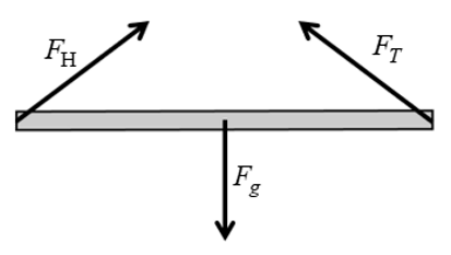
Direction matters on every force diagram
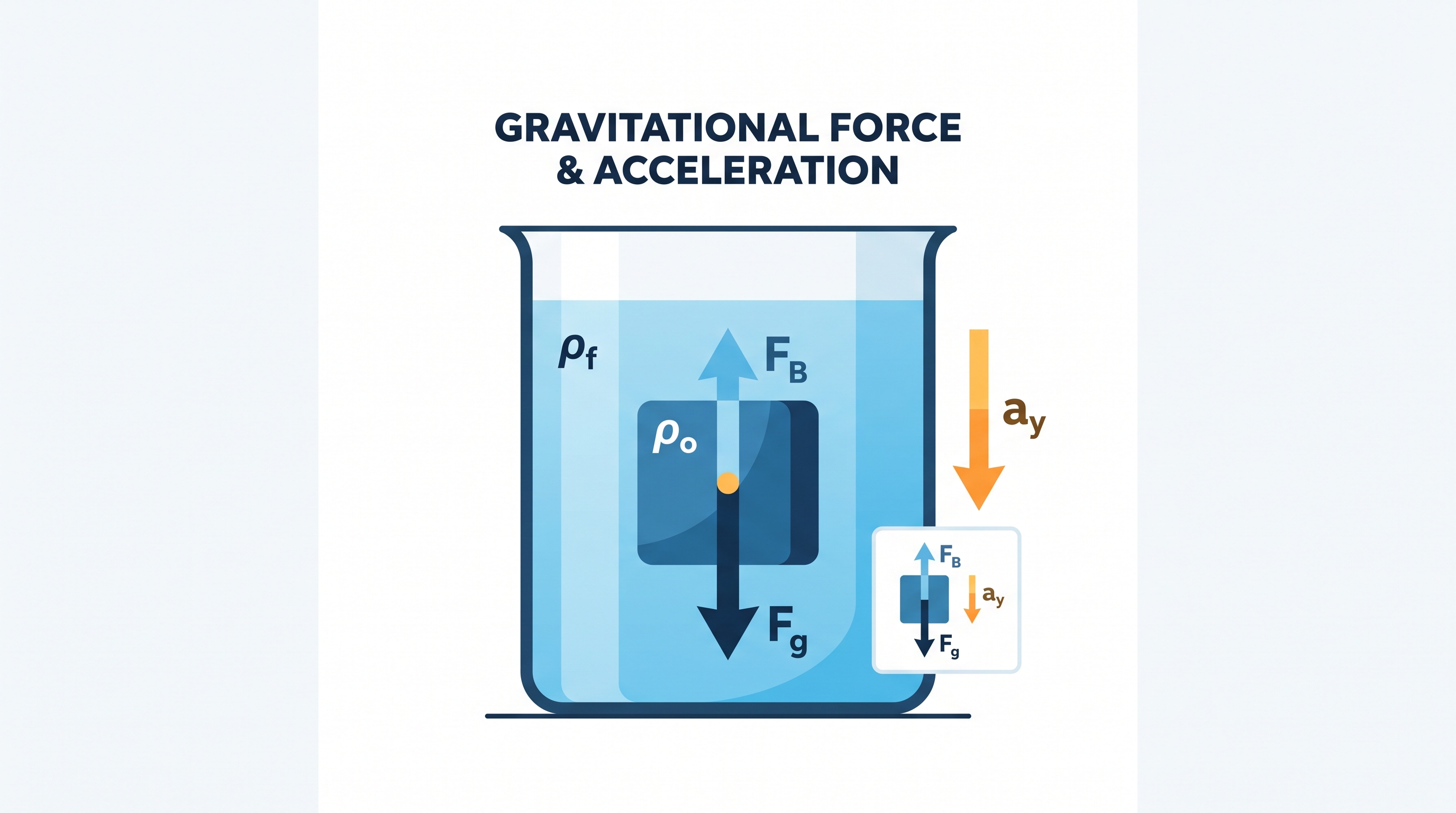
Gravity always points toward the attracting body. Buoyant force, by contrast, points upward in a fluid because pressure is greater at greater depth. For a submerged object, the vertical forces may be
$$ \sum F_y = F_B - F_g, $$
where $F_B$ is upward and $F_g$ is downward. If the object has volume $V$ and the fluid has density $\rho_f$, the buoyant-force magnitude is
$$ F_B = \rho_f Vg. $$
For an object of mass $m$ and density $\rho_o$, its mass can be written as $m=\rho_oV$. Therefore,
$$ \sum F_y = \rho_f Vg-\rho_o Vg = Vg(\rho_f-\rho_o), $$
and the acceleration is
$$ a_y=\frac{\sum F_y}{m} =\frac{Vg(\rho_f-\rho_o)}{\rho_oV} =g\left(\frac{\rho_f}{\rho_o}-1\right). $$
This equation shows the functional dependence clearly: acceleration depends on the ratio of fluid density to object density. Reversing the force directions would incorrectly change the sign and physical interpretation.
Misconception check — “Buoyant force and gravitational force point in the same direction.”
They oppose each other for an object immersed in a fluid. First draw the vectors; only then calculate the net force.
Apparent weightlessness
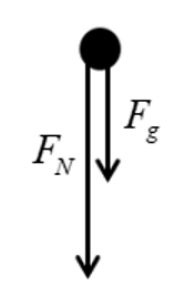
A scale does not directly measure gravitational force. It measures the contact force exerted by the scale, often called the normal force. An object appears weightless when that relevant contact force is absent, even if gravity is still acting.
For example, an astronaut orbiting Earth is continuously pulled downward by Earth’s gravity. The astronaut and spacecraft are both freely falling, so the spacecraft does not need to push upward on the astronaut. The normal force is approximately zero, producing the sensation of weightlessness.
The CED identifies this idea as 2.6.C.3: a system appears weightless when no forces act on it or when gravity is the only force acting on it. 2.6.C.4, the equivalence principle, states that an observer in a noninertial reference frame cannot distinguish between apparent weight and the gravitational force produced by a gravitational field in the appropriate local situation.
Gravity and circular motion
An orbiting object does not move in a circle because its speed is automatically “maintained.” It moves in a circle because a net force continually points toward the center. For a satellite in a circular orbit, gravity supplies the centripetal force:
$$ \frac{GMm}{r^2}=\frac{mv^2}{r}. $$
Canceling $m$ gives
$$ v=\sqrt{\frac{GM}{r}}. $$
The required circular speed is therefore smaller at larger orbital radius. Under stated conditions, an object must have at least the required speed to maintain the intended circular motion; too little speed causes the path to dip inward rather than remain on that circular path. The force vector is always radial, pointing toward the planet’s center, even though the object’s instantaneous velocity is tangent to the circle.
Representations and evidence
Near Earth, gravitational potential energy is
$$ U_g=mgh, $$
so its graph versus height is linear for constant $g$. Do not automatically treat it as the mirror image of a spring-potential-energy graph: spring energy depends on displacement squared, while gravitational energy depends linearly on vertical position. The slope of a potential-energy graph is connected to force, so the graph’s direction and steepness carry physical meaning.
In an investigation of gravitational force, repeated trials at the same location improve reliability by reducing the influence of random measurement variation. A graph of force versus mass should be consistent with $F_g=mg$; its slope represents the local gravitational field strength $g$.
The AP science practices are visible throughout this topic:
- Science Practice 1: Creating Representations — draw correctly directed force vectors, free-body diagrams, field diagrams, and force-versus-position graphs.
- Science Practice 2: Mathematical Routines — construct $\sum F$, substitute density or orbital relations, and derive functional dependence such as $a_y=g(\rho_f/\rho_o-1)$.
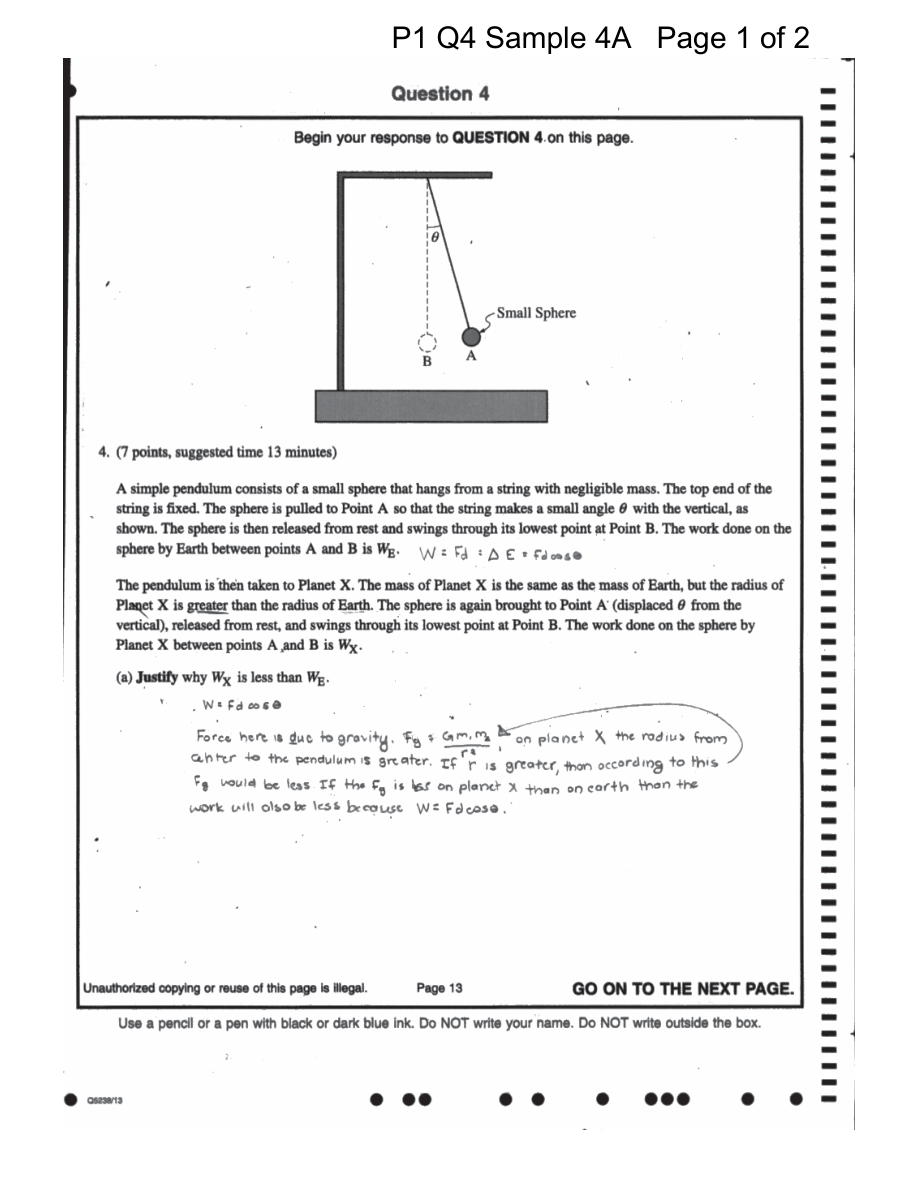
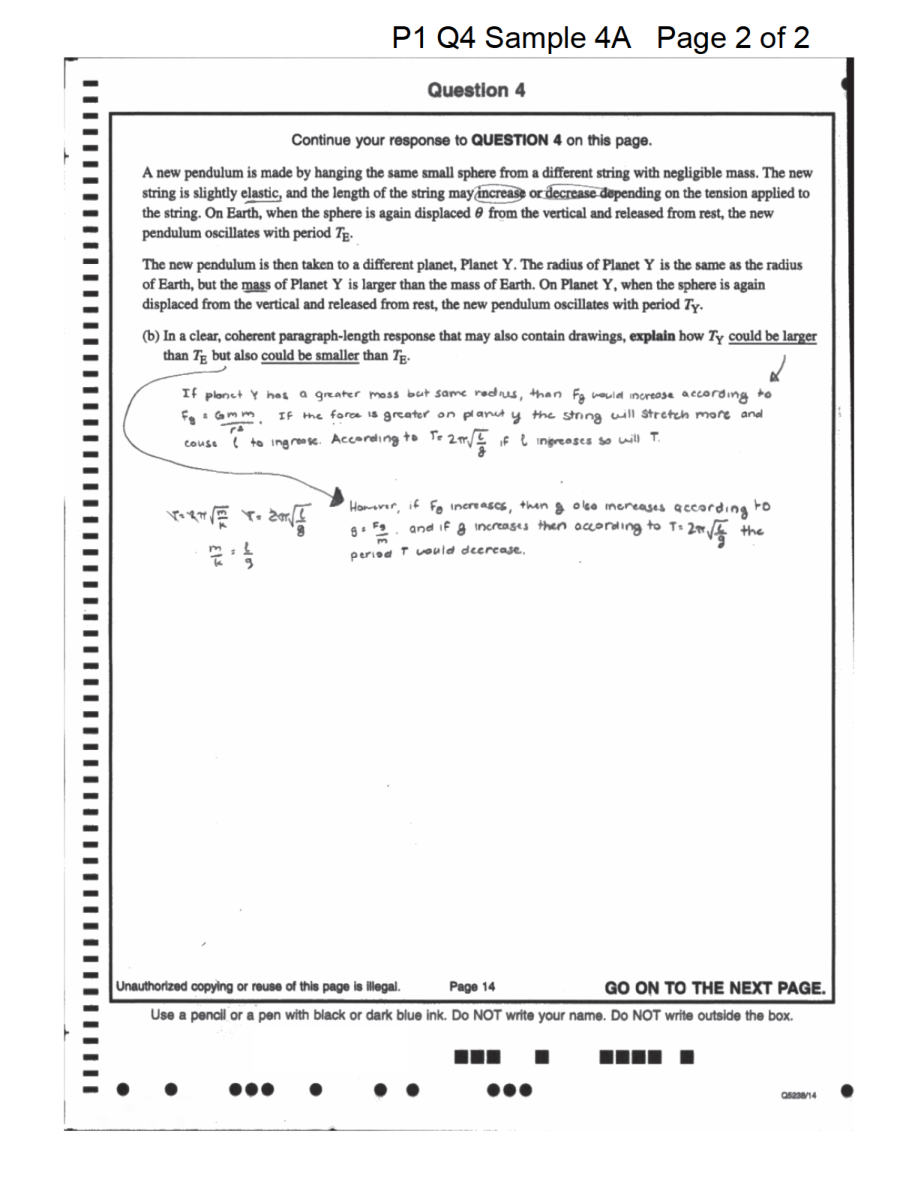
- Science Practice 3: Scientific Questioning and Argumentation — justify apparent weightlessness, compare planetary gravitational fields, and use repeated trials as evidence.
- Experimental Design and Analysis — identify repeated measurements as a way to improve reliability and interpret slopes.
- Qualitative/Quantitative Translation — move between “denser fluid,” vector diagrams, algebraic expressions, and predicted acceleration.
One final action-reaction reminder: if a cart exerts friction on a block, the block exerts friction of equal magnitude and opposite direction on the cart. Those forces act on different objects; they do not cancel on a single-object free-body diagram.
Retrieval check: A block is fully submerged and has $\rho_o=2\rho_f$. Which direction is its acceleration? From
$$ a_y=g\left(\frac{\rho_f}{\rho_o}-1\right) =g\left(\frac{1}{2}-1\right)=-\frac{g}{2}, $$
the acceleration is downward. The negative sign comes from assigning buoyant force upward and gravitational force downward.
Source Materials
- Review the Exam Updates (.pdf)
- AP Physics 1: Algebra-Based Course and Exam Description
- AP Physics 1 Course Overview
- AP Physics 1 Course at a Glance
- AP Physics 1 Course at a Glance Poster
- Adopt AP Physics 1: Algebra-Based
- AP Physics 1: Algebra-Based
- AP Physics 1: Algebra-Based
- (a)(ii) For an explanation that refers to the difference in the stretch length and indicates that the
- (a)(ii) For an explanation that refers to the difference in the stretch length and indicates that the
- Scoring Note: Examples of appropriate labels for the gravitational force include FG , Fg ,
- Scoring Note: Examples of appropriate labels for the gravitational force include FG , Fg ,