From the free course AP Physics 1 on Lykke
5.6 Newton’s Second Law in Rotational Form
Key concepts: Newton’s second law in rotational form · Net torque and angular acceleration · Rotational inertia · Angular momentum and its rate of change · Angular impulse · Torque produced by friction · Rolling motion on an incline · Single-plane rotation boundary · Qualitative proportional relationships among torque, inertia, and angular acceleration
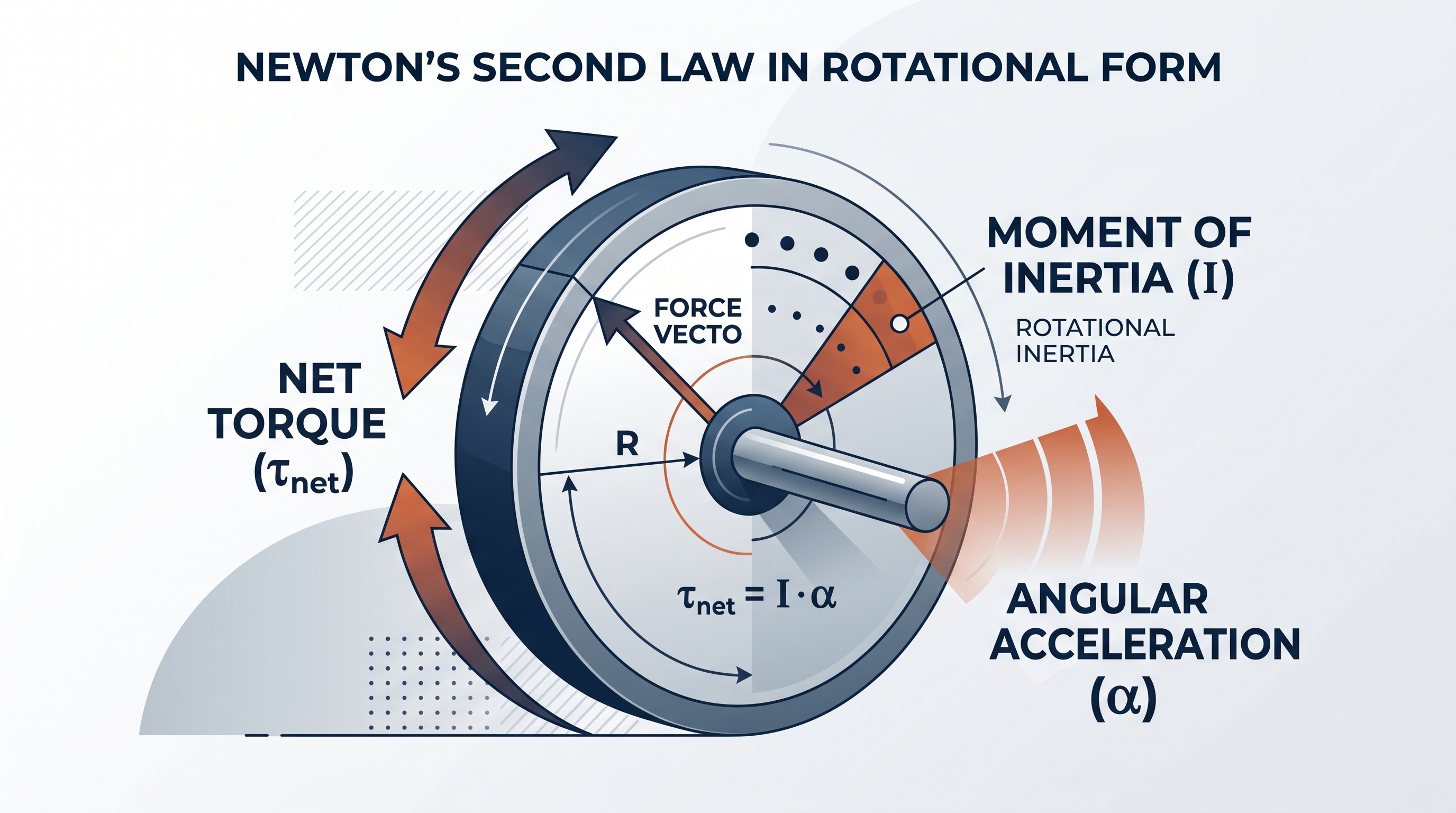
A rotating object changes its angular velocity when its rotational dynamics produce angular acceleration. For a rigid body rotating about a fixed axis with constant rotational inertia, the cause is the net torque:
5.6 Newton’s Second Law in Rotational Form
A rotating object changes its angular velocity when its rotational dynamics produce angular acceleration. For a rigid body rotating about a fixed axis with constant rotational inertia, the cause is the net torque:
$$\tau_{\text{net}} = I\alpha$$
Here, $\tau_{\text{net}}$ is the sum of torques about the chosen axis, $I$ is rotational inertia—the rotational analogue of mass—and $\alpha$ is angular acceleration.
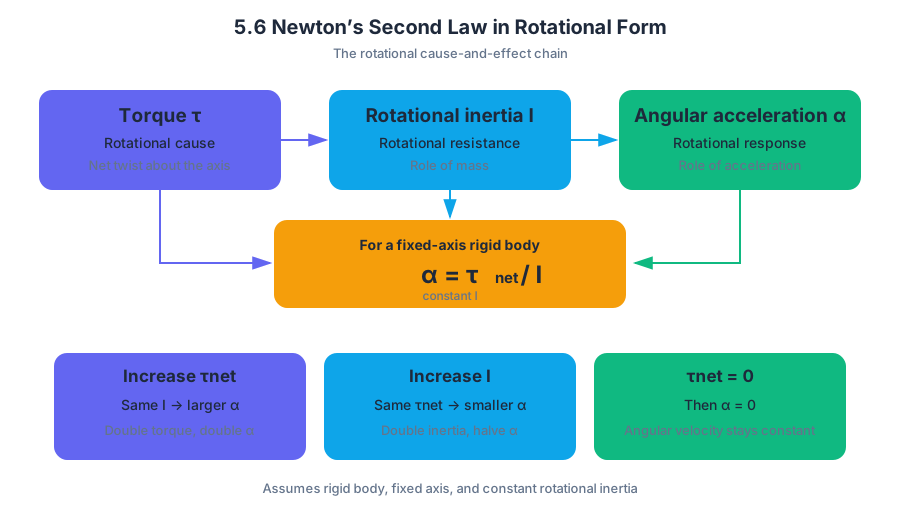
The rotational cause-and-effect chain
Newton’s second law in rotational form says that torque plays the role of force, rotational inertia plays the role of mass, and angular acceleration plays the role of linear acceleration:
For a fixed-axis rigid body with constant $I$,
$$\alpha = \frac{\tau_{\text{net}}}{I}$$
This creates two important proportional relationships:
- For a given $I$, angular acceleration is directly proportional to $\tau_{\text{net}}$ and points in the same rotational direction.
- For a given $\tau_{\text{net}}$, angular acceleration is inversely proportional to $I$.
Thus, doubling the net torque doubles $\alpha$, while doubling the rotational inertia halves $\alpha$. A nonzero net torque is necessary for a change in angular velocity when the object is rigid, rotates about a fixed axis, and has constant $I$. If $\tau_{\text{net}}=0$, then $\alpha=0$, so $\omega$ remains constant.
Essential Knowledge 5.6.A.2: For a system with constant rotational inertia, $\alpha_{\text{sys}}=\dfrac{\sum \tau}{I_{\text{sys}}}=\dfrac{\tau_{\text{net}}}{I_{\text{sys}}}$.
Torque, angular momentum, and angular impulse
Angular momentum provides the more general statement. For a rigid object rotating about a fixed axis,
$$L=I\omega$$
and the rotational form of Newton’s second law can be written as
$$\tau_{\text{net}}=\frac{dL}{dt}$$
If $I$ is constant, then
$$\tau_{\text{net}}=\frac{d(I\omega)}{dt}=I\frac{d\omega}{dt}=I\alpha$$
Finite-difference forms such as
$$\tau_{\text{net}}=\frac{\Delta L}{\Delta t}=I\frac{\Delta\omega}{\Delta t}=I\alpha$$
are appropriate when the torque and rotational inertia remain constant over the interval, or when the quantities represent suitable average values.
Angular impulse is the accumulated effect of torque over time:
$$\int_{t_1}^{t_2}\tau_{\text{net}},dt=\Delta L$$
Only for constant torque does this reduce to
$$\tau_{\text{net}}\Delta t=\Delta L$$
This explains why a longer-duration torque can produce the same angular-momentum change as a stronger torque acting briefly.
Essential Knowledge 6.3.C.2.ii: The rotational impulse–momentum relationship connects angular impulse to the change in angular momentum.
Important caveat: changing rotational inertia
The statement “zero net torque means constant angular velocity” is not universal. It applies to constant-$I$ rotation. If external torque is zero but the object changes its mass distribution, angular momentum can remain constant while angular velocity changes:
$$L=I\omega=\text{constant}$$
A figure skater who pulls in their arms decreases $I$, so $\omega$ increases even though $\tau_{\text{ext}}=0$. The general law $\tau_{\text{net}}=dL/dt$ handles both constant-$I$ and variable-$I$ motion.
Misconception check — “No net torque means no change in $\omega$.”
That is true only when $I$ is constant. With variable $I$, conservation of angular momentum can require $\omega$ to change.
Worked example: a rolling disk on an incline
A solid disk rolls without slipping down an incline of angle $\theta$. Its rotational inertia about its center is
$$I=\frac{1}{2}MR^2$$
The disk’s center accelerates down the ramp, while friction produces the torque that makes the disk rotate.
Take down the ramp as positive. The forces parallel to the ramp give
$$Mg\sin\theta-F_f=Ma$$
The frictional force produces the net torque about the disk’s center:
$$F_fR=I\alpha$$
Rolling without slipping connects the angular and translational accelerations:
$$\alpha=\frac{a}{R}$$
Substitute both relationships:
$$F_fR=\left(\frac{1}{2}MR^2\right)\left(\frac{a}{R}\right)$$
so
$$F_f=\frac{1}{2}Ma$$
Insert this into the translational equation:
$$Mg\sin\theta-\frac{1}{2}Ma=Ma$$
$$Mg\sin\theta=\frac{3}{2}Ma$$
Therefore,
$$a=\frac{2}{3}g\sin\theta$$
The solution requires both analyses: $\tau_{\text{net}}=I\alpha$ describes the disk’s rotation, while $F_{\text{net}}=Ma$ describes the center of mass. This is the meaning of 5.6.A.3: in complex motion, linear and rotational analyses may need to be performed independently.
Friction and the direction of torque
In the rolling-disk example, gravity’s component $Mg\sin\theta$ pulls the center of mass down the incline, while friction acts in the opposite direction along the ramp. Friction is not automatically “the force that slows motion”; here, its torque is essential to producing the disk’s angular acceleration.
Misconception check — “Friction cannot cause rotation because it acts at the contact point.”
A force produces torque whenever its line of action has a nonzero perpendicular distance from the axis. About the disk’s center, the frictional force has lever arm $R$, so it produces torque.
AP practice lens
This topic develops Science Practice 1: Creating Representations through free-body diagrams and torque diagrams; Science Practice 2: Mathematical Routines through simultaneous equations involving $F_{\text{net}}=Ma$, $\tau_{\text{net}}=I\alpha$, and $\alpha=a/R$; and Science Practice 3: Scientific Questioning and Argumentation through claims about how torque, inertia, and acceleration depend on one another.
Retrieval check: A wheel has constant $I$. If its net torque changes from $3\ \mathrm{N,m}$ to $6\ \mathrm{N,m}$, what happens to $\alpha$? If instead $\tau_{\text{net}}=0$ while $I$ decreases, can $\omega$ change? The answers are: $\alpha$ doubles, and yes—angular momentum conservation can make $\omega$ increase.