From the free course AP Physics 1 on Lykke
3.1 Translational Kinetic Energy
Key concepts: Translational kinetic energy · Linear motion of an object's center of mass · Mass · Velocity (speed) · Scalar quantity
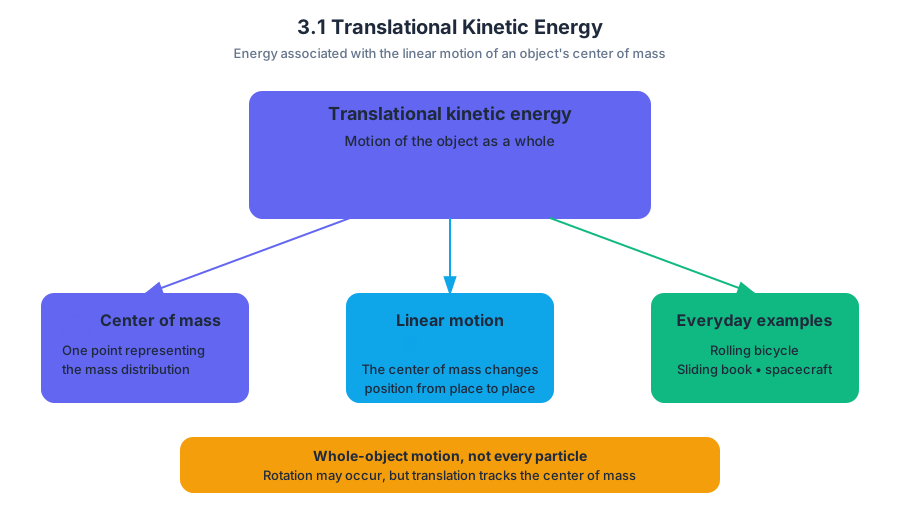
An object has translational kinetic energy when its center of mass moves from one place to another. A rolling bicycle, a sliding book, and a spacecraft traveling through space all possess translational kinetic energy because their overall motion is linear, even if the objects also rotate.
3.1 Translational Kinetic Energy
An object has translational kinetic energy when its center of mass moves from one place to another. A rolling bicycle, a sliding book, and a spacecraft traveling through space all possess translational kinetic energy because their overall motion is linear, even if the objects also rotate.
Translational kinetic energy is the energy associated with the linear motion of an object’s center of mass.
The center of mass is the single location that represents the object’s overall distribution of mass. For many ordinary problems, it moves as though all the object’s mass were concentrated at that point. Thus, the translational kinetic energy describes the motion of the object as a whole, not the detailed motion of every individual particle within it.
The mathematical model
The translational kinetic energy of an object depends on its mass and its velocity:
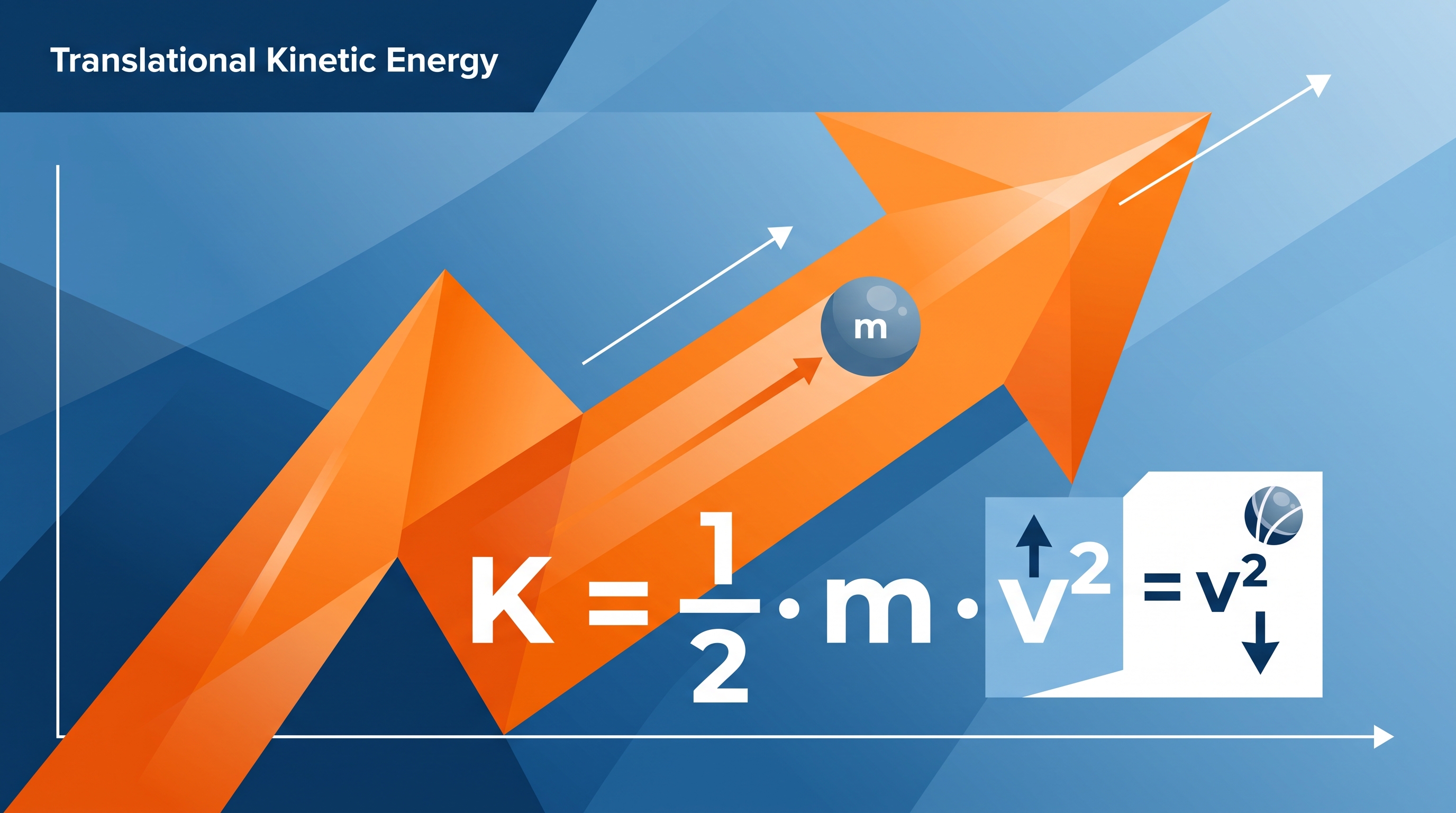
$$ K = \frac{1}{2}mv^2 $$
Here, $K$ is translational kinetic energy, measured in joules ($\text{J}$), $m$ is mass in kilograms ($\text{kg}$), and $v$ is the object’s speed in meters per second ($\text{m/s}$). Although the formula uses the symbol $v$ for velocity, the squared quantity $v^2$ means that the energy depends on the velocity’s magnitude, or speed.
The equation reveals two important scaling rules:
- If the mass doubles while the speed stays constant, $K$ doubles.
- If the speed doubles while the mass stays constant, $K$ becomes four times as large because $(2v)^2 = 4v^2$.
That squared dependence makes speed especially important in collisions and transportation safety. Increasing a vehicle’s speed from $10\ \text{m/s}$ to $20\ \text{m/s}$ does not merely double its translational kinetic energy; it quadruples it.
Worked example: comparing two carts
A laboratory cart has mass $m = 2.0\ \text{kg}$ and moves at speed $v = 3.0\ \text{m/s}$. Its translational kinetic energy is
$$ K = \frac{1}{2}mv^2 $$
$$ K = \frac{1}{2}(2.0\ \text{kg})(3.0\ \text{m/s})^2 $$
$$ K = 9.0\ \text{J} $$
Now consider a second cart with the same mass moving at $6.0\ \text{m/s}$. Because its speed is twice as great,
$$ K_2 = \frac{1}{2}(2.0\ \text{kg})(6.0\ \text{m/s})^2 = 36\ \text{J} $$
The second cart has four times the kinetic energy, not twice the kinetic energy. A useful AP strategy is to compare ratios before calculating:
$$ \frac{K_2}{K_1} = \left(\frac{v_2}{v_1}\right)^2 = \left(\frac{6.0}{3.0}\right)^2 = 4 $$
Kinetic energy is scalar
Translational kinetic energy is a scalar quantity, meaning it has magnitude but no direction. Velocity is a vector, so an object moving east and an identical object moving west have opposite velocities. However, if they have the same mass and speed, they have the same translational kinetic energy:
$$ K_{\text{east}} = \frac{1}{2}m(+v)^2 = \frac{1}{2}mv^2 $$
$$ K_{\text{west}} = \frac{1}{2}m(-v)^2 = \frac{1}{2}mv^2 $$
The negative sign disappears when velocity is squared. This does not mean direction never matters in physics; direction matters greatly for vector quantities such as velocity, acceleration, force, and momentum. It means only that direction does not change the value of kinetic energy for a given mass and speed.
Common misconception — “Kinetic energy can be negative.”
Translational kinetic energy cannot be negative because $m$ is positive and $v^2$ is never negative. A negative velocity can describe direction, but it still produces positive kinetic energy.
Reference frames matter
Different observers can measure different translational kinetic energies for the same object because they may measure different speeds. A passenger sitting inside a train may measure a backpack’s speed as $0\ \text{m/s}$, giving $K = 0$. An observer standing beside the track measures the same backpack moving with the train and therefore measures a nonzero kinetic energy.
The equation itself has not changed; the measured velocity has. Always identify the observer’s reference frame before comparing kinetic energies.
AP skill connection
This topic directly develops 1.A: Create representations. A motion sketch should label the center of mass, show the chosen positive direction, and identify the measured speed. It also develops 2.B: Calculate or estimate an unknown quantity with units from known quantities, by selecting and following a logical computational pathway: identify $m$ and $v$, substitute into $K = \frac{1}{2}mv^2$, and report joules.
Retrieval check: Two identical balls have equal speeds, but one travels north and the other travels south. Which has greater translational kinetic energy? Neither: their kinetic energies are equal because kinetic energy depends on mass and $v^2$, not on the direction of velocity.
Source Materials
- Review the Exam Updates (.pdf)
- AP Physics 1: Algebra-Based Course and Exam Description
- AP Physics 1 Course Overview
- AP Physics 1 Course at a Glance
- AP Physics 1 Course at a Glance Poster
- Adopt AP Physics 1: Algebra-Based
- AP Physics 1: Algebra-Based
- AP Physics 1: Algebra-Based
- AP Physics 1 Past Exam Questions — AP Central
- Khan Academy — AP/College Physics 1
- AP Physics 1 — AP Students
- YouTube — Flipping Physics