From the free course AP Physics 1 on Lykke
4.4 Elastic and Inelastic Collisions
Key concepts: Elastic collisions · Inelastic collisions · Conservation of momentum · Conservation of kinetic energy · Kinetic energy and speed · Position-versus-time graphs · Center of mass motion · Velocity as the slope of a position-versus-time graph · Collision-system modeling and external forces · Predicting changes using functional relationships
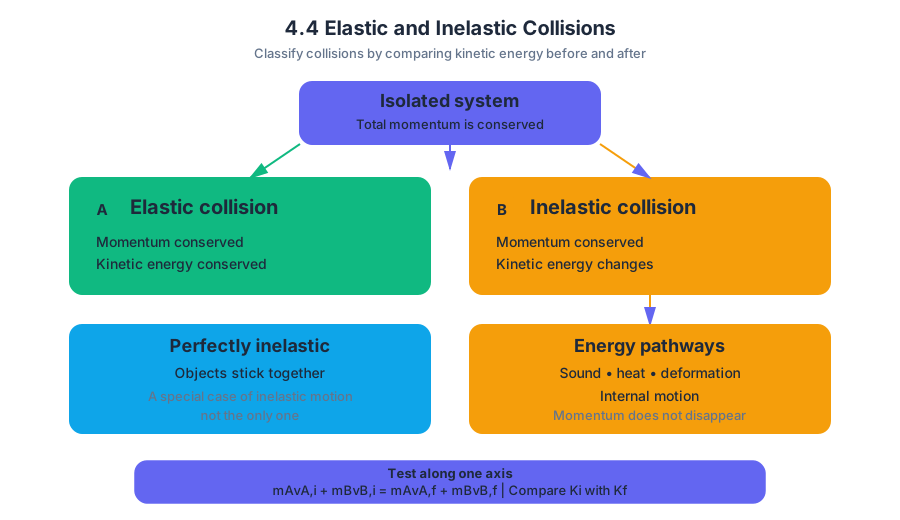
A collision can conserve the system’s total momentum while not conserving its kinetic energy. The key question is therefore not “Was momentum conserved?”—for an isolated two-object system, it is—but “What happened to the kinetic energy?”
4.4 Elastic and Inelastic Collisions
A collision can conserve the system’s total momentum while not conserving its kinetic energy. The key question is therefore not “Was momentum conserved?”—for an isolated two-object system, it is—but “What happened to the kinetic energy?”
Two collision classifications
Using the conservation-of-momentum result from Topic 4.3 for an isolated system, compare kinetic energy before and after the collision.
Elastic collision: Momentum and total kinetic energy are both conserved.
Inelastic collision: Momentum is conserved, but total kinetic energy is not conserved.
“Inelastic” does not mean that momentum disappears. Kinetic energy may be transformed into sound, thermal energy, deformation, or internal motion, while the vector total momentum of the two-object system remains unchanged. A collision in which objects stick together is a perfectly inelastic collision, but objects do not have to stick for a collision to be inelastic.
For two objects moving along one axis, apply
$$ m_Av_{A,i}+m_Bv_{B,i}=m_Av_{A,f}+m_Bv_{B,f}. $$
Then compare
$$ K_i=\frac{1}{2}m_Av_{A,i}^2+\frac{1}{2}m_Bv_{B,i}^2 $$
with
$$ K_f=\frac{1}{2}m_Av_{A,f}^2+\frac{1}{2}m_Bv_{B,f}^2. $$
The signs of velocity matter in the momentum equation; kinetic energy uses speed, so each squared velocity contributes positively.
Worked comparison: two carts
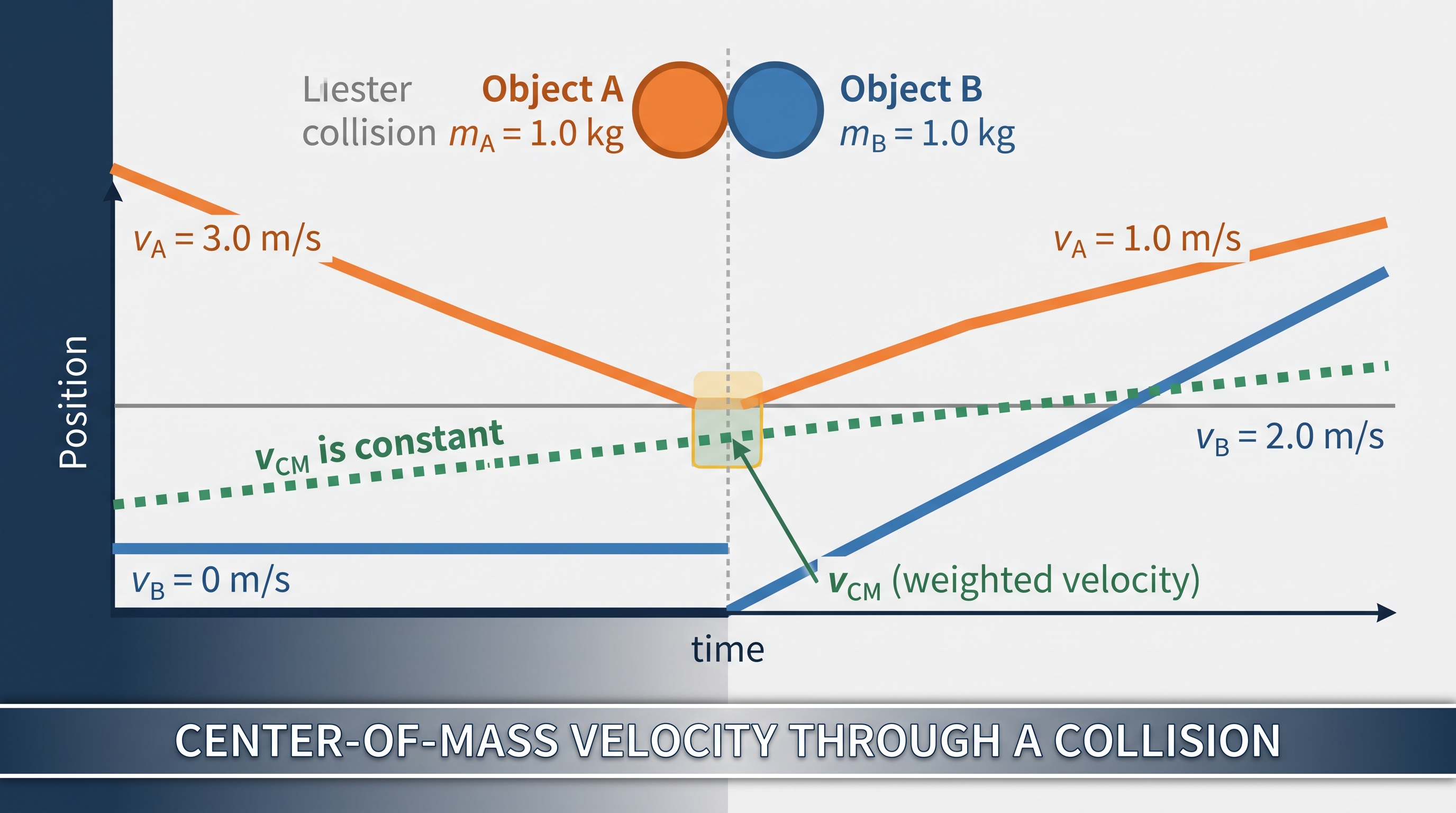
A $1.0\ \text{kg}$ cart moves at $3.0\ \text{m/s}$ toward a stationary $1.0\ \text{kg}$ cart. After the collision, the first cart stops and the second cart moves at $3.0\ \text{m/s}$.
Momentum:
$$ p_i=(1.0)(3.0)+(1.0)(0)=3.0\ \text{kg}\cdot\text{m/s} $$
$$ p_f=(1.0)(0)+(1.0)(3.0)=3.0\ \text{kg}\cdot\text{m/s}. $$
Kinetic energy:
$$ K_i=\frac{1}{2}(1.0)(3.0)^2=4.5\ \text{J} $$
$$ K_f=\frac{1}{2}(1.0)(3.0)^2=4.5\ \text{J}. $$
This collision is elastic.
Now suppose the same carts leave the collision with the first cart moving at $1.0\ \text{m/s}$ and the second at $2.0\ \text{m/s}$. Momentum is still
$$ p_f=(1.0)(1.0)+(1.0)(2.0)=3.0\ \text{kg}\cdot\text{m/s}, $$
but
$$ K_f=\frac{1}{2}(1.0)(1.0)^2+\frac{1}{2}(1.0)(2.0)^2=2.5\ \text{J}. $$
The missing $2.0\ \text{J}$ has been transformed into other forms of energy. This collision is inelastic.
Finding speed from kinetic energy
If an object starts from rest and gains kinetic energy, solve the kinetic-energy equation for its final speed:
$$ K=\frac{1}{2}mv^2 $$
$$ v=\sqrt{\frac{2K}{m}}. $$
For example, a stationary $2.0\ \text{kg}$ block gains $18\ \text{J}$ of kinetic energy. Its final speed is
$$ v=\sqrt{\frac{2(18\ \text{J})}{2.0\ \text{kg}}} =\sqrt{18}\ \text{m/s} \approx 4.2\ \text{m/s}. $$
The result is a speed, not a signed velocity. Direction requires additional information.
Misconception check: Doubling kinetic energy does not double speed. Because $K$ is proportional to $v^2$, speed changes with the square root of kinetic energy.
Reading collision motion on a position-versus-time graph
On a position-versus-time graph, the slope is velocity:
$$ v=\frac{\Delta x}{\Delta t}. $$
A constant velocity appears as a straight line. A positive slope means positive velocity; the object’s position itself may be positive, zero, or negative.
If Object A continues moving forward but slows down, its post-collision graph must have a positive slope that is less steep than its precollision slope. If Object B begins moving forward at constant speed, its post-collision graph is a straight line with a positive, nonzero slope.
The collision instant may appear as a corner where the slope changes. The vertical position at that instant does not jump unless the object undergoes an impossible instantaneous change in location; the slope changes because the velocity changes.
Center of mass through the collision
For two objects, the center-of-mass velocity is
$$ v_{\mathrm{CM}}=\frac{m_Av_A+m_Bv_B}{m_A+m_B}. $$
When no net external force acts on the two-object system, total momentum is constant, so $v_{\mathrm{CM}}$ remains constant before and after the collision.
Using the inelastic example with $m_A=m_B=1.0\ \text{kg}$, initial velocities $3.0\ \text{m/s}$ and $0$, and final velocities $1.0\ \text{m/s}$ and $2.0\ \text{m/s}$,
$$ v_{\mathrm{CM},i}=\frac{(1.0)(3.0)+(1.0)(0)}{2.0}=1.5\ \text{m/s} $$
and
$$ v_{\mathrm{CM},f}=\frac{(1.0)(1.0)+(1.0)(2.0)}{2.0}=1.5\ \text{m/s}. $$
Thus the center-of-mass position-versus-time graph has the same straight-line slope before and after the collision, even though the individual objects’ slopes change.
Retrieval check: A collision has conserved momentum, but the final kinetic energy is smaller than the initial kinetic energy. Is it elastic or inelastic? If Object A’s position graph changes from a steep positive slope to a less-steep positive slope, what happened to its velocity? Finally, if the system has no net external force, should the center-of-mass slope change? Explain each answer in one sentence.
Source Materials
- Review the Exam Updates (.pdf)
- AP Physics 1: Algebra-Based Course and Exam Description
- AP Physics 1 Course Overview
- AP Physics 1 Course at a Glance
- AP Physics 1 Course at a Glance Poster
- Adopt AP Physics 1: Algebra-Based
- AP Physics 1: Algebra-Based
- AP Physics 1: Algebra-Based
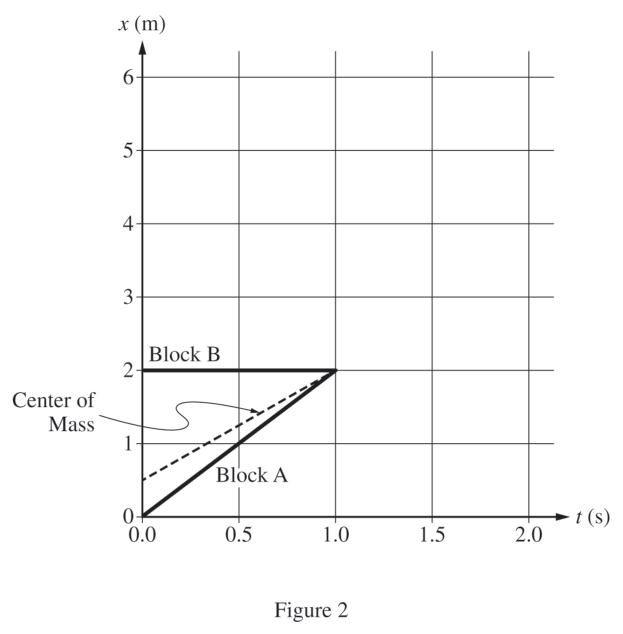
- The graph shown in Figure 2 represents the positions x of Block A, Block B, and the center of mass of the two-block system as functions of t between t 0 = and t 1.0 s = .