From the free course AP Physics 1 on Lykke
2.9 Circular Motion
Key concepts: Uniform circular motion · Centripetal force · Spring force and Hooke’s law · Tangential speed and angular speed · Radius of circular motion · Force analysis for an object moving in a circle · Motion on a frictionless horizontal table · Equilibrium and unstretched spring length · Deriving equations from force relationships · Checking qualitative and quantitative consistency
A block moving at constant speed around a circle is accelerating even when its speedometer reading never changes. The reason is that velocity includes direction, and the direction changes continuously; therefore, a net force must point toward the center of the circular path.
2.9 Circular Motion
A block moving at constant speed around a circle is accelerating even when its speedometer reading never changes. The reason is that velocity includes direction, and the direction changes continuously; therefore, a net force must point toward the center of the circular path.
A spring-powered circular-motion system
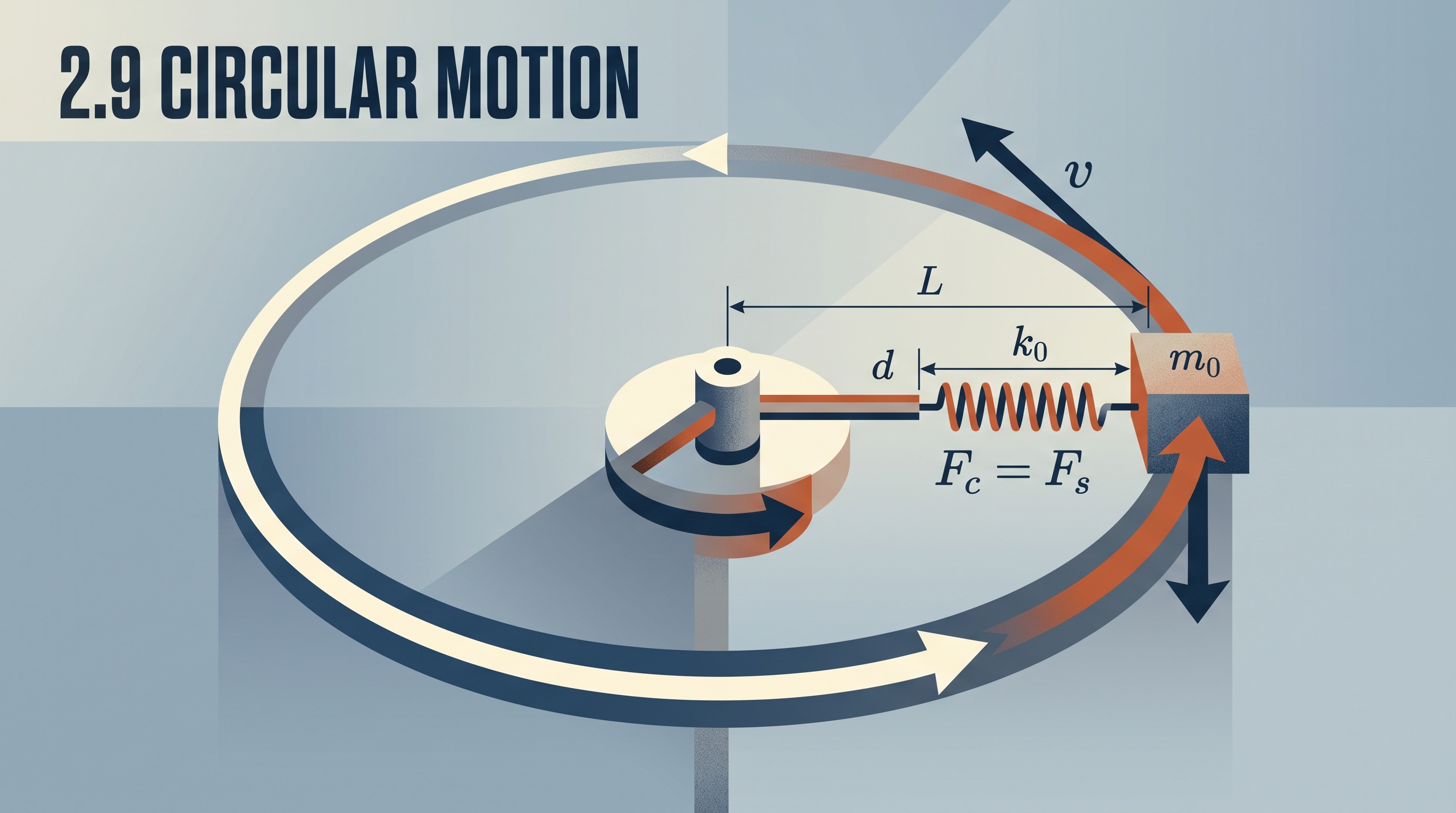
A block of mass $m_0$ is attached to a spring with spring constant $k_0$ on a frictionless horizontal table. One end of the spring connects to a central rotating rod, which a motor can turn.
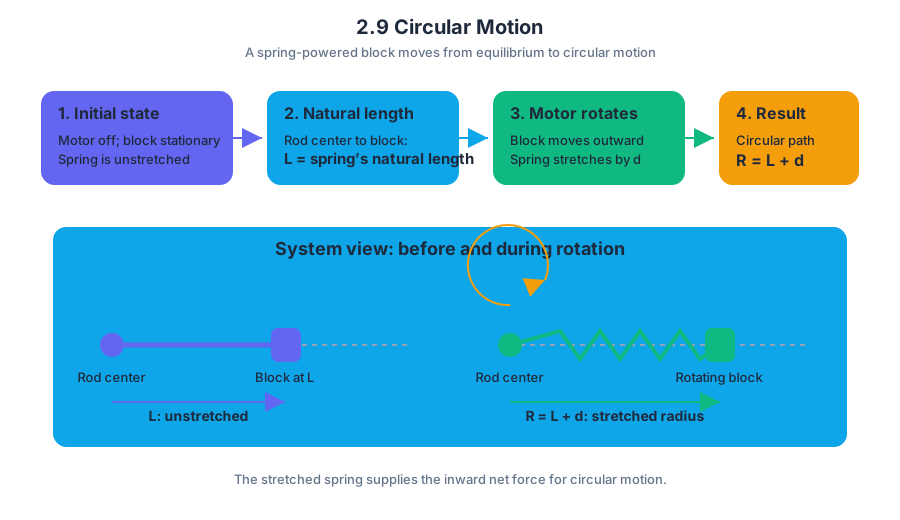
Initially, the motor is off. The block is stationary, the spring is unstretched, and the distance from the rod’s center to the block is $L$. Here, $L$ is the spring’s natural length, meaning its length when it is neither compressed nor stretched.
Because the block is stationary, the horizontal forces are in equilibrium:
$$ \sum F_x = 0 $$
The spring exerts no horizontal force at this instant because its extension is zero. This initial equilibrium is different from the later rotating situation: once the spring stretches, it exerts an inward force that supplies the net force required for circular motion.
When the rod rotates, the block moves outward until the spring stretches by a distance $d$. The radius of the block’s circular path is therefore not merely $L$; it is
$$ R = L+d $$
The two distances have different meanings: $L$ is the original natural length, while $d$ is the additional stretch caused by rotation.
The inward force: centripetal force
Centripetal force is the name for the net force directed toward the center of circular motion. It is not a new kind of force. In this system, the spring force is the physical force that provides the centripetal net force.
From Hooke’s law, the stretched spring force has magnitude
$$ F_s = k_0d $$
For uniform circular motion—motion with constant tangential speed—the required inward net force is
$$ F_c = \frac{m_0v^2}{R} $$
Substituting $R=L+d$ gives
$$ F_c = \frac{m_0v^2}{L+d} $$
Since the spring is the only horizontal force on the block,
$$ F_s=F_c $$
and therefore
$$ k_0d=\frac{m_0v^2}{L+d} $$
Solving for the tangential speed $v$:
$$ v^2=\frac{k_0d(L+d)}{m_0} $$
$$ \boxed{v=\sqrt{\frac{k_0d(L+d)}{m_0}}} $$
Force analysis
A correct force diagram for the block contains:
- a normal force $N$ upward,
- a gravitational force $m_0g$ downward,
- a spring force $F_s=k_0d$ horizontally inward.
The vertical forces cancel because the table provides no vertical acceleration:
$$ N-m_0g=0 $$
The horizontal force does not cancel. It produces the inward acceleration
$$ a_c=\frac{v^2}{R} $$
so Newton’s second law becomes
$$ k_0d=m_0a_c=m_0\frac{v^2}{L+d} $$
Tangential speed and angular speed
Tangential speed $v$ measures how quickly the block moves along the circular path in meters per second. Angular speed $\omega$ measures how quickly the radius turns through an angle in radians per second.
They are related by
$$ v=\omega R $$
For this system,
$$ v=\omega(L+d) $$
Thus, two blocks can have the same angular speed but different tangential speeds if they move at different radii. The block farther from the center travels a greater distance during each revolution.
Reading the equation qualitatively
The derived equation gives more than a numerical answer. Holding $k_0$, $d$, and $m_0$ fixed,
$$ v=\sqrt{\frac{k_0d}{m_0}}\sqrt{L+d} $$
so
$$ v\propto\sqrt{L+d} $$
Increasing the radius increases the required tangential speed according to a square-root relationship. For example, if $L+d$ becomes four times larger while the other quantities remain fixed, the predicted speed becomes twice as large—not four times as large.
This is a qualitative-to-quantitative consistency check: a verbal prediction about how changing a variable affects motion must agree with the mathematical dependence in the derived equation.
Spring energy is not spring force
The stretched spring also stores elastic potential energy:
$$ U_s=\frac{1}{2}k_0d^2 $$
This quantity is measured in joules and describes stored energy. The spring force,
$$ F_s=k_0d $$
is measured in newtons and describes the instantaneous interaction that pulls the block inward. Confusing these expressions produces a dimensional error: $k_0d$ can be a force, whereas $\frac{1}{2}k_0d^2$ is an energy.
Key distinction: $F_s=k_0d$ supplies the centripetal force; $U_s=\frac{1}{2}k_0d^2$ describes energy stored in the stretched spring.
Misconception check
Misconception: “Centripetal force” is an additional force alongside the spring force.
Correction: centripetal force is the inward net-force role. Here, the spring force fills that role.
Misconception: The block moves outward because an outward force keeps it in the circle.
Correction: on the frictionless table, the horizontal spring force points inward. The block’s tendency to continue in a straight line is balanced by this inward force, producing circular motion.
Misconception: A larger radius automatically means a larger speed.
Correction: the conclusion depends on what is held fixed. The equation above shows $v\propto\sqrt{L+d}$ only when $k_0$, $d$, and $m_0$ are unchanged.
AP reasoning in this model
This problem directly exercises Science Practice 1—Creating Representations, especially 1.A (representing a physical situation) through the labeled setup and force diagram; Science Practice 2—Mathematical Routines, especially 2.A (using algebraic relationships) and 2.B (calculating a physical quantity); and Science Practice 3—Scientific Questioning and Argumentation, especially 3.A (making a claim supported by evidence). The evidence for a claim about increased speed is the functional relationship $v\propto\sqrt{L+d}$, not merely an unsupported verbal assertion.
Retrieval check: If the spring suddenly became slack while the block was moving, which way would the block initially travel, and which equation identifies the inward force before that happens?
The block would initially travel tangent to the circle, because its instantaneous velocity is tangential. Before the spring becomes slack, the inward force is identified by
$$ F_s=k_0d=\frac{m_0v^2}{L+d} $$