From the free course AP Physics 1 on Lykke
1.4 Reference Frames and Relative Motion
Key concepts: Reference frames · Relative motion · Motion described relative to a reference frame · Measurements from a given reference frame · Relationships between objects in a single scenario · One-dimensional relative motion · Accelerating (non-inertial) reference frames · Models and representations of physical systems · Qualitative sketches of graphs · Applying laws, definitions, theoretical relationships, or models to make claims
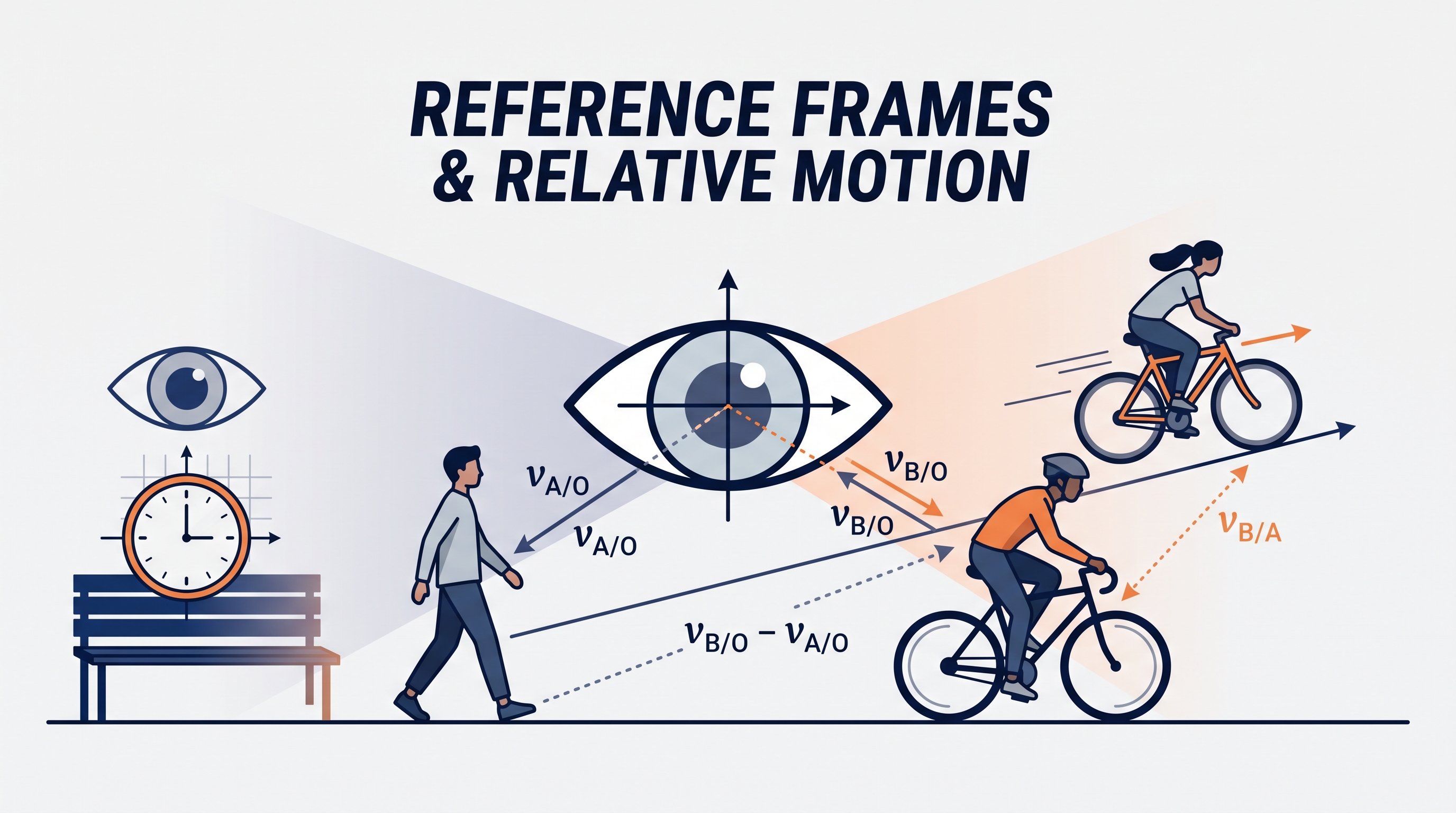
A passenger sitting on a moving train is at rest relative to the train but moving relative to the ground. Both descriptions are correct because motion is measured relative to a reference frame—the coordinate system and observer chosen to describe position and time.
1.4 Reference Frames and Relative Motion
A passenger sitting on a moving train is at rest relative to the train but moving relative to the ground. Both descriptions are correct because motion is measured relative to a reference frame—the coordinate system and observer chosen to describe position and time.
The same motion, different observers
A reference frame is the viewpoint, coordinate system, and clock used to measure an object’s location and motion. Position, displacement, velocity, and acceleration are not meaningful until the reference frame is specified.
Learning Objective 1.4.A: Describe the reference frame of a given observer.
Essential Knowledge 1.4.A.1: A reference frame is a coordinate system relative to which measurements of position, distance, displacement, velocity, and acceleration are made.
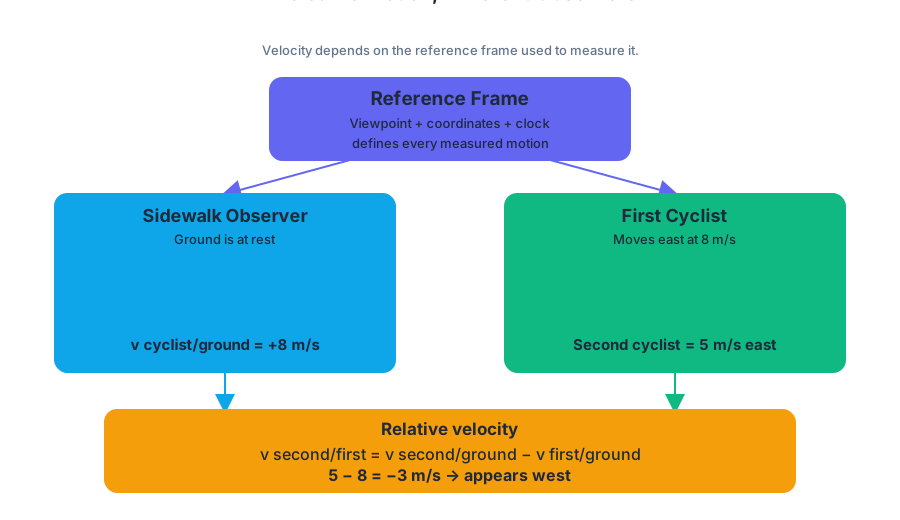
Imagine a cyclist traveling east at $8\ \text{m/s}$ past a stationary observer on the sidewalk. The sidewalk observer measures the cyclist’s velocity as
$$ v_{\text{cyclist/ground}}=+8\ \text{m/s}. $$
A second cyclist rides east at $5\ \text{m/s}$. To the first cyclist, the second cyclist moves east at only
$$ v_{\text{second/first}}=v_{\text{second/ground}}-v_{\text{first/ground}} =5-8=-3\ \text{m/s}. $$
The negative sign means that the second cyclist appears to move west relative to the first cyclist—even though both cyclists move east relative to the ground.
Relative velocity: “of” relative to “with respect to”
Relative motion describes how one object’s position changes as measured from another object or reference frame. The notation makes the viewpoint explicit:
$$ v_{A/B}=\text{velocity of object }A\text{ relative to reference frame }B. $$
For one-dimensional motion, relative velocities combine algebraically:
$$ v_{A/C}=v_{A/B}+v_{B/C}. $$
Equivalently, if both velocities are measured relative to the ground,
$$ v_{A/B}=v_{A/\text{ground}}-v_{B/\text{ground}}. $$
The subtraction is not an extra physical force or interaction. It is a comparison of two measurements made along the same axis. Choose a positive direction first, then attach signs to every velocity.
Worked example: two trains
Train $A$ travels east at $20\ \text{m/s}$, while train $B$ travels west at $12\ \text{m/s}$. Let east be positive:
$$ v_{A/\text{ground}}=+20\ \text{m/s}, \qquad v_{B/\text{ground}}=-12\ \text{m/s}. $$
The velocity of train $A$ relative to train $B$ is
$$ v_{A/B}=20-(-12)=+32\ \text{m/s}. $$
Thus, train $A$ approaches train $B$ at $32\ \text{m/s}$. Their relative separation decreases at that rate.
Misconception check — “opposite directions require adding automatically.”
Velocities are always added or subtracted according to the signed equation. Here, subtraction of a negative velocity produces addition. The signs—not a memorized direction rule—determine the result.
Locations and relationships in one scenario
A useful representation shows every object, its location, its direction, and the chosen reference frame. For objects on a straight track, a number line is often enough.
Suppose a dog is at position $x_D=14\ \text{m}$ and a runner is at position $x_R=6\ \text{m}$. The dog’s position relative to the runner is
$$ x_{D/R}=x_D-x_R=14-6=8\ \text{m}. $$
If the dog runs at $+4\ \text{m/s}$ and the runner at $+2\ \text{m/s}$, then
$$ v_{D/R}=4-2=+2\ \text{m/s}. $$
The dog is $8\ \text{m}$ ahead and is moving farther ahead at $2\ \text{m/s}$. If both move at $4\ \text{m/s}$, then $v_{D/R}=0$, so the dog remains stationary relative to the runner even though both move relative to the ground.
Inertial reference frames
An inertial reference frame is one moving at constant velocity relative to another inertial frame. In the AP Physics 1 model, observers in different inertial frames can disagree about position and velocity, but ordinary Newtonian relationships remain consistent.
Students are not expected to account for accelerating, or non-inertial, reference frames unless a problem explicitly mentions them. If a bus accelerates while you stand inside it, the bus frame is non-inertial; do not introduce that complication unless the prompt requires it.
Graphs as reference-frame evidence
A position–time graph changes when the reference frame changes. If two objects have identical constant velocities relative to the ground, their separation remains constant, so a graph of relative position versus time is horizontal:
$$ x_{A/B}(t)=\text{constant}. $$
If $v_{A/B}$ is constant but nonzero, the relative-position graph is a straight line whose slope is $v_{A/B}$. A positive slope means the separation coordinate increases; a negative slope means it decreases.
Retrieval check: A skateboard moves east at $6\ \text{m/s}$ beside a cyclist moving east at $6\ \text{m/s}$. What does the cyclist measure for the skateboard’s velocity?
Answer: $v_{\text{skateboard/cyclist}}=6-6=0\ \text{m/s}$; the skateboard is at rest in the cyclist’s frame.
AP skills assessed in Topic 1.4
Topic 1.4 explicitly develops these AP skills:
- 1.C — Create qualitative sketches of graphs that represent features of a model or the behavior of a physical system. Sketch relative position or velocity graphs from the signs and constancy of relative motion.
- 2.A — Derive a symbolic expression from known quantities by selecting and following a logical mathematical pathway. Derive $v_{A/B}=v_{A/C}-v_{B/C}$ from the relative-velocity relationship.
- 2.B — Calculate or estimate an unknown quantity with units from known quantities, by selecting and following a logical computational pathway. Substitute signed velocities and report units.
- 3.C — Justify or support a claim using evidence from experimental data, physical representations, or physical principles or laws. Use a number-line model, graph, or velocity relationship to defend a statement about what an observer measures.
The central habit is to label every measurement with its observer: relative to whom? Once that label is explicit, one-dimensional relative-motion problems become a controlled comparison of positions and velocities rather than a clash between apparently contradictory descriptions.