From the free course AP Physics 1 on Lykke
4.2 Change in Momentum and Impulse
Key concepts: Impulse · Change in linear momentum · Impulse-momentum theorem · Momentum bar charts · Effects of bouncing versus sticking collisions · Conservation of momentum in a selected system · Change in velocity and momentum during interactions · Transfer of kinetic energy in collisions · Experimental investigation of impulse and momentum
A dart that bounces from a cart can make the cart move faster than a dart that sticks to it—even when the dart has the same mass and incoming speed in both trials.
4.2 Change in Momentum and Impulse
A dart that bounces from a cart can make the cart move faster than a dart that sticks to it—even when the dart has the same mass and incoming speed in both trials. The decisive difference is not simply the force during impact; it is the dart’s change in momentum, which determines the impulse delivered to the cart.
Topic 4.2 — Change in Momentum and Impulse
Learning Objective: Use impulse and change in momentum to make claims about interactions.
Essential knowledge: The impulse delivered to an object or system equals its change in linear momentum.
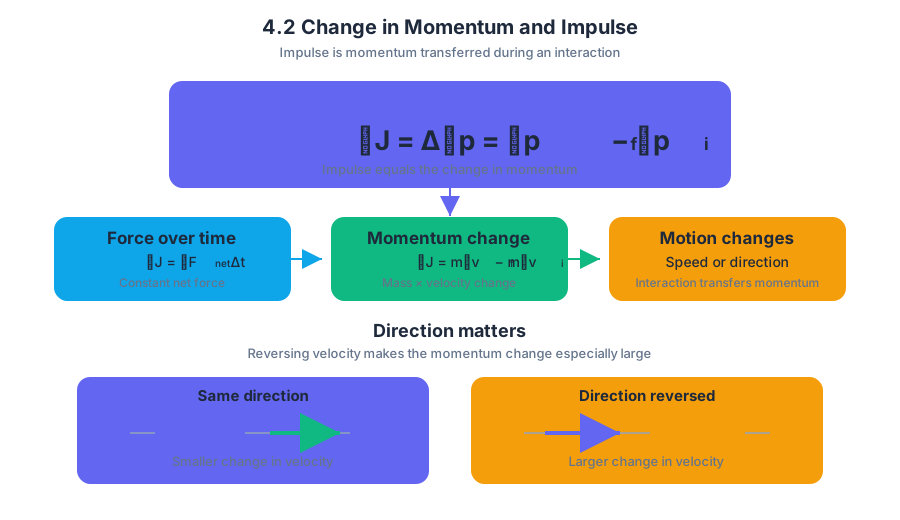
Impulse is momentum transferred during an interaction
Impulse measures the effect of a force acting over a time interval. For a constant net force,
$$ \vec{J}=\vec{F}_{\text{net}}\Delta t $$
The impulse-momentum theorem connects that interaction to motion:
$$ \boxed{\vec{J}=\Delta \vec{p}=\vec{p}_f-\vec{p}_i} $$
Because linear momentum is $\vec{p}=m\vec{v}$, an object’s impulse can also be written as
$$ \vec{J}=m\vec{v}_f-m\vec{v}_i $$
Impulse is a vector, so direction matters. A large change in speed can produce a large impulse, but reversing direction is especially important: the initial and final velocity vectors point opposite ways, making the change in velocity—and therefore the change in momentum—larger.
Worked comparison: sticking versus bouncing
Suppose a dart has mass $m$ and initially moves right with velocity $+v$. Compare two interactions with a cart initially at rest.
| Interaction | Dart’s initial momentum | Dart’s final momentum | Dart’s momentum change |
|---|---|---|---|
| Dart sticks to cart | $+mv$ | approximately $0$ relative to the cart’s motion | $-mv$ |
| Dart bounces backward | $+mv$ | $-mv$ | $-2mv$ |
For the sticking case,
$$ \Delta p_{\text{dart}}=0-mv=-mv $$
For the bouncing case,
$$ \Delta p_{\text{dart}}=(-mv)-(+mv)=-2mv $$
The bounce gives the dart a change in momentum with twice the magnitude in this idealized comparison. By Newton’s third-law interaction, the cart receives an impulse equal in magnitude and opposite in direction to the dart’s impulse. Therefore, the bouncing dart delivers the greater impulse to the cart and produces the larger change in the cart’s momentum.
Misconception check — “The cart gets more impulse because the collision force is automatically larger.”
The safer reasoning is $\vec{J}=\Delta\vec{p}$. A force sensor may register a different force depending on collision time and springiness, but the total impulse is determined by the object’s momentum change. A short, intense force and a longer, gentler force can produce the same impulse.
Reading momentum bar charts
A momentum bar chart represents the momentum of each object before and after an interaction. Choose a positive direction first, then draw bars above the axis for positive momentum and below it for negative momentum. The change in a selected object’s bar is its impulse.
For the dart-cart system, the dart’s negative momentum change during a bounce corresponds to a positive momentum change for the cart. If the dart sticks, the dart does not reverse direction, so the cart receives less momentum. If the dart passes through the cart or stops and drops after impact, the same method applies: compare the dart’s initial and final momentum, then infer the cart’s impulse from the interaction.
Skill connection — Science Practice 1: Creating Representations. Translate the physical collision into velocity arrows, momentum bars, and a system diagram. The representation must show signs, not merely speeds.
Skill connection — Science Practice 2: Mathematical Routines. Use definitions and theoretical relationships such as $\vec{p}=m\vec{v}$ and $\vec{J}=\Delta\vec{p}$, maintaining a consistent sign convention.
Skill connection — Science Practice 3: Scientific Questioning and Argumentation. Make a claim—“the bounce gives the cart greater momentum”—and support it with the dart’s larger change in momentum. This is stronger than saying only that the bounce “looks more powerful.”
The arrow-and-pumpkin ranking
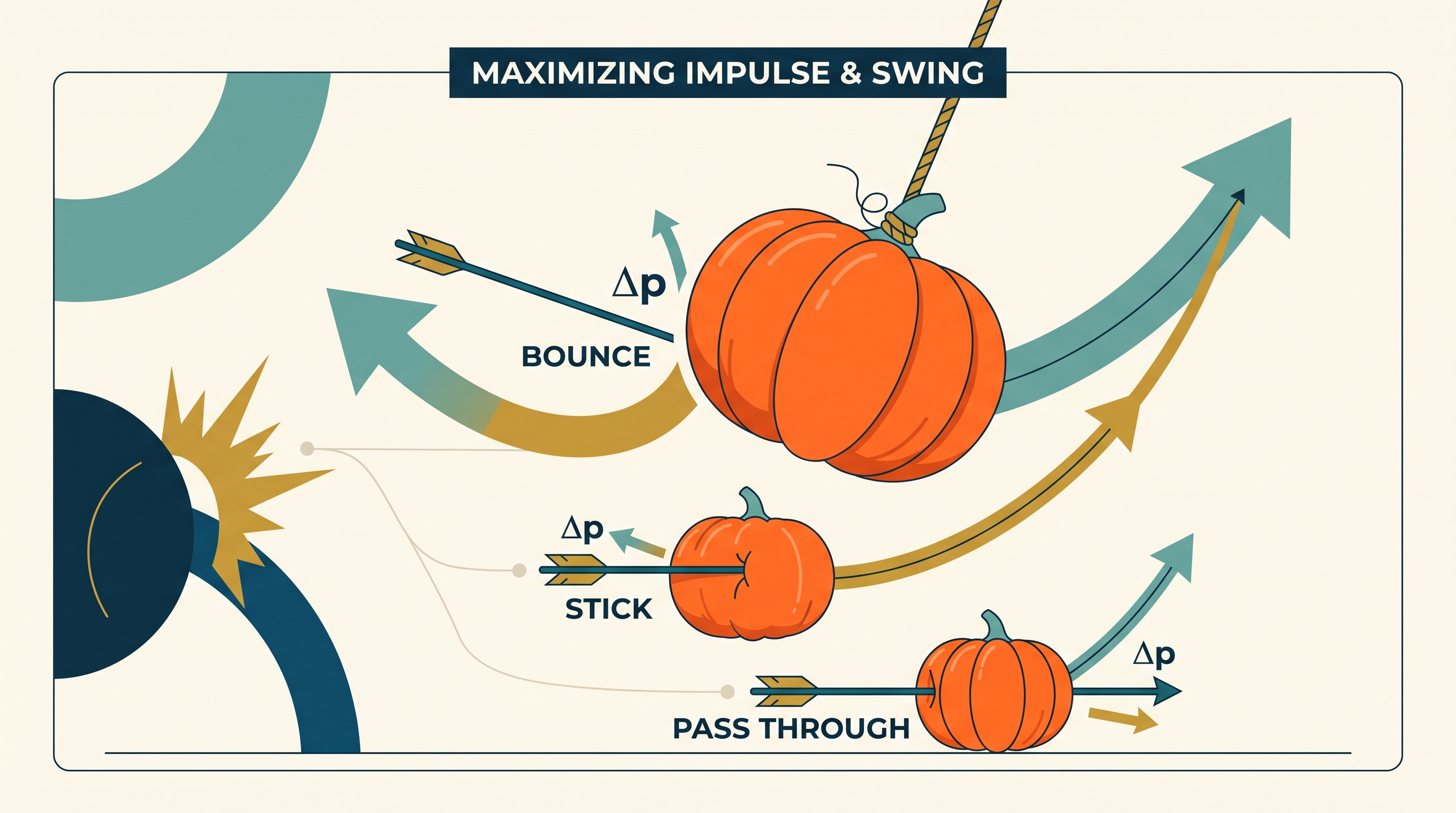
An arrow strikes a hanging pumpkin in three possible ways: it sticks, passes through, or bounces backward. The pumpkin’s initial momentum after the interaction is greatest when the arrow bounces and smallest when the arrow passes through, because the bounce produces the greatest change in the arrow’s momentum.
$$ \boxed{\theta_{\text{bounce}}>\theta_{\text{stick}}>\theta_{\text{pass}}} $$
After the collision, the pumpkin swings upward. Its kinetic energy is converted into gravitational potential energy,
$$ K \rightarrow U_g $$
so greater initial momentum gives the pumpkin greater initial speed and therefore a greater maximum height and swing angle. The ranking follows the impulse first, then the energy transformation after the collision.
Choosing a system
Momentum can remain constant when the chosen system has negligible net external impulse during the interaction. For example, selecting both the arrow and pumpkin includes the interaction forces inside the system; those forces are internal and cancel in the system’s total momentum accounting. Selecting only the pumpkin does not make its momentum constant, because the arrow exerts an external impulse on that smaller system.
Do not confuse this statement with conservation of kinetic energy. Momentum may be conserved for the selected system even while kinetic energy decreases because objects stick, deform, heat up, or make sound.
Retrieval check
A cart receives a dart that arrives moving right. In Case A the dart stops; in Case B it rebounds left with nearly its original speed. Which case gives the cart the greater impulse, and why? State the answer using one equation and one directional argument.
Answer: Case B. The dart’s momentum changes from approximately $+mv$ to $-mv$, so
$$ \Delta p_{\text{dart}}\approx -2mv $$
Its momentum-change magnitude is greater than in the stopping case, so the cart receives the greater opposite impulse.