From the free course AP Physics 1 on Lykke
3.4 Conservation of Energy
Key concepts: Conservation of energy · Work–energy principle · Positive and negative work · Energy transformations caused by forces · Energy bar charts and system diagrams · Gravitational potential energy and kinetic energy · Rotational inertia and rotational kinetic energy · Symbolic derivation from known quantities · Energy conservation in ramps and vertical-loop motion · Conservation of momentum and kinetic energy in collisions
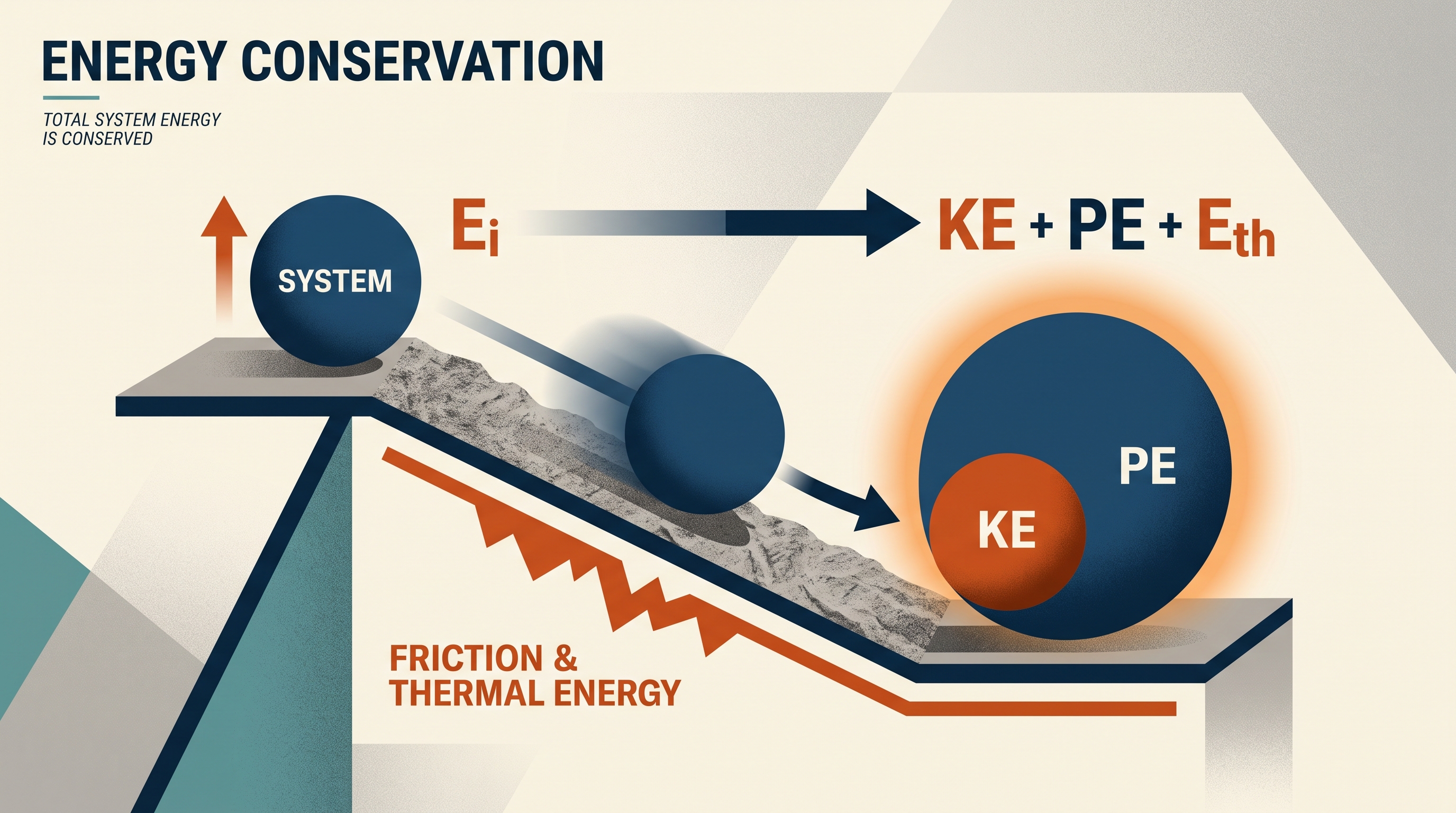
A cart can speed up, slow down, climb, dip, and loop without energy disappearing: energy changes form while the total energy of a chosen system remains constant.
3.4 Conservation of Energy
A cart can speed up, slow down, climb, dip, and loop without energy disappearing: energy changes form while the total energy of a chosen system remains constant. The central question is therefore not “Where did the energy go?” but “Which form of energy increased, and which form decreased?”
Conservation of energy: Energy cannot be created or destroyed. For an isolated system, the total energy remains constant even when energy is transformed between kinetic, potential, thermal, and other forms.
Work changes the energy of a system
Work is energy transferred to or from a system by a force acting through a displacement. The work–energy principle connects work directly to translational kinetic energy:
$$W_{\text{net}}=\Delta K=K_f-K_i$$
A force doing positive work transfers energy into the system’s kinetic energy or another internal form. A force doing negative work removes energy from the system or transfers it into another form.
For a constant force parallel to the displacement,
$$W=Fd$$
More generally,
$$W=Fd\cos\theta$$
where $\theta$ is the angle between the force and the displacement. A force perpendicular to the motion does zero work because $\cos 90^\circ=0$.
Consider a box sliding to the right. A pushing force pointing right does positive work and increases the box’s kinetic energy. Kinetic friction pointing left does negative work; if the box slows, its kinetic energy becomes thermal energy in the box and floor.
Misconception check — “Negative work means negative energy.”
Negative work is not a separate kind of energy. It describes energy transfer out of the system’s kinetic or mechanical energy, often into thermal energy.
The conservation-of-energy equation
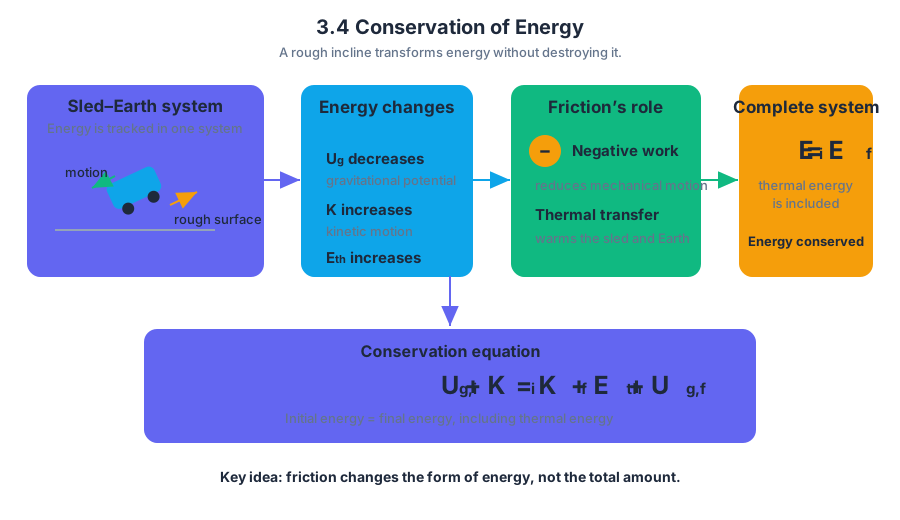
Choose the system first. If the system includes the object, Earth, and any relevant spring, then gravitational or spring interactions can be represented as internal potential energy. For a system with no external energy transfer,
$$E_i=E_f$$
A common mechanical-energy form is
$$K_i+U_{g,i}+U_{s,i}=K_f+U_{g,f}+U_{s,f}$$
where
$$K=\frac{1}{2}mv^2,\qquad U_g=mgh,\qquad U_s=\frac{1}{2}kx^2$$
If friction or another external interaction transfers energy into the system as thermal energy, include that form explicitly rather than pretending mechanical energy is conserved.
Worked example: a cart and a vertical loop
A cart is released from rest at height $h_i$ above the bottom of a frictionless track. It rolls down a ramp and enters a vertical loop whose top is at height $2R$, where $R$ is the loop radius.
At release, $v_i=0$, so the initial energy is entirely gravitational:
$$E_i=mgh_i$$
At the top of the loop,
$$E_f=mg(2R)+\frac{1}{2}mv_{\text{top}}^2$$
Conservation of energy gives
$$mgh_i=mg(2R)+\frac{1}{2}mv_{\text{top}}^2$$
For the cart to remain in contact at the top, circular-motion dynamics requires a minimum speed satisfying
$$\frac{mv_{\text{top}}^2}{R}\geq mg$$
Thus,
$$v_{\text{top}}^2\geq gR$$
Substituting this minimum condition into the energy equation,
$$mgh_i\geq 2mgR+\frac{1}{2}mgR$$
so
$$h_i\geq \frac{5R}{2}$$
The release height must be greater than the top of the loop because the cart needs not only enough energy to reach that height, but also enough kinetic energy to maintain the required centripetal acceleration.
Energy bar charts and system diagrams
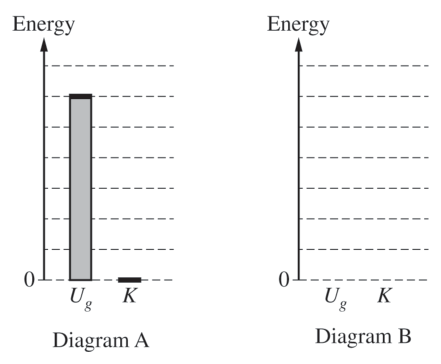
An energy bar chart displays the amount of each energy form at different moments. It is a representation, not a picture of the object. Begin with a zero-energy reference line, choose the system, and keep the vertical scale consistent.
For the cart released from rest and later moving at a lower height:
| State | $K$ | $U_g$ | Total |
|---|---|---|---|
| Release | $0$ | large | same |
| During descent | positive | smaller | same |
| Bottom of track | largest | near zero reference | same |
The exact bar heights must reflect the energy magnitudes. If the final gravitational-energy bar is half as large as the initial bar, the kinetic-energy bar must account for the missing amount. A chart that shows the correct energy types but inconsistent relative heights does not fully represent conservation.
Worked example: a rolling yo-yo
A yo-yo of mass $m$ and rotational inertia $I$ rolls down a ramp. If its string connects at radius $r$, and the yo-yo rolls without slipping, then
$$v=r\omega$$
The rotational inertia can be determined from the mass and connection radius when the yo-yo is modeled appropriately. For a simple rotating mass concentrated near radius $r$,
$$I=mr^2$$
If the yo-yo travels distance $d$ in time $t$ from rest with constant acceleration, then
$$d=\frac{1}{2}at^2$$
so
$$a=\frac{2d}{t^2},\qquad v^2=2ad=\frac{4d^2}{t^2}$$
Energy conservation relates the measured motion to the vertical drop $h$:
$$mgh=\frac{1}{2}mv^2+\frac{1}{2}I\omega^2$$
Using $\omega=v/r$,
$$mgh=\frac{1}{2}mv^2+\frac{1}{2}I\frac{v^2}{r^2}$$
This is a symbolic derivation: quantities are substituted in a logical sequence until the desired relationship appears.
Representations and AP Science Practices
Topic 3.4 explicitly develops these official science-practice skills:
- 1.A — Create diagrams, tables, charts, or schematics to represent physical situations. Draw the system boundary, identify energy forms, and construct scaled energy bars.
- 2.A — Derive a symbolic expression from known quantities by selecting and following a logical mathematical pathway. Start with conservation of energy, substitute relationships such as $v=r\omega$, and simplify step by step.
- 2.C — Compare physical quantities between two or more scenarios or at different times and locations in a single scenario. Compare speeds at different heights or determine which object has greater kinetic energy.
- 3.C — Justify or support a claim using evidence from experimental data, physical representations, or physical principles or laws. Use an energy chart, measured $d$ and $t$, or the conservation law to defend a conclusion.
Elastic collisions: energy and momentum together
In an ideal elastic collision, both momentum and kinetic energy are conserved. If object $A$ initially moves with speed $v_i$ and object $B$ is initially at rest, then
$$m_Av_i=m_Av_{f1}+m_Bv_{f2}$$
and
$$\frac{1}{2}m_Av_i^2=\frac{1}{2}m_Av_{f1}^2+\frac{1}{2}m_Bv_{f2}^2$$
Momentum conservation tracks the system’s motion; kinetic-energy conservation identifies the collision as elastic. Do not use kinetic-energy conservation for every collision: in an inelastic collision, some kinetic energy transforms into thermal energy, sound, or deformation.
Retrieval check
A sled moves down a rough incline. The sled’s gravitational potential energy decreases, its kinetic energy increases, and thermal energy also increases. Is the work done by friction positive or negative on the sled–Earth system, and which conservation equation would you write? The expected reasoning is that friction performs negative work on the mechanical motion while the complete system still satisfies $E_i=E_f$ when thermal energy is included.
Source Materials
- Review the Exam Updates (.pdf)
- AP Physics 1: Algebra-Based Course and Exam Description
- AP Physics 1 Course Overview
- AP Physics 1 Course at a Glance
- AP Physics 1 Course at a Glance Poster
- Adopt AP Physics 1: Algebra-Based
- AP Physics 1: Algebra-Based
- AP Physics 1: Algebra-Based
- Diagram A shows an energy bar chart that represents the gravitational potential energy Ug of the block-Earth system and the kinetic energy K of the block at Point A, when the block is released from re