From the free course AP Physics 1 on Lykke
6.1 Rotational Kinetic Energy
Key concepts: Rotational kinetic energy · Translational kinetic energy · Rotational inertia · Energy partition between translational and rotational motion · Conservation of mechanical energy · Rolling motion · Comparison of objects with different rotational inertia · Force and torque analysis of rolling objects · Motion down an incline · Quantitative and qualitative energy representations
A rolling object can arrive at the bottom of an incline with less translational speed than a sliding object because some of its energy is carried by rotation.
6.1 Rotational Kinetic Energy
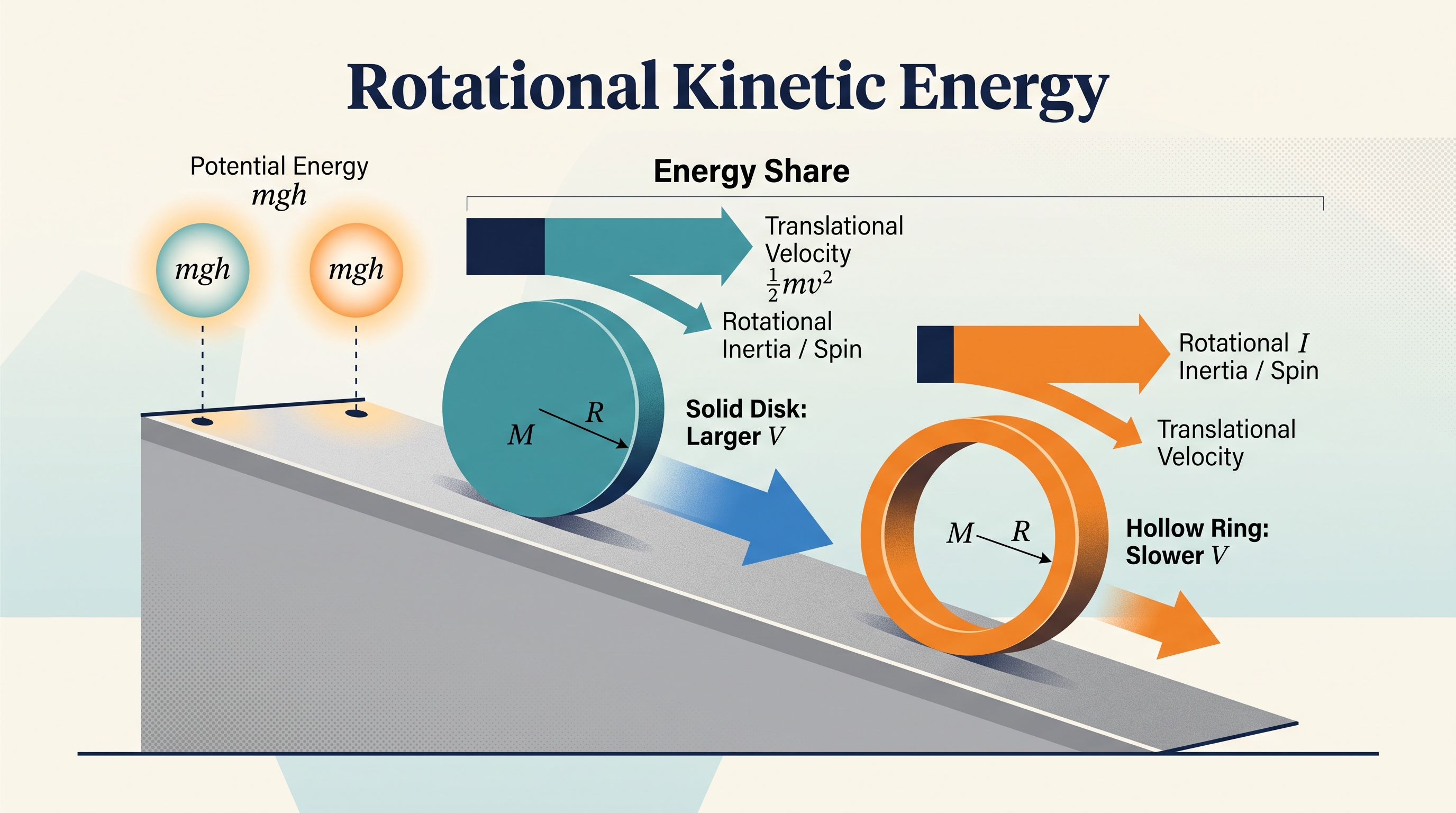
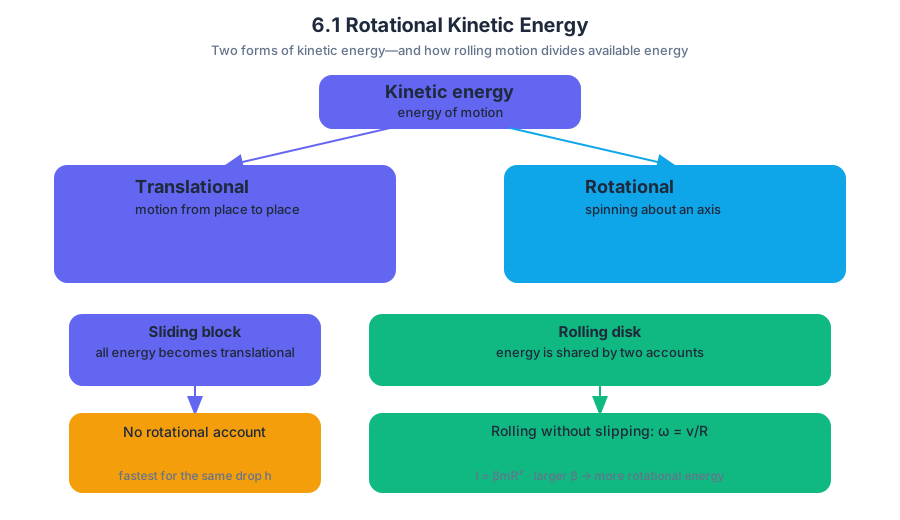
A rolling object can arrive at the bottom of an incline with less translational speed than a sliding object because some of its energy is carried by rotation. The central question is: when gravity supplies the same energy, how is that energy divided between moving forward and spinning?
Two forms of kinetic energy
Translational kinetic energy is the energy associated with an object’s motion from place to place:
$$K_{\text{trans}}=\frac{1}{2}mv^2$$
Rotational kinetic energy is the energy associated with an object spinning about an axis:
$$K_{\text{rot}}=\frac{1}{2}I\omega^2$$
Here, $m$ is mass, $v$ is the center-of-mass speed, $I$ is rotational inertia—a measure of how difficult it is to change an object’s rotational motion—and $\omega$ is angular speed.
For a frictionless block sliding from rest through a vertical drop $h$, all initial gravitational potential energy becomes translational kinetic energy:
$$mgh=\frac{1}{2}mv^2$$
A rolling disk at the same height has two energy “accounts”:
$$mgh=\frac{1}{2}mv^2+\frac{1}{2}I\omega^2$$
For rolling without slipping, $\omega=v/R$, so if $I=\beta mR^2$,
$$mgh=\frac{1}{2}mv^2(1+\beta)$$
and therefore
$$v=\sqrt{\frac{2gh}{1+\beta}}$$
A larger $\beta$ means more of the available energy is rotational and less is translational.
Worked comparison: block, disk, and ring
Suppose a cart, a solid disk, and a ring have equal mass and radius and start from rest at the same height on identical inclines. Model the cart as primarily translating, the disk as having $I=\frac{1}{2}mR^2$, and the ring as having $I=mR^2$.
| Object | $\beta$ in $I=\beta mR^2$ | Energy partition | Predicted acceleration |
|---|---|---|---|
| Cart | $0$ | Nearly all translational | $g\sin\theta$ |
| Disk | $\frac{1}{2}$ | Translational plus rotational | $\frac{g\sin\theta}{1+\frac{1}{2}}$ |
| Ring | $1$ | Greater rotational share | $\frac{g\sin\theta}{2}$ |
Energy reasoning predicts the cart has the greatest final translational speed, the disk is next, and the ring is slowest. To justify the acceleration and therefore the finishing order, use force and torque reasoning.
For a rolling object on an incline, let $f$ be the static friction force directed up the incline:
$$ma=mg\sin\theta-f$$
The friction force supplies the torque needed for rolling:
$$I\alpha=fR$$
The no-slip condition connects linear and angular acceleration:
$$\alpha=\frac{a}{R}$$
Substituting $I=\beta mR^2$ gives $f=\beta ma$, so
$$ma=mg\sin\theta-\beta ma$$
and
$$a=\frac{g\sin\theta}{1+\beta}$$
Thus the acceleration ranking is
$$a_{\text{cart}}>a_{\text{disk}}>a_{\text{ring}}$$
and, because all begin together and travel the same distance, the predicted order at the bottom is cart first, disk second, ring third. The energy equation explains the final speed ranking; the force-and-torque equations establish the acceleration and travel-time ranking.
Misconception check: “Friction always removes mechanical energy”
Static friction in ideal rolling does not necessarily reduce the system’s total mechanical energy. The contact point is instantaneously at rest relative to the surface, so ideal static friction transfers energy within the object without dissipating it. It is essential for producing the torque that makes the object rotate.
By contrast, kinetic friction during slipping generally converts mechanical energy into thermal energy. The distinction is not “friction versus no friction,” but static rolling contact versus slipping contact.
Ranking three rolling conditions
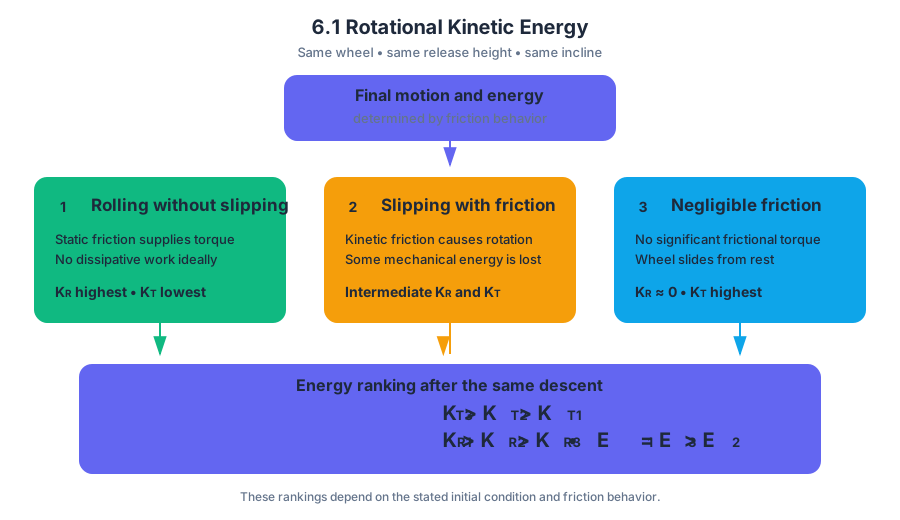
Consider the same wheel released from rest at the same height and compare its state after descending the same incline:
- Case 1: The track is rough enough for rolling without slipping. Static friction supplies torque, but ideal static friction does no net dissipative work.
- Case 2: The track has some friction, but the wheel slips. Kinetic friction produces rotation while dissipating part of the mechanical energy.
- Case 3: The track has negligible friction. Starting from rest, the wheel receives essentially no frictional torque, so it slides without significant rotation.
Under these specific conditions, the intended rankings are
$$K_{T3}>K_{T2}>K_{T1}$$
$$K_{R1}>K_{R2}>K_{R3}$$
and
$$E_1=E_3>E_2$$
where $K_T$ is translational kinetic energy, $K_R$ is rotational kinetic energy, and $E$ is total mechanical energy. These inequalities depend on the stated initial condition and friction behavior; they are not universal rules for every slipping problem.
AP reasoning in this topic
This topic develops Science Practice 1—Creating Representations, especially energy bar charts and qualitative force-and-torque diagrams. Science Practice 2—Mathematical Routines appears when relating $I$, $\omega$, $m$, $R$, and $v$ algebraically. Science Practice 3—Scientific Questioning and Argumentation is used when defending why one object wins a race or evaluating whether a friction assumption is justified.
The recurring assessment skills are Mathematical Routines, Translation Between Representations, Experimental Design and Analysis, and Qualitative/Quantitative Translation. For example, a student may translate an energy bar chart into an equation, derive a speed ratio, or design a measurement of acceleration and rotational inertia.
Retrieval check
A disk and a ring have equal mass, radius, and starting height and roll without slipping. Which has the smaller translational speed at the bottom, and why?
The ring is slower because its larger rotational inertia gives it a larger rotational share of the fixed gravitational energy. Its acceleration is also smaller because
and the ring has the larger value of $\beta$.
Source Materials
- Review the Exam Updates (.pdf)
- AP Physics 1: Algebra-Based Course and Exam Description
- AP Physics 1 Course Overview
- AP Physics 1 Course at a Glance
- AP Physics 1 Course at a Glance Poster
- Adopt AP Physics 1: Algebra-Based
- AP Physics 1: Algebra-Based
- AP Physics 1: Algebra-Based
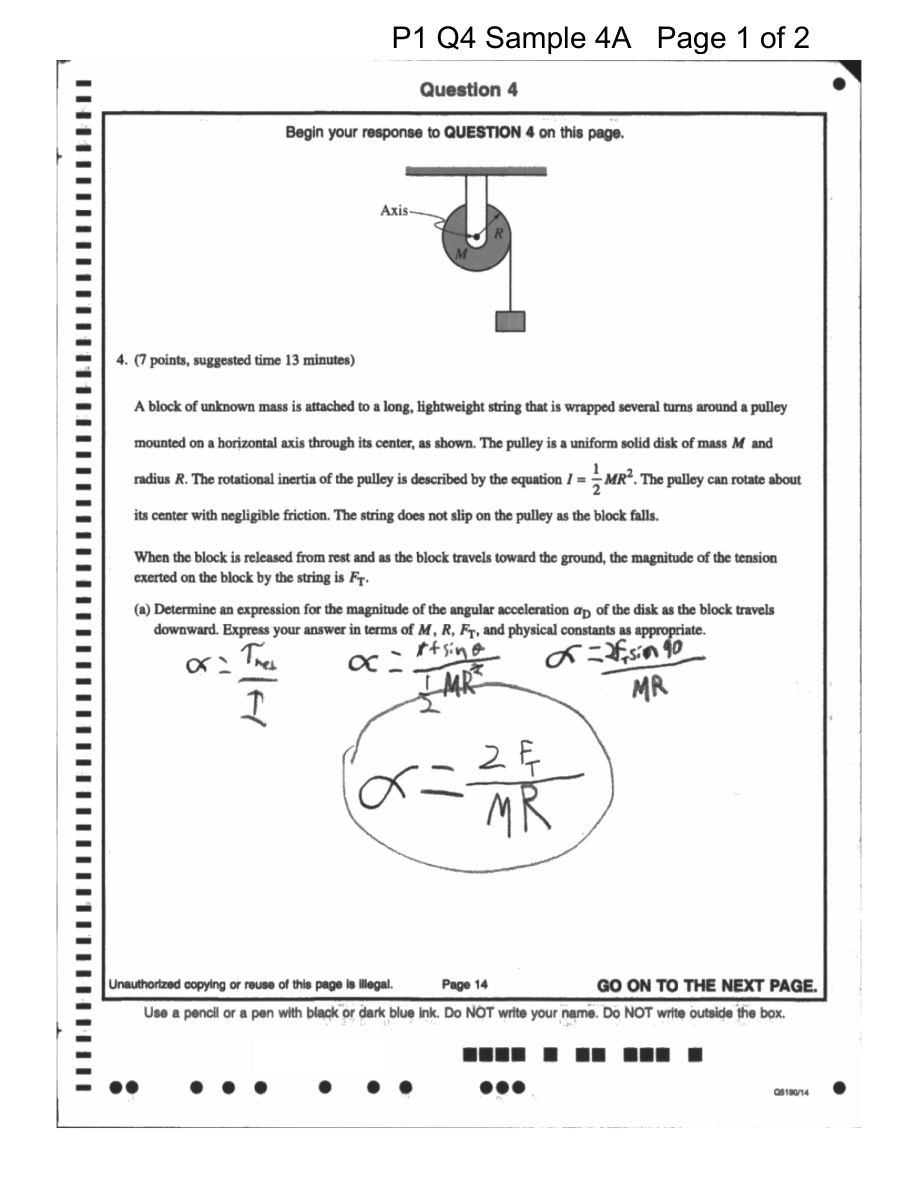
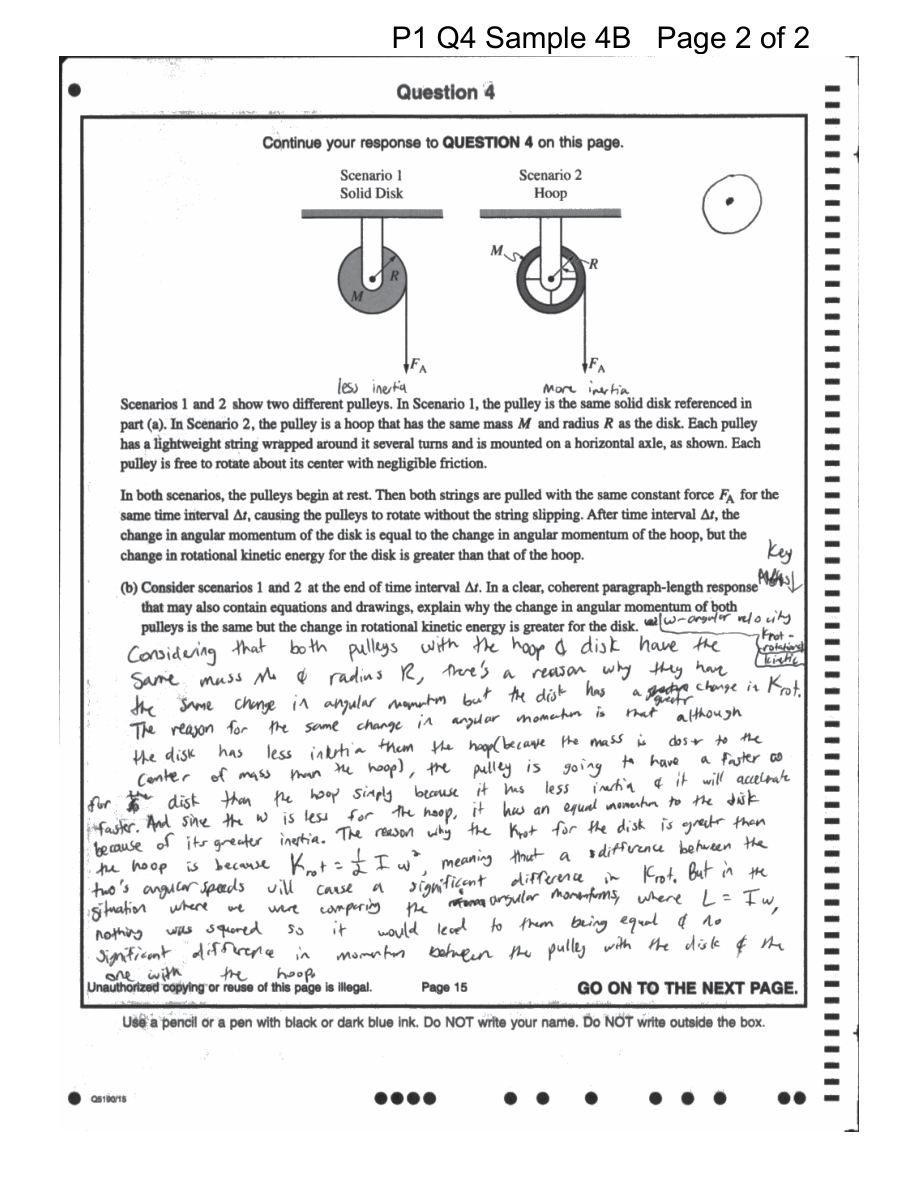
- Figure — Sample Responses Q4 (p. 4)
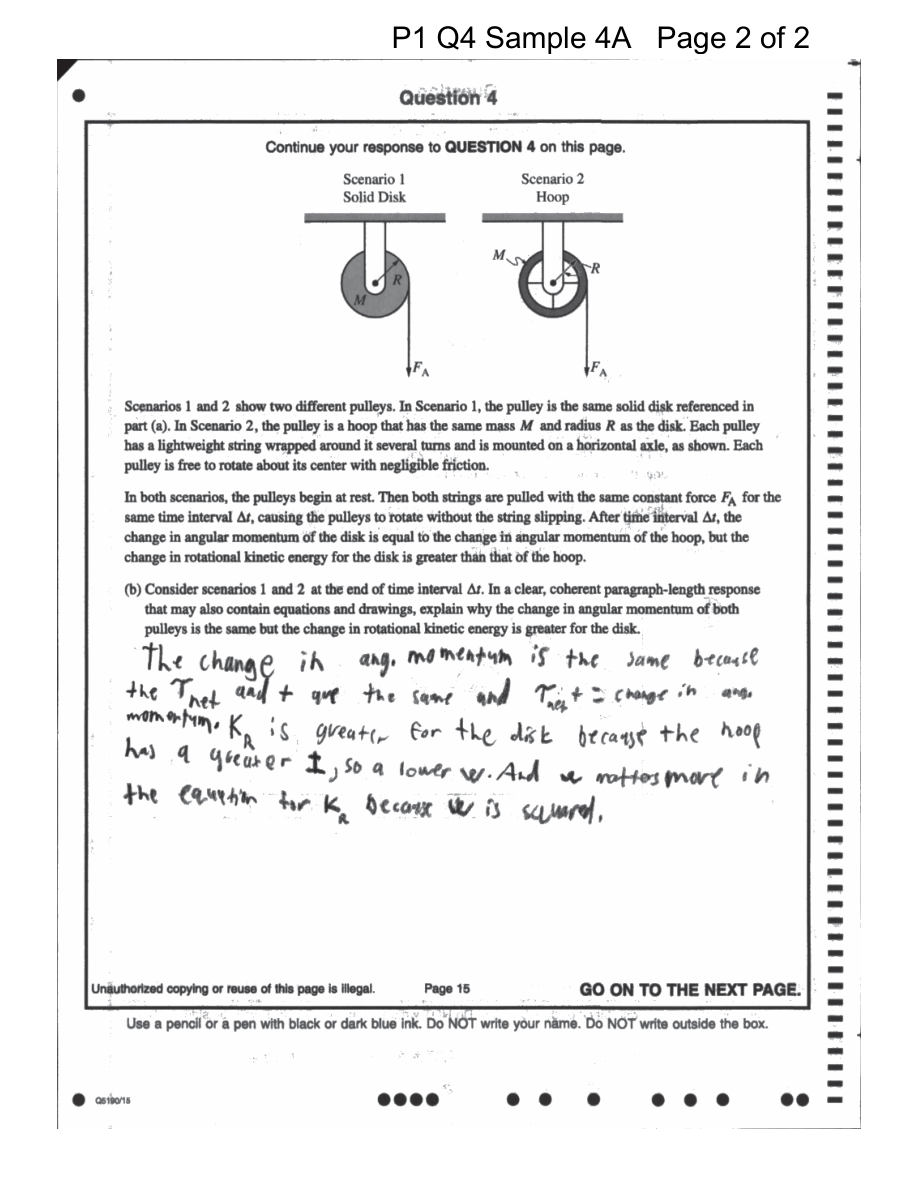
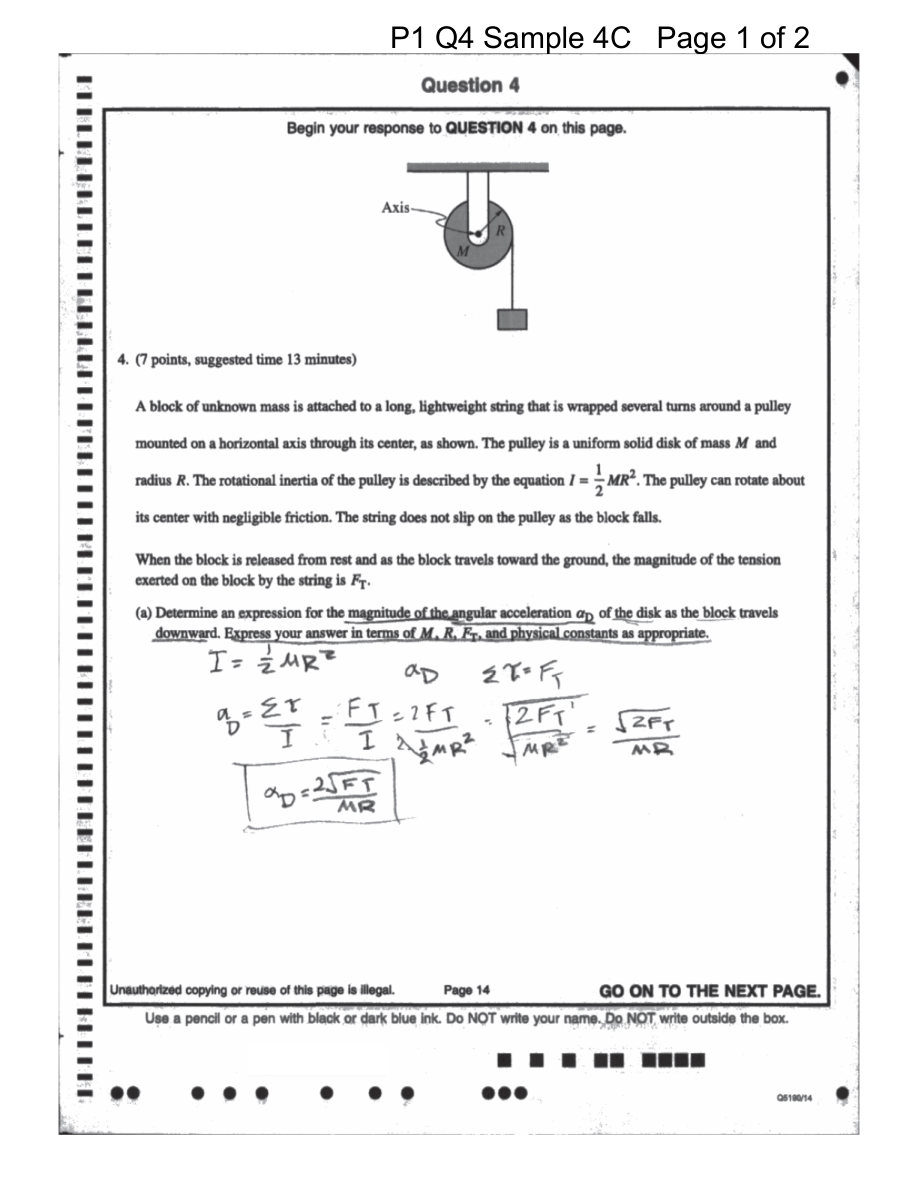
- Figure — Sample Responses Q4 (p. 5)
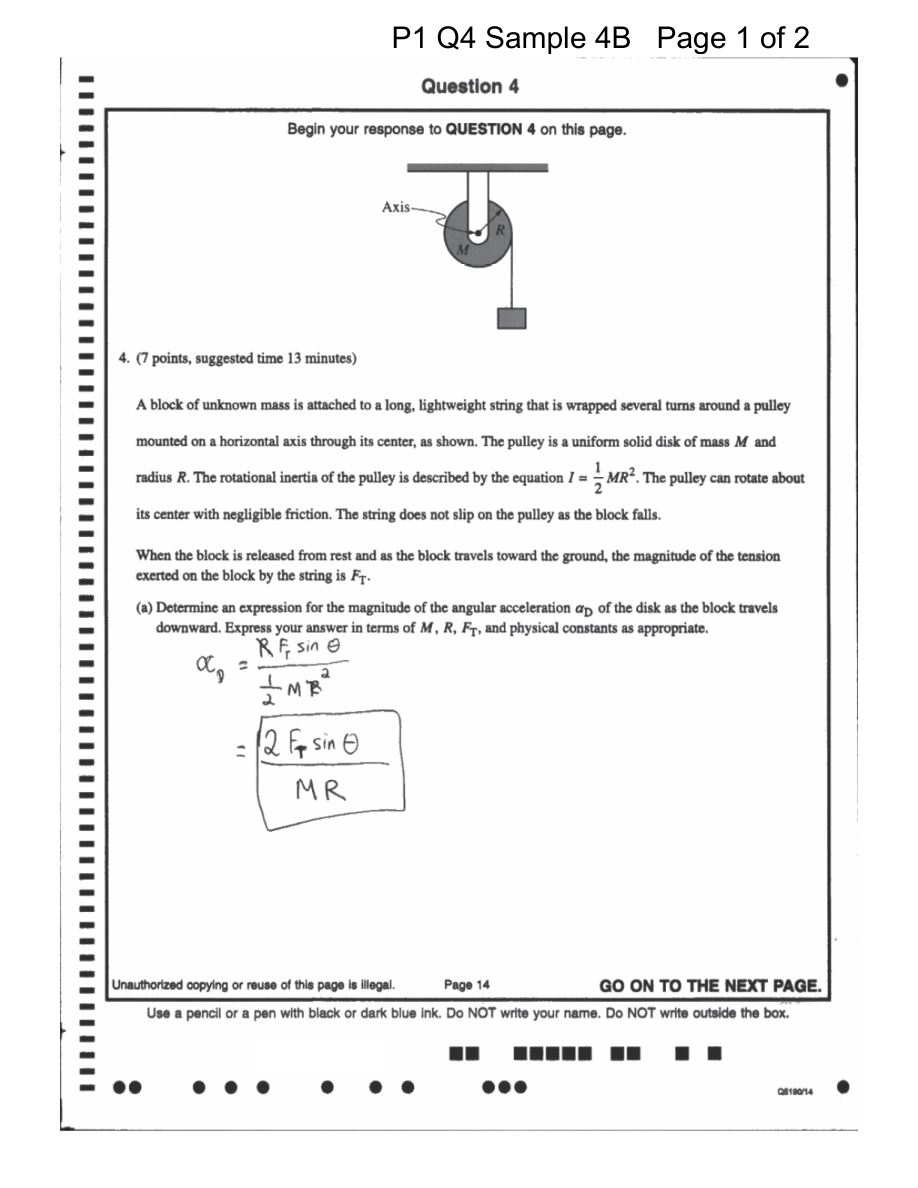
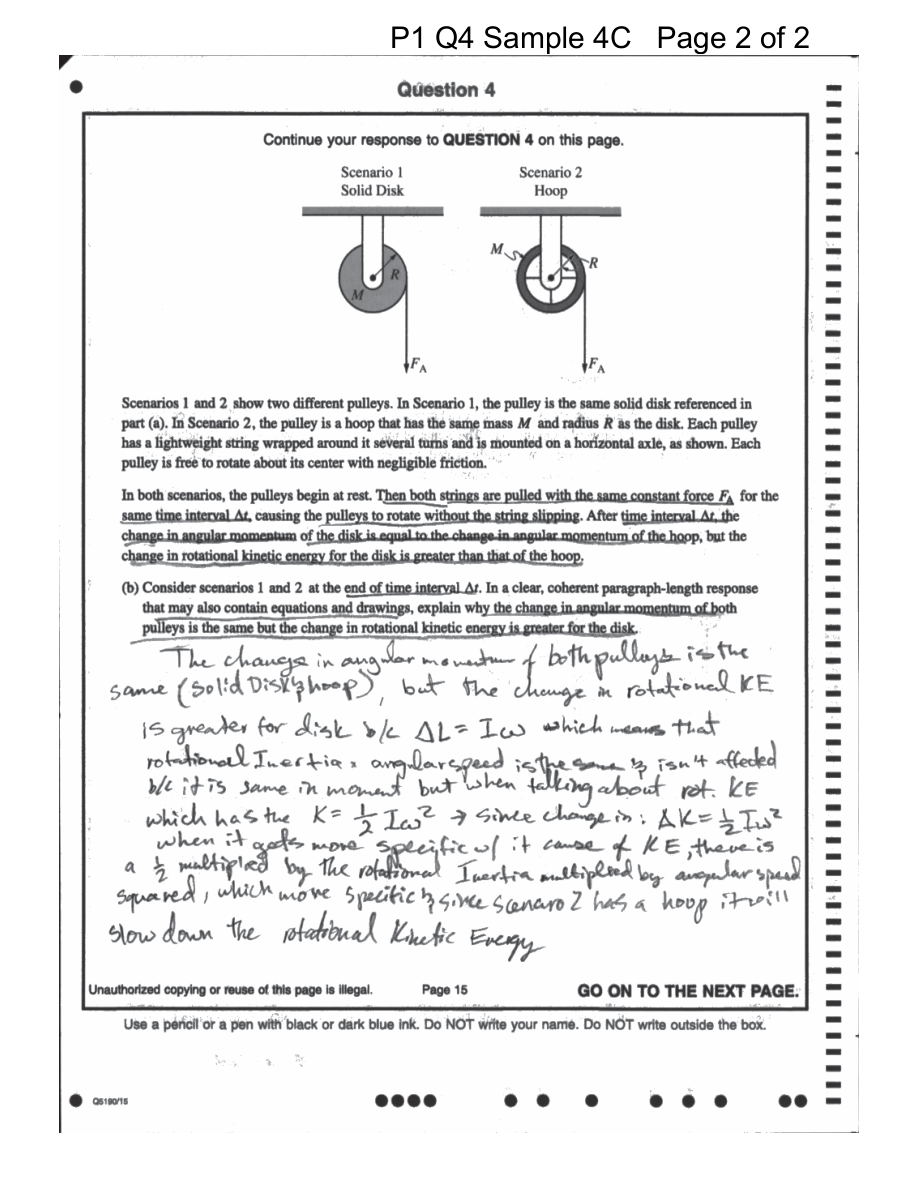
- Figure — Sample Responses Q4 (p. 6)
- Figure — Sample Responses Q4 (p. 7)