From the free course AP Physics 1 on Lykke
5.2 Connecting Linear and Rotational Motion
Key concepts: Connecting linear and rotational motion · Relationship between linear and angular quantities for a rotating rigid body · Tangential velocity and angular velocity · Tangential acceleration and angular acceleration · Rigid-body rotation about a fixed axis · Rolling motion without slipping · Applying laws, definitions, and theoretical relationships to make claims · Calculating unknown quantities with units from known quantities · Creating quantitative graphs with appropriate scales and units · Rolling while slipping is beyond the scope of AP Physics 1
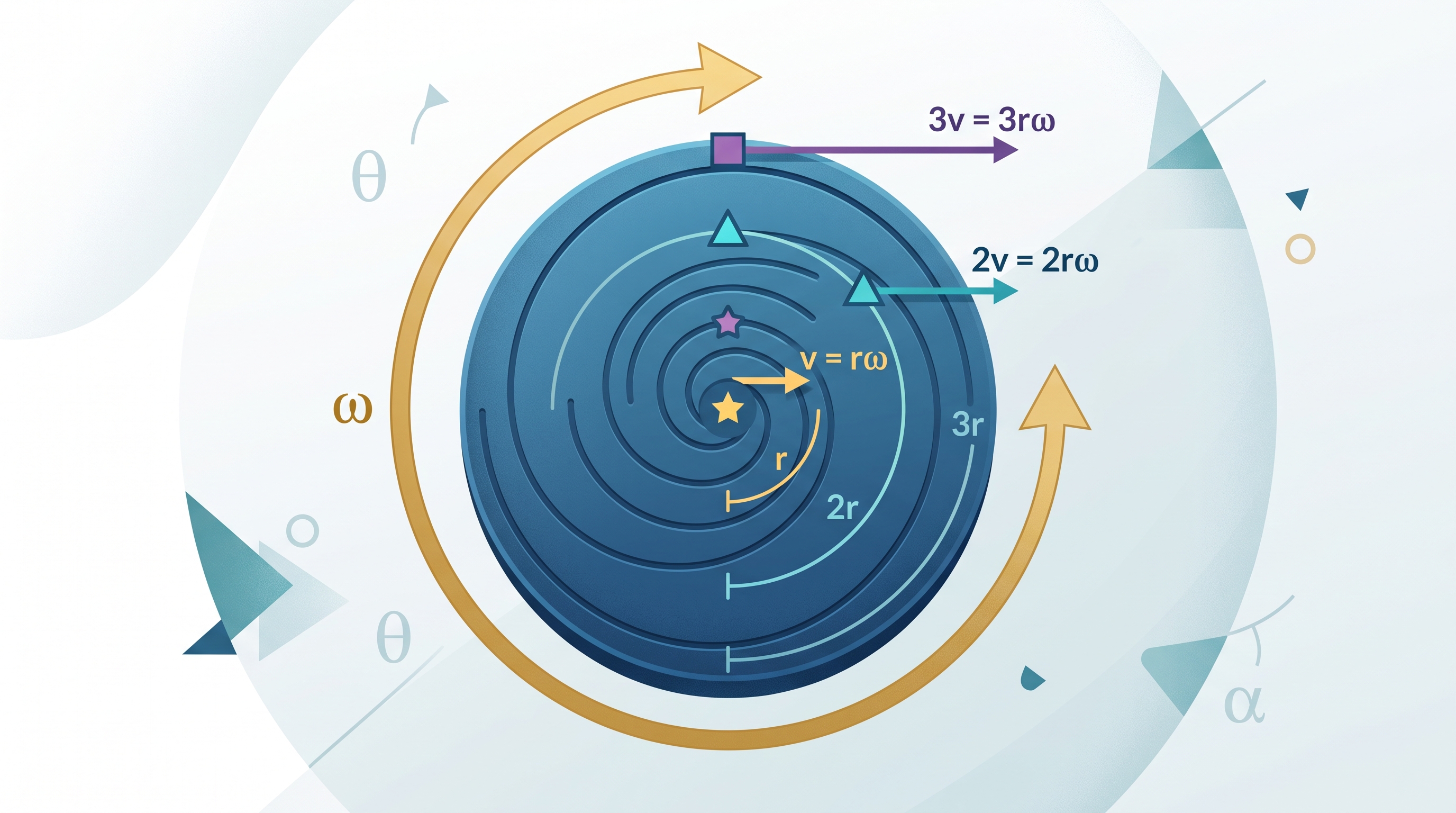
A rotating wheel can have one angular velocity but many different linear velocities: points farther from the axle travel faster because they sweep through the same angle along larger circular arcs.
5.2 Connecting Linear and Rotational Motion
A rotating wheel can have one angular velocity but many different linear velocities: points farther from the axle travel faster because they sweep through the same angle along larger circular arcs. The key question is: How does an angular description of motion become a linear description?
The geometry of a rotating rigid body
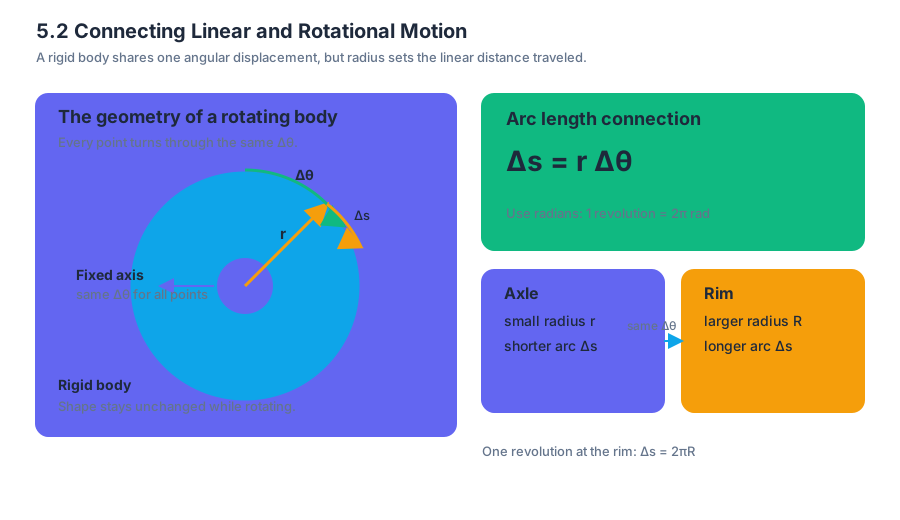
A rigid body is an object whose shape does not change as it moves. When it rotates about a fixed axis, every point turns through the same angular displacement $\Delta\theta$, but points at different distances $r$ from the axis travel different linear distances.
For a point at radius $r$, the arc length traveled is
$$ \Delta s = r\Delta\theta $$
where $\Delta\theta$ must be measured in radians. One complete revolution is $2\pi$ radians, so a point on the rim of radius $R$ travels $2\pi R$ during one revolution.
The equation explains why the axle and rim of a rotating wheel do not have the same linear speed. They share the same $\Delta\theta$, but the rim has a greater $r$.
From angular velocity to tangential velocity
Dividing $\Delta s=r\Delta\theta$ by the time interval $\Delta t$ produces the relationship between linear and angular velocity:
$$ v = r\omega $$
Here, $\omega$ is angular velocity and $v$ is the tangential velocity, the instantaneous linear velocity directed tangent to the circular path. The angular velocity is the same for every point on a rigid body rotating about one fixed axis, but $v$ increases directly with $r$.
For example, a disk rotates with $\omega=4.0\ \mathrm{rad/s}$. A point $0.10\ \mathrm{m}$ from the axis has
$$ v=(0.10\ \mathrm{m})(4.0\ \mathrm{rad/s}) =0.40\ \mathrm{m/s} $$
A point at $r=0.30\ \mathrm{m}$ has
$$ v=(0.30\ \mathrm{m})(4.0\ \mathrm{rad/s}) =1.2\ \mathrm{m/s} $$
Both points complete each revolution together, but the outer point covers three times as much distance in the same time.
Tangential acceleration
When the angular velocity changes, the tangential speed changes. Differentiating $v=r\omega$ with respect to time for a fixed radius gives
$$ a_t=r\alpha $$
where $a_t$ is the tangential component of acceleration and $\alpha$ is angular acceleration. This component changes the magnitude of the velocity, while the inward, or radial, component changes its direction.
A point twice as far from the axis has twice the tangential acceleration when the entire rigid body has the same $\alpha$. For $\alpha=3.0\ \mathrm{rad/s^2}$ and $r=0.25\ \mathrm{m}$,
$$ a_t=(0.25\ \mathrm{m})(3.0\ \mathrm{rad/s^2}) =0.75\ \mathrm{m/s^2} $$
The radius must be fixed for this direct conversion. If a point moves inward or outward, additional reasoning is required.
Connecting quantities across locations
For two points on the same rotating rigid body,
$$ \frac{v_1}{v_2}=\frac{r_1}{r_2} \qquad\text{and}\qquad \frac{a_{t1}}{a_{t2}}=\frac{r_1}{r_2} $$
provided both points share the same angular velocity or angular acceleration, respectively. This is a useful comparison strategy: do not calculate every quantity from scratch when proportional reasoning is enough.
Misconception check — “Every point on a wheel has the same velocity.” Every point has the same angular velocity, but not the same velocity vector. The speed depends on $r$, and the direction is tangent to the circle, so the direction also changes from point to point.
Rolling without slipping
A wheel rolls without slipping when the point of contact with the surface is instantaneously at rest relative to that surface. The center of mass moves forward while the wheel rotates, and the two motions are linked by
$$ v_{\mathrm{cm}}=R\omega $$
For changing motion, the corresponding relation is
$$ a_{\mathrm{cm}}=R\alpha $$
where $R$ is the wheel radius.
A bicycle wheel with $R=0.35\ \mathrm{m}$ rotating at $\omega=8.0\ \mathrm{rad/s}$ has center-of-mass speed
$$ v_{\mathrm{cm}}=(0.35\ \mathrm{m})(8.0\ \mathrm{rad/s}) =2.8\ \mathrm{m/s} $$
If the wheel slides while rotating, these equations no longer directly connect its center-of-mass motion to its rotation.
Key insight: In fixed-axis rotation, angular quantities describe the whole rigid body; linear quantities depend on the point’s distance from the axis.
AP skills in action
This topic explicitly develops 1.C: Create qualitative sketches of graphs that represent features of a model or the behavior of a physical system by recognizing that $v$ versus $r$ is a straight line through the origin with slope $\omega$.
It develops 2.A: Derive a symbolic expression from known quantities by selecting and following a logical mathematical pathway through $\Delta s=r\Delta\theta$, $v=r\omega$, and $a_t=r\alpha$. It develops 2.C: Compare physical quantities between two or more scenarios or at different times and locations in a single scenario through radius-based ratios, and 3.B: Apply an appropriate law, definition, theoretical relationship, or model to make a claim when using the rolling condition or any linear-angular relationship.
Retrieval check: A disk has constant $\omega$. If the radius changes from $r$ to $3r$, what happens to tangential speed? What happens to angular speed? The answer is $v\rightarrow3v$, while $\omega$ remains unchanged for the rigid disk.
Source Materials
- Review the Exam Updates (.pdf)
- AP Physics 1: Algebra-Based Course and Exam Description
- AP Physics 1 Course Overview
- AP Physics 1 Course at a Glance
- AP Physics 1 Course at a Glance Poster
- Adopt AP Physics 1: Algebra-Based
- AP Physics 1: Algebra-Based
- AP Physics 1: Algebra-Based
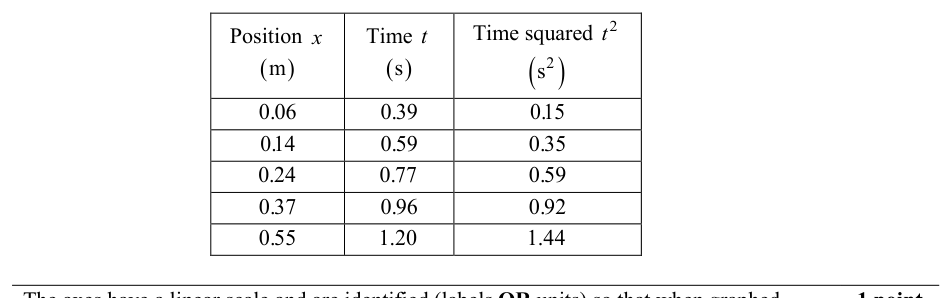
- (a)(ii) The axes have a linear scale and are identified (labels OR units) so that when graphed correctly, the data will span more than half of the horizontal and vertical axes
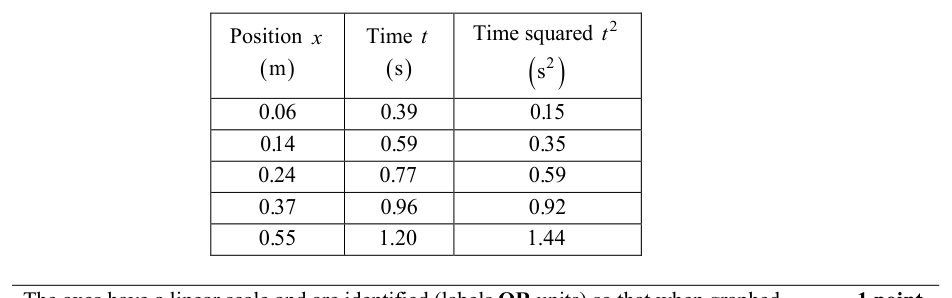
- (a)(ii) The axes have a linear scale and are identified (labels OR units) so that when graphed correctly, the data will span more than half of the horizontal and vertical axes