From the free course AP Physics 1 on Lykke
AP Practice 2
Key concepts: AP Physics exam structure and timing · Position-time and velocity-time representations · Newton’s second law and system analysis · Static friction and coefficient of friction · Kinetic (sliding) friction · Circular motion and centripetal acceleration · Tangential and net acceleration · Tension in strings with nonnegligible mass · Gravitational field near Earth’s surface · Motion and force modeling using equations and narratives
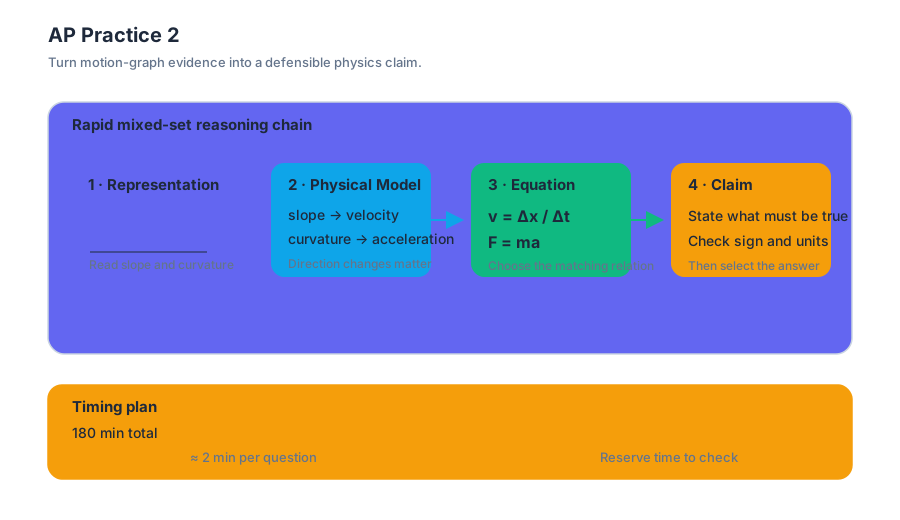
A motion graph is not merely a picture of motion: its slope, curvature, and changing direction make testable claims about velocity, acceleration, and force. A strong multiple-choice solution moves through a chain:
AP Practice 2
A motion graph is not merely a picture of motion: its slope, curvature, and changing direction make testable claims about velocity, acceleration, and force. A strong multiple-choice solution moves through a chain:
$$ \text{representation} \rightarrow \text{physical model} \rightarrow \text{equation} \rightarrow \text{claim} $$
The AP Physics 1 exam lasts $180\ \text{min}$. Beginning with the updated format, $5\ \text{min}$ are shifted from free response to multiple choice to accommodate two additional multiple-choice questions. Use this practice as a rapid mixed set: aim for about $2\ \text{min}$ per question, but reserve the final minutes to check units, signs, and whether your selected model matches the physical situation.
Question 1: Frame-by-frame motion
A camera records a cart moving along a straight track. The cart’s position is measured every $1.0\ \text{s}$:
| Time $t$ ($\text{s}$) | Position $x$ ($\text{m}$) |
|---|---|
| $0$ | $0$ |
| $1$ | $1$ |
| $2$ | $4$ |
| $3$ | $9$ |
Which description best matches the cart’s motion?
(A) Constant positive velocity
(B) Constant positive acceleration
(C) Constant negative acceleration
(D) Positive velocity that is decreasing
Answer: (B). The successive displacements are $1\ \text{m}$, $3\ \text{m}$, and $5\ \text{m}$ during equal time intervals. The displacement increases by equal amounts, so the velocity increases at a constant rate. The position-time data are consistent with
$$x=t^2,$$
which gives
$$v=\frac{dx}{dt}=2t$$
and
$$a=\frac{dv}{dt}=2\ \text{m/s}^2.$$
The crucial correction is that the displacements do not increase by equal amounts; their equal increases indicate constant acceleration. Choice (A) would require equal displacements in equal time intervals, while (D) predicts decreasing displacement.
Question 2: Newton’s second law and systems
A $4.0\ \text{kg}$ box is pulled horizontally by a rope with force $18\ \text{N}$. Kinetic friction opposes the motion with force $6.0\ \text{N}$. What is the box’s acceleration?
(A) $1.5\ \text{m/s}^2$
(B) $3.0\ \text{m/s}^2$
(C) $4.5\ \text{m/s}^2$
(D) $6.0\ \text{m/s}^2$
Answer: (B). Choose the box as the system and calculate the net horizontal force:
$$F_{\text{net}}=18\ \text{N}-6.0\ \text{N}=12\ \text{N}.$$
Newton’s second law gives
$$F_{\text{net}}=ma,$$
so
$$a=\frac{12\ \text{N}}{4.0\ \text{kg}}=3.0\ \text{m/s}^2.$$
This explicitly connects the equation to the physical situation. The unit check is decisive: $\text{N}/\text{kg}=\text{m/s}^2$.
Question 3: Static and kinetic friction
A student gradually increases the pull on a crate using a spring scale. The crate remains at rest until the scale reads $24\ \text{N}$, then begins sliding. While it slides at constant speed, the scale reads $18\ \text{N}$. The normal force is $80\ \text{N}$. Which pair gives the coefficients of friction?
(A) $\mu_s=0.23,\ \mu_k=0.30$
(B) $\mu_s=0.30,\ \mu_k=0.23$
(C) $\mu_s=0.30,\ \mu_k=0.30$
(D) $\mu_s=0.23,\ \mu_k=0.23$
Answer: (B). The largest static friction is the force just before slipping:
$$\mu_s=\frac{f_{s,\max}}{N}=\frac{24\ \text{N}}{80\ \text{N}}=0.30.$$
During sliding at constant speed, the net force is zero, so the kinetic friction equals the pulling force:
$$f_k=18\ \text{N},\qquad \mu_k=\frac{18\ \text{N}}{80\ \text{N}}=0.225\approx0.23.$$
Misconception check: static friction is not always $\mu_sN$; it adjusts up to a maximum. Slipping and sliding occur when the surfaces move relative to one another, so kinetic friction applies after motion begins.
Question 4: Circular motion
A car travels around a circular track. Its speed is increasing. Which statement correctly describes its acceleration?
(A) It points only tangent to the track.
(B) It points only toward the center.
(C) It has a centripetal component toward the center and a tangential component along the track.
(D) It is zero because the car follows a circular path.
Answer: (C). The centripetal acceleration points toward the center:
$$a_c=\frac{v^2}{r}.$$
Because the speed is increasing, the car also has tangential acceleration, directed tangent to the path. The net acceleration is the vector sum:
$$\vec a=\vec a_c+\vec a_t.$$
A changing velocity requires acceleration even if the car’s path is smooth and its speed were constant.
Examiner-reward reasoning and error review
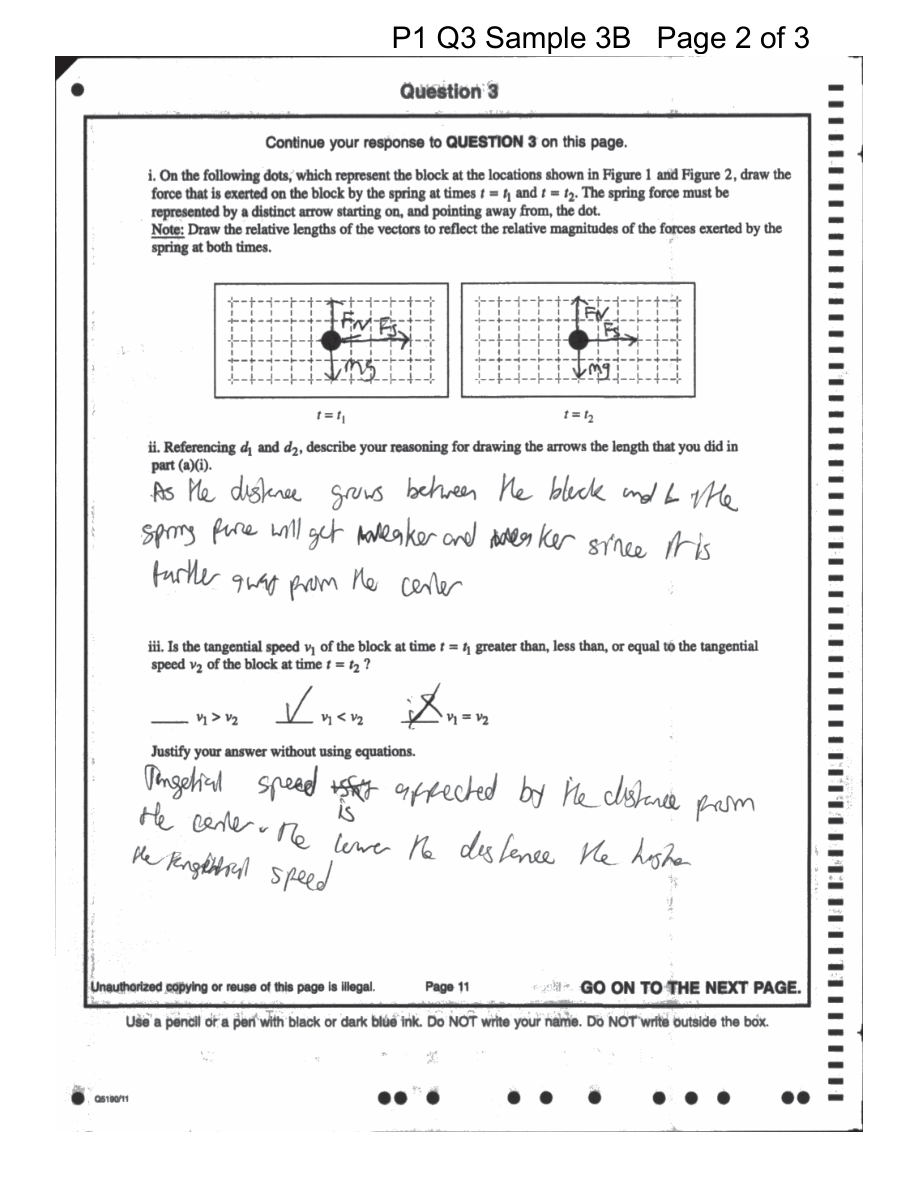
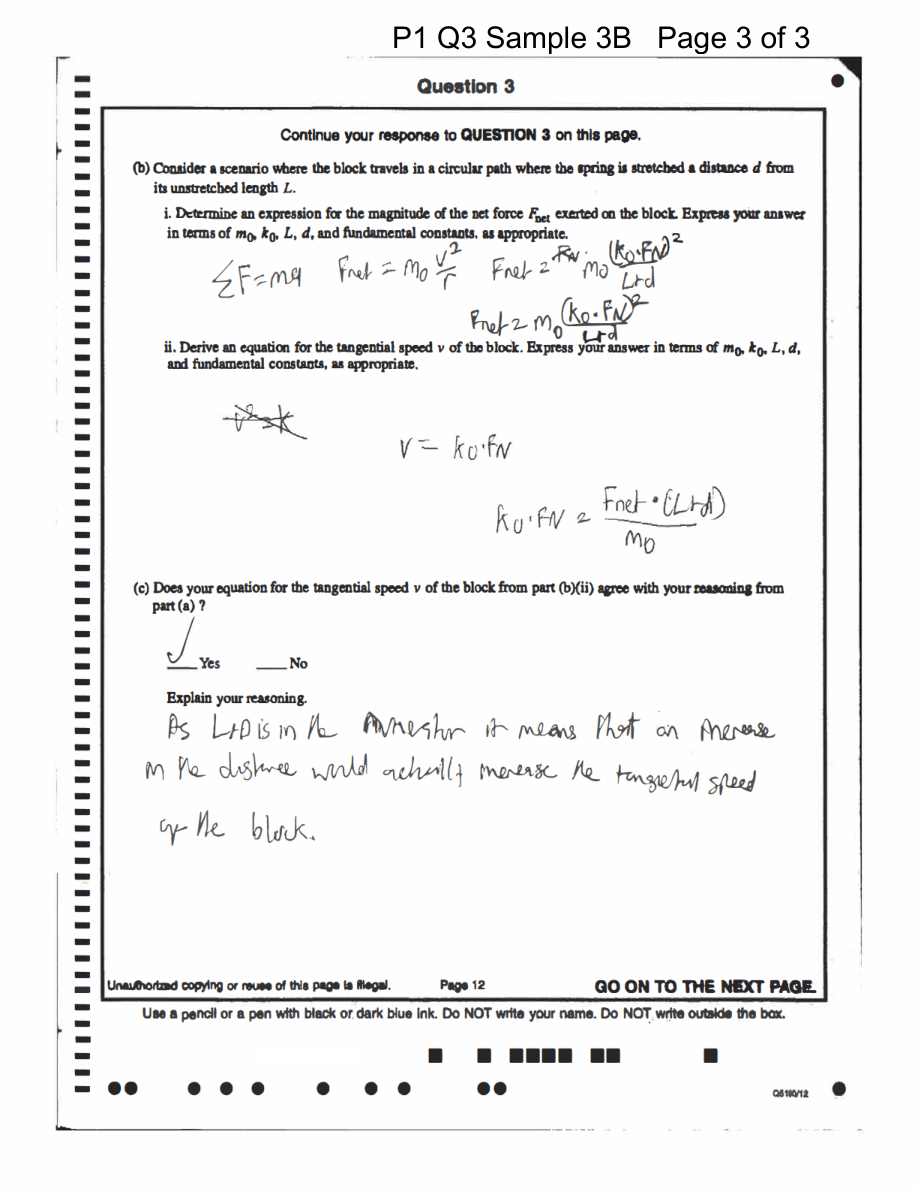
For multiple choice, the scored result is the selected answer, but the physics behind it should still satisfy Science Practice 1: Creating Representations, Science Practice 2: Mathematical Routines, and Science Practice 3: Scientific Questioning and Argumentation. In particular, 2.A: Deriving new expressions from fundamental principles supports using $F_{\text{net}}=ma$ and friction definitions; 2.D: Making predictions using functional dependence between variables supports reading how $x$, $v$, and $a$ change; 3.B: Making claims supports selecting the motion description; and 3.C: Supporting claims using evidence supports citing slopes, force differences, and acceleration components.
After checking your answers, classify every error: representation error, model-selection error, algebra or arithmetic error, unit error, or misconception. Re-solve without looking at the answer, then write one sentence of evidence—for example, “The increasing successive displacements show increasing velocity, not constant velocity.” That sentence turns a guessed choice into a defensible physical claim.

Source Materials
- Review the Exam Updates (.pdf)
- AP Physics 1: Algebra-Based Course and Exam Description
- AP Physics 1 Course Overview
- AP Physics 1 Course at a Glance
- AP Physics 1 Course at a Glance Poster
- Adopt AP Physics 1: Algebra-Based
- AP Physics 1: Algebra-Based
- AP Physics 1: Algebra-Based
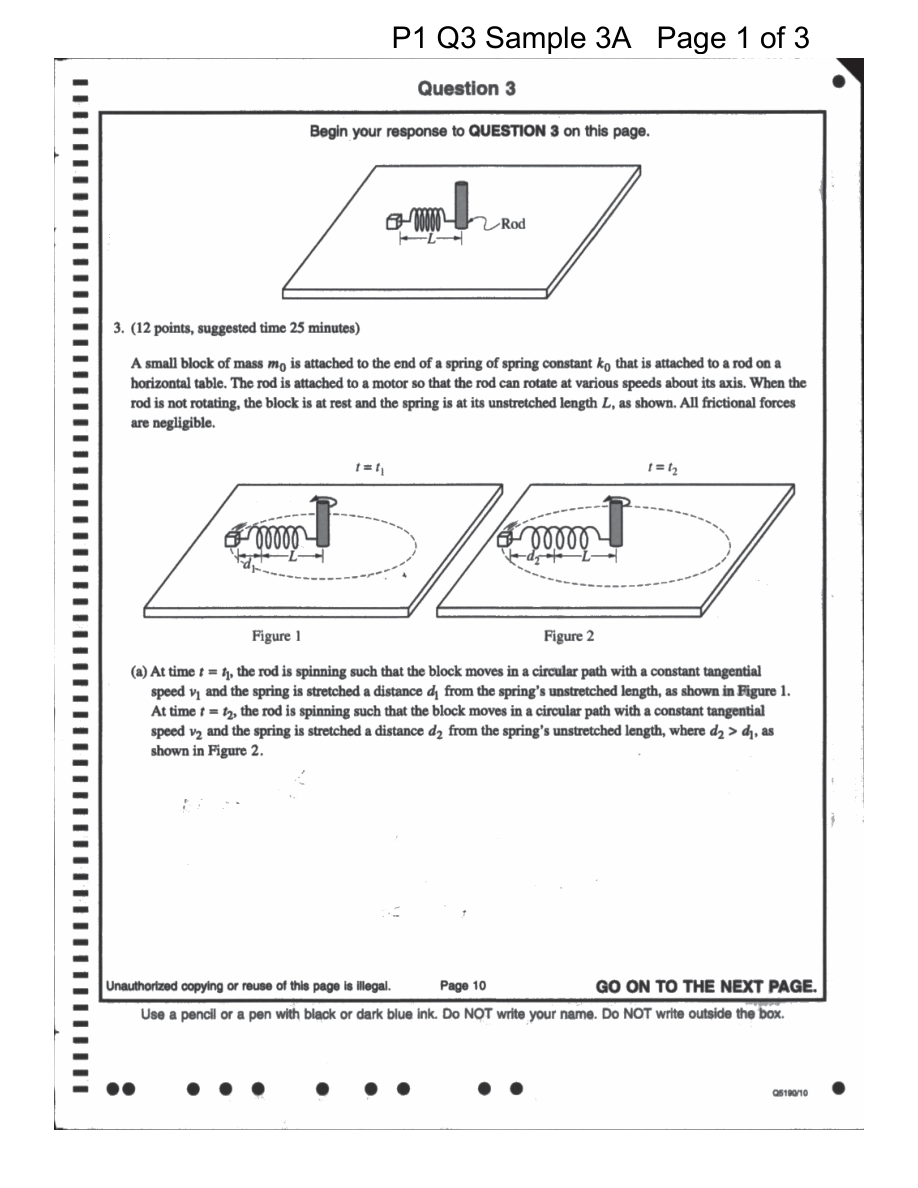
- Figure — Sample Responses Q3 (p. 6)
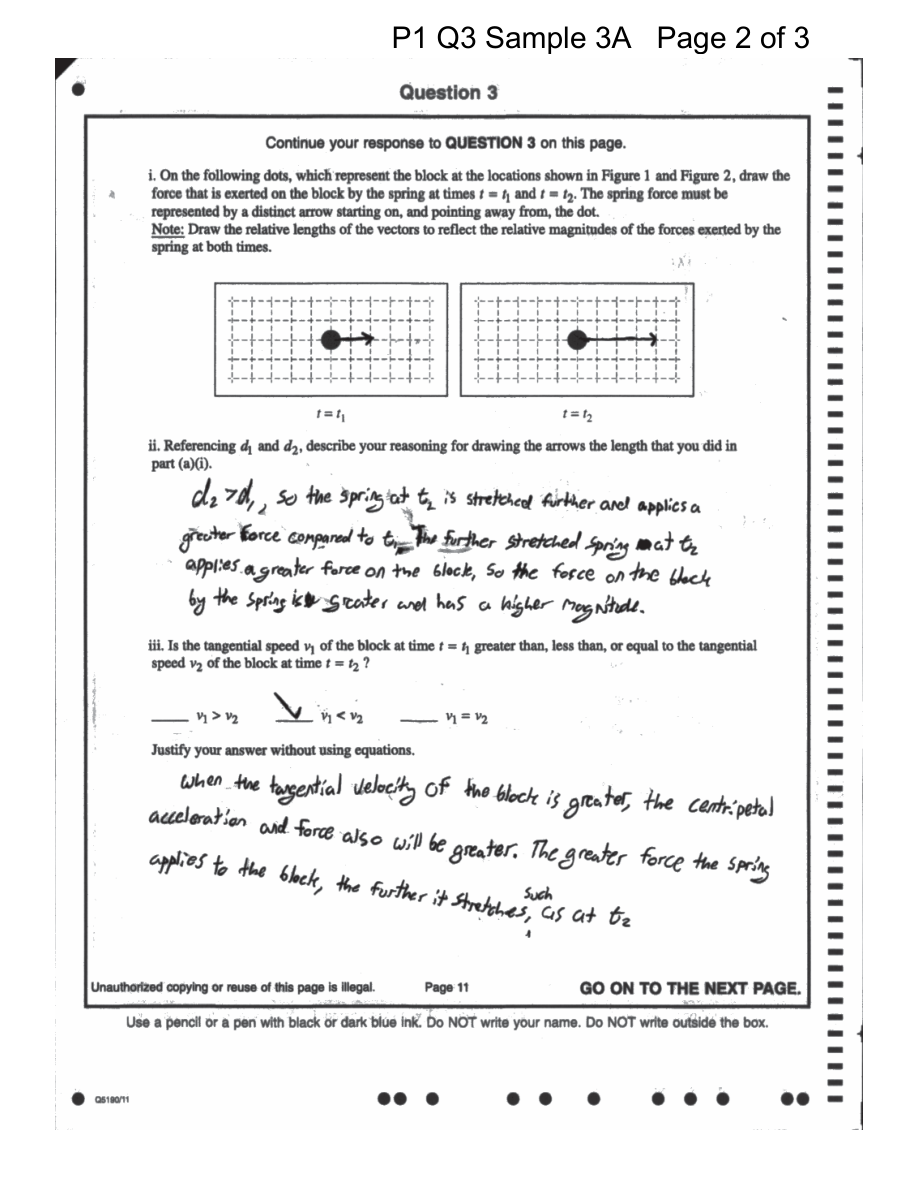
- Figure — Sample Responses Q3 (p. 7)
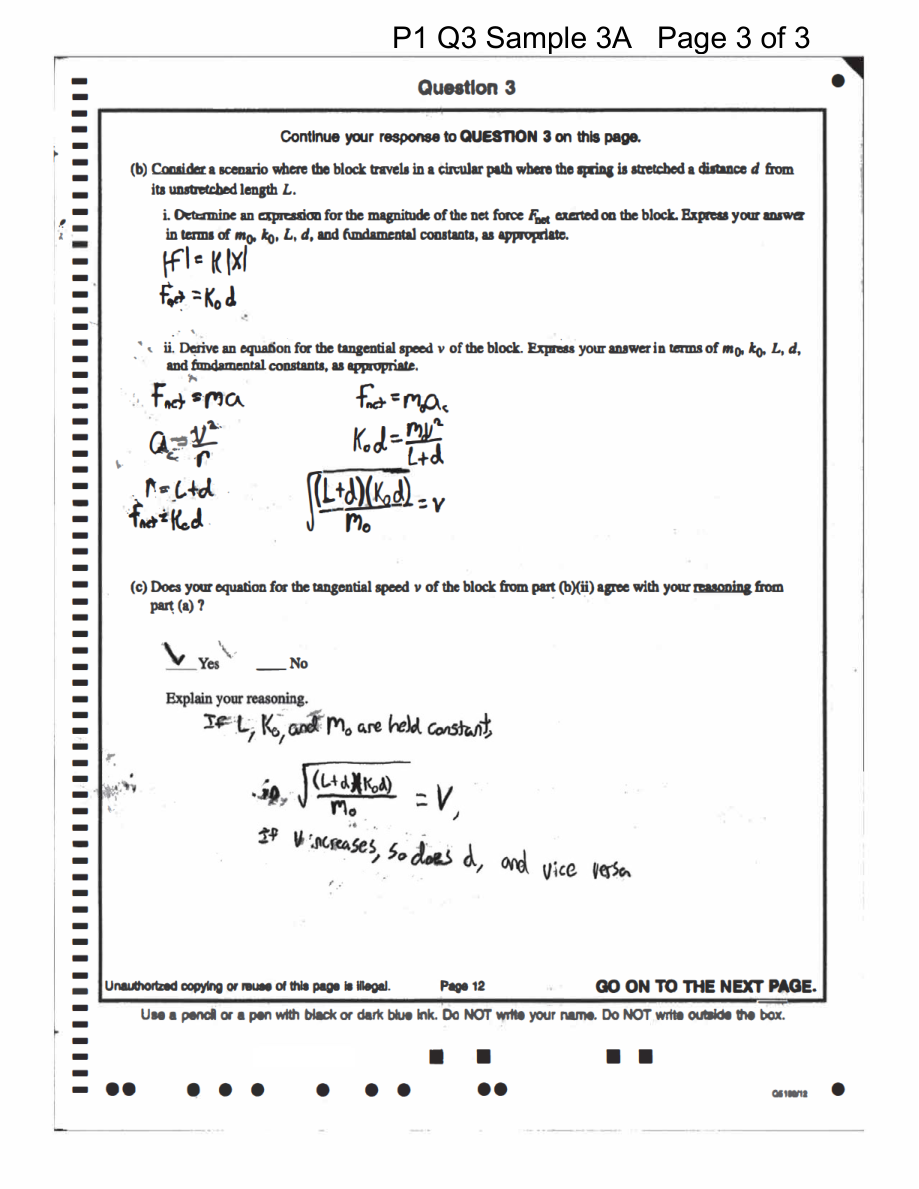
- Figure — Sample Responses Q3 (p. 8)
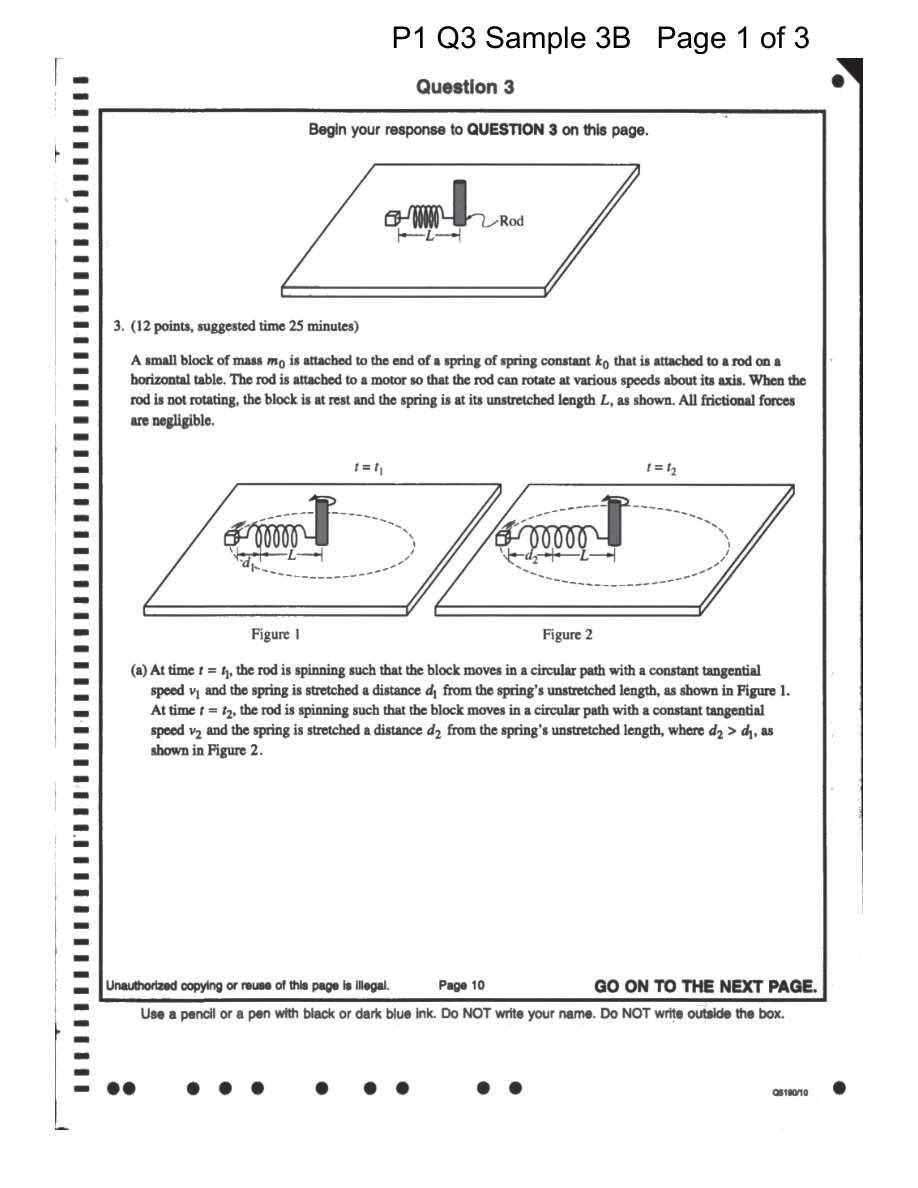
- Figure — Sample Responses Q3 (p. 9)