From the free course AP Physics 1 on Lykke
2.2 Forces and Free-Body Diagrams
Key concepts: Forces and translational dynamics · Free-body diagrams · Forces represented as vectors · Contact forces · Interatomic electric forces · Newton’s First Law · Systems and center of mass · Force diagrams for rigid systems and torque · Newton’s Third Law · Using physical principles and experimental evidence to support claims
A force is an interaction between two objects or systems that can change an object’s motion, shape, or internal condition. The key question is never “What force does this object have?” but “What other object or system is interacting with it?”
2.2 Forces and Free-Body Diagrams
A force is an interaction between two objects or systems that can change an object’s motion, shape, or internal condition. The key question is never “What force does this object have?” but “What other object or system is interacting with it?”
Forces are interactions, not properties
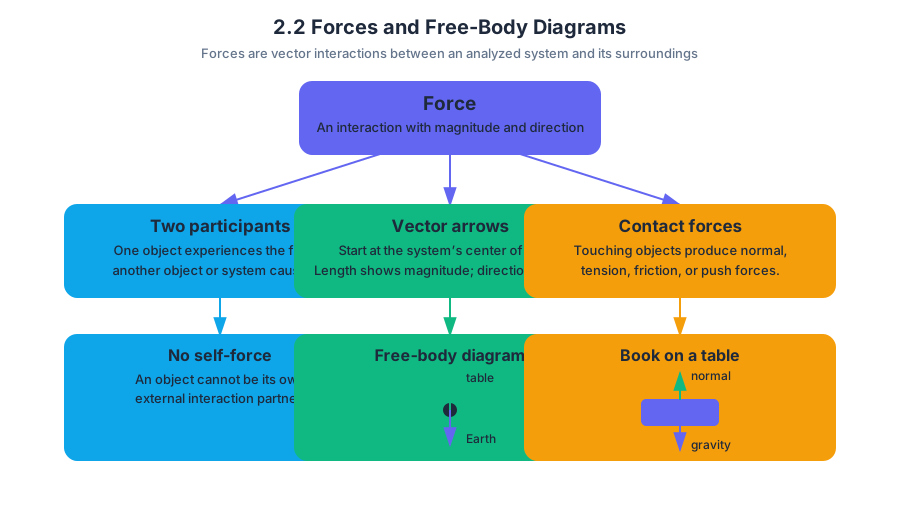
A force requires two participants: one object experiences the force, and another object or system causes it. A book resting on a table experiences an upward force from the table and a downward gravitational force from Earth. The book cannot exert a net force on itself, because an object cannot be its own external interaction partner.
Essential Knowledge 2.2.A.1: Forces are vector quantities that describe the interactions between objects or systems.
Because force is a vector, it has both magnitude and direction. A force arrow therefore needs a scale, an orientation, and a clear starting point. In a force analysis, arrows originate from the object or system being analyzed, usually represented by a dot at its center of mass.
Contact forces occur when objects or systems touch. The normal force from a floor, tension from a rope, friction from a surface, and the push from a hand are all contact forces. At the microscopic level, these are macroscopic effects of interatomic electric forces: atoms in the contacting materials resist being pushed into the same space, producing the observable interaction.
Essential Knowledge 2.2.A.1.i: A force exerted on an object or system is always due to the interaction of that object with another object or system.
Essential Knowledge 2.2.A.1.ii: An object or system cannot exert a net force on itself.
Essential Knowledge 2.2.A.2: Contact forces describe the interaction of an object or system touching another object or system and are macroscopic effects of interatomic electric forces.
Free-body diagrams isolate one system
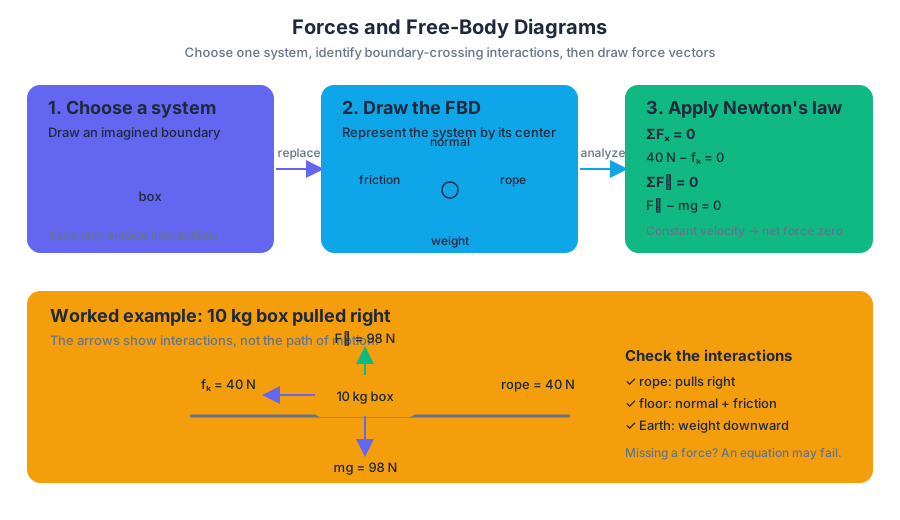
A free-body diagram is a deliberately simplified representation showing every force exerted on one chosen object or system by its environment. First draw or imagine the boundary around the system; then include only interactions that cross that boundary.
Learning Objective 2.2.B: Describe the forces exerted on an object or system using a free-body diagram.
The center-of-mass convention makes the diagram manageable: represent the system as a dot, treat its mass as concentrated at that point, and draw force vectors outward from the dot. The arrows do not show the path of motion; they show the directions of interactions.
Worked example: a box pulled across a rough floor. A $10\ \mathrm{kg}$ box is pulled horizontally to the right by a rope with force $40\ \mathrm{N}$. The floor exerts a normal force upward and kinetic friction to the left. If the box moves at constant velocity, Newton’s First Law requires zero net force:
$$\sum F_x = 0 \qquad \text{and} \qquad \sum F_y = 0.$$
Vertically, the upward normal force balances the downward weight:
$$F_N - mg = 0,$$
so
$$F_N = (10\ \mathrm{kg})(9.8\ \mathrm{m,s^{-2}})=98\ \mathrm{N}.$$
Horizontally, constant velocity means the friction force must be $40\ \mathrm{N}$ to the left:
$$40\ \mathrm{N}-f_k=0 \quad \Rightarrow \quad f_k=40\ \mathrm{N}.$$
The diagram supplies the equations. It also exposes missing interactions: if the rope is drawn but the floor’s normal force is omitted, the vertical equation cannot be justified.
Newton’s First Law: equilibrium is a force statement
Newton’s First Law states that if the net external force on a system is zero, its velocity remains constant. “Constant velocity” includes both staying at rest and moving in a straight line at unchanging speed:
$$\sum \vec{F}=0 \quad \Rightarrow \quad \vec{v}=\text{constant}.$$
This does not mean that no forces act. In the box example, several forces act, but they cancel vectorially. A stationary laptop is not force-free; its weight and the table’s normal force balance.
Misconception check — “Motion requires a net force.”
A net force is required to change velocity, not to maintain constant velocity. If friction disappeared from a sliding object, the object would continue moving with constant velocity rather than immediately stop.
Free-body diagrams versus force diagrams
A free-body diagram focuses on forces acting on a selected object or system and is used to determine translational motion. A force diagram can instead represent forces on a rigid system when analyzing the torques those forces exert. For torque, the location and line of action matter; for translational analysis, the vector sum is the central concern.
Do not place forces that the selected object exerts on its surroundings onto its own free-body diagram. Those forces belong on the diagram of the other object. This distinction prepares the paired-interaction reasoning required by Newton’s Third Law, which concerns action-reaction force pairs.
AP reasoning practices in this topic
The topic develops Science Practice 1: Creating Representations, especially Skill 1.A: Create representations of physical situations by constructing accurate free-body diagrams. It also uses Science Practice 2: Mathematical Routines, including Skill 2.D: Predict new values or factors of change of physical quantities using functional dependence between variables, such as predicting how acceleration changes when net force changes.
Students apply Skill 3.B: Apply an appropriate law, definition, theoretical relationship, or model to make a claim by using Newton’s First Law or Newton’s Second Law after drawing the diagram. They develop Skill 3.C: Justify or support a claim using evidence from experimental data, physical representations, or physical principles or laws by connecting a claim about equilibrium or acceleration to the arrows and equations.
Retrieval check
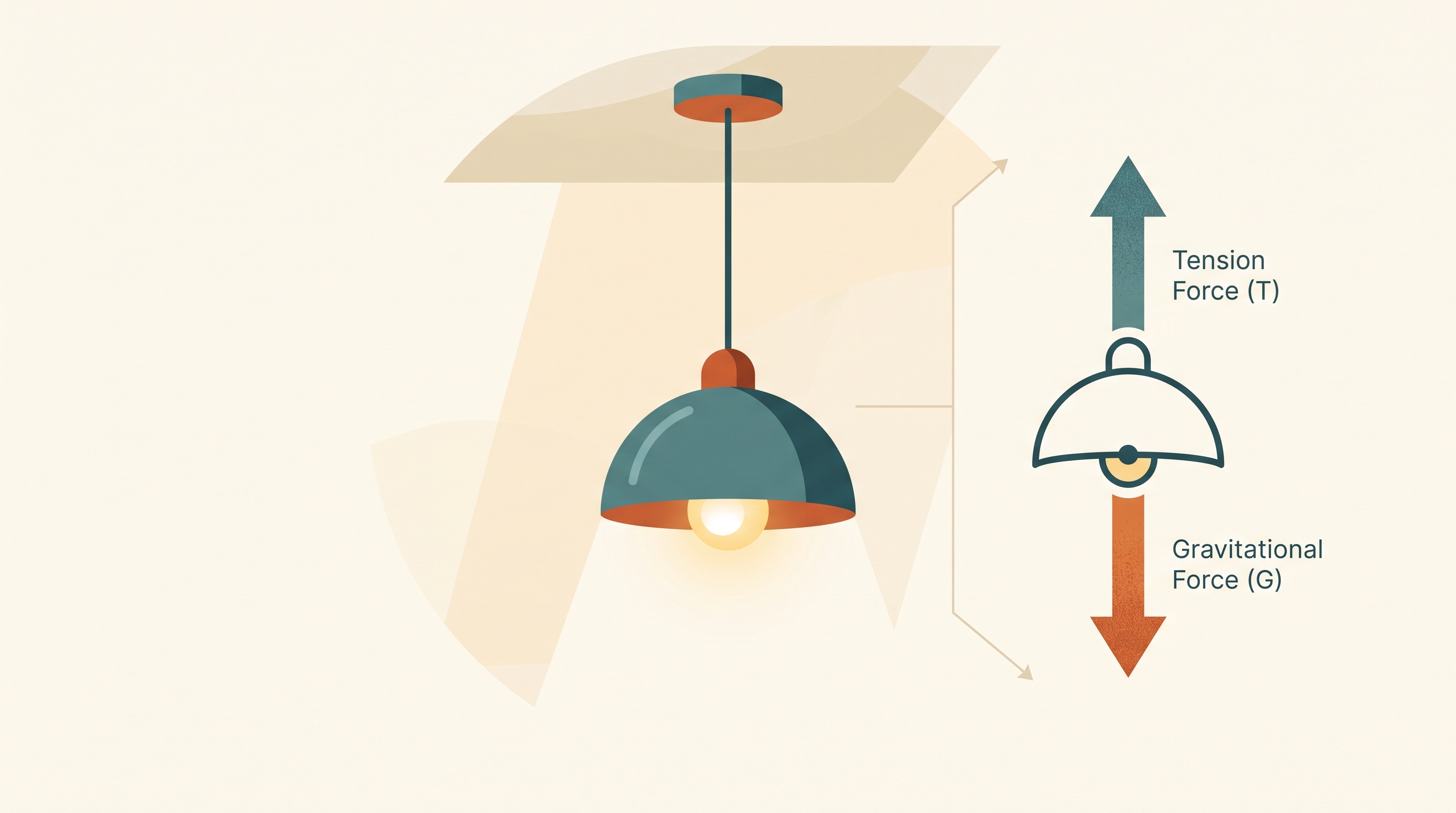
A lamp hangs motionless from a ceiling cord. Name the system, identify the forces on it, and state the net force. The correct reasoning is: for the lamp alone, the cord exerts an upward tension and Earth exerts a downward gravitational force; because the lamp is at rest, the vector sum is zero. The ceiling’s force on the cord is not placed on the lamp’s free-body diagram.
Source Materials
- Review the Exam Updates (.pdf)
- AP Physics 1: Algebra-Based Course and Exam Description
- AP Physics 1 Course Overview
- AP Physics 1 Course at a Glance
- AP Physics 1 Course at a Glance Poster
- Adopt AP Physics 1: Algebra-Based
- AP Physics 1: Algebra-Based
- AP Physics 1: Algebra-Based
- Figure — Free-Response Questions (p. 2)
- Figure — Free-Response Questions (p. 3)
- Figure — Free-Response Questions (p. 15)
- Figure — Scoring Statistics (p. 1)