From the free course AP Physics 1 on Lykke
AP Practice 1
Key concepts: AP Physics 1 Algebra-Based course framework effective Fall 2024 · AP course principles: evidence-based reasoning and independent thinking · Respectful debate and inclusion of diverse perspectives in AP classrooms · Multiple-choice exam structure updates · Inquiry-based laboratory instruction · Science practices in AP Physics 1 · Hands-on laboratory work and course time allocation · The eight AP Physics 1 course units · Multiple representations in kinematics · Momentum of rotating systems, oscillations, and fluids
AP Physics 1 is an algebra-based, introductory college-level physics course whose framework is effective beginning in Fall 2024. Its central question is not merely “Which equation applies?” but How can evidence, representations, mathematics, and physical principles justify a claim about what a system does?
AP Practice 1
AP Physics 1 is an algebra-based, introductory college-level physics course whose framework is effective beginning in Fall 2024. Its central question is not merely “Which equation applies?” but How can evidence, representations, mathematics, and physical principles justify a claim about what a system does?
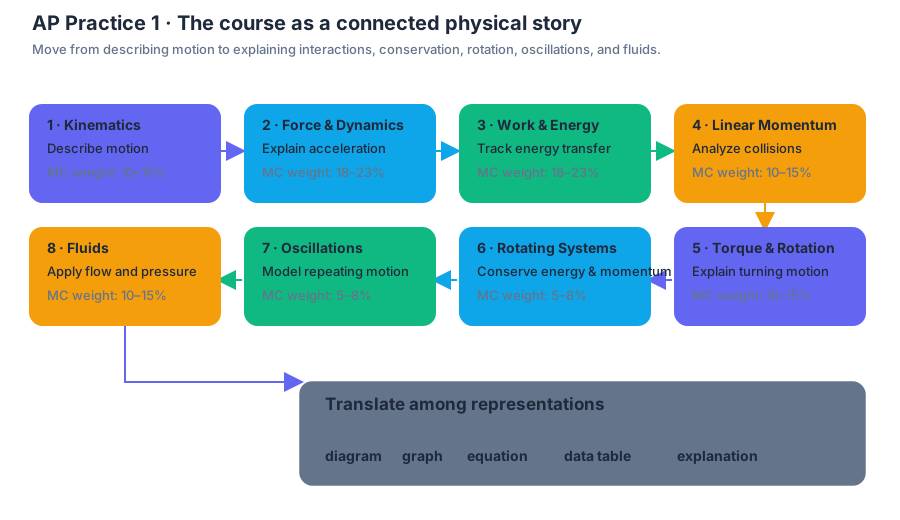
The course as a connected physical story
The framework contains eight units arranged from describing motion to analyzing interactions, conservation laws, rotation, oscillations, and fluids. Their multiple-choice exam weightings are:
| Unit | Multiple-choice exam weighting |
|---|---|
| Unit 1: Kinematics | $10$–$15%$ |
| Unit 2: Force and Translational Dynamics | $18$–$23%$ |
| Unit 3: Work, Energy, and Power | $18$–$23%$ |
| Unit 4: Linear Momentum | $10$–$15%$ |
| Unit 5: Torque and Rotational Dynamics | $10$–$15%$ |
| Unit 6: Energy and Momentum of Rotating Systems | $5$–$8%$ |
| Unit 7: Oscillations | $5$–$8%$ |
| Unit 8: Fluids | $10$–$15%$ |
The sequence is deliberately interconnected. A motion graph from Unit 1 can become evidence for a force model in Unit 2; the same system can then be analyzed using energy in Unit 3 or momentum in Unit 4. Physics becomes more powerful when a student can translate among a diagram, graph, equation, data table, and verbal explanation.
The complete science-practice framework
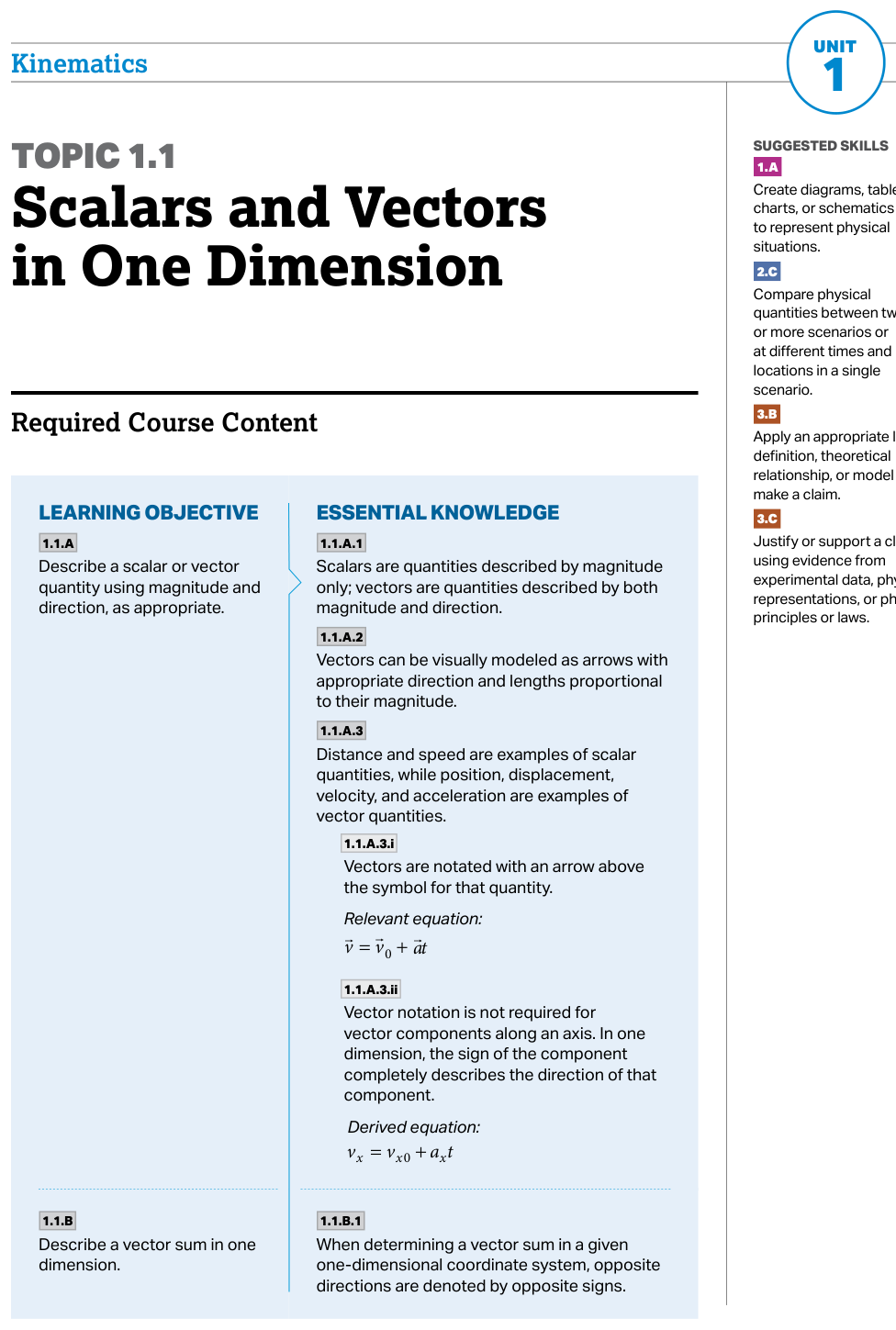
Creating Representations means building or interpreting a useful model of a physical situation: a motion map, free-body diagram, graph, energy bar chart, vector diagram, or symbolic equation. In Unit 1, for example, a position–time graph and a velocity–time graph represent the same motion differently; the slope of the first gives velocity, while the slope of the second gives acceleration.
Mathematical Routines means using algebraic, proportional, graphical, and computational reasoning to connect quantities. A strong solution does not begin with random substitution. It identifies the relationship, tracks units, rearranges symbolically when useful, and checks whether the result has a physically sensible direction and magnitude.
Scientific Questioning begins with a testable question about a system. Data Analysis then uses measurements, graphs, patterns, uncertainty, and comparisons to evaluate what happened. Theoretical Relationships connect the evidence to principles such as Newton’s laws, conservation of energy, or momentum. Argumentation completes the chain: a claim is supported by relevant evidence and justified through an appropriate physical relationship.
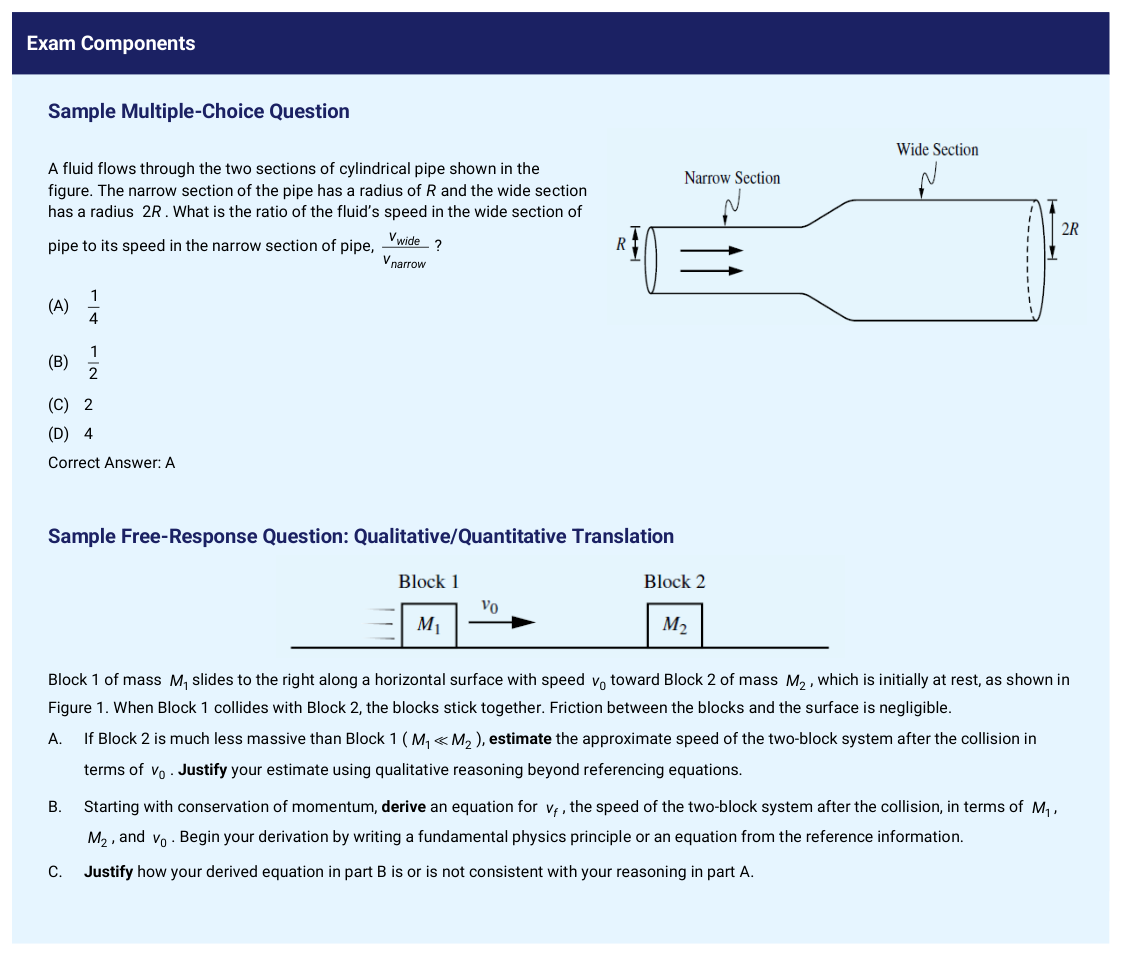
These practices appear both in laboratories and on the exam. A laboratory may ask students to design a procedure and defend a conclusion from data; a free-response problem may ask them to interpret a graph, derive a relationship, justify an experimental choice, or explain why a prediction agrees or disagrees with observations. Multiple-choice questions can test the same practices more briefly through a diagram, data set, graph, or claim.
Inquiry laboratory work
At least $25%$ of instructional time must involve hands-on laboratory work, and those laboratories should emphasize inquiry rather than following a recipe with predetermined results. Inquiry-based investigation gives students room to pose a question, choose measurements, identify variables, construct representations, analyze data, and defend a conclusion.
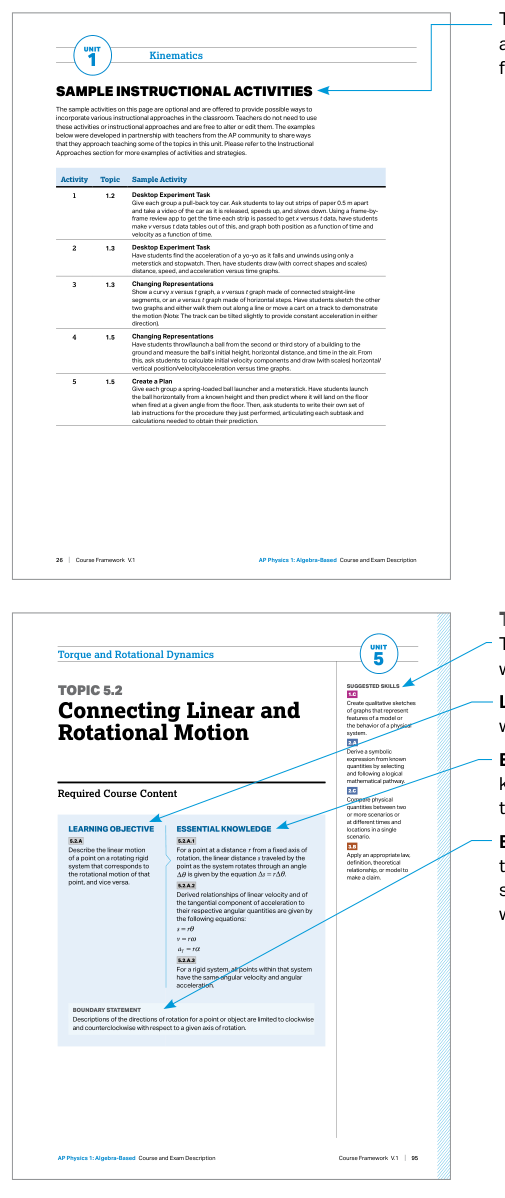
A simple motion investigation illustrates the idea. Students could measure a rock’s position with a stopwatch, or record a cart moving along a track. Tilting the track slightly provides approximately constant acceleration in either direction. Students might ask how position changes with time, collect repeated measurements, graph the results, and decide whether the data support a constant-acceleration model.
The important product is not just a numerical value for acceleration. It is an evidence-based argument: the measured pattern supports or does not support the proposed model because the graph, calculated quantities, and uncertainties show a particular relationship. Lab notebooks or portfolios preserve this reasoning.
Evidence, independence, and inclusion
AP classrooms are expected to encourage evidence-based reasoning and independent thinking. Students should evaluate arguments, not one another. Respectful disagreement is productive when it focuses on the model, evidence, assumptions, or logic rather than on a person.
Inclusion does not require students to adopt one cultural or political viewpoint. AP students are not expected to subscribe to one specific set of cultural or political values; they are expected to engage seriously with physical evidence and explain their reasoning clearly while respecting diverse perspectives.
Multiple-choice update and practice
Beginning with the May 2027 AP Physics 1 exam, the multiple-choice section changes from $40$ to $42$ questions, and its allotted time increases from the previous $80$ minutes. The practical consequence is still the same: use representations and proportional reasoning early, avoid becoming trapped in lengthy algebra, and return later to unusually time-consuming questions.
Original multiple-choice practice: A cart moves along a slightly tilted track. Its velocity changes from $+0.40\ \mathrm{m/s}$ to $+1.60\ \mathrm{m/s}$ during a $3.0\ \mathrm{s}$ interval. Which statement is necessarily supported by these measurements?
A. The cart’s acceleration is zero.
B. The cart travels in the negative direction.
C. The cart has a positive average acceleration.
D. The cart’s position remains constant.
Answer: C. Apply the definition of average acceleration:
$$ a_{\mathrm{avg}}=\frac{\Delta v}{\Delta t} =\frac{1.60-0.40}{3.0} =+0.40\ \mathrm{m/s^2}. $$
The positive sign establishes positive average acceleration. It does not by itself prove constant acceleration, and positive acceleration is not the same as positive velocity at every instant.
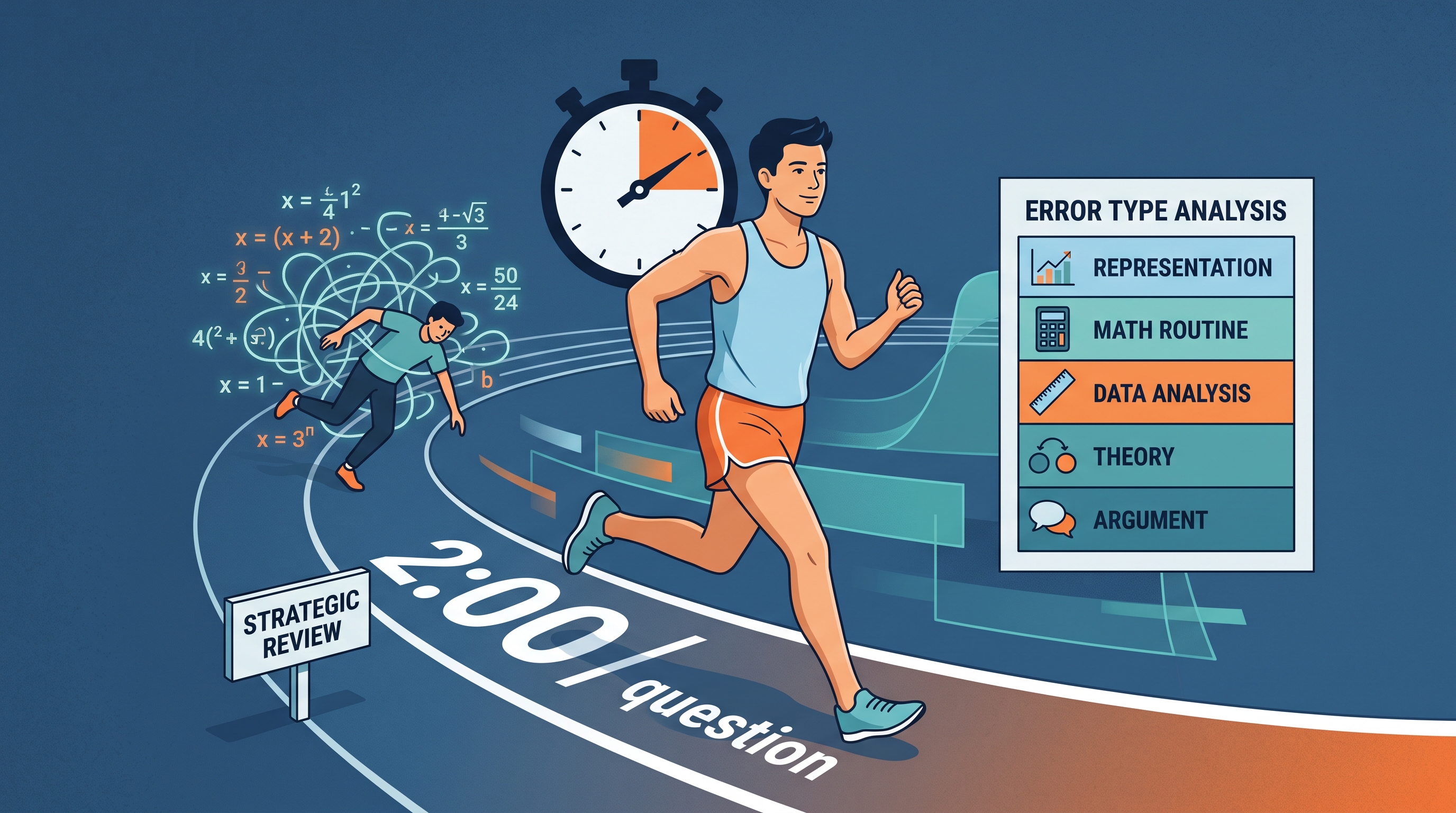
For a $42$-question section, a useful first-pass rhythm is roughly $2$ minutes per question, while preserving time to revisit marked items. After practice, classify each error as a representation error, mathematical-routine error, data-analysis error, theoretical-relationship error, or argumentation error; correcting the category is more valuable than merely memorizing the answer.


Source Materials
- Review the Exam Updates (.pdf)
- AP Physics 1: Algebra-Based Course and Exam Description
- AP Physics 1 Course Overview
- AP Physics 1 Course at a Glance
- AP Physics 1 Course at a Glance Poster
- Adopt AP Physics 1: Algebra-Based
- AP Physics 1: Algebra-Based
- AP Physics 1: Algebra-Based
- Course Framework V.1 | 20 AP Physics 1: Algebra-Based Course and Exam Description
- Course Framework V.1 | 27 AP Physics 1: Algebra-Based Course and Exam Description
- Course Framework V.1 | 32 AP Physics 1: Algebra-Based Course and Exam Description
- Educators: apcentral.collegeboard.org/courses/ap-physics-1 Students: apstudent.collegeboard.org/courses/ap-physics-1 © 2026 The College Board. (Updated Fall 2026)