AP World History: Modern
167 study materials · 45 sections
AP World History: Modern students working the current College Board Course and Exam Description, including first-time students with no prior background, plus teachers reviewing the page for CED alignment.; Teach every official CED unit and every numbered topic at topic granularity.; Develop every AP skill / science-practice code explicitly and by name.; Replace description with teaching: worked contextual examples, named misconceptions, and in-flow retrieval checks.; Build an exam-practice unit covering every task type on the current exam.
Course Sections
Course Framework, Skills and Reasoning Processes
Key concepts: Course framework alignment with college-level learning · Organization of content and skills into course units · Themes as cross-cutting concepts that build and spiral conceptual understanding · Historical thinking skills · Reasoning processes · Instructional approaches for developing historical thinking and reasoning · AP Course Audit and curriculum review · Progress Checks for assessing knowledge and skills · Alignment between classroom curriculum and AP Exam tasks · Unit planning and scaffolding
Historical study combines factual knowledge with disciplined actions: students must explain why developments occurred, evaluate evidence, connect regions, and construct defensible arguments. In AP World History: Modern, content knowledge matters because it gives students something meaningful to analyze—but the…
1.1 Developments in East Asia · 1.2 Developments in Dar al-Islam
Key concepts: Developments in East Asia · Developments in Dar al-Islam · Chinese cultural traditions and their effects on East Asia · Intellectual innovation in Dar al-Islam · Rise of Islamic states · Cultural developments and interactions · Spread of Hinduism and Buddhism into Southeast Asia · Fragmentation of the Abbasid Caliphate · Turkic-dominated Islamic political entities · Continuity, innovation, and cultural transfers
Between approximately $1200$ and $1450$, two large cultural worlds changed through a similar process: older traditions remained powerful, but they were repeatedly adapted to new political and social conditions.
1.3 Developments in South and Southeast Asia · 1.4 State Building in the Americas
Key concepts: State building · Governance · Continuity and change · Causation · South and Southeast Asian states · Song Dynasty of China · Confucianism · Imperial bureaucracy · State systems in the Americas · State systems in Africa
Between c. 1200 and c. 1450, states in South and Southeast Asia built power by adapting older religious traditions to new political circumstances, while American societies created powerful urban and regional systems without reproducing Eurasian models.
1.5 State Building in Africa · 1.6 Developments in Europe
Key concepts: State building in Ethiopia · Swahili Coast city-states and merchant settlement · Spread of Islam across Eurasia and Africa · Ottoman Empire in Southern Europe, the Middle East, and North Africa · Safavid Empire in the Middle East · Industrialization in Europe · European colonialism in Africa · Civilizing mission and Social Darwinism · Railways and new communication technologies in Africa · European-Muslim interactions and exploration
A state can grow from two very different foundations: Ethiopia built political authority around a durable Christian kingdom, while the Swahili Coast developed through commercially connected city-states whose power depended on merchants, ports, and Indian Ocean exchange.
1.7 Comparison in the Period from c. 1200 to c. 1450
Key concepts: Political fragmentation in medieval Europe · Serfdom · Monarchical power and military assistance · Mongol expansion and its effects on Europe · Cross-cultural interactions · Diffusion of technologies through exchange networks · Long-distance trade routes and environmental knowledge · Diffusion of crops and pathogens · Bubonic plague · Social hierarchy and sovereign authority in Japan
Between c. 1200 and c. 1450, Europe’s fragmented political structure made coordinated responses to external threats difficult, while expanding Afro-Eurasian exchange networks connected societies through technologies, environmental knowledge, crops, and disease.
2.1 The Silk Roads · 2.2 The Mongol Empire and the Making of the Modern World
Key concepts: The Silk Roads · The Mongol Empire and the Making of the Modern World · Cultural developments and interactions · Governance and state formation · Economic systems and exchange · Social interactions and organization · Technology and innovation · Turkic-dominated political entities · New Islamic political entities · Production, exchange, and consumption of goods and services
A caravan carrying silk from China to Central Asia was not simply moving merchandise: it was moving languages, technologies, religions, diseases, and political influence across thousands of kilometers.
2.3 Exchange in the Indian Ocean · 2.4 Trans-Saharan Trade Routes
Key concepts: Indian Ocean trade networks · Trans-Saharan trade · Swahili Coast · Gujarat · Sultanate of Malacca · Muslim–European rivalry in the Indian Ocean · Diasporic merchant communities · Interregional trade in luxury goods · Transportation innovations · Chinese textiles, porcelain, iron, and steel production
After $1200$, Indian Ocean and trans-Saharan commerce expanded not because entirely new routes suddenly appeared, but because older routes became more efficient, profitable, and politically important.
2.5 Cultural Consequences of Connectivity · 2.6 Environmental Consequences of Connectivity
Key concepts: Cultural consequences of connectivity · Environmental consequences of connectivity · Authorial audience · Neighbors · Tatar ruler · Audience identification (Skill 2)
A trade route does more than move silk, salt, or gold: it moves habits of thought. When merchants, pilgrims, soldiers, and migrants cross long distances, they carry religions, languages, artistic styles, technologies, crops, and diseases with them.
2.7 Comparison of Economic Exchange
Why did similar goods travel through very different systems? Between approximately $1200$ and $1450$, merchants connected Afro-Eurasia through the Silk Roads, Indian Ocean routes, and Trans-Saharan networks.
3.1 Empires Expand · 3.2 Empires: Administration
Key concepts: Expanding European maritime empires · Resistance to European imperial expansion · Failure to modernize · European industrial power · Falling behind Europe industrially
Between 1450 and 1750, the Ottoman Empire faced a new kind of rival: European states that could project power across oceans, seize strategic ports, and connect military expansion to long-distance commerce.
3.3 Empires: Belief Systems · 3.4 Comparison in Land-Based Empires
Key concepts: Land-Based Empires · Empires: Belief Systems · Comparison in Land-Based Empires · Empires: Administration · Empires Expand · Governance (GOV) · Causation · Continuity and Change · Devshirme system in the Ottoman Empire · Religious ideas, art, and monumental architecture as tools of political legitimacy
Between c. 1450 and c. 1750, rulers did not rely on force alone to govern enormous territories.
4.1 Technological Innovations from 1450 to 1750 · 4.2 Exploration: Causes and Events from 1450 to 1750
Key concepts: Technological innovations from 1450 to 1750 · Exploration causes and events from 1450 to 1750 · Maritime technology and navigational skills · China’s naval expeditions in the Indian Ocean basin · Western European geographical knowledge and mapmaking · Technological change and human development · Intended and unintended consequences of technological advances · Causation in historical analysis · Transoceanic interconnections · The TEC theme: technology and innovation
Explain and apply 4.1 Technological Innovations from 1450 to 1750 · 4.2 Exploration: Causes and Events from 1450 to 1750.
4.3 Columbian Exchange · 4.4 Maritime Empires Established
Key concepts: Columbian Exchange · Maritime empires · European maritime expansion · Navigation and maritime technology · Christopher Columbus and Spanish voyages · Atlantic demographic, cultural, and social change · Exchange of pathogens, people, and plants · Mercantilism · Colonial raw-material extraction and manufacturing · Plantation economies and the development of a global economy
A voyage intended to reach India instead connected two previously separated biological worlds. When Spain sent Christopher Columbus westward in 1492, the expedition reached the Americas rather than Asia; the resulting movement of plants, animals, people, diseases, and cultural practices became known as the…
4.5 Maritime Empires Maintained and Developed · 4.6 Internal and External Challenges to State Power from 1450 to 1750
Key concepts: Governance and state power · Internal and external factors in state formation, expansion, and decline · Administrative institutions, policies, and procedures used to maintain order · Recruitment and use of bureaucratic elites and military professionals · Maritime empires · The Ottoman devshirme system · Salaried samurai in Japan · Ming China · Tokugawa Japan · The Protestant and Catholic reformations and the growth of Christianity
Explain and apply 4.5 Maritime Empires Maintained and Developed · 4.6 Internal and External Challenges to State Power from 1450 to 1750.
4.7 Changing Social Hierarchies from 1450 to 1750 · 4.8 Continuity and Change from 1450 to 1750
Key concepts: Changing social hierarchies from 1450 to 1750 · Continuity and change over time · Social interactions and organization · Cultural developments and interactions · Demographic change in Africa · Trade in enslaved persons · Differential treatment of social and religious groups · Religious encounters and their political, social, and cultural effects · Global economic interconnections · State policies limiting European political influence
Explain and apply 4.7 Changing Social Hierarchies from 1450 to 1750 · 4.8 Continuity and Change from 1450 to 1750.
5.1 The Enlightenment · 5.2 Nationalism and Revolutions from 1750 to 1900
Key concepts: Enlightenment thought · Nationalism · Revolutions and rebellions from 1750 to 1900 · Democratic ideals · Questioning established traditions · Commonality based on language, religion, social customs, and territory · Government use of nationalism to foster unity · Colonial resistance in the Americas · Causes and effects of revolutions · Historical development of states and empires
Between approximately 1750 and 1900, political authority faced a powerful double challenge: people questioned why governments should rule, and they increasingly asked who belonged to the political community.
5.3 Industrial Revolution Begins · 5.4 Industrialization Spreads from 1750 to 1900
Key concepts: Industrial Revolution · Industrial capitalism · Industrialization and change, continuity, and causation from 1750 to 1900 · First Industrial Revolution in England · Second Industrial Revolution · Urbanization · Factory labor and working-class family economies · Environmental effects of industrialization · Standards of living · Historical comparison and contextualization
The Industrial Revolution was the shift from hand production and household workshops toward mechanized production in factories, beginning in England during the period $c. 1750$ to $c.
5.5 Technology of the Industrial Age · 5.6 Industrialization: Government’s Role from 1750 to 1900
Key concepts: Industrialization from 1750 to 1900 · Technology of the Industrial Age · The spread of industrialization · Government’s role in industrialization · Causation in historical developments · Continuity and change over time · Interactions between humans and the environment · Economic developments during industrialization
Industrialization became transformative when machines stopped being isolated inventions and became parts of systems: factories needed power, railways needed steel, telegraphs needed governments and capital, and expanding states increasingly shaped who received the benefits.
5.7 Economic Developments and Innovations in the Industrial Age · 5.8 Reactions to the Industrial Economy from 1750 to 1900
Key concepts: Technological innovation and increased efficiency, comfort, and security · Diffusion of technology through cross-cultural interactions · Innovations in ship design and navigation, including the lateen sail and compass · Industrialization and the global nature of trade and production · Large-scale manufacturing and the production of consumer goods · Industrial capitalism and its social and economic effects · The emergence of new social classes, including the middle class · Government and organizational responses to industrial capitalism · Calls for social, economic, and cultural changes in industrial societies · The demand for factory raw materials and increased food supplies
Explain and apply 5.7 Economic Developments and Innovations in the Industrial Age · 5.8 Reactions to the Industrial Economy from 1750 to 1900.
5.9 Society and the Industrial Age · 5.10 Continuity and Change in the Industrial Age
Key concepts: Society and the Industrial Age · Continuity and change in the Industrial Age · Industrialization’s impact on cities · Social change in terms of race, class, gender, and religion · Political and social changes in the 20th century · Women’s labor activism and political organization · Historical contextualization (skill 4.B) · Industrial Revolution transportation and communication technologies · Continuities involving caste, Hindu states, and Confucianism · Industrialization’s effects on quality of life
Industrialization did more than increase production: it reorganized where people lived, how they worked, and how societies defined race, class, gender, and religion. The central historical question is therefore not simply what changed, but which social structures changed, which persisted, and why.
6.1 Rationales for Imperialism from 1750 to 1900 · 6.2 State Expansion from 1750 to 1900
Key concepts: Rationales for imperialism from 1750 to 1900 · State expansion from 1750 to 1900 · Ideologies contributing to imperialism · Governance and the exercise of political power · Religious ideas used to legitimize rule · Art and monumental architecture as tools of political legitimacy · Mughal zamindar tax collection · Ottoman tax farming · Cultural developments and interactions under imperialism · Ashanti resistance to imperial expansion in West Africa
Imperialism was not driven by one motive. From $1750$ to $1900$, states expanded through a combination of political competition, economic goals, strategic calculation, and ideologies that presented domination as justified or even beneficial.
6.3 Indigenous Responses to State Expansion from 1750 to 1900 · 6.4 Global Economic Development from 1750 to 1900
Key concepts: Indigenous responses to state expansion · State expansion from 1750 to 1900 · Rationales for imperialism · Industrialization · Global economic development · Economic systems and global trade · Migration · Bureaucracy and state rule · Nationalism and direct resistance · Karl Marx, socialism, and communism
Explain and apply 6.3 Indigenous Responses to State Expansion from 1750 to 1900 · 6.4 Global Economic Development from 1750 to 1900.
6.5 Economic Imperialism from 1750 to 1900 · 6.6 Causes of Migration in an Interconnected World
Key concepts: Economic imperialism · Causes of migration in an interconnected world · Consequences of industrialization, c. 1750–1900 · Commodity trade and unequal economic relationships · European economic influence in China · European joint-stock companies and imperial control in Asia · State intervention in economic life · Migration of Europeans to the Americas · Government regulation of immigrants · The relationship between economic pressures and social or gender changes
A country could dominate another economy without formally annexing its territory. Between $1750$ and $1900$, European merchants and states used economic imperialism—the extension of economic power over another society’s trade, markets, labor, or resources—to make distant regions serve European commercial interests.
6.7 Effects of Migration · 6.8 Causation in the Imperial Age
Key concepts: Effects of migration · Causation in the Imperial Age · Historical reasoning · Explaining multiple themes or perspectives to explore complexity · Imperial examination system · Mandate of Heaven · Confucian scholars · Buddhist monks · Neo-Confucianism · Social prestige of scholars
Migration transforms more than population maps: it creates diasporas, rearranges labor systems, and produces new political and racial hierarchies. In the imperial age, the central historical question is not simply who moved, but how movement changed both the migrants’ lives and the societies that recruited, ruled,…
7.1 Shifting Power After 1900 · 7.2 Causes of World War I
Key concepts: The rise of new global powers after 1900 · The decline of established empires, including the Ottoman Empire and Qing China · Imperialist expansion and competition for resources · Nationalism and territorial or regional conflicts · The alliance system and its role in creating global conflict · The relative significance of multiple causes of World War I
By 1900, global power was becoming more competitive: the United States, Russia, and Japan expanded their influence while older empires such as the Ottoman Empire and Qing China struggled to survive.
7.3 Conducting World War I · 7.4 The Economy in the Interwar Period
Key concepts: Militarism · Nationalism · Alliance systems · Territorial and regional conflicts · Global escalation of local tensions · Colonial participation in World War I · Anti-colonial critique of European imperialism · Interwar economic systems · The New Deal · Fascist corporatism and Nazi militarism
World War I became global because a local crisis moved through an interconnected political system: territorial disputes, regional conflicts, intense nationalism, and a flawed alliance system transformed one confrontation into a war involving empires across Europe, Africa, Asia, and the Middle East.
7.5 Unresolved Tensions After World War I · 7.6 Causes of World War II
Key concepts: Unresolved tensions after World War I · Causes of World War II · Point of view, purpose, historical situation, and audience · Continuity and change · Mexican Revolution · Russian Revolution · Imperialism · Territorial and regional conflicts · Alliance systems · Nationalism
World War II did not begin from a single spark. It emerged when the unresolved political debts of World War I met economic crisis, imperial expansion, territorial disputes, weak international institutions, and aggressive nationalism.
7.7 Conducting World War II · 7.8 Mass Atrocities After 1900
Key concepts: Conducting World War II · Mass atrocities after 1900 · The Holocaust · Genocide and ethnic violence · Xenophobic nationalism · Extremist groups gaining power · Colonial consequences of World War II · Armenians in the Ottoman Empire · Cambodia · Consequences of mass atrocities
World War II was conducted not only through armies and battlefields but also through air power, occupation, imperial conquest, and ideological persecution. The bombing of Pearl Harbor in December 1941 brought the United States directly into the war, while Japan’s invasions across Asia reshaped European colonial…
7.9 Causation in Global Conflict
Key concepts: Causation in Global Conflict · Contextualization · Evidence
A global war rarely has a single cause: causation means explaining how several conditions, decisions, and developments combined to produce an outcome, while distinguishing long-term pressures from immediate triggers.
8.1 Setting the Stage for the Cold War and Decolonization · 8.2 The Cold War
Key concepts: Cold War · Decolonization · Global balance of power · Self-government and nationalism · Revolutionary movements · Political and social order · Land-based empires · Military alliances · Collapse of the Soviet Union · Colonial metropole
After 1945, the world was no longer organized around the old European imperial balance: World War II had weakened European empires, elevated the United States and Soviet Union, and intensified demands for national self-government.
8.3 Effects of the Cold War · 8.4 Spread of Communism After 1900
Key concepts: Effects of the Cold War · Spread of communism after 1900 · The ideological struggle between the United States and the Soviet Union · The emergence of the United States and USSR as superpowers after World War II · Military alliances during the Cold War · The nuclear weapons buildup · Proxy wars in the developing world · Cold War effects in the Eastern and Western Hemispheres · Sukarno in Indonesia · Kwame Nkrumah in Ghana
The Cold War transformed an ideological disagreement between the democratic United States and the authoritarian communist Soviet Union into a worldwide struggle over political influence, military security, and the future of postcolonial states.
8.5 Decolonization After 1900 · 8.6 Newly Independent States
Key concepts: Decolonization after 1900 · Newly independent states · African nationalism · Anti-imperialism · Postcolonial states · Nonviolent and violent anticolonial movements · The impact of the World Wars on European imperial powers · Economic globalization and globally competitive corporations · Comparison of historical developments across regions · Historical evidence and source limitations
African independence was not a single event but a two-stage transformation: decolonization ended formal imperial rule, while newly independent states had to build political and economic systems after European authority withdrew.
8.7 Global Resistance to Established Order After 1900 · 8.8 End of the Cold War
Key concepts: Global resistance to established power structures after 1900 · Decolonization and the dissolution of empires · Negotiated independence · Armed struggle for independence · End of the Cold War · Causes of the end of the Cold War · Margaret Thatcher · China under Deng Xiaoping · Anti-imperialist sentiment · Changing global balance of power after World War II
After World War II, resistance to established power structures reshaped both political borders and the global balance of power. Some colonies secured independence through negotiation, while others fought armed struggles; by the late twentieth century, a different challenge—the weakening of Soviet power—brought the…
8.9 Causation in the Age of the Cold War and Decolonization
Key concepts: Causation in the context of the Cold War and decolonization · Post–World War II European economic struggles and the weakening of colonial empires · African anticolonial movements and the achievement of independence · The establishment of independent postcolonial states in Africa · The adoption of communist or socialist ideologies by some postcolonial African states · Cold War competition between communist and capitalist powers · Superpower support for African independence movements · Postcolonial control over economies and natural resources · The relationship between colonial economic policies and the goods colonies could produce, receive, import, or obtain · Environmental and economic factors contributing to anticolonial movements
After World War II, European empires weakened because the states that had ruled them were financially exhausted, militarily damaged, and increasingly unable to justify the cost of colonial control.
9.1 Advances in Technology and Exchange After 1900 · 9.2 Technological Advances and Limitations After 1900: Disease
Key concepts: Technological innovation after 1900 · Globalization and exchange · Communication technologies · The Green Revolution · Commercial agriculture · Chemical and genetically modified agriculture · Medical innovations · Vaccines and antibiotics · Increased human longevity · Persistent and emerging diseases
Explain and apply 9.1 Advances in Technology and Exchange After 1900 · 9.2 Technological Advances and Limitations After 1900: Disease.
9.3 Technological Advances: Debates About the Environment After 1900 · 9.4 Economics in the Global Age
Key concepts: Human adaptation and innovation · Technological advances after 1900 · Environmental change and human populations · Deforestation · Desertification · Air-quality decline · Greenhouse-gas emissions · Freshwater consumption and competition · Disease and medical/scientific developments · Government intervention in the economy
After 1900, technology made it possible for human beings to produce, travel, communicate, and consume on an unprecedented scale—but the same systems that increased comfort and security also transformed forests, farmland, air, water, and climate.
9.5 Calls for Reform and Responses After 1900 · 9.6 Globalized Culture After 1900
Key concepts: Calls for reform after 1900 · Responses to globalization · Challenges to assumptions about race, class, gender, and religion · The United Nations Universal Declaration of Human Rights · Global development and inequality · Per capita income as an indicator of standard of living · Tanzimat reforms in the Ottoman Empire · Japanese selective Westernization in response to Matthew Perry · The Opium Wars and Boxer Rebellion · Women’s long hours and harsh working conditions in factory jobs
After 1900, globalization connected societies more tightly—but it also made inequality, exclusion, and cultural domination harder to ignore. Reformers therefore asked a fundamental question: Who should count as a full member of society, and what rights should that membership guarantee?
9.7 Resistance to Globalization After 1900 · 9.8 Institutions Developing in a Globalized World
Key concepts: Globalization after 1900 · Resistance to globalization · Globalized culture · Global consumer culture · International institutions · Human rights · Global inequality · World Health Organization · Global commerce and brands · Historical contextualization
Globalization connected people across national borders, but connection did not produce universal agreement. The same networks that carried medicine, brands, media, and commerce also exposed unequal access to wealth and power—and created new targets for protest.
9.9 Continuity and Change in a Globalized World
Key concepts: Globalization and international interactions · International organizations · United Nations · World peace and international cooperation · Continuity and change over time · Argumentation · Skill 6.D: corroborating, qualifying, or modifying an argument · Complex historical arguments · Analyzing multiple variables · Explaining continuity and change, causes and effects, and similarities and differences
Globalization changed international interactions among states, but greater connection did not automatically produce agreement, equality, or peace. The central historical problem is therefore one of continuity and change over time: what changed in global relationships after 1900, what persisted, and how far did new…
AP Practice 1
Key concepts: AP course frameworks and sample assessments · Evidence-based inquiry and the scientific method · Independent thinking and drawing conclusions · Evaluating source credibility · Respectful debate and protection of diverse perspectives · Parent and student choice in AP enrollment · AP Classroom assessments and progress feedback · Teacher flexibility in adapting instructional activities · DBQ contextualization · DBQ evidence and complexity criteria
A strong Document-Based Question (DBQ) answer does more than summarize documents: it makes a defensible historical argument, places that argument in context, and uses evidence with deliberate reasoning.
AP Practice 2
Key concepts: Historical argumentation · Sourcing and analysis of historical evidence · Complexity in historical reasoning · Effects of migration · African colonial soldiers in World War I · Imperialism and colonial rule · Nationalism and patriotism · Anti-colonial resistance and independence movements · Cultural diffusion and technology · Coerced labor systems and agricultural change
An African soldier who fought for France during World War I could return to his village with new dignity, courage, and respect—yet also with a sharper understanding of the violence and inequality built into colonial rule.
AP Practice 3
Industrialization gave European states new military and commercial tools, but those tools did not automatically produce complete control over China. Between 1839 and 1911, European powers used industrial advantages to reshape China’s economy, diplomacy, and territory, while Chinese officials and reformers responded…
AP Practice 4
A Document-Based Question (DBQ) asks you to build a historical argument from a set of sources while adding relevant knowledge beyond those sources. The strongest response does not summarize six documents one by one; it uses documents as evidence inside an argument about change, causation, comparison, or continuity.
AP Practice 5
A strong Long Essay Question (LEQ) answer does more than remember facts: it turns historical knowledge into a defensible explanation. The writer must establish a historical setting, answer the prompt with a precise thesis, use specific evidence, and explain why the evidence proves the argument.
AP Practice 6
A strong Long Essay Question (LEQ) response does more than name events. It makes a defensible claim, places that claim in a wider historical setting, supports it with specific evidence, and explains why the evidence proves the argument.
Source Materials
- AP World History: Modern Course and Exam Description
- AP World History: Modern Course and Exam Description Clarifications and Corrections
- AP World History: Modern Course Overview
- AP World History: Modern Course at a Glance
- AP World History: Modern Course at a Glance Poster
- AP World History: Modern
- AP World History: Modern
- AP World History: Modern Sample Syllabus 1
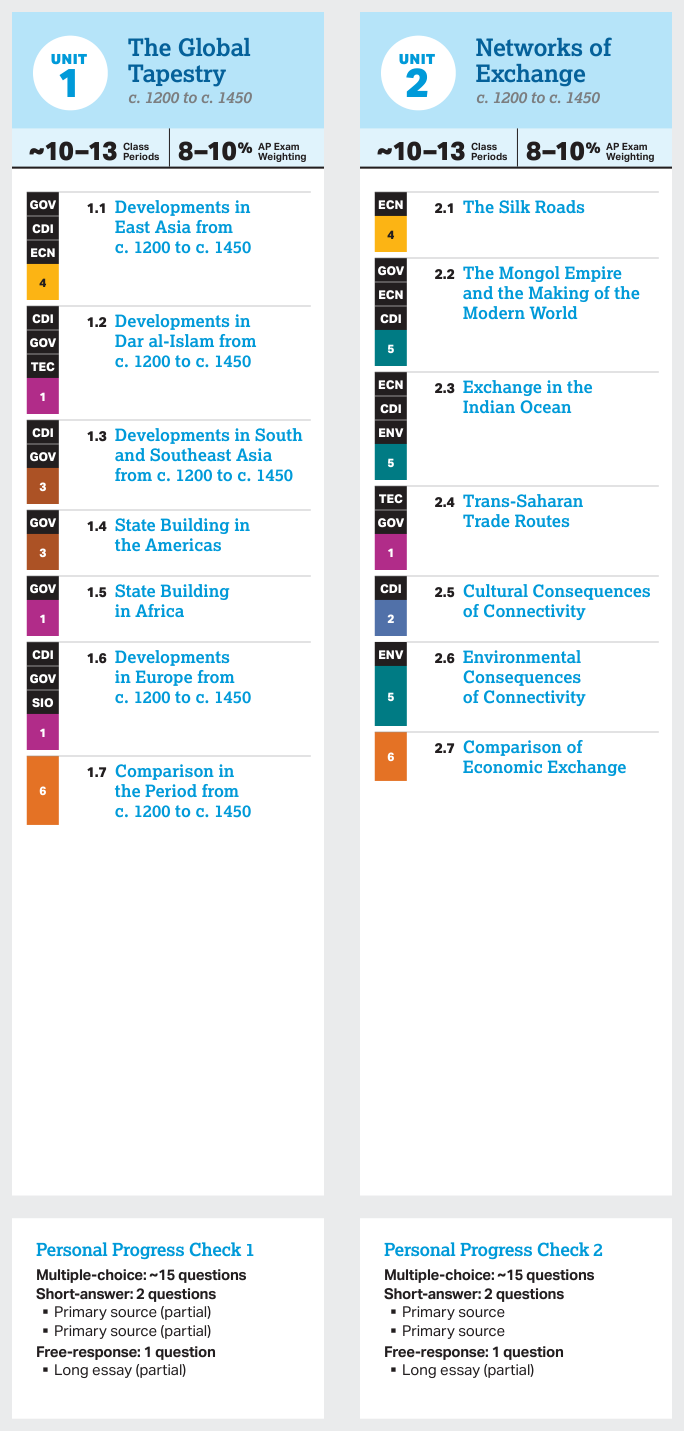
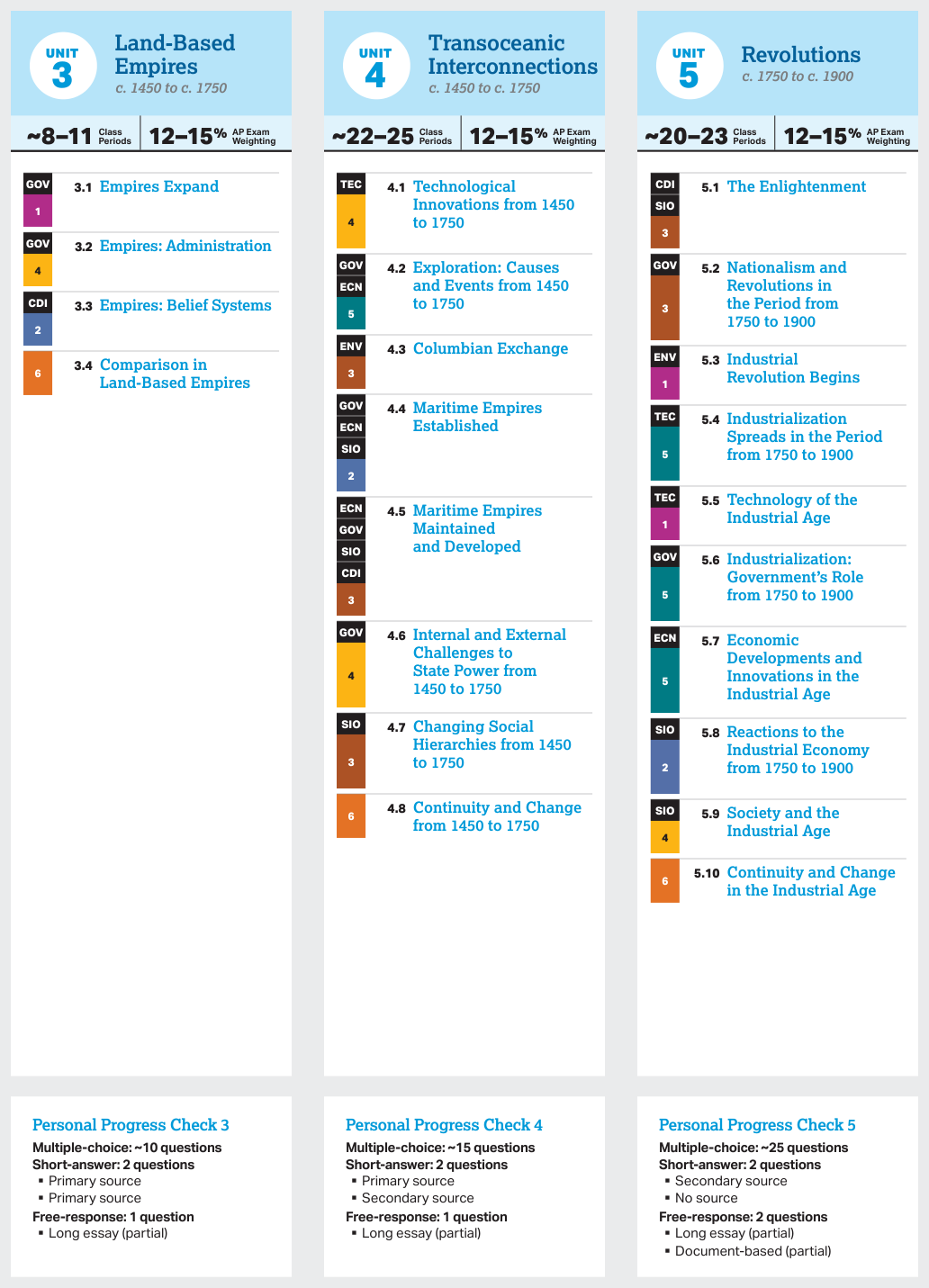
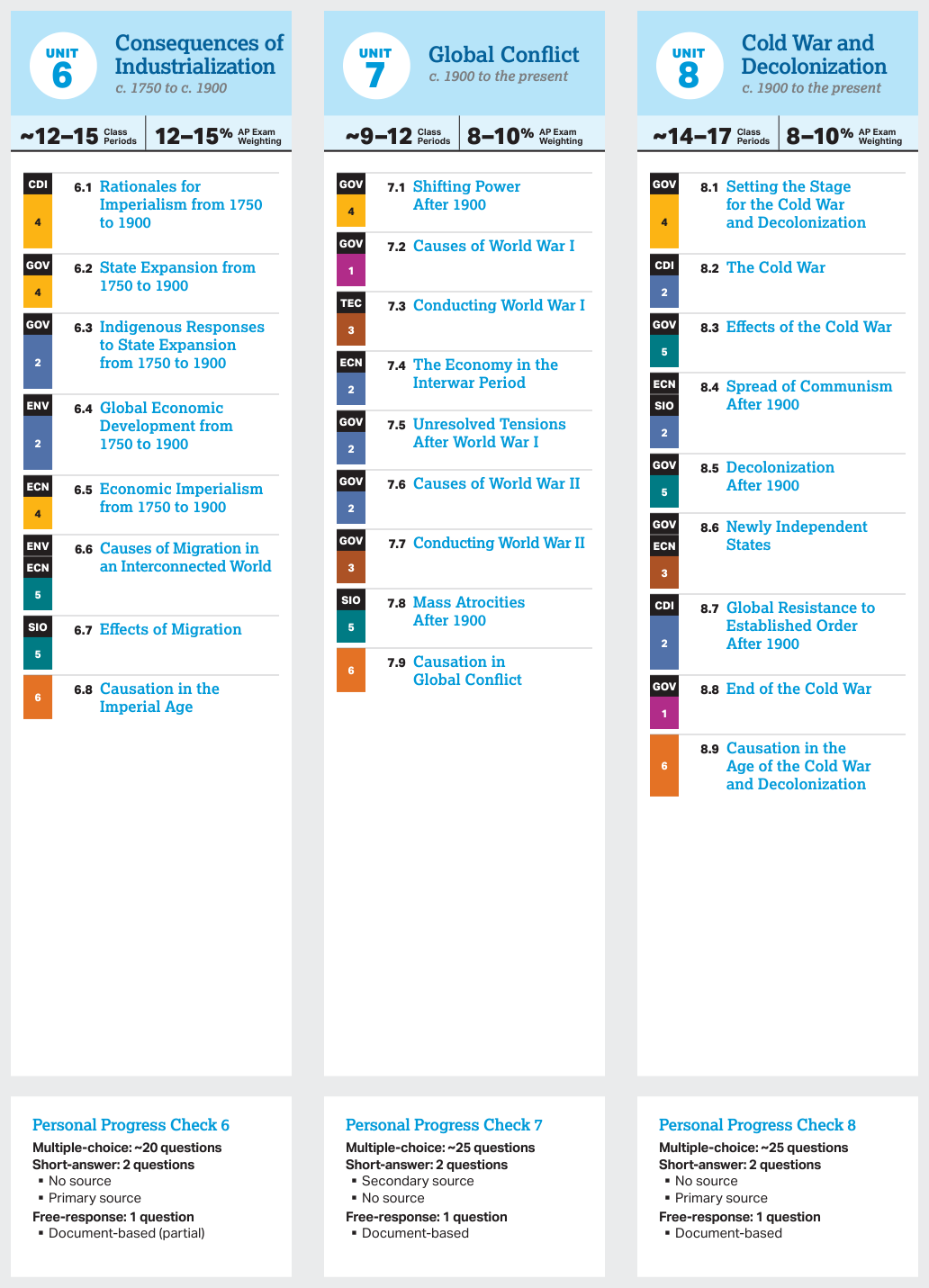
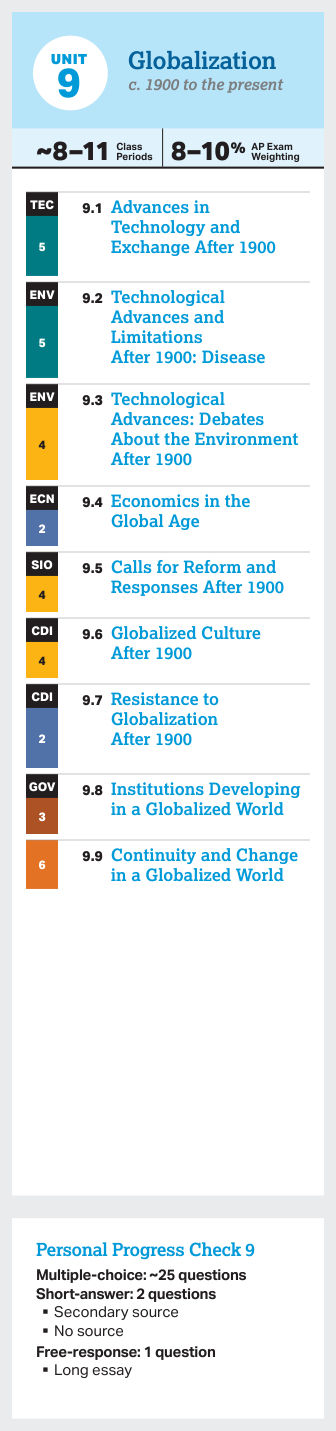
- NOTE: Partial versions of the free-response questions are provided to prepare students for more complex, full questions that they will encounter on the AP Exam.
- V.1 | 23 © 2019 College Board
- © 2019 College Board V.1 | 24
- Figure — AP World History: Modern Course at a Glance (p. 4)
Study AP World History: Modern on Lykke
This course page is free to open: signed out, you can read its first two sections, and signing in, on any plan, opens the rest. The free Lykke Chrome extension syncs your own Canvas courses, so ChatGPT, Claude and Muse can answer from your classes and deadlines. It only reads Canvas.
Add the free extensionSign in to open every section