From the free course AP World History: Modern on Lykke
5.9 Society and the Industrial Age · 5.10 Continuity and Change in the Industrial Age
Key concepts: Society and the Industrial Age · Continuity and change in the Industrial Age · Industrialization’s impact on cities · Social change in terms of race, class, gender, and religion · Political and social changes in the 20th century · Women’s labor activism and political organization · Historical contextualization (skill 4.B) · Industrial Revolution transportation and communication technologies · Continuities involving caste, Hindu states, and Confucianism · Industrialization’s effects on quality of life
Industrialization did more than increase production: it reorganized where people lived, how they worked, and how societies defined race, class, gender, and religion. The central historical question is therefore not simply what changed, but which social structures changed, which persisted, and why.
5.9 Society and the Industrial Age · 5.10 Continuity and Change in the Industrial Age
Industrialization did more than increase production: it reorganized where people lived, how they worked, and how societies defined race, class, gender, and religion. The central historical question is therefore not simply what changed, but which social structures changed, which persisted, and why.
Unit 5: Learning Objective J: Explain how industrialization caused change in existing social hierarchies and standards of living.
The thematic lens is Social Interactions and Organization (SIO): the ways societies group members and regulate relationships among groups and individuals shape political, economic, and cultural institutions. The required historical development KC-5.1.VI.A identifies the emergence of new social classes, especially the middle class and the industrial working class.
Industrialization’s impact on cities
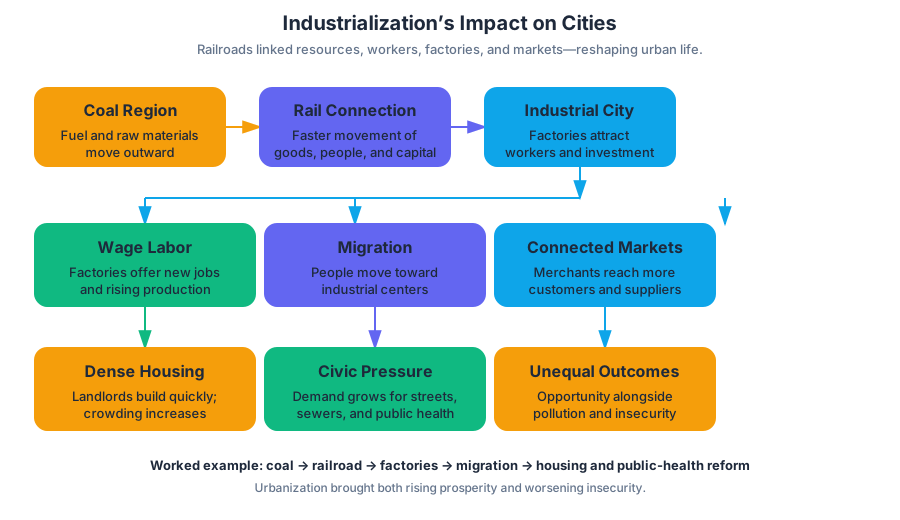
Railroads were a powerful engine of social change. By connecting factories, mines, ports, and markets, they accelerated urban growth and made cities more tightly connected to regional and global economies. People increasingly moved toward industrial centers in search of wage labor, while goods, information, and investment moved more rapidly between cities.
Urbanization created opportunities but also produced crowded neighborhoods, dangerous working conditions, pollution, and sharp inequalities in housing and sanitation. A city could therefore represent both rising standards of living for some groups and worsening insecurity for others.
Worked contextual example: A railroad linking an inland coal region to a coastal manufacturing city creates a chain of effects: coal reaches factories more cheaply; factories employ more workers; migrants arrive; landlords build dense housing; merchants gain new customers; and city governments face pressure to improve streets, sewage, and public health. The railroad is not merely a transportation technology—it changes the organization of society.
Race, class, gender, and religion
Social change during the Industrial Age must be analyzed through four connected categories:
| Social category | Historical question |
|---|---|
| Class | Who owned factories, controlled capital, or depended on wages? |
| Gender | Which kinds of work and political participation were considered appropriate for women and men? |
| Race | How did racial hierarchies shape labor, citizenship, education, and imperial rule? |
| Religion | How did religious beliefs support, challenge, or adapt to industrial society? |
Industrial society did not erase older hierarchies. Instead, it often layered new class divisions onto existing distinctions of race, gender, and religion. Access to education, skilled employment, political rights, and safe living conditions remained unequal, even where industrialization created new possibilities.
Misconception check: Industrialization did not produce universal progress. It raised production and eventually improved life for many people, but its benefits were distributed unevenly and often followed prolonged periods of exploitation.
Women’s labor activism
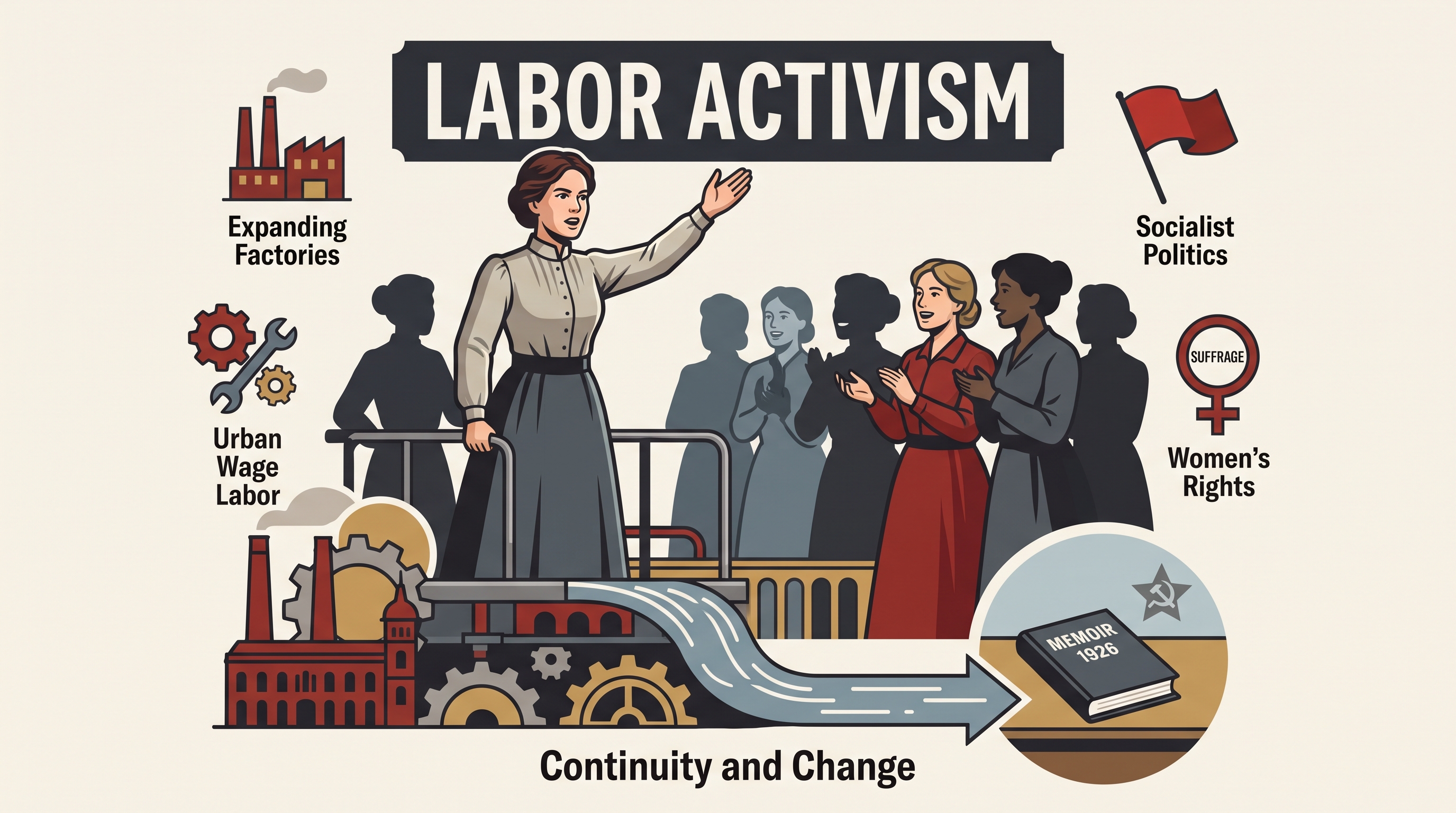
Women were not merely passive victims of industrialization. In the 1890s, a Russian woman labor activist organized women factory workers in St. Petersburg through the Factory Workers’ Society. Each branch elected a chairwoman and secretary, demonstrating that women workers could create formal organizations, select leaders, and advocate collectively.
The activist’s memoir was published in the Soviet Union in 1926, showing how later political movements preserved and interpreted earlier labor activism. This example connects workplace organization to broader changes in political participation: industrial workers became an increasingly important constituency, and women used labor organizations to challenge both class exploitation and gender exclusion.
For Skill 4.B: Explain how a specific historical development or process is situated within a broader historical context, place this activism within the expansion of factories, urban wage labor, socialist politics, and debates over women’s rights. The strongest explanation links the Factory Workers’ Society to all four conditions rather than treating it as an isolated event.
Continuity and change after 1900
The twentieth century brought major changes in communication and technology. Technologies including the microchip expanded the speed and reach of information, while medical and scientific discoveries improved the quality of life for hundreds of millions of people. Yet technological change did not automatically eliminate inequality: access to education, health care, and new technologies remained shaped by class, race, gender, religion, and geography.
Political and social changes in the twentieth century also transformed the arts. In the second half of the century, popular and consumer culture became more global, and arts, entertainment, and popular culture increasingly reflected a globalized society.
This is a classic continuity-and-change pattern:
- Change: railroads, microchips, medical discoveries, mass media, urban growth, and global consumer culture altered daily life.
- Continuity: social inequality, cultural traditions, religious relationships, and inherited hierarchies persisted.
- Interaction: new technologies could spread ideas rapidly while existing institutions determined who gained access and influence.
A global comparison
Continuity and change can also be examined through the persistence of numerous jatis, or caste communities, within South Asian societies; the development of various Hindu states; and changing relationships involving Confucianism in East Asia. Industrial and political transformation did not simply replace older social systems. Instead, older institutions adapted, resisted, or became entangled with new states, markets, and technologies.
Retrieval check: Explain one way industrialization changed urban society, one way it preserved an older inequality, and one reason the Factory Workers’ Society represents more than a workplace organization. A complete answer should connect technology, social organization, and political action rather than listing the examples separately.
Source Materials
- AP World History: Modern Course and Exam Description
- AP World History: Modern Course and Exam Description Clarifications and Corrections
- AP World History: Modern Course Overview
- AP World History: Modern Course at a Glance
- AP World History: Modern Course at a Glance Poster
- AP World History: Modern
- AP World History: Modern
- AP World History: Modern Sample Syllabus 1
- A Identify one technological development in communication or transportation in the twentieth century.
- A Identify one technological development in communication or transportation in the twentieth century.