From the free course AP World History: Modern on Lykke
9.5 Calls for Reform and Responses After 1900 · 9.6 Globalized Culture After 1900
Key concepts: Calls for reform after 1900 · Responses to globalization · Challenges to assumptions about race, class, gender, and religion · The United Nations Universal Declaration of Human Rights · Global development and inequality · Per capita income as an indicator of standard of living · Tanzimat reforms in the Ottoman Empire · Japanese selective Westernization in response to Matthew Perry · The Opium Wars and Boxer Rebellion · Women’s long hours and harsh working conditions in factory jobs
After 1900, globalization connected societies more tightly—but it also made inequality, exclusion, and cultural domination harder to ignore. Reformers therefore asked a fundamental question: Who should count as a full member of society, and what rights should that membership guarantee?
9.5 Calls for Reform and Responses After 1900 · 9.6 Globalized Culture After 1900
After 1900, globalization connected societies more tightly—but it also made inequality, exclusion, and cultural domination harder to ignore. Reformers therefore asked a fundamental question: Who should count as a full member of society, and what rights should that membership guarantee?
Reform in a Globalizing World
Reform movements sought to change political institutions, social hierarchies, education, labor conditions, or cultural assumptions. Some reforms came from governments responding to foreign pressure; others emerged from mass movements challenging the effects of industrialization, imperialism, and global integration.
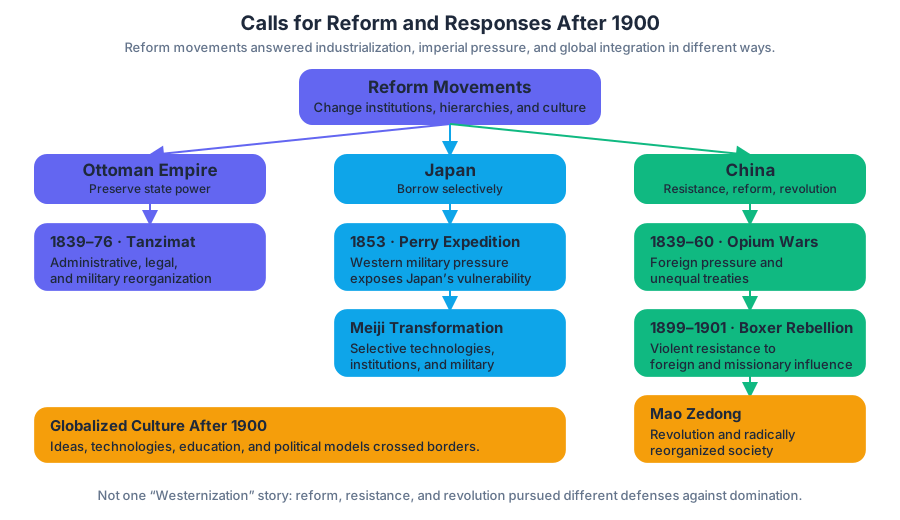
Earlier reform examples continued to shape the modern period. The Ottoman Tanzimat reforms attempted to strengthen and reorganize the empire through administrative, legal, and military changes. In Japan, the arrival of Commodore Matthew Perry’s American naval expedition exposed the danger of Western military pressure. Japan responded with selective Westernization: it adopted selected technologies, institutions, and military practices while attempting to preserve Japanese political authority and cultural identity.
China faced a different sequence of responses. The Opium Wars demonstrated the military consequences of foreign economic pressure and unequal treaties. The Boxer Rebellion represented violent resistance to foreign influence and Christian missionaries, while later reformers argued that China needed major political and educational changes to survive. Mao Zedong, a Communist leader, eventually associated reform and revolution with the creation of a radically reorganized Chinese society.
These cases should not be collapsed into a single “Westernization” story. Tanzimat reform tried to preserve Ottoman state power; Japan borrowed selectively to resist domination; Chinese movements debated whether resistance, reform, or revolution offered the best defense against foreign pressure.
Rights, Social Categories, and Inclusion
The CED connects this development to Unit 9: Learning Objective E and KC-6.3.III.i: rights-based discourses challenged older assumptions about race, class, gender, and religion. A rights-based discourse argues that people possess rights because they are human—not merely because they belong to a favored nation, class, race, sex, or faith.
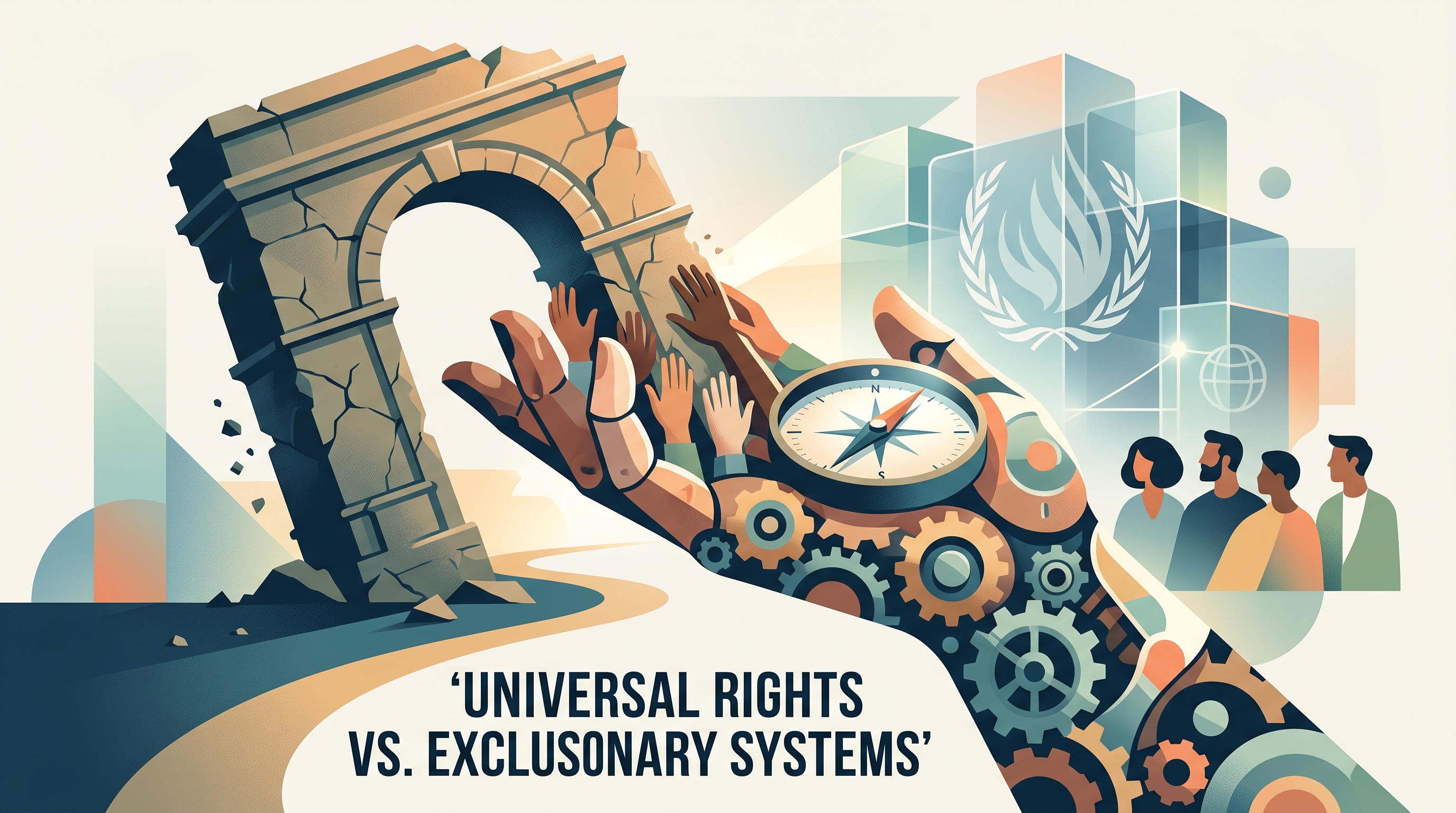
The United Nations Universal Declaration of Human Rights challenged traditional assumptions by presenting dignity and basic rights as universal principles.
The 1948 declaration especially emphasized the rights of children, women, and refugees. It did not instantly eliminate discrimination, but it supplied reformers with a shared language for criticizing governments and institutions. Related challenges included global feminist movements, the Negritude movement, which affirmed Black cultural identity against racist colonial assumptions, and liberation theology in Latin America, which connected Christian teachings to struggles against poverty and oppression.
KC-6.3.III.ii emphasizes that access to education and participation in political and professional roles became more inclusive in much of the world. Examples include women gaining voting or office-holding rights in the United States in 1920, Brazil in 1932, Turkey in 1934, Japan in 1945, India in 1947, and Morocco in 1963. The pattern was significant but incomplete: legal access did not guarantee equal wages, safety, political influence, or social acceptance.
Industrial employment also produced contradiction. Documents 3, 5, and 6 illustrate the long hours and harsh working conditions women routinely faced in factories. Industrialization could create paid employment and public activism while preserving the assumption that women belonged primarily in domestic roles.
Measuring Development and Inequality
Globalization increased access to goods, education, communication, and employment for some populations while distributing its economic and environmental costs unevenly. KC-6.3.II.C identifies worldwide movements protesting this inequality. A protest against globalization might target labor exploitation, unequal trade, environmental damage, or institutions seen as favoring wealthy states and corporations.
The 2011 Snapshot “Global Development and Inequality” in Strayer, page 1031, should be read as a quantitative source: a source using numerical data to make comparisons. One important measure is per capita income, calculated by dividing a country’s total income by its population:
$$\text{Per capita income}=\frac{\text{total national income}}{\text{population}}$$
Per capita income can help compare average economic resources, but it is not the same as the average person’s actual experience. It can conceal wealth concentrated among elites, unpaid labor, regional disparities, unequal access to health care, or differences in the cost of living. Statistical indicators of standard of living—the material and social conditions in which people live—may also include literacy, life expectancy, infant mortality, access to education, nutrition, housing, and medical care.
A country may have a high per capita income but poor access to health services for rural communities. Conversely, a country with lower average income may achieve strong literacy or life-expectancy outcomes through broad public programs. The strongest interpretation therefore treats per capita income as one indicator, not a complete definition of development.
AP Historical Reasoning: Contextualization and Sourcing
The suggested skill is Contextualization (4.B): Explain how a specific historical development or process is situated within a broader historical context. To contextualize the Universal Declaration, connect it to the world wars, imperialism, mass atrocities, refugee crises, and expanding international institutions of the twentieth century. Its universal language made sense partly because earlier national and imperial systems had excluded entire categories of people from equal protection.
When analyzing a document about women’s factory work, use Sourcing: explain the source’s point of view, purpose, historical situation, and/or audience. A reform photograph intended for middle-class policymakers may emphasize exhaustion and danger to provoke legislation; a factory owner’s report may minimize those conditions to defend production. Sourcing does not mean dismissing a source—it means explaining why its perspective matters.
Misconception check: “Reform automatically produced equality.”
Reform often widened formal rights while leaving economic inequality, racism, gender expectations, religious discrimination, and exploitative labor intact.
Retrieval check: Explain one way the Universal Declaration challenged an older social assumption. Then explain why per capita income alone cannot fully measure standard of living. Finally, contextualize either Tanzimat reform or Japanese selective Westernization by identifying the foreign pressure that shaped it.
Source Materials
- AP World History: Modern Course and Exam Description
- AP World History: Modern Course and Exam Description Clarifications and Corrections
- AP World History: Modern Course Overview
- AP World History: Modern Course at a Glance
- AP World History: Modern Course at a Glance Poster
- AP World History: Modern
- AP World History: Modern
- AP World History: Modern Sample Syllabus 1
- Sample Free-Response Questions