From the free course AP World History: Modern on Lykke
8.5 Decolonization After 1900 · 8.6 Newly Independent States
Key concepts: Decolonization after 1900 · Newly independent states · African nationalism · Anti-imperialism · Postcolonial states · Nonviolent and violent anticolonial movements · The impact of the World Wars on European imperial powers · Economic globalization and globally competitive corporations · Comparison of historical developments across regions · Historical evidence and source limitations
African independence was not a single event but a two-stage transformation: decolonization ended formal imperial rule, while newly independent states had to build political and economic systems after European authority withdrew.
8.5 Decolonization After 1900 · 8.6 Newly Independent States
African independence was not a single event but a two-stage transformation: decolonization ended formal imperial rule, while newly independent states had to build political and economic systems after European authority withdrew. The central question is therefore not only when did a colony become independent? but also what changed—and what continued—after independence?
Decolonization: why European rule weakened
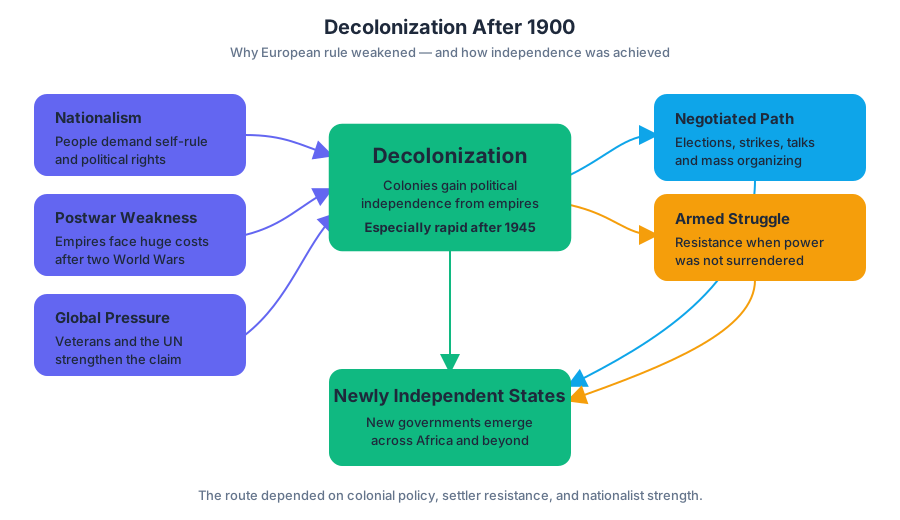
Decolonization means the process by which colonies gained political independence from imperial powers. In Africa, nationalist and anti-imperialist ideas expanded during the twentieth century, encouraging people to challenge European rule and demand self-government.
After 1945, European empires were weaker and less able to maintain their colonies. France and other Western nations had suffered enormous economic and political costs during the two World Wars. African veterans who had served in those wars also used their military experience and contributions as evidence that they deserved political rights and independence. International support for self-determination, including attention from the United Nations, further strengthened anticolonial claims.
Decolonization took both nonviolent and violent forms. Some nationalist movements used strikes, elections, protests, negotiations, and mass political organizing. Others concluded that colonial governments would not surrender power peacefully and adopted armed struggle. The difference was shaped by the policies of each imperial state, the strength of local nationalist organizations, settler resistance, and the willingness of colonial authorities to use force.
| Path toward independence | Typical methods | Historical pattern |
|---|---|---|
| Negotiated or largely nonviolent | Elections, strikes, boycotts, constitutional talks | Nationalists pressured imperial governments to transfer authority |
| Violent anticolonial movement | Guerrilla warfare, armed revolt, attacks on colonial forces | Independence followed prolonged conflict when negotiation failed |
| Mixed process | Peaceful organizing combined with repression or armed resistance | Political movements shifted tactics as colonial governments responded |
A useful comparison is Ghana and Algeria. Ghana’s independence in 1957 followed sustained nationalist mobilization and negotiations with Britain, although political pressure included strikes and mass protest. Algeria’s war against France, by contrast, became intensely violent because French settlers and the French government resisted relinquishing control; Algeria achieved independence in 1962 after a devastating war. Both movements were nationalist and anti-imperialist, but the colonial power’s response produced different routes to independence.
Colonial economies and the problem of state-building
European colonial rule in Africa was connected to capitalist economic systems and unequal class structures. Colonial governments often organized production around exports, labor extraction, taxation, and the interests of European firms rather than balanced development for local populations. Political independence therefore did not erase inherited economic structures.
Unit 8: Learning Objective H: Explain the economic changes and continuities resulting from the process of decolonization.
The establishment of a postcolonial state—a state governing after colonial rule—created a new challenge: leaders had to provide education, infrastructure, employment, health services, and national unity while relying on economies shaped by imperialism. Under [KC-6.3.I.C], governments in newly independent states often took a strong role in guiding economic life to promote development. State-led planning and socialist policies appealed to some leaders because European capitalism was associated with exploitation and unequal colonial development.
This did not mean every postcolonial government became communist, nor that socialism solved economic dependence. Many states remained dependent on a small number of export commodities, foreign loans, imported technology, or investment by globally competitive corporations. Those corporate connections were enabled by the late-twentieth-century trend toward economic globalization, which increased cross-border flows of capital, goods, and services while sometimes preserving unequal bargaining power.
Independence did not end every colonial connection
Under [KC-6.2.III.B], migration from former colonies to imperial metropoles—the major cities of former colonizing countries—maintained cultural and economic ties after empires dissolved. African migrants who moved to cities such as London or Paris created durable connections through families, remittances, language, education, political activism, and trade. Thus, formal sovereignty changed political authority, but colonial-era relationships could continue through migration and economic networks.
Source perspective: what a text can and cannot show
When evaluating a source about decolonization or postcolonial development, ask who produced it, why, and for whom. A speech by an African nationalist may reveal the goals and grievances of an independence movement but understate internal disagreements; a corporate report may describe investment as mutually beneficial while minimizing labor inequality or resource extraction. The author’s perspective and purpose can make a source valuable for understanding one dimension of the past while limiting its usefulness for judging the whole process.
Skill 2: Sourcing and Situation requires connecting a source’s point of view, purpose, historical situation, or audience to its meaning. Skill 5: Making Connections is especially important here: compare regions, identify causes, and track continuity and change rather than treating “Africa” as a single political experience. Skill 6: Argumentation then turns those observations into a defensible claim supported by specific evidence.
Misconception check: Independence movements did not all follow the same pattern. Compare Ghana and Algeria by explaining one similarity in their nationalist goals and one difference in their methods or political circumstances.
Retrieval check: Explain why European weakness after the World Wars facilitated African independence, then identify one economic continuity that limited the freedom of a newly independent state. Finally, explain how migration to an imperial metropole could preserve a colonial-era connection after political decolonization.

Source Materials
- AP World History: Modern Course and Exam Description
- AP World History: Modern Course and Exam Description Clarifications and Corrections
- AP World History: Modern Course Overview
- AP World History: Modern Course at a Glance
- AP World History: Modern Course at a Glance Poster
- AP World History: Modern
- AP World History: Modern
- AP World History: Modern Sample Syllabus 1