From the free course AP World History: Modern on Lykke
1.5 State Building in Africa · 1.6 Developments in Europe
Key concepts: State building in Ethiopia · Swahili Coast city-states and merchant settlement · Spread of Islam across Eurasia and Africa · Ottoman Empire in Southern Europe, the Middle East, and North Africa · Safavid Empire in the Middle East · Industrialization in Europe · European colonialism in Africa · Civilizing mission and Social Darwinism · Railways and new communication technologies in Africa · European-Muslim interactions and exploration
A state can grow from two very different foundations: Ethiopia built political authority around a durable Christian kingdom, while the Swahili Coast developed through commercially connected city-states whose power depended on merchants, ports, and Indian Ocean exchange.
1.5 State Building in Africa · 1.6 Developments in Europe
A state can grow from two very different foundations: Ethiopia built political authority around a durable Christian kingdom, while the Swahili Coast developed through commercially connected city-states whose power depended on merchants, ports, and Indian Ocean exchange. Across both regions, religion and long-distance interaction helped shape political life.
1.5 State Building in Africa
Ethiopia is an example of African state building in which Christianity supported both political identity and royal authority. The Church of St. George at Lalibela, carved from living rock, illustrates how religious architecture could express the strength, resources, and distinctiveness of a state.
The Swahili Coast of East Africa followed a different pattern. Rather than one unified empire, it contained independent or semi-independent city-states, including port settlements whose wealth came from commercial exchange across the Indian Ocean. Merchants settled in these cities, linking African communities with Arabia, Persia, India, and other regions.
The Swahili cities were not simply “foreign trading posts.” Their culture emerged from sustained interaction: African languages and customs combined with Islamic religious influence and commercial practices from across the Indian Ocean. This makes the coast a region shaped by cross-cultural commercial interaction, not a place where one civilization merely replaced another.
Islamic networks and African state building
The early Islamic conquests spread Islam across Eurasia and Africa, creating a large religious and commercial zone. Islam moved through conquest in some areas and through merchants, scholars, rulers, and urban communities in others. On the Swahili Coast, conversion connected local elites and merchants to wider networks of law, literacy, pilgrimage, and trade.
A useful synthesis is that Ethiopia, the Swahili city-states, and Islamic networks connected religion to state formation in different ways. Ethiopia used Christian institutions to reinforce a territorial kingdom; Swahili rulers used port-city wealth and commercial relationships; Islamic networks provided a wider cultural system through which African states and cities could participate in Afro-Eurasian exchange.
Misconception check: Islam did not spread across Africa only through military conquest. The early conquests created an important political foundation, but merchants, migration, scholarship, and urban trade also carried Islam into new communities.
1.6 Developments in Europe
Europe in this period was politically fragmented, but the Christian churches—especially Catholic, Orthodox, and later Protestant churches—held major social and political power. Churches shaped education, law, public rituals, architecture, and ideas about legitimate authority. Interactions among Europe, Africa, and the Muslim world also intensified through trade, diplomacy, conflict, and intellectual exchange.
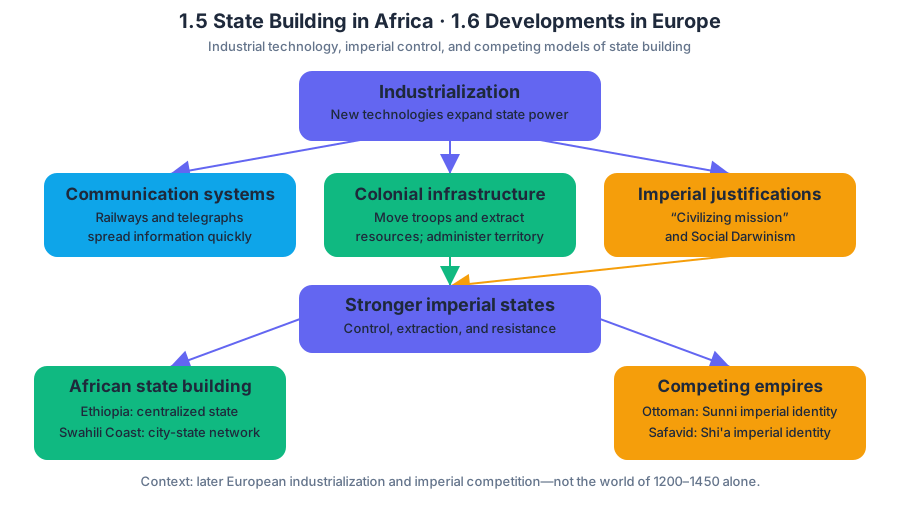
The Ottoman Empire demonstrates how an expanding land empire connected several regions. It expanded into Southern Europe, the Middle East, and North Africa, bringing diverse peoples and religious communities under one imperial structure. The Safavid Empire, centered in the Middle East, likewise became a major regional power; political and religious disputes between the Ottomans and Safavids produced rivalry and conflict.
Europe, technology, and exploration
Interactions between Europe and the Muslim world facilitated early European exploration. Europeans gained access to navigational knowledge, geographic information, commercial goods, and technologies that circulated through Muslim-controlled or Muslim-connected regions. Exploration therefore developed from cross-cultural contact as well as from European political and economic ambitions.
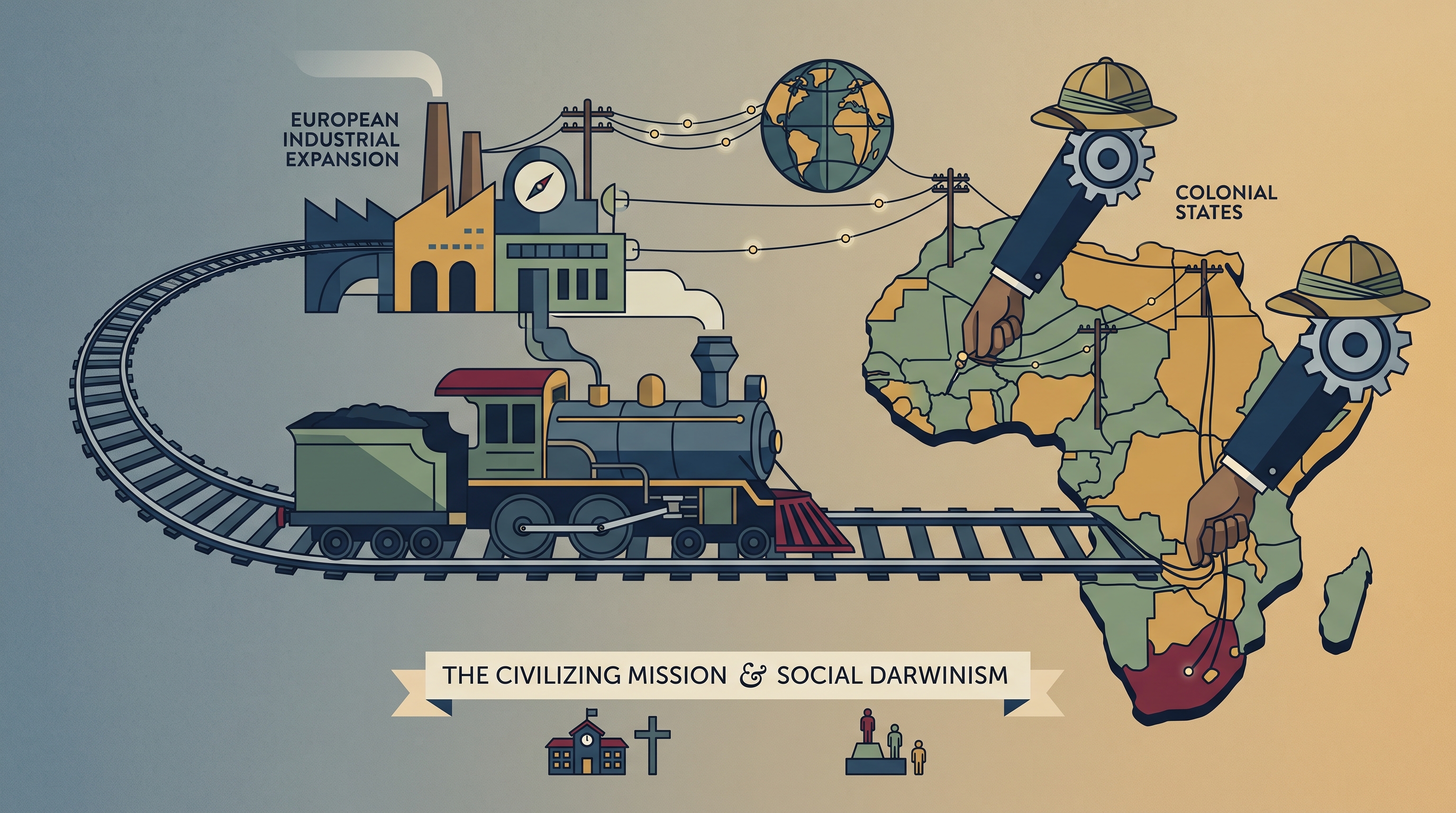
Industrialization in Europe belongs mainly to the later period after the eighteenth century, so it should not be projected backward into the years around $1200$–$1450$. Its later effects nevertheless matter for African history: industrialization helped spread new technologies, and European colonial states used railways, telegraphs, and other communication systems to strengthen control in Africa.
Some Europeans justified colonial expansion through the civilizing mission, the belief that Europeans had a duty to reshape other societies, and Social Darwinism, the misuse of evolutionary language to rank human societies and rationalize imperial domination. These ideas encouraged colonial governments to build infrastructure not simply for African communities, but to move troops, extract resources, administer territory, and expand European power.
Skill connection — 4.A Contextualization: Place a development in its broader historical setting. For example, railways in colonial Africa make sense only when connected to later European industrialization, imperial competition, and racial ideologies—not to the political conditions of $1200$–$1450$ alone.
Retrieval check: Why is Ethiopia a different state-building example from the Swahili Coast? Then explain how the Ottoman and Safavid empires show that religious and political disputes could strengthen imperial identity while also producing interstate conflict.
Source Materials
- AP World History: Modern Course and Exam Description
- AP World History: Modern Course and Exam Description Clarifications and Corrections
- AP World History: Modern Course Overview
- AP World History: Modern Course at a Glance
- AP World History: Modern Course at a Glance Poster
- AP World History: Modern
- AP World History: Modern
- AP World History: Modern Sample Syllabus 1
- A Identify one development that contributed to the spread of gunpowder technologies in the period before circa 1500.
- A Identify one development that contributed to the spread of gunpowder technologies in the period before circa 1500.