From the free course AP World History: Modern on Lykke
AP Practice 5
A strong Long Essay Question (LEQ) answer does more than remember facts: it turns historical knowledge into a defensible explanation. The writer must establish a historical setting, answer the prompt with a precise thesis, use specific evidence, and explain why the evidence proves the argument.
Task: Write a Causation LEQ
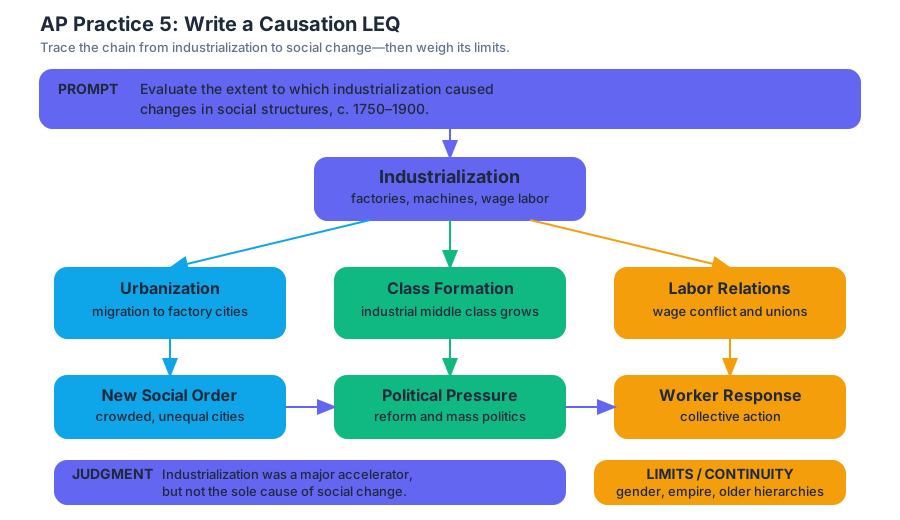
Prompt: Evaluate the extent to which industrialization caused changes in social structures from approximately 1750 to 1900.
This original, unofficial prompt asks for a judgment about causation—the relationship between factors that produce change and the resulting historical developments. “Evaluate the extent” means that a sophisticated response should not simply claim that industrialization changed society; it should explain how much it changed society, identify limits or continuities, and distinguish industrialization from other causes.
First move: Build a causal map
Before drafting, translate the prompt into a compact reasoning chain:
| Historical factor | Social change it encouraged | Limit or qualification |
|---|---|---|
| Factory production | Growth of an urban industrial working class | Workers remained divided by skill, gender, and region |
| Industrial wealth | Expansion of an industrial middle class | Aristocratic elites retained political and cultural influence |
| Urbanization | New neighborhoods, public-health reforms, and class tensions | Rural life continued for much of the population |
| Wage labor | Labor unions and socialist movements | Coercive labor systems and unequal gender roles persisted |
The map prevents a common error: treating “social structures” as a synonym for “working conditions.” Social structures include classes, gender relationships, political organization, urban communities, and systems of status. Industrialization affected all of these, but it did not erase every older hierarchy.
What the rubric rewards
The LEQ rubric rewards six distinct points. Each point requires a visible action in the essay rather than a collection of disconnected facts.
| Rubric criterion | What the reader must see |
|---|---|
| Thesis/Claim | A historically defensible claim that answers the prompt and establishes a line of reasoning |
| Contextualization | Broader developments that occurred before, during, or beyond the central period and help explain the issue |
| Evidence: one point | At least one specific historical example relevant to the topic |
| Evidence: two points | At least two specific examples used to support the argument |
| Analysis and Reasoning: one point | The argument consistently uses causation |
| Analysis and Reasoning: one point | The response demonstrates complex understanding through qualification, comparison, multiple causes, or continuity and change |
These criteria connect directly to the official historical thinking skills: Skill 1: Developments and Processes, Skill 4: Contextualization, Skill 5: Making connections through comparison, causation, continuity and change, and Skill 6: Argumentation. An LEQ does not reward name-dropping; it rewards using historical examples as evidence in a chain of reasoning.
Worked thesis and outline
A weak thesis would say: “Industrialization changed society in many ways.” It identifies a topic but makes no judgment, gives no categories, and does not establish an argument.
A stronger thesis is:
Industrialization substantially transformed social structures from 1750 to 1900 by creating a large urban working class, strengthening an industrial middle class, and encouraging labor-based political movements; however, its effects were limited because aristocratic privilege, gender inequality, and coercive labor systems continued alongside factory production.
This thesis earns the thesis point because it answers extent, identifies three lines of reasoning, and includes a qualification. It also previews the essay’s structure: working class, middle class and politics, then continuities and limits.
Contextualization: place industrialization in motion
A contextual paragraph might explain that before industrialization, most people worked in agriculture or household production, social status was strongly shaped by inherited privilege, and manufacturing often occurred through small workshops or the putting-out system, in which merchants supplied raw materials to rural households. Britain’s access to coal, capital, commercial markets, and agricultural improvements helped shift production toward mechanized factories.
The key is the connection: these earlier conditions explain why factory production represented a major change rather than appearing suddenly. Simply writing “the Enlightenment happened before industrialization” would not earn contextualization unless the response explains how political and economic ideas helped shape later debates about labor, property, or reform.
Evidence paragraphs: turn facts into proof
Body paragraph 1 — working-class formation: Factories concentrated wage laborers in cities such as Manchester. Long hours, dangerous machinery, crowded housing, and low wages produced shared class grievances. These conditions helped encourage trade unions, strikes, and socialist criticism, including Karl Marx’s argument that industrial society was divided between the bourgeoisie, who controlled capital, and the proletariat, who sold their labor.
The analysis must explain the mechanism: factories placed workers under common rules and schedules, concentrated them geographically, and made collective action easier. The evidence therefore demonstrates not merely poverty, but the creation of a new social class with shared political interests.
Body paragraph 2 — middle-class expansion: Industrialization increased the influence of factory owners, merchants, engineers, bankers, and professional managers. This industrial middle class gained wealth and pressed for political influence, as seen in British reforms that gradually expanded representation and in liberal arguments favoring property, contracts, and private enterprise.
Again, the causal explanation matters: industrial wealth challenged older status systems based primarily on land and aristocratic birth. Yet the argument should avoid claiming that aristocrats disappeared. In Britain and elsewhere, landed elites often adapted by investing in industry, entering government, or preserving social prestige.
Complexity: explain change and continuity together
A complex response recognizes that industrialization transformed some relationships while preserving others. Women entered factories and wage labor in large numbers, but industrial societies frequently paid women less and continued to define domestic responsibility as feminine. Likewise, legal abolition of slavery in much of the Atlantic world did not end exploitative labor: indentured labor, colonial labor systems, and racial hierarchies remained powerful.
Named misconception check — “Industrialization created equality”: Industrialization expanded mobility for some people, but it also created sharper class distinctions and preserved gender, racial, and imperial inequalities. The best answer argues that industrialization reorganized social structures; it did not produce a classless or fully merit-based society.
Timing and error review
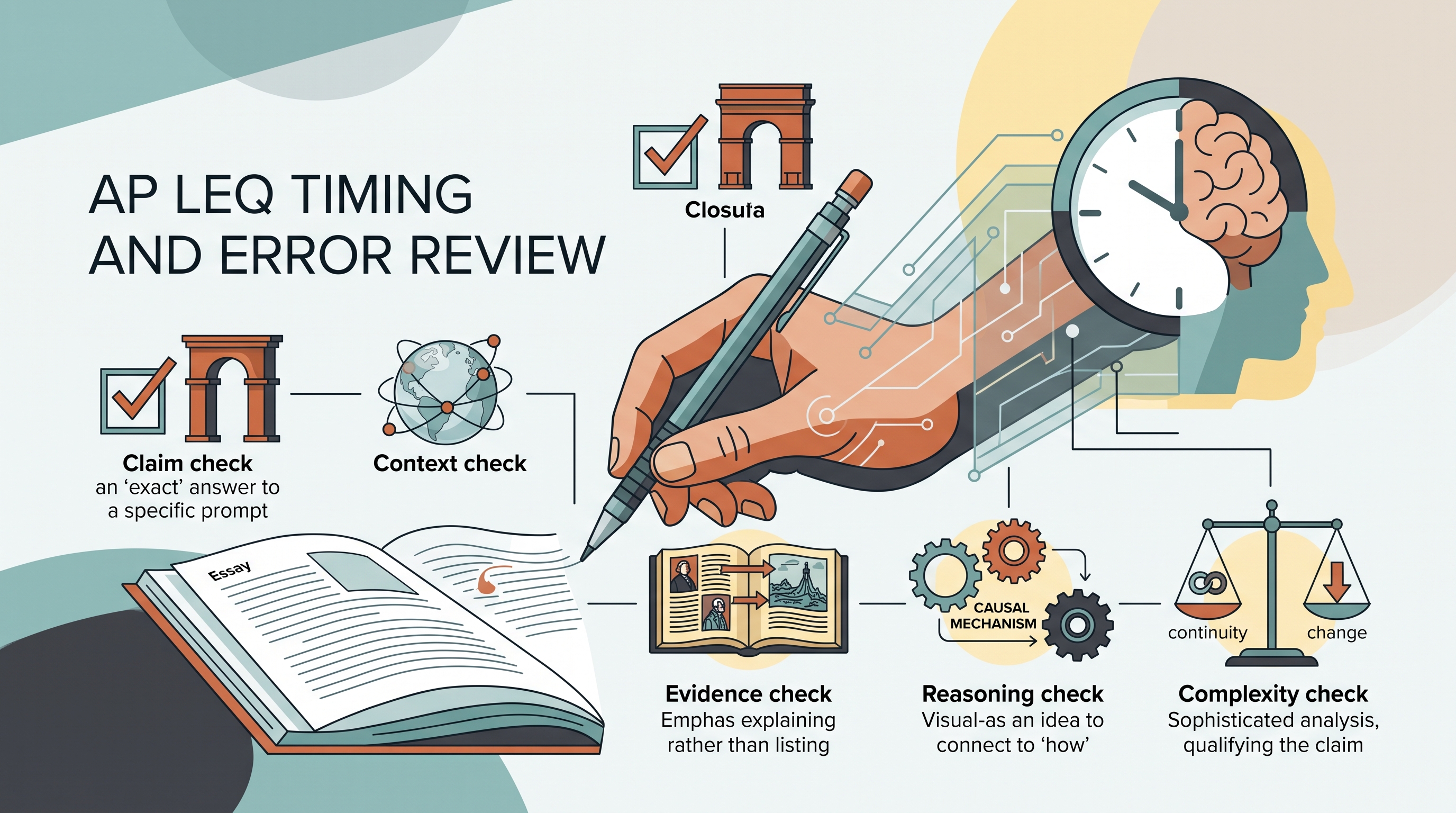
Allow approximately 40 minutes for a timed LEQ: spend about 5 minutes planning, 30 minutes writing, and 5 minutes revising. During revision, underline the thesis, circle specific evidence, and draw an arrow from each example to the claim it proves.
Use this error-review routine after writing:
- Claim check: Does the thesis answer the exact verb and extent of the prompt?
- Context check: Did the broader background connect directly to the argument?
- Evidence check: Are at least two specific examples explained rather than merely listed?
- Reasoning check: Does every body paragraph show a causal mechanism?
- Complexity check: Did the essay qualify its claim or explain continuity alongside change?
If the essay names factories, Marx, unions, urbanization, or reform laws but never explains how those developments altered class power, political organization, or gender relations, it is descriptive rather than analytical. The examiner rewards the bridge between evidence and argument.
Source Materials
- AP World History: Modern Course and Exam Description
- AP World History: Modern Course and Exam Description Clarifications and Corrections
- AP World History: Modern Course Overview
- AP World History: Modern Course at a Glance
- AP World History: Modern Course at a Glance Poster
- AP World History: Modern
- AP World History: Modern
- AP World History: Modern Sample Syllabus 1
- AP World History Past Exam Questions — AP Central
- Khan Academy — AP World History: Modern
- Freeman-pedia — AP World History: Modern
- YouTube — Heimler's History