From the free course AP World History: Modern on Lykke
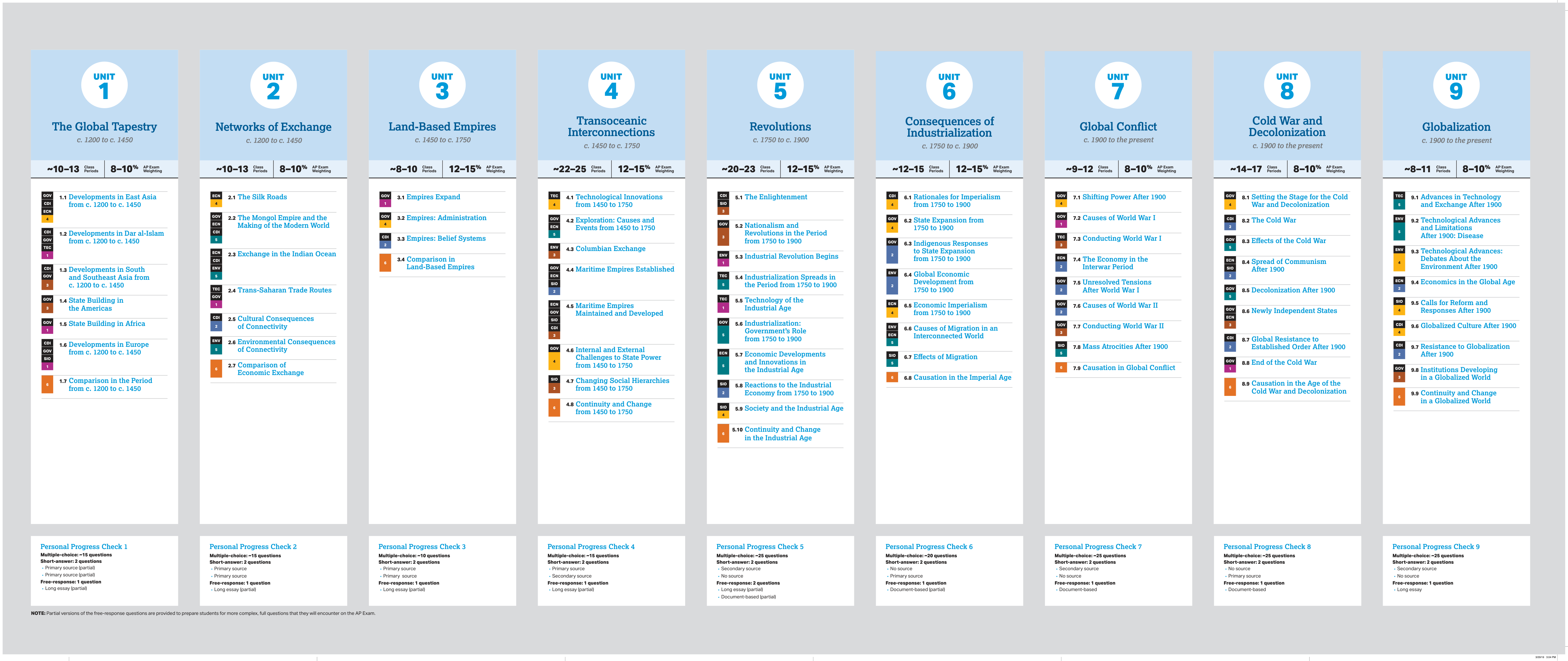
2.1 The Silk Roads · 2.2 The Mongol Empire and the Making of the Modern World
Key concepts: The Silk Roads · The Mongol Empire and the Making of the Modern World · Cultural developments and interactions · Governance and state formation · Economic systems and exchange · Social interactions and organization · Technology and innovation · Turkic-dominated political entities · New Islamic political entities · Production, exchange, and consumption of goods and services
A caravan carrying silk from China to Central Asia was not simply moving merchandise: it was moving languages, technologies, religions, diseases, and political influence across thousands of kilometers.
2.1 The Silk Roads · 2.2 The Mongol Empire and the Making of the Modern World
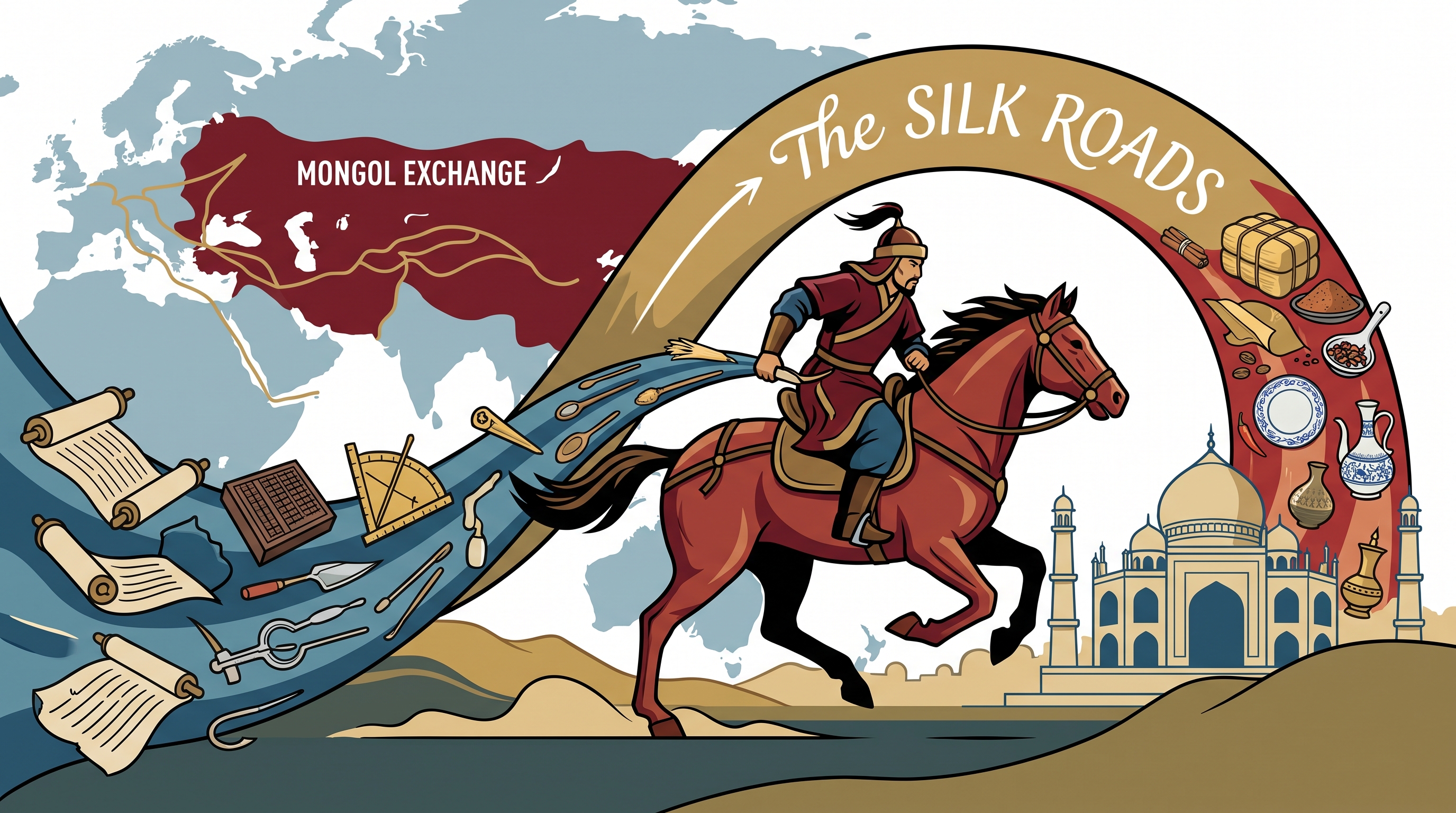
A caravan carrying silk from China to Central Asia was not simply moving merchandise: it was moving languages, technologies, religions, diseases, and political influence across thousands of kilometers. Between c. 1200 and c. 1450, the Silk Roads became especially powerful because existing routes connected with expanding states—and because the Mongol Empire temporarily imposed order across much of Eurasia.
The Silk Roads: networks, not one road
The Silk Roads were a network of overland routes linking East Asia, Central Asia, the Middle East, and parts of Europe. Their name reflects the importance of Chinese silk, but silk was only one item exchanged. Textiles, porcelains, spices, precious metals, horses, paper products, and other luxury goods moved through a chain of merchants and caravan cities.
The geography shaped the economic system. Deserts, mountain passes, and long distances made bulk goods expensive to transport, so merchants generally emphasized high-value goods that could survive a difficult journey. Caravanserais—rest stations for travelers, animals, and merchandise—reduced risk, while states and cities profited by taxing trade and protecting routes.
Economic systems describe how societies produce, exchange, and consume goods and services.
Production and exchange were interconnected. Chinese workshops produced silk and porcelain for export; Central Asian societies supplied horses and served as commercial intermediaries; cities in the Islamic world connected eastern goods to Mediterranean markets. The result was not a single unified marketplace, but a linked series of regional economies.
Political change across Eurasia
The period also saw the formation and expansion of political entities dominated by Turkic peoples. The Seljuk Empire, the Mamluk Sultanate of Egypt, and the Delhi sultanates were important Islamic political entities, although they differed in geography, administration, and social composition. Their existence demonstrates that political development was diverse rather than following one universal pattern.
The Mongols transformed this political landscape. Beginning with the conquests of Chinggis Khan in the early thirteenth century, Mongol armies created the largest contiguous land empire in history. The empire eventually divided into major khanates, including the Yuan dynasty in China, the Ilkhanate in Persia, the Chagatai Khanate in Central Asia, and the Golden Horde in northern Eurasia.
Mongol rule combined military conquest with practical administration. Mongol rulers used local officials, collected tribute and taxes, protected important routes, and incorporated skilled administrators from conquered societies. Their political system was therefore not simply destruction followed by disorder; it also created conditions for increased movement across Eurasia.
The Mongol Empire and connectivity
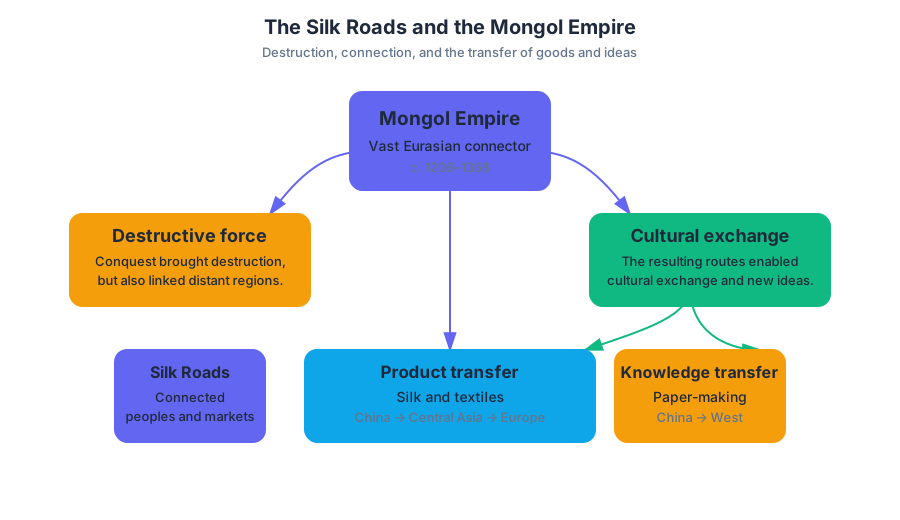
The period of relatively secure travel under Mongol rule is often called the Pax Mongolica, or “Mongol peace.” The phrase does not mean that all violence ended. Mongol conquest was extraordinarily destructive in many regions, but once territories were incorporated, imperial protection could make long-distance travel more predictable for merchants, diplomats, and missionaries.
Interregional contacts and conflicts between states and empires, including the Mongols, encouraged significant technological and cultural transfers (KC-3.2.II.A.ii). Knowledge moved alongside objects: Greco-Islamic medical learning reached western Europe, numbering systems traveled to Europe, and the Mongols adopted the Uyghur script for administrative use.
These exchanges reveal both continuity and innovation. Older routes and commercial practices continued, but new imperial connections increased their reach. Human adaptation and innovation—such as improved transportation practices, commercial finance, and administrative borrowing—could increase efficiency and comfort even while imperial expansion imposed severe costs on conquered populations.
Themes and reasoning in action
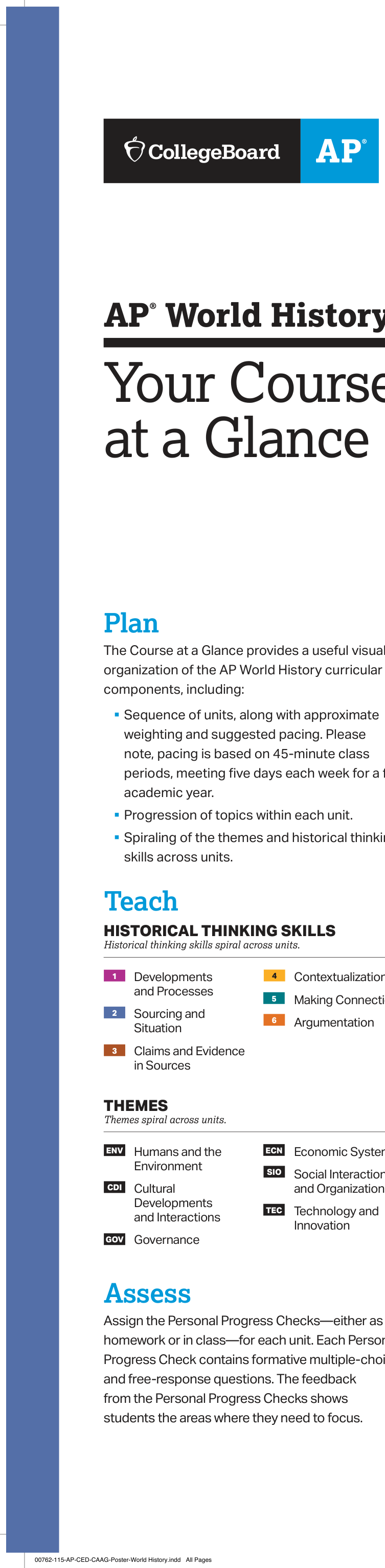
The six course themes provide different lenses for interpreting the same development:
- Humans and the Environment [ENV]: deserts, mountains, and climate shaped routes and travel.
- Cultural Developments and Interactions [CDI]: religions, scripts, medical knowledge, and numbering systems crossed cultural boundaries.
- Governance [GOV]: empires protected routes, collected revenue, and managed diverse peoples.
- Economic Systems [ECN]: production for export and long-distance exchange linked regional economies.
- Social Interactions and Organization [SIO]: merchants, nomads, artisans, officials, and religious communities interacted across political borders.
- Technology and Innovation [TEC]: transportation, administrative techniques, and practical knowledge helped people manage distance.
For this topic, practice Skill 1.A: Identify and describe a historical concept, development, or process by naming what made the Silk Roads a network rather than a single route. Practice Skill 1.B: Explain a historical concept, development, or process by linking Mongol political consolidation to increased Eurasian exchange. Practice Skill 5.A: Identify patterns among or connections between historical developments and processes by connecting Silk Roads trade with cultural transfer and state revenue. The central reasoning process is causation: political security influenced commercial movement, while commerce and cultural exchange strengthened connections among societies.
Worked example: tracing one historical process
Suppose a prompt asks why the Mongol Empire was significant beyond its military conquests. Build the explanation in three steps:
- Political cause: Mongol conquest unified or linked large areas of Eurasia under related imperial authorities.
- Immediate effect: Route protection and administrative coordination made travel and exchange more predictable.
- Broader significance: Merchants, technologies, medical knowledge, scripts, and religious ideas moved more widely, producing cultural and economic consequences.
A strong answer also qualifies the claim: Mongol rule encouraged connectivity after conquest, but conquest itself caused destruction, displacement, and disease transmission. Increased exchange was therefore both productive and dangerous.
Misconception check
Misconception: “The Silk Roads mainly carried silk from China directly to Europe.” In reality, they were multi-route networks involving many intermediaries, goods, and cultural exchanges. Misconception: “The Pax Mongolica was permanent peace.” It describes relative security under Mongol rule, not the absence of warfare or suffering.
Retrieval check
Explain in two sentences why the Mongol Empire could be both destructive and a force for cultural exchange. Then identify one example of a product transfer and one example of a knowledge or technology transfer connected to the Silk Roads.
Source Materials
- AP World History: Modern Course and Exam Description
- AP World History: Modern Course and Exam Description Clarifications and Corrections
- AP World History: Modern Course Overview
- AP World History: Modern Course at a Glance
- AP World History: Modern Course at a Glance Poster
- AP World History: Modern
- AP World History: Modern
- AP World History: Modern Sample Syllabus 1
- 00762-115-AP-CED-CAAG-Poster-World History.indd All Pages 3/29/19 3:04 PM
- 00762-115-AP-CED-CAAG-Poster-World History.indd All Pages 3/29/19 3:04 PM
- Figure — AP World History: Modern Course Overview (p. 3)
- Figure — Sample Responses - DBQ - Set 1 (p. 4)