From the free course AP World History: Modern on Lykke
1.7 Comparison in the Period from c. 1200 to c. 1450
Key concepts: Political fragmentation in medieval Europe · Serfdom · Monarchical power and military assistance · Mongol expansion and its effects on Europe · Cross-cultural interactions · Diffusion of technologies through exchange networks · Long-distance trade routes and environmental knowledge · Diffusion of crops and pathogens · Bubonic plague · Social hierarchy and sovereign authority in Japan
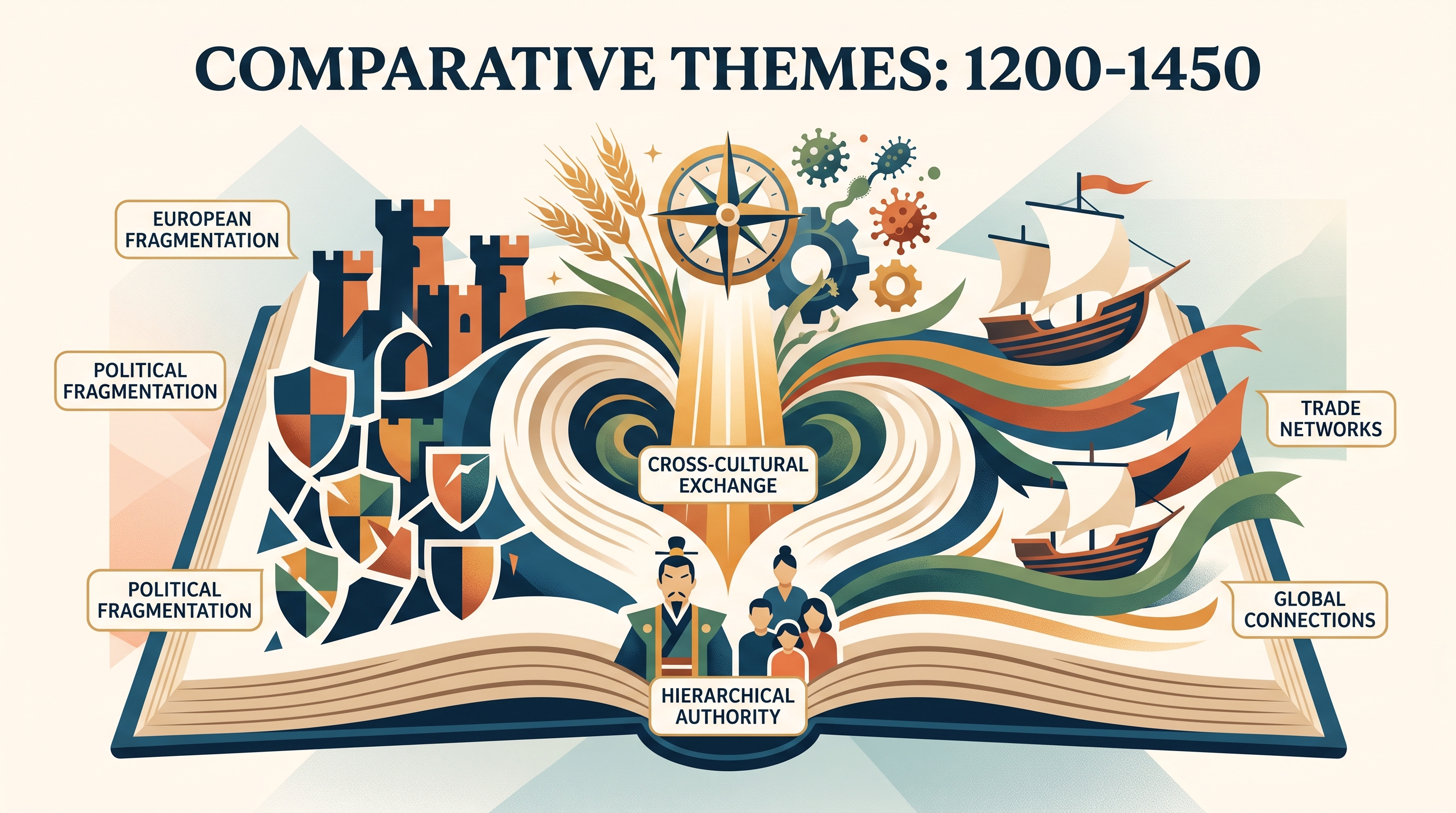
Between c. 1200 and c. 1450, Europe’s fragmented political structure made coordinated responses to external threats difficult, while expanding Afro-Eurasian exchange networks connected societies through technologies, environmental knowledge, crops, and disease.
1.7 Comparison in the Period from c. 1200 to c. 1450
Between c. 1200 and c. 1450, Europe’s fragmented political structure made coordinated responses to external threats difficult, while expanding Afro-Eurasian exchange networks connected societies through technologies, environmental knowledge, crops, and disease.
Europe: Fragmentation, Hierarchy, and Limited Coordination
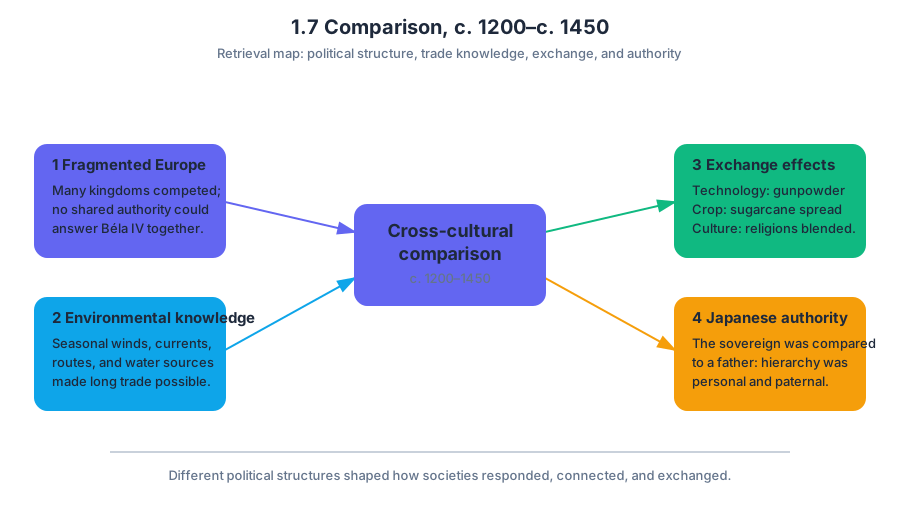
Medieval Europe was divided among competing monarchies, nobles, and other political authorities, and its social order included serfdom, a system in which peasants were legally tied to the land and owed labor or payments to a lord. The important comparison is not simply that Europe was fragmented, but that fragmentation shaped what European rulers could do: kings depended on cooperation from nobles whose military service and political support were necessary but not guaranteed.
A letter written around 1250 by King Béla IV of Hungary to Pope Innocent IV makes this problem concrete. Béla warned that a people advancing from the Black Sea steppes and Central Asia threatened the survival of his kingdom and requested military assistance. His appeal reveals both the scale of the danger and the limits of his authority: a king could ask for aid, but he could not automatically command the resources of all European rulers.
The political fragmentation of Europe helps explain why Béla did not receive the military assistance he requested. European monarchies and nobles competed with one another, and no single authority could easily organize a unified response across the continent. Monarchical power and military assistance were therefore linked: kings sought to strengthen central authority, but their ability to mobilize armies still depended heavily on local elites and broader political cooperation.
Comparison insight: A state may possess a king, armies, and a social hierarchy without possessing highly centralized power. The existence of monarchy does not automatically mean the existence of an effective national government.
Mongol Expansion and Cross-Cultural Contact
Mongol expansion intensified contact between Europe and the societies of Central and East Asia. Mongol conquests disrupted existing political arrangements, threatened states such as Hungary, and also connected distant regions through routes used by merchants, travelers, diplomats, and missionaries. The same expansion could therefore produce destruction and connection at once.
Cross-cultural interaction encouraged the diffusion of scientific and technological innovations. Gunpowder and paper from China moved westward through exchange networks, where technologies could be adapted to new political and commercial settings. Travelers such as Marco Polo, Ibn Battuta, and Margery Kempe also recorded observations that reveal how people encountered unfamiliar societies, customs, and landscapes.
Environmental Knowledge as Infrastructure
Long-distance trade did not operate through goods alone. Merchants and travelers needed environmental knowledge—information about climates, terrain, waterways, agricultural conditions, and seasonal winds—to decide when and where movement was possible. In the Indian Ocean, for example, knowledge of the monsoon winds allowed sailors to plan voyages around predictable seasonal wind patterns rather than treating the ocean as an unknowable barrier.
This knowledge functioned like infrastructure. A merchant who knew the timing of favorable winds, the location of reliable ports, or the availability of food and water could reduce risk, calculate travel time, and coordinate trade across great distances. Environmental information was shared through repeated travel, local pilots, port communities, and written or oral accounts; exchange networks expanded partly because people learned how to read the environments through which they moved.
Exchange Carries Life—and Epidemics
Trade networks also carried biological consequences. Crops continued to diffuse across Afro-Eurasia, supporting dietary change and sometimes population growth, while pathogens moved with travelers, animals, and goods. The bubonic plague spread along trade routes as an epidemic disease, demonstrating that connectivity could make societies more prosperous and more vulnerable at the same time.
Common misconception — “Trade only spreads culture and wealth.” Exchange networks also transmit environmental knowledge, agricultural species, and pathogens. Connectivity is not automatically beneficial; its effects depend on what moves, who controls movement, and how societies respond.
Comparing Cultural Perspectives
Written accounts also show that cross-cultural interaction depended on social assumptions. A Japanese quotation compares the sovereign to Heaven and the father to Heaven in relation to the child, reinforcing hierarchical authority and the expectation that obedience sustains social order. This perspective differs from a European narrator’s account of a person becoming willing to interact with a blind boy after a war, while the narrator had previously been unable to interact similarly with Europeans.
The contrast illustrates that contact can change attitudes, but it does not erase cultural boundaries automatically. The Japanese passage emphasizes hierarchy and proper relationships; the European reflection emphasizes how war and personal experience altered perceptions of outsiders. For Skill 2: Sourcing and Situation, ask what each writer’s position and historical experience reveal about the interaction. For Skill 3: Claims and Evidence in Sources, identify the claim about social authority or cross-cultural trust, then connect it to the passage’s specific evidence.
AP Historical Reasoning
Topic 1.7 Comparison in the Period from c. 1200 to c. 1450 is anchored in Learning Objective 1.7 and KC-1.7.I, especially comparison of political organization and the consequences of exchange. The central reasoning process is Skill 5: Making Connections, including comparison: identify a meaningful similarity or difference, then explain why it mattered. A strong comparison would connect Europe’s divided authority to Béla’s failed request, while contrasting that political fragmentation with the wider connectivity created by Mongol expansion and trade routes.
A complete argument might claim: Europe’s fragmented authority limited coordinated military action, whereas Afro-Eurasian exchange networks enabled sustained movement across political boundaries; however, both systems depended on cooperation among local actors and produced mixed consequences, including cultural diffusion alongside epidemic disease.
Retrieval Check
- Why did Europe’s political fragmentation make Béla IV’s request difficult to answer collectively?
- How did environmental knowledge help long-distance trade routes function?
- Name one technology, one crop-or-pathogen consequence, and one cultural effect of cross-cultural exchange.
- What does the Japanese comparison between sovereign and father reveal about hierarchical authority?
Source Materials
- AP World History: Modern Course and Exam Description
- AP World History: Modern Course and Exam Description Clarifications and Corrections
- AP World History: Modern Course Overview
- AP World History: Modern Course at a Glance
- AP World History: Modern Course at a Glance Poster
- AP World History: Modern
- AP World History: Modern
- AP World History: Modern Sample Syllabus 1
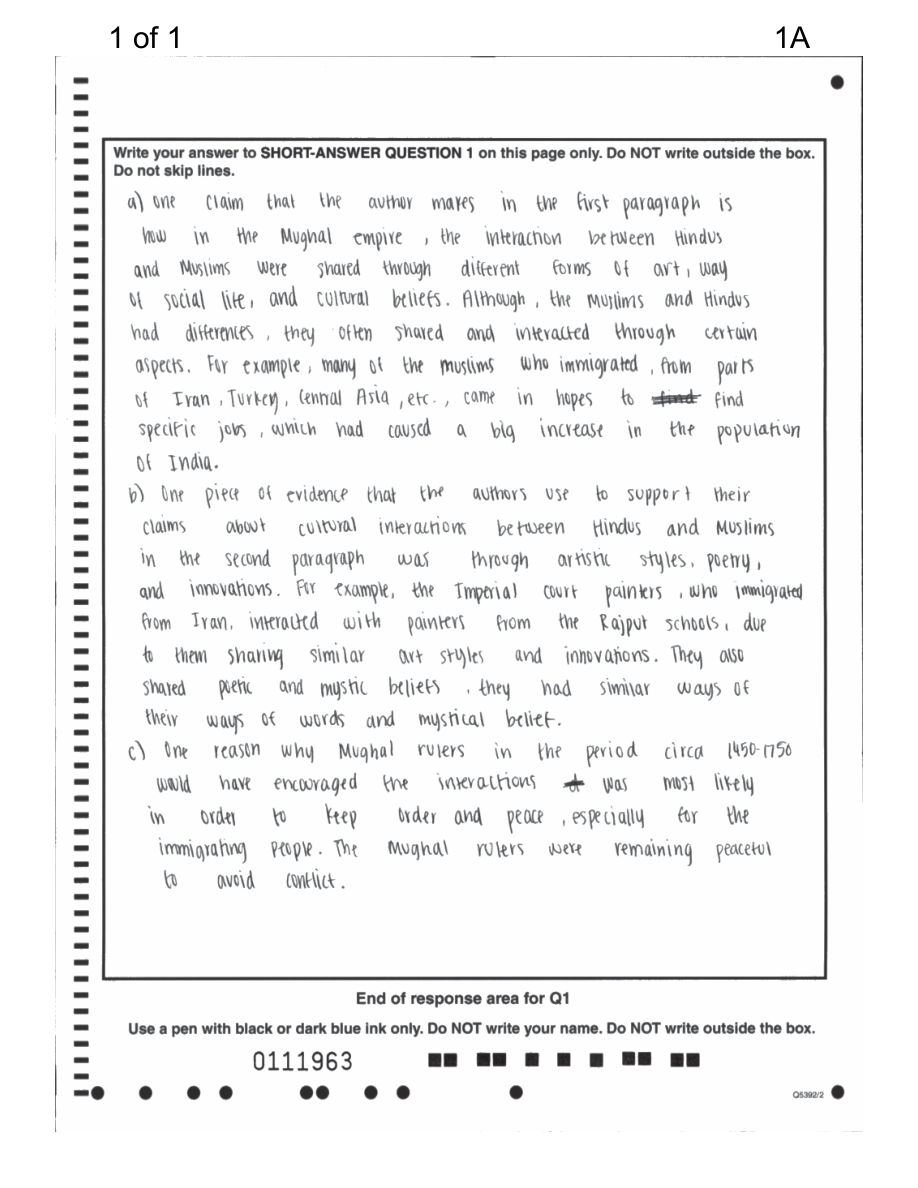
- Figure — Sample Responses - SAQ 1 - Set 1 (p. 4)
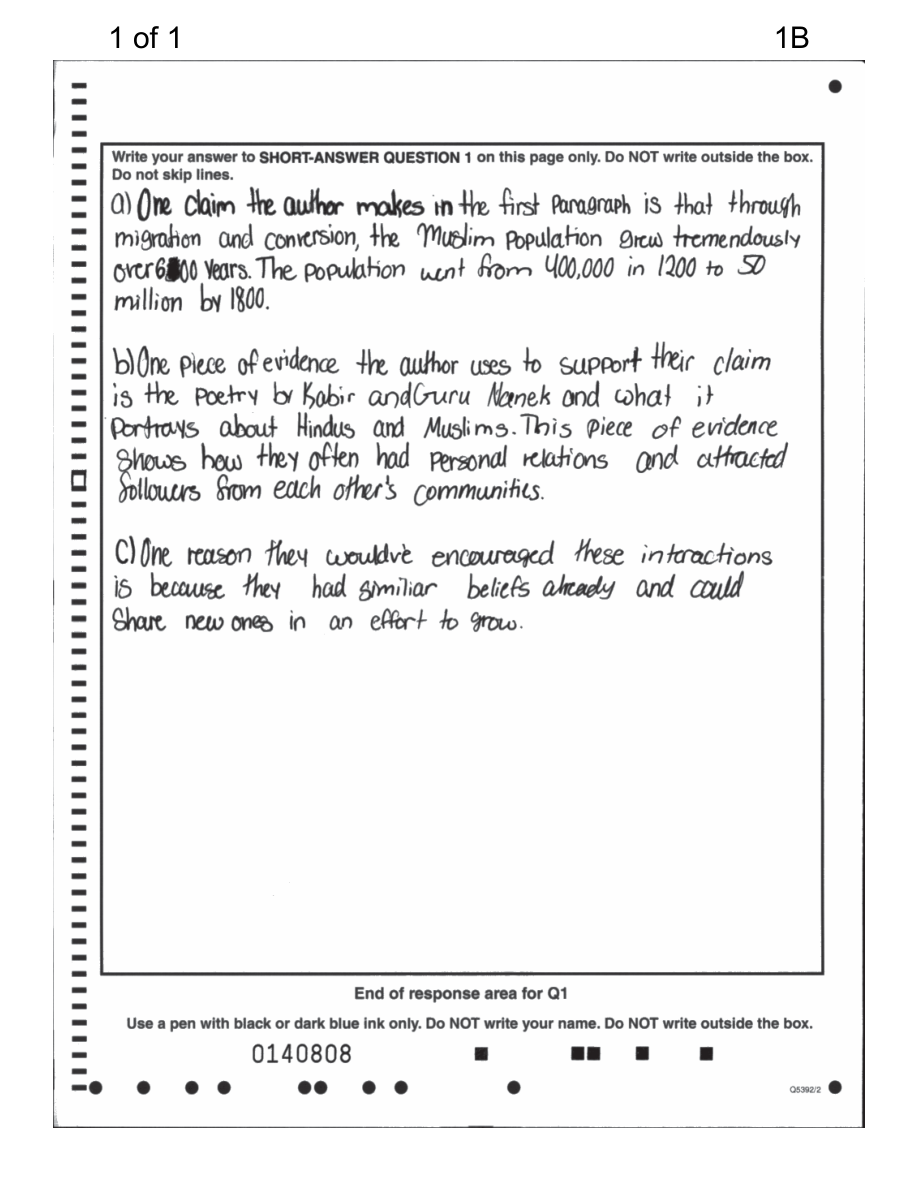
- Figure — Sample Responses - SAQ 1 - Set 1 (p. 5)
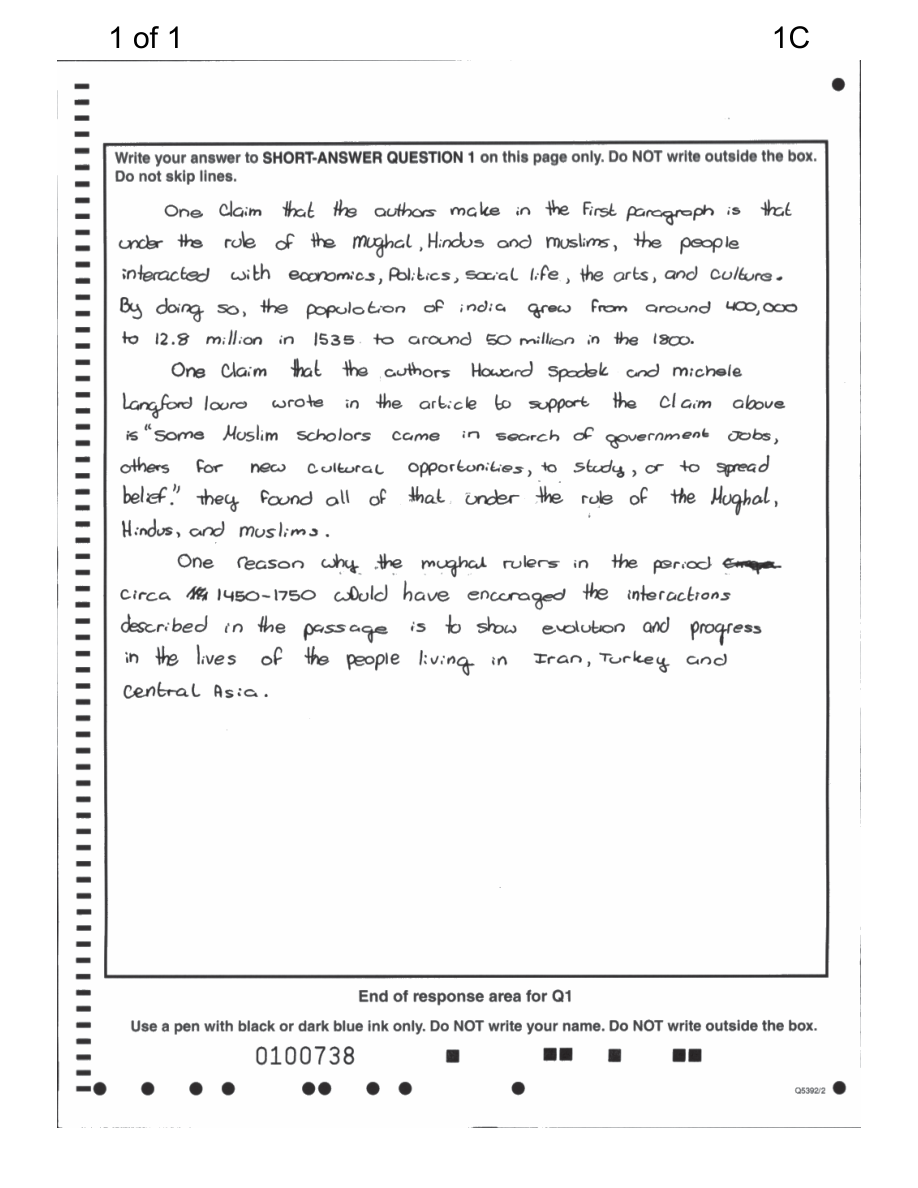
- Figure — Sample Responses - SAQ 1 - Set 1 (p. 6)
- [a] Identify ONE development in the period circa 1200–1300 that facilitated the establishment of the Mongol Empire.