From the free course AP World History: Modern on Lykke
6.3 Indigenous Responses to State Expansion from 1750 to 1900 · 6.4 Global Economic Development from 1750 to 1900
Key concepts: Indigenous responses to state expansion · State expansion from 1750 to 1900 · Rationales for imperialism · Industrialization · Global economic development · Economic systems and global trade · Migration · Bureaucracy and state rule · Nationalism and direct resistance · Karl Marx, socialism, and communism
Explain and apply 6.3 Indigenous Responses to State Expansion from 1750 to 1900 · 6.4 Global Economic Development from 1750 to 1900.
6.3 Indigenous Responses to State Expansion from 1750 to 1900 · 6.4 Global Economic Development from 1750 to 1900
When expanding states met established societies between $1750$ and $1900$, the result was never simply “conquest.” Indigenous peoples resisted, negotiated, reorganized, migrated, and sometimes built new states of their own. At the same time, industrial production connected distant economies so tightly that the way one society produced and exchanged goods could transform another.
6.3 Indigenous Responses to State Expansion from 1750 to 1900
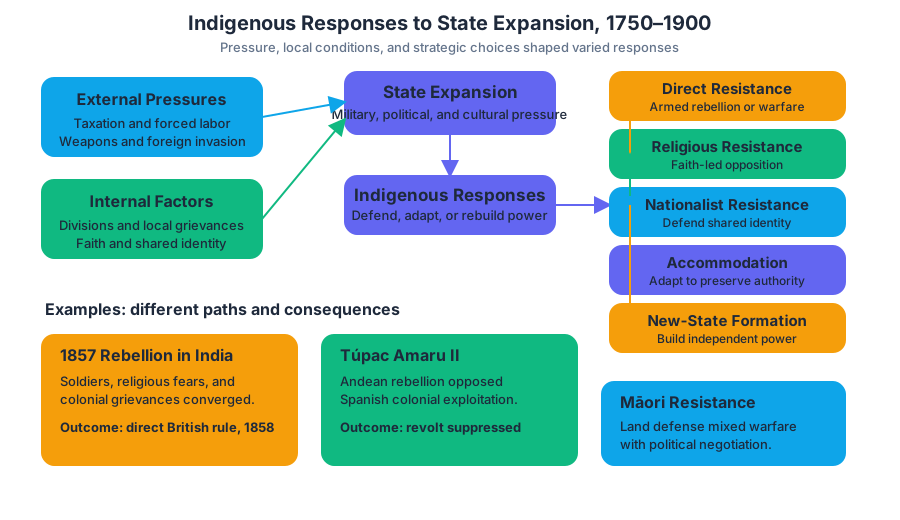
Indigenous responses to state expansion were the strategies used by peoples facing the military, political, economic, or cultural pressure of expanding empires and centralized states. These responses were shaped by both internal factors—such as political divisions, religious beliefs, nationalism, and dissatisfaction with local rulers—and external factors, including military technology, taxation, forced labor, and foreign invasion.
The major response patterns included:
- Direct resistance: armed rebellion or warfare against an expanding state.
- Religious resistance: opposition organized around religious leaders or beliefs.
- Nationalist resistance: attempts to defend or create a political community based on shared identity.
- Accommodation: selective cooperation or adaptation to preserve land, authority, or cultural practices.
- New-state formation: creating an independent or semi-independent political structure.
The 1857 rebellion in India shows how several causes could combine. Indian soldiers in the British East India Company’s army rebelled amid distrust of British policies, military grievances, and fears that colonial rule threatened established religious and social practices. The uprising spread beyond the army, but it failed to remove British power. Its consequence was nevertheless substantial: the British government ended the East India Company’s rule and assumed direct control of India in $1858$.
Other examples reveal different combinations of resistance and state-building. Túpac Amaru II’s rebellion in Peru opposed Spanish colonial authority and burdens imposed on Indigenous communities. In West Africa, Samory Touré fought French expansion, while the Yaa Asantewaa War challenged British efforts to dominate the Asante region. The Zulu Kingdom and the Sokoto Caliphate demonstrate that African peoples did not merely react to European expansion; they also built powerful states using military organization, religious legitimacy, and political consolidation.
Misconception check — “Indigenous resistance was always spontaneous.” Resistance often depended on organized leadership and preexisting political structures. Nationalism, religious ideas, and local conflicts could turn opposition into a sustained movement. Conversely, internal divisions could weaken resistance even when external pressure was intense.
Source skill: 2.C Sourcing and Situation
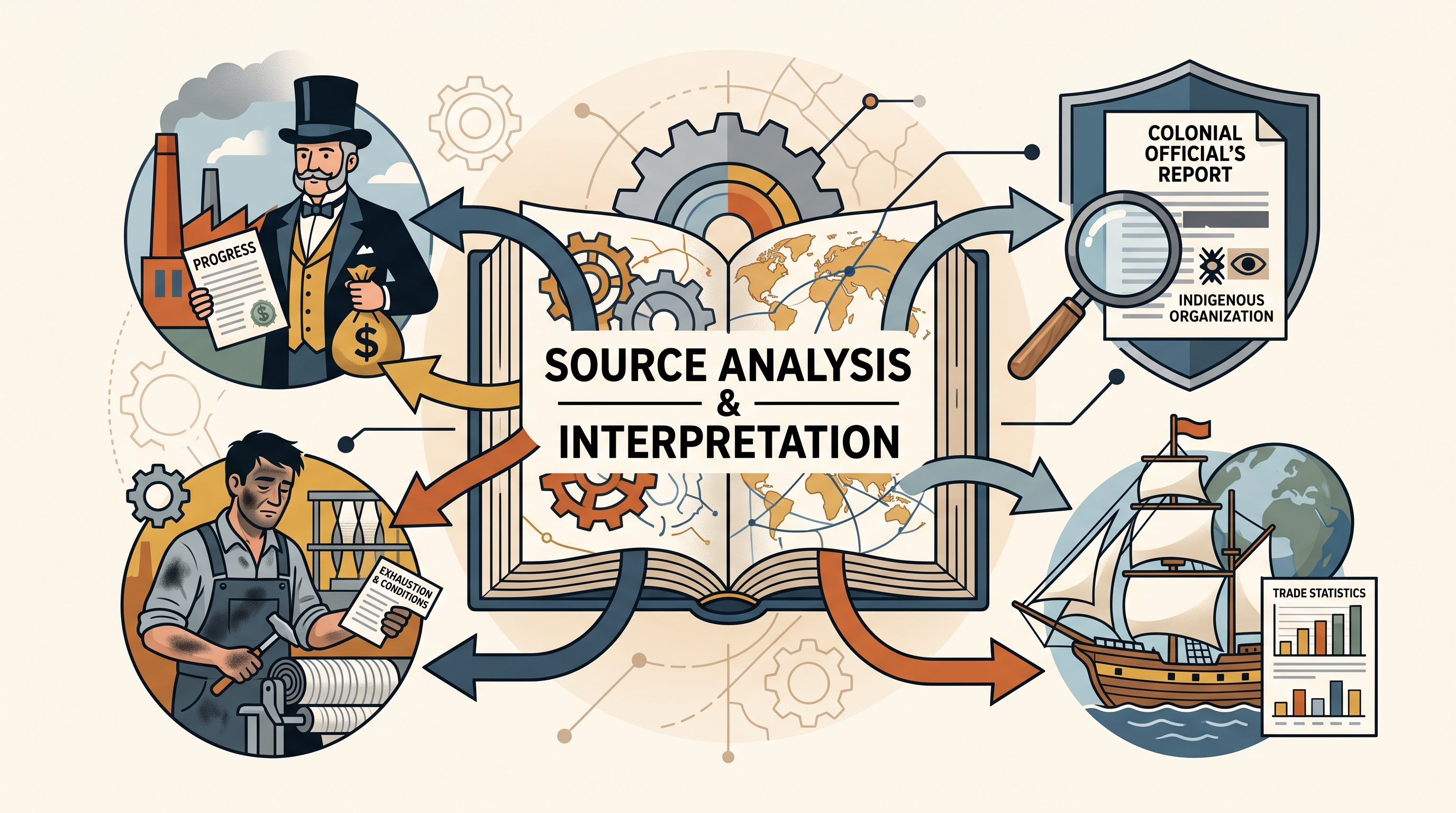
The suggested skill for Topic 6.3 is 2.C: Explain the significance of a source’s point of view, purpose, historical situation, and/or audience, including how these might limit the use(s) of a source. A colonial official describing a rebellion may emphasize “disorder” to justify repression; a rebel proclamation may stress religion or national identity to mobilize support. Neither source should be accepted as a complete account without considering who created it, why, and under what conditions.
Worked interpretation: If a British report calls the 1857 uprising a military mutiny, its purpose may be to reassure British readers that the rebellion was narrow and controllable. Evidence that civilians and regional leaders also participated would complicate that description. The source remains useful—but primarily for revealing how British authorities wanted the uprising understood.
6.4 Global Economic Development from 1750 to 1900
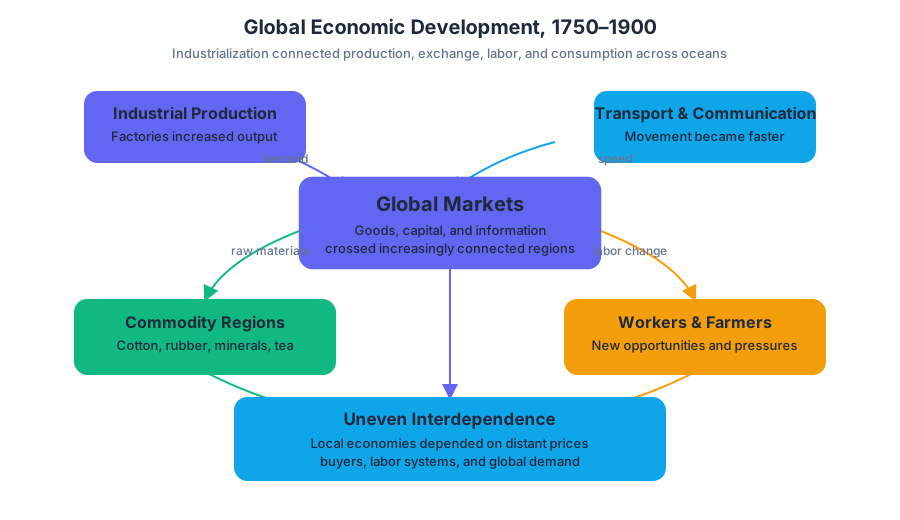
Global economic development means the changing ways societies produced, exchanged, and consumed goods across increasingly connected regions. Industrialization expanded factory production, transportation, and demand for raw materials, while global trade linked producers, merchants, workers, and consumers across oceans.
The relationship worked in both directions:
| Economic change | Consequence |
|---|---|
| Industrial production increased demand for raw materials | Regions producing cotton, rubber, minerals, tea, and other commodities became more important to global markets |
| Railways, steamships, and communication systems reduced travel and transaction time | Goods, capital, information, and people moved more rapidly |
| Global trade expanded | Local economies became more dependent on distant prices and buyers |
| Factory labor and commercial agriculture grew | Workers and farmers experienced new opportunities, pressures, and forms of inequality |
Industrialization also encouraged new political and economic ideologies. Karl Marx argued that industrial society was divided by class conflict, especially between owners of capital and wage laborers. Socialism proposed greater collective control over production, while communism sought a classless society in which productive resources would not be privately controlled. These ideologies grew partly from discontent with established power structures and the poverty and insecurity associated with industrial economies.
Migration formed another major connection between industrialization and global development. Many people relocated voluntarily in search of work, including migrants moving toward expanding industrial cities, plantations, mines, and infrastructure projects. Industrial economies therefore created both labor demand and population movement, although migration patterns varied according to wages, coercion, legal restrictions, and access to transportation.
Source skill: 2.B Sourcing and Situation
Topic 6.4 emphasizes 2.B: Explain how the point of view, purpose, historical situation, and/or audience of a source might affect its interpretation. A factory owner’s account may present industrial growth as progress, while a worker’s testimony may emphasize exhaustion, low wages, or dangerous conditions. A trade statistic can demonstrate expanding exchange, but it may not reveal who controlled the profits or who bore the social costs.
Retrieval check: Explain one way the 1857 rebellion in India reflected both internal and external pressures. Then identify one reason a source written by a colonial official might understate Indigenous political organization. Finally, connect industrialization to global trade in one causal sentence.

Source Materials
- AP World History: Modern Course and Exam Description
- AP World History: Modern Course and Exam Description Clarifications and Corrections
- AP World History: Modern Course Overview
- AP World History: Modern Course at a Glance
- AP World History: Modern Course at a Glance Poster
- AP World History: Modern
- AP World History: Modern
- AP World History: Modern Sample Syllabus 1
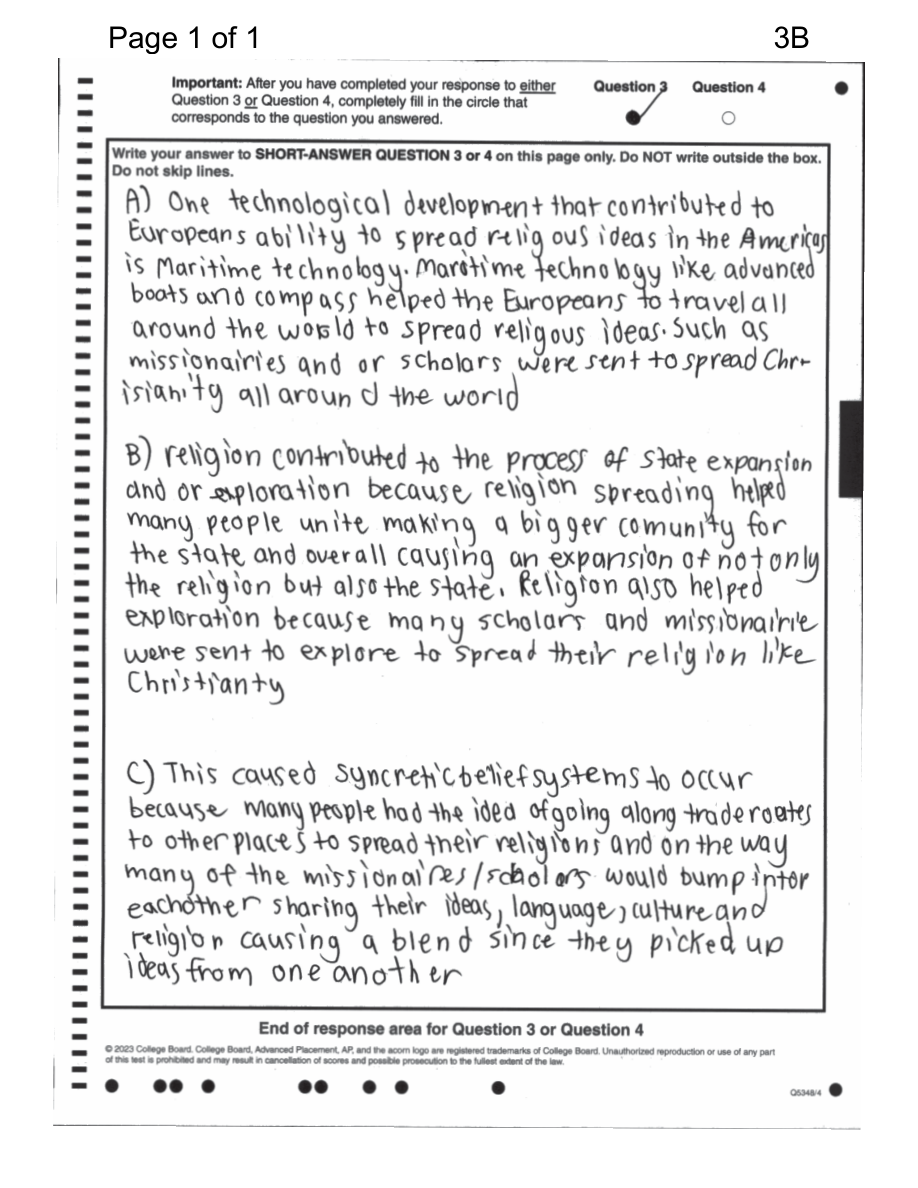
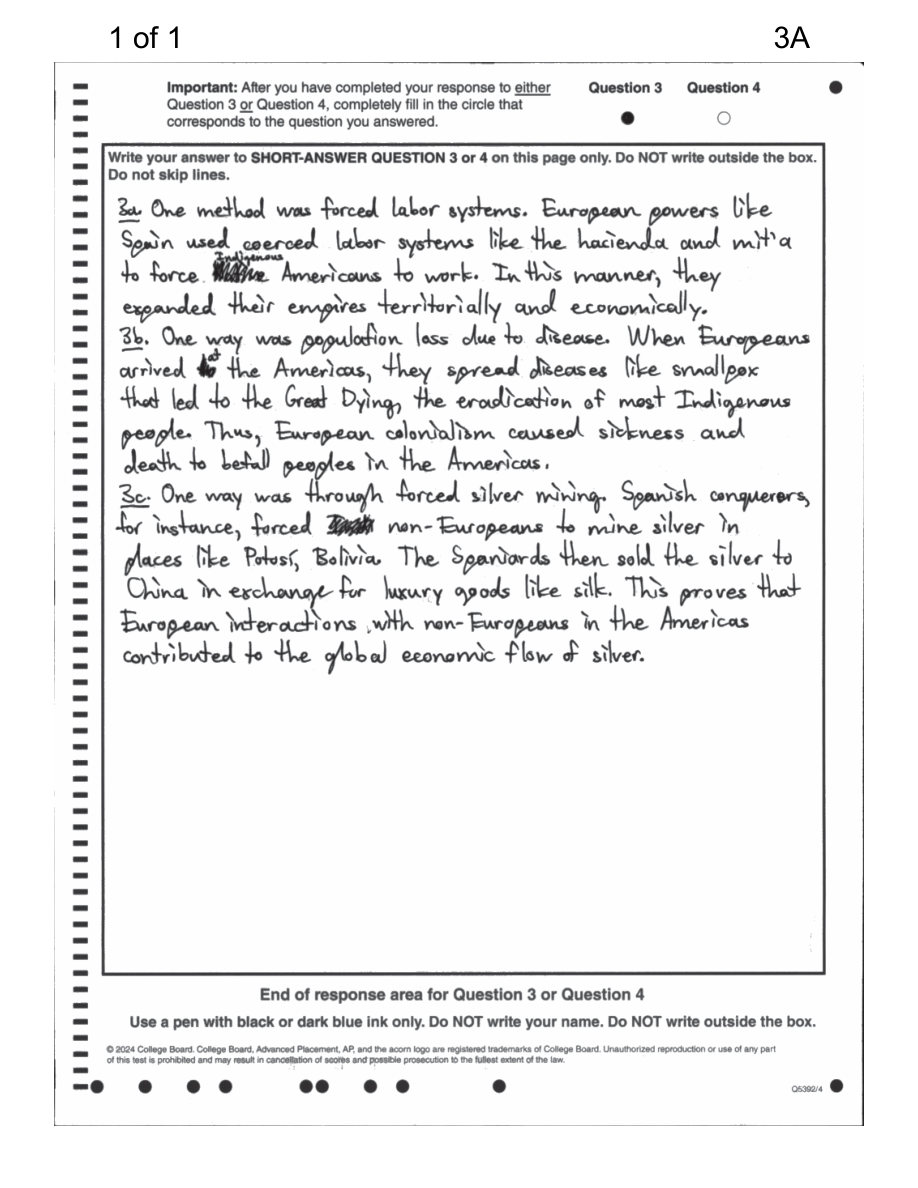
- Figure — Sample Responses - SAQ 3 - Set 2 (p. 4)
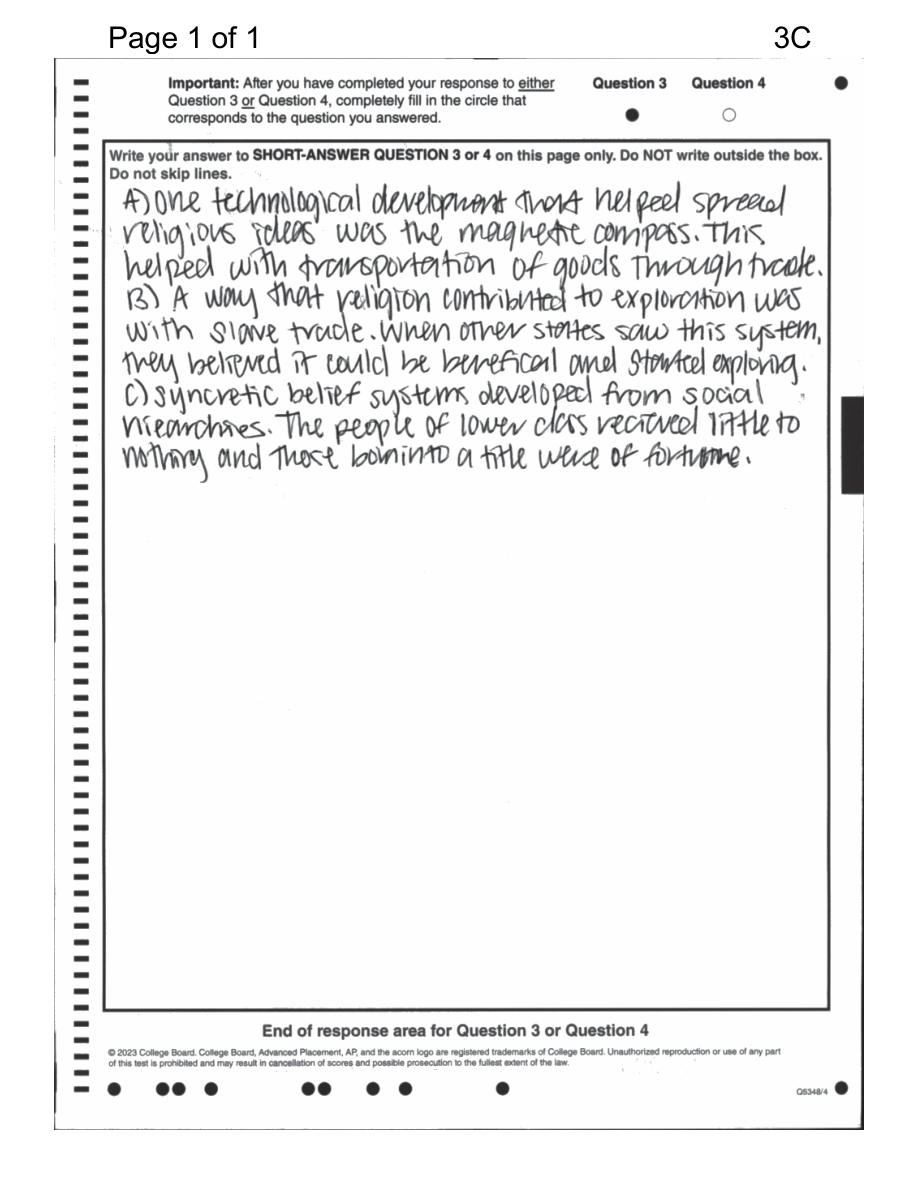
- Figure — Sample Responses - SAQ 3 - Set 2 (p. 5)
- Figure — Sample Responses - SAQ 3 - Set 2 (p. 6)
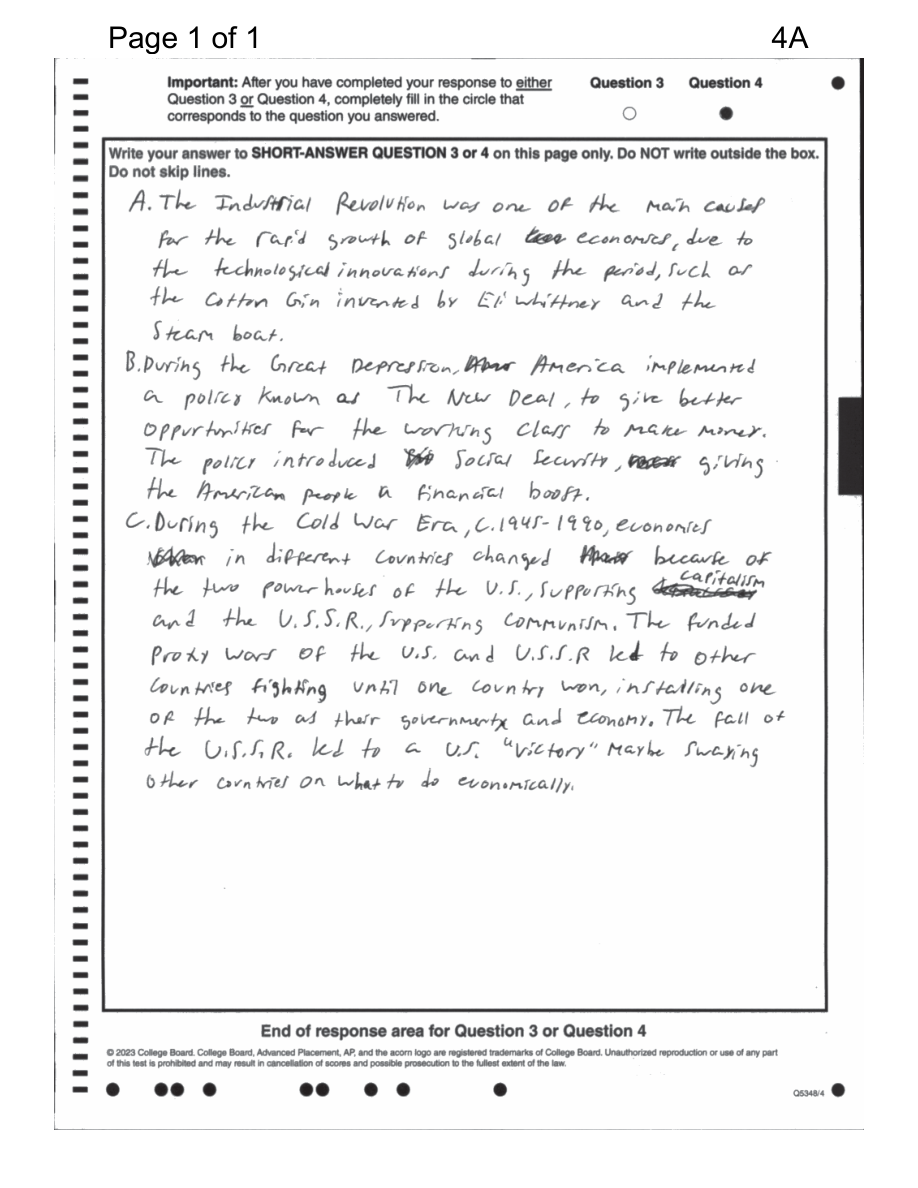
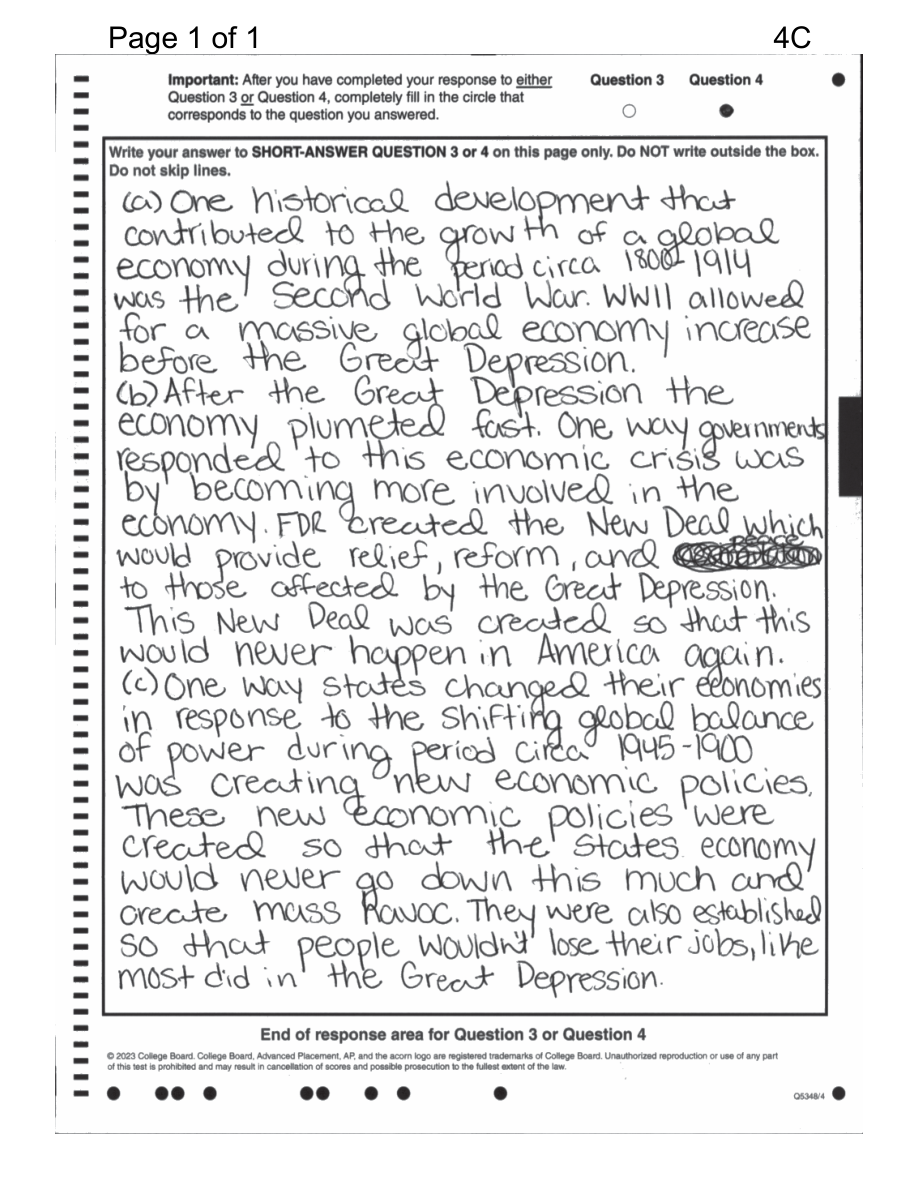
- Figure — Sample Responses - SAQ 4 - Set 2 (p. 4)