From the free course AP World History: Modern on Lykke
5.5 Technology of the Industrial Age · 5.6 Industrialization: Government’s Role from 1750 to 1900
Key concepts: Industrialization from 1750 to 1900 · Technology of the Industrial Age · The spread of industrialization · Government’s role in industrialization · Causation in historical developments · Continuity and change over time · Interactions between humans and the environment · Economic developments during industrialization
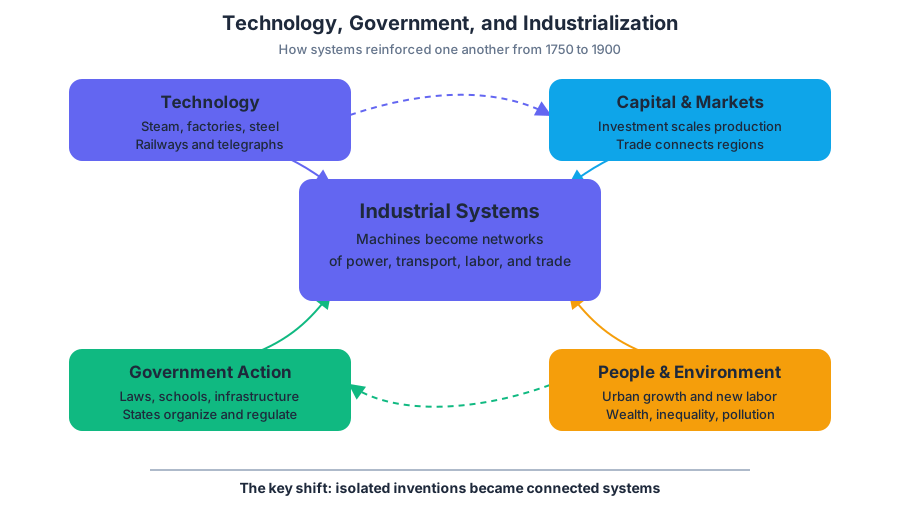
Industrialization became transformative when machines stopped being isolated inventions and became parts of systems: factories needed power, railways needed steel, telegraphs needed governments and capital, and expanding states increasingly shaped who received the benefits.
5.5 Technology of the Industrial Age · 5.6 Industrialization: Government’s Role from 1750 to 1900
Industrialization became transformative when machines stopped being isolated inventions and became parts of systems: factories needed power, railways needed steel, telegraphs needed governments and capital, and expanding states increasingly shaped who received the benefits. The central question is therefore not simply what technologies appeared, but how technology, government action, economic development, and the environment reinforced one another from 1750 to 1900.
5.5 Technology of the Industrial Age examines how new technologies supported industrialization and spread beyond Britain. 5.6 Industrialization: Government’s Role from 1750 to 1900 examines how governments actively encouraged, organized, or controlled that process.
Technology became a connected industrial system
A steam engine mattered because it could do more than replace human muscle. Attached to factory machinery, it supplied regular power; placed in a locomotive, it moved coal, workers, and manufactured goods; adapted to ships, it altered the speed and reliability of oceanic transport. One invention therefore generated effects across production, transportation, communication, and state power.
| Technological change | Immediate function | Wider historical connection |
|---|---|---|
| Steam-powered machinery | Supplied mechanical energy | Expanded factory production |
| Railroads | Connected mines, factories, cities, and ports | Integrated national markets |
| Steamships | Made ocean transport faster and more predictable | Intensified global exchange |
| Telegraphy | Sent information rapidly across distance | Improved commercial and governmental coordination |
The technology of the Industrial Age did not spread automatically. Industrialization and its technologies expanded from Britain to other parts of Europe and to the United States, Russia, and Japan, but each society adapted imported machinery to its own resources, institutions, and political goals. Coal deposits, transportation networks, skilled labor, investment capital, and state policy all influenced the pace and character of industrial development.
Government was an industrial actor
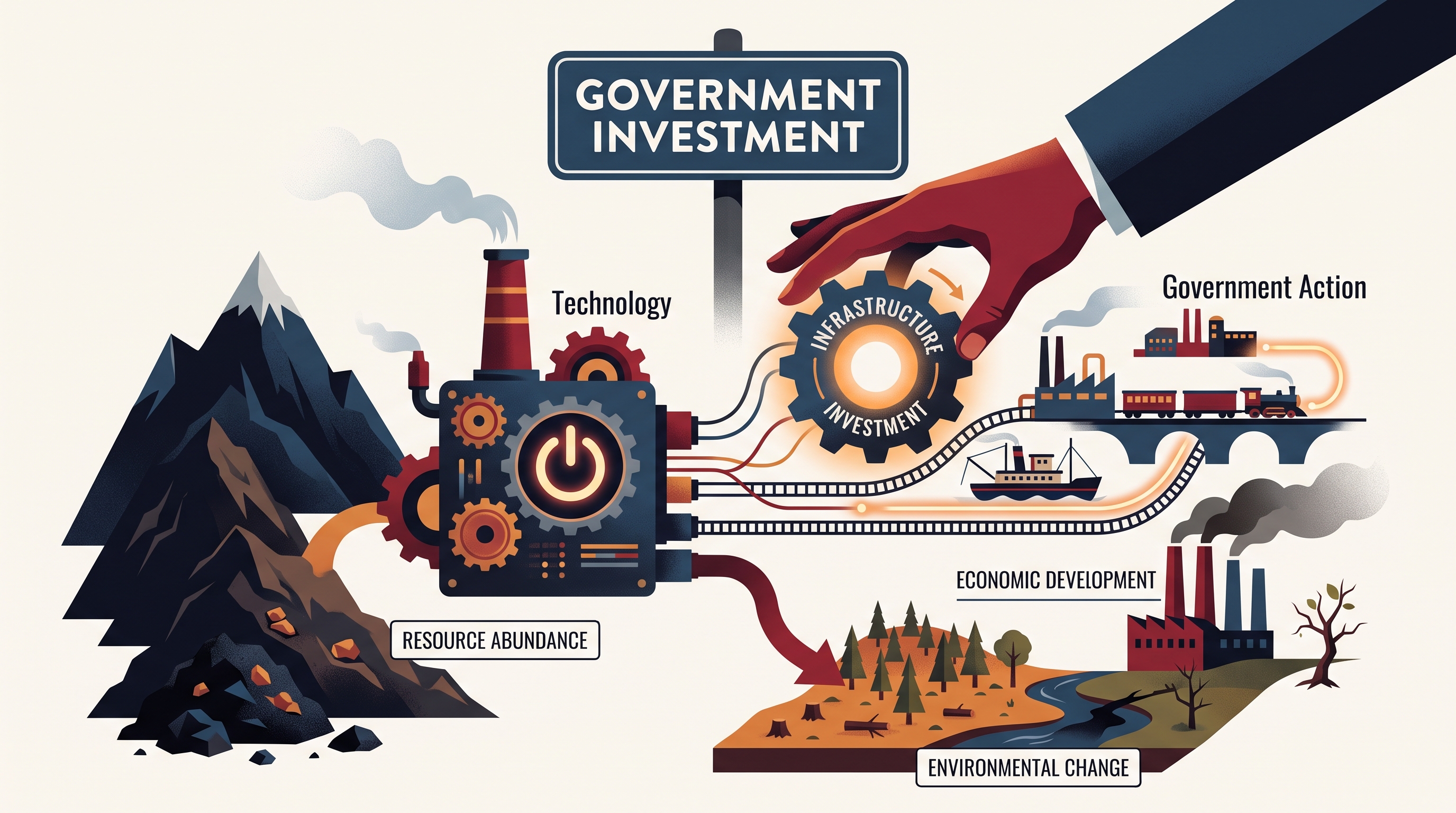
The government’s role was a central historical development of the period. States could sponsor railways, protect domestic industries with tariffs, invest in infrastructure, support technical education, provide legal systems for corporations and contracts, and use military power to secure resources and markets. Industrialization was therefore not merely a story of private entrepreneurs inventing machines.
Key distinction: Governments did not all industrialize in the same way. Some encouraged private investment; others directly managed major projects or used industrialization to strengthen military and political power.
Worked example: Japan’s industrial transformation
After the Meiji government consolidated power in the late nineteenth century, it treated industrialization as a means of strengthening the state. Officials supported modern factories, transportation networks, military production, and technical training. The reasoning chain is:
- Government action: the state directed resources toward modern infrastructure and industry.
- Technological effect: imported and adapted technologies increased production and transportation capacity.
- Economic effect: Japan developed stronger industrial and commercial capabilities.
- Political effect: the central government gained greater military and international power.
This example demonstrates causation without reducing history to a single cause. Technology enabled change, but government policy helped determine which technologies were acquired, funded, and placed into national service.
Industrialization reshaped the environment—and the reverse
The relationship between industrial society and the environment operated in both directions. Coal, iron, waterways, and agricultural land shaped where industries could develop; meanwhile, mines, factories, railroads, and expanding cities transformed landscapes. Growing and changing populations also altered environments by increasing demand for fuel, food, housing, and transportation.
A useful causal map is:
Resources → industrial technology → expanded production → population growth and urban change → increased environmental pressure
The arrow is not one-way. Environmental resources made industrialization possible, while industrialization reorganized those resources and changed the environments in which people lived.
Historical reasoning: causation and continuity/change
For Skill 5.A: Identify patterns among or connections between historical developments and processes, connect repeated relationships rather than merely listing inventions. For example, railways, steamships, and telegraphy all compressed distance and helped governments and businesses coordinate larger economies.
For Skill 5.B: Explain how a historical development or process relates to another historical development or process, explain the mechanism linking them. A strong explanation does not say only “industrialization spread because of technology”; it shows that state investment, transportation, resources, and economic goals helped technologies move and operate in new settings.
Continuity and change over time requires a balanced claim. Industrialization changed the scale and speed of production, but older political institutions, unequal access to resources, and environmental dependence continued. The period was therefore neither total rupture nor simple continuation.
Misconception check
Misconception: “Industrialization was caused by inventions alone.” Inventions created possibilities, but governments, investors, labor forces, natural resources, and markets determined whether those possibilities became durable industrial systems. A precise historical answer links technological change to institutional and environmental conditions.
Retrieval check
Explain one way government action connected technology to economic development between 1750 and 1900. Then identify one environmental factor that shaped industrialization and one way industrialization reshaped the environment. Your answer should use a clear cause-and-effect chain, not just three separate examples.
Source Materials
- AP World History: Modern Course and Exam Description
- AP World History: Modern Course and Exam Description Clarifications and Corrections
- AP World History: Modern Course Overview
- AP World History: Modern Course at a Glance
- AP World History: Modern Course at a Glance Poster
- AP World History: Modern
- AP World History: Modern
- AP World History: Modern Sample Syllabus 1