From the free course AP World History: Modern on Lykke
8.7 Global Resistance to Established Order After 1900 · 8.8 End of the Cold War
Key concepts: Global resistance to established power structures after 1900 · Decolonization and the dissolution of empires · Negotiated independence · Armed struggle for independence · End of the Cold War · Causes of the end of the Cold War · Margaret Thatcher · China under Deng Xiaoping · Anti-imperialist sentiment · Changing global balance of power after World War II
After World War II, resistance to established power structures reshaped both political borders and the global balance of power. Some colonies secured independence through negotiation, while others fought armed struggles; by the late twentieth century, a different challenge—the weakening of Soviet power—brought the…
8.7 Global Resistance to Established Order After 1900 · 8.8 End of the Cold War
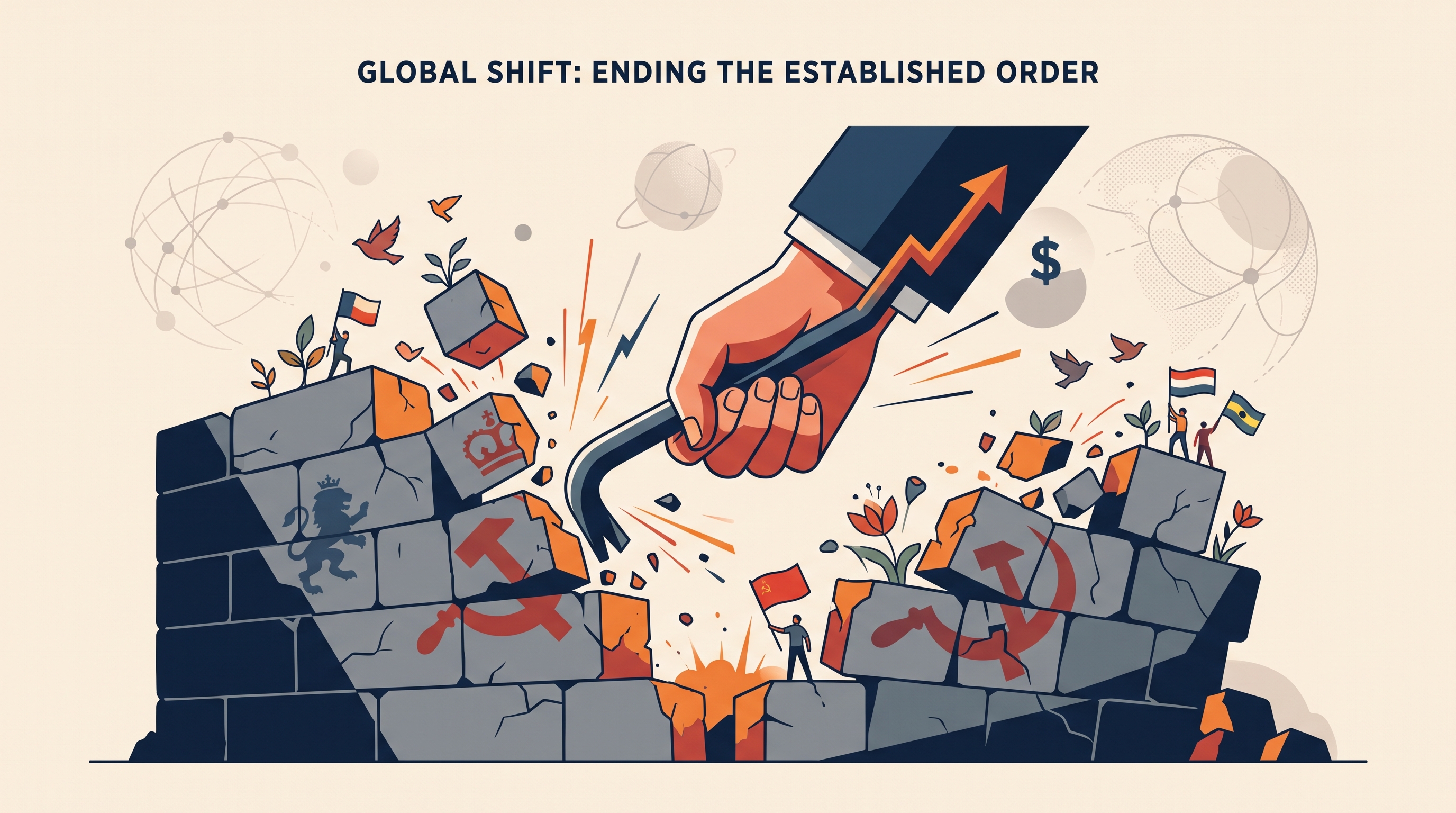
After World War II, resistance to established power structures reshaped both political borders and the global balance of power. Some colonies secured independence through negotiation, while others fought armed struggles; by the late twentieth century, a different challenge—the weakening of Soviet power—brought the Cold War to an end.
Resistance and the Dissolution of Empires
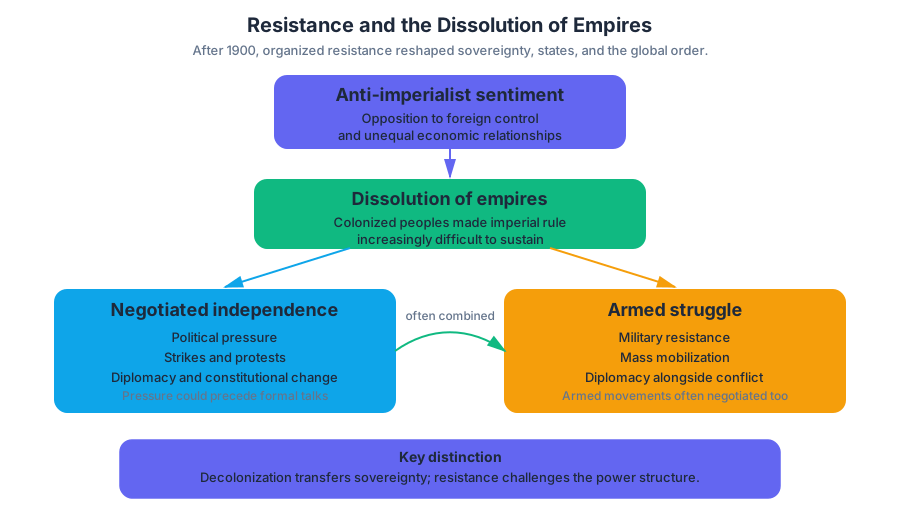
Anti-imperialist sentiment means opposition to foreign political control and the unequal economic relationships associated with empire. After World War II, this sentiment contributed to the dissolution of empires and the restructuring of states. The change was not simply a European decision to withdraw: colonized peoples used political organizations, mass movements, diplomacy, and armed resistance to make imperial rule increasingly difficult to sustain.
Key distinction: Decolonization describes the transfer or recovery of political sovereignty; resistance describes the methods used to challenge the existing power structure.
The contrast between negotiated independence and armed struggle for independence is therefore analytical rather than absolute. Negotiation could follow strikes, protests, or political pressure, while armed movements often combined military action with diplomacy. The important question is not whether one method was universally successful, but how each shaped the timing, boundaries, and political conditions of independence.
Worked comparison: Angola and Vietnam
Angola gained independence from the Portuguese Empire after a prolonged armed struggle. Portugal’s withdrawal followed anti-colonial warfare and political upheaval in Portugal itself, so Angolan independence emerged amid intense competition among rival movements and outside powers. Independence ended Portuguese rule, but it did not immediately produce political stability.
Vietnam gained independence from the French Empire through armed conflict led by Vietnamese nationalists and communists. The struggle demonstrated that an anti-colonial movement could defeat a European empire militarily, but it also became entangled with the wider Cold War. Vietnam therefore illustrates how resistance to imperialism and rivalry between superpowers could operate simultaneously.
| Case | Imperial power | Main independence pathway | Broader significance |
|---|---|---|---|
| Angola | Portugal | Armed struggle | Decolonization overlapped with Cold War intervention and internal conflict |
| Vietnam | France | Armed struggle | Anti-imperial nationalism became connected to communist revolution and superpower rivalry |
Misconception check — “Negotiated independence was peaceful.” Negotiation describes the formal method of transferring authority, not necessarily the entire history leading to that transfer. Political pressure, violence, economic disruption, or fear of wider conflict could all push an imperial government toward negotiations.
Historical Context and Power Shifts
The postwar restructuring of states rested on a major shift in global power. KC-6.2.IV.C.i identifies the technological and economic gains experienced during World War II by victorious nations as a factor that shifted the global balance of power. The war weakened European empires while strengthening the United States and the Soviet Union, whose competing political and economic models shaped the international environment in which new states emerged.
The required thematic lens for Topic 8.7 is Cultural Developments and Interactions [CDI]. Resistance was not only military or governmental: anti-imperialist movements challenged ideas of racial hierarchy, European cultural superiority, and the supposed legitimacy of foreign rule. This connects to Unit 8: Learning Objective I, “Explain various reactions to existing power structures in the period after 1900,” because resistance changed both institutions and the beliefs used to justify them.
Why the Cold War Ended
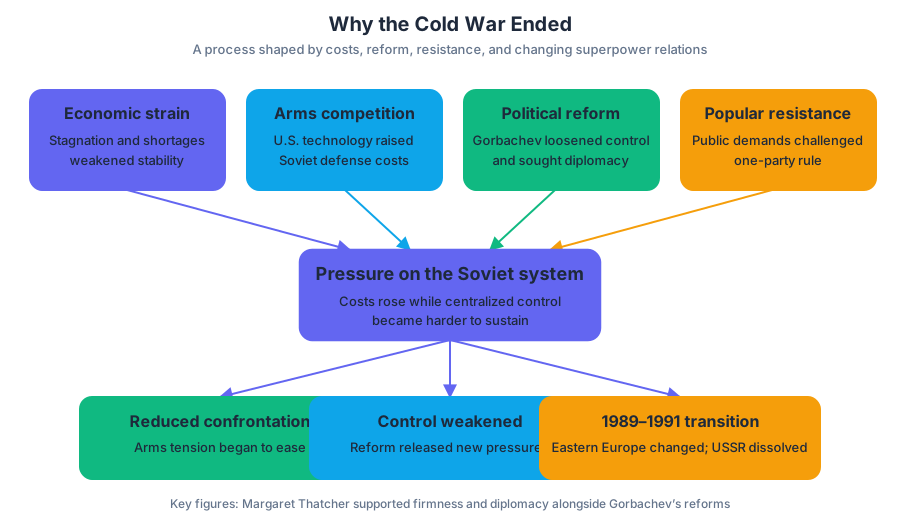
The Cold War ended through the interaction of economic strain, political reform, popular resistance, and technological competition—not because of one isolated event. The Soviet Union faced the enormous cost of maintaining military power and competing technologically with the United States while also dealing with stagnating economic performance and growing demands for political change.
Advances in U.S. military and technological development increased pressure on the Soviet system. The competition required the Soviet Union to devote substantial resources to defense and technology. Soviet costly military and technological development deepened that burden: resources spent sustaining superpower competition were resources unavailable for consumer needs, economic modernization, and political stability.
Political leadership also mattered. Margaret Thatcher, the British prime minister, is identified as an important figure associated with the end of the Cold War because she supported a firm stance toward the Soviet Union while also engaging in diplomacy with Soviet leader Mikhail Gorbachev. In the Soviet Union, Gorbachev’s reforms loosened political controls and attempted to reduce the costs of confrontation, but these reforms also released pressures that the Soviet government could not fully contain.
The end of the Cold War was therefore a process: arms competition increased Soviet costs; reform weakened centralized control; popular movements challenged communist governments in Eastern Europe; and the Soviet Union ultimately dissolved in 1991. The collapse of the Soviet state ended the bipolar structure that had organized international politics since the mid-twentieth century.
A New Global Economic Direction
The post-Cold War order also encouraged governments to adopt free-market economic policies and promote economic liberalization, meaning the reduction of state controls over markets, trade, and private enterprise. KC-6.3.I.D connects this trend to the end of the Cold War and identifies China under Deng Xiaoping, Chile under Augusto Pinochet, and knowledge economies such as Finland, Japan, and the United States as relevant developments.
China under Deng Xiaoping is especially important because political rule remained communist while economic policy incorporated market-oriented reforms. This demonstrates that the end of the Cold War did not create one identical political system everywhere; instead, states selectively combined centralized authority, global trade, private enterprise, and technological development.
Misconception check — “The Cold War ended only because the United States won an arms race.” Military and technological pressure was significant, but it interacted with Soviet economic difficulties, reform politics, resistance in Eastern Europe, and changing international relationships. A strong explanation must connect multiple causes rather than name a single victor or event.
Retrieval Check
Explain the difference between Angola and Vietnam as examples of armed independence struggles, then identify two connected causes of the end of the Cold War. A strong response would link anti-imperialist resistance to the dissolution of empires, and would connect U.S. technological pressure with the Soviet Union’s costly military development and internal political-economic strain.
Source Materials
- AP World History: Modern Course and Exam Description
- AP World History: Modern Course and Exam Description Clarifications and Corrections
- AP World History: Modern Course Overview
- AP World History: Modern Course at a Glance
- AP World History: Modern Course at a Glance Poster
- AP World History: Modern
- AP World History: Modern
- AP World History: Modern Sample Syllabus 1