From the free course AP World History: Modern on Lykke
9.1 Advances in Technology and Exchange After 1900 · 9.2 Technological Advances and Limitations After 1900: Disease
Key concepts: Technological innovation after 1900 · Globalization and exchange · Communication technologies · The Green Revolution · Commercial agriculture · Chemical and genetically modified agriculture · Medical innovations · Vaccines and antibiotics · Increased human longevity · Persistent and emerging diseases
Explain and apply 9.1 Advances in Technology and Exchange After 1900 · 9.2 Technological Advances and Limitations After 1900: Disease.
9.1 Advances in Technology and Exchange After 1900 · 9.2 Technological Advances and Limitations After 1900: Disease
After 1900, technology made the world more connected, productive, and medically resilient—but also more vulnerable to rapid global crises. A message, crop variety, or infectious disease could now cross oceans at a speed earlier societies could scarcely imagine.
Core distinction: technological innovation increased humanity’s ability to move information, goods, food, and people; it also increased the speed and scale at which diseases and unintended consequences could spread.
A faster web of exchange
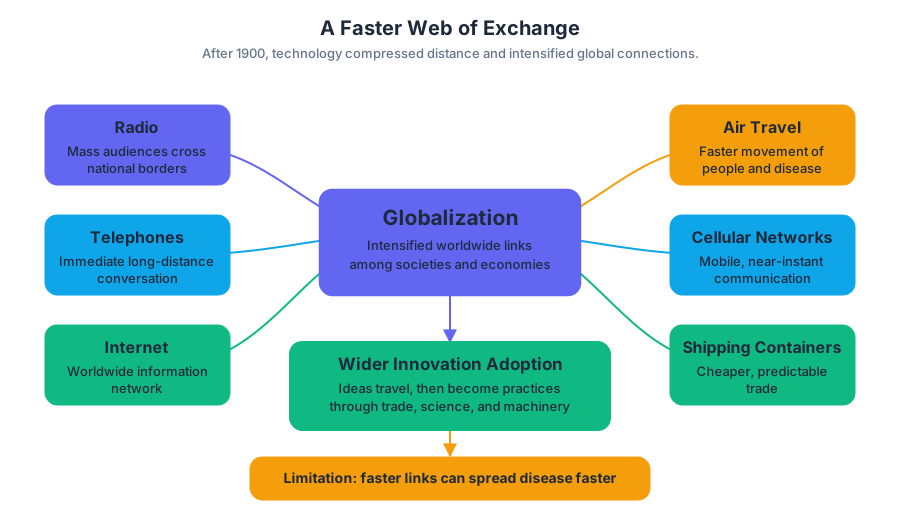
Radio, telephones, cellular communication, and the internet accelerated the movement of ideas and information. Air travel and shipping containers similarly accelerated the movement of people and goods, helping create globalization, the intensification of worldwide connections among societies and economies.
The pattern is cumulative:
- Radio allowed information to reach mass audiences across national borders.
- Telephones and cellular networks made communication nearly immediate across long distances.
- The internet connected individuals, businesses, governments, and researchers in a worldwide information network.
- Air travel compressed geographic distance for passengers and disease carriers.
- Shipping containers made international commerce faster, cheaper, and more predictable.
Worked connection: A new agricultural technique developed in one region could be reported through radio, discussed by scientists through telephones, distributed through international trade, and adopted elsewhere using industrial fertilizers and machinery. Technology therefore changed not only how fast exchange occurred but also how widely innovations could be adopted.
Food production and the Green Revolution
The Green Revolution was the spread of agricultural practices and technologies that sharply increased productivity, especially through improved crop varieties, irrigation, chemical fertilizers, and pesticides. Commercial agriculture—farming organized increasingly for markets and large-scale production—helped supply expanding urban and global populations.
The key historical claim is not simply that farmers produced more food. The Green Revolution increased productivity sufficiently to help sustain a growing global population, while also spreading chemically modified and genetically modified forms of agriculture. These technologies could raise yields, but they also tied farmers more closely to purchased seeds, fertilizers, pesticides, machinery, and market prices.
CED evidence — KC-6.1.I.B: The Green Revolution and commercial agriculture increased productivity and helped sustain the earth’s growing population as chemically and genetically modified forms of agriculture spread.
Misconception check — “More food automatically solved hunger.” Higher productivity improved the total food supply, but hunger also depended on access, distribution, land ownership, income, war, and government policy. Increased production did not guarantee equal food security.
Other technologies reshaping daily life
The CED also links technological change to energy and reproduction. Petroleum-based energy supported transportation and industrial production, while nuclear technology created new energy possibilities alongside serious risks. Effective birth control gave women greater control over fertility and contributed to declining fertility rates.
Key CED connections: KC-6.1.I.D — energy technologies, including petroleum and nuclear power; KC-6.1.III.B — effective birth control and declining fertility rates.
Medical innovation: prevention, survival, and longer lives
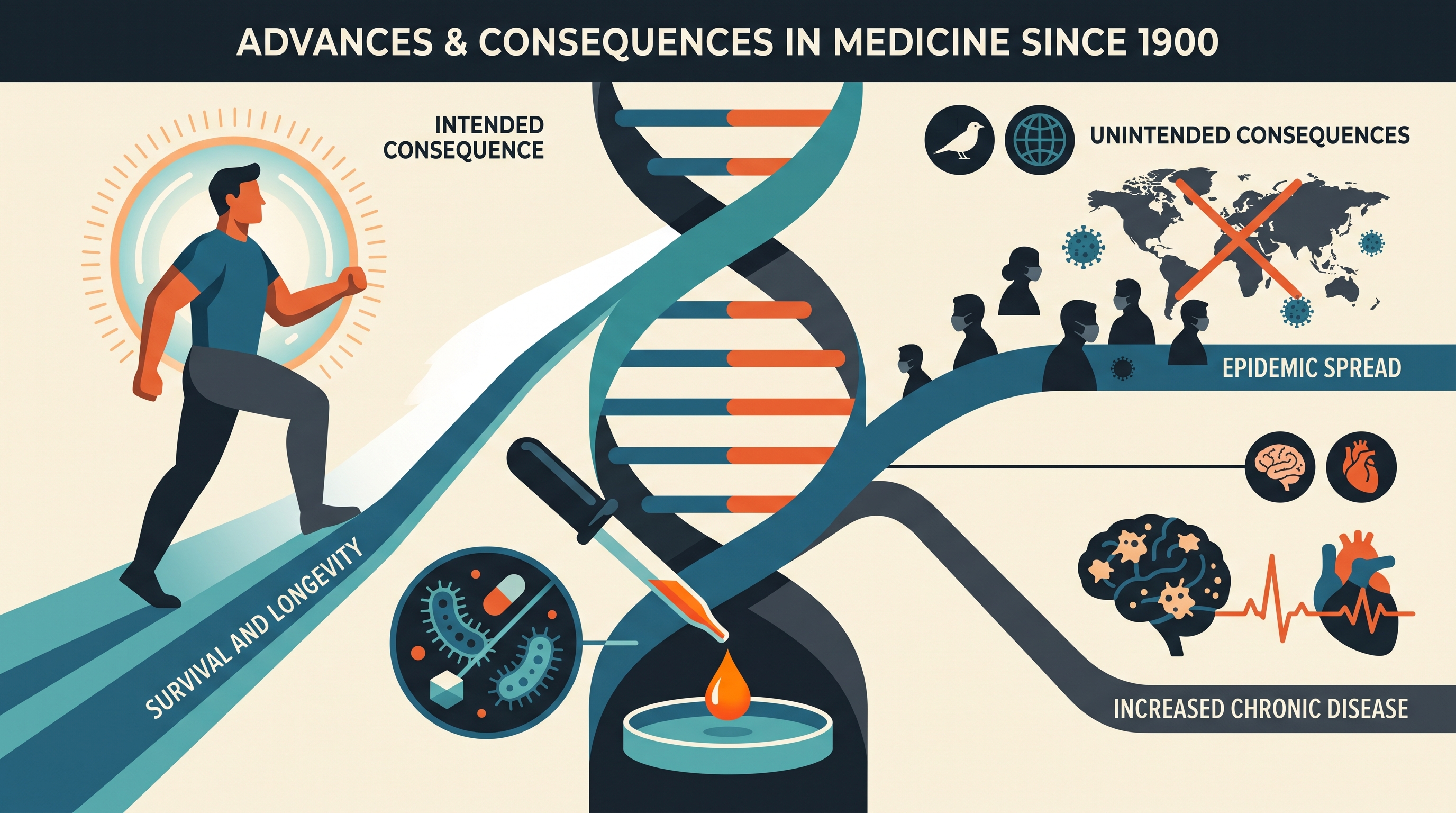
Vaccines increased humans’ ability to prevent infectious diseases by preparing the immune system to recognize and resist particular pathogens. Antibiotics—especially penicillin—allowed humans to survive bacterial illnesses that had previously been frequently fatal.
Together with improved public health and medical knowledge, these innovations increased average human longevity. The crucial distinction is between prevention and treatment: vaccines primarily reduce the likelihood or severity of infection, while antibiotics treat certain bacterial infections after illness occurs. Antibiotics do not cure viral diseases such as influenza.
Misconception check — “Medical progress ended disease.” Medical advances improved survival and extended lives, but diseases persisted, evolved, and sometimes emerged as new epidemics. Longer life also increased the number of people vulnerable to chronic conditions associated with aging, including heart disease and Alzheimer’s disease.
The paradox of connection: epidemics
The same interconnected systems that spread medical knowledge could spread disease. The 1918 influenza pandemic demonstrates this danger: modern transportation and wartime movement helped a highly infectious disease reach populations across the globe, producing a major international health crisis.
This is the central continuity-and-change pattern of Topics 9.1 and 9.2:
| Technological development | Intended benefit | Unintended or continuing problem |
|---|---|---|
| Phones and the internet | Faster exchange of information and ideas | Faster circulation of misinformation and crisis reports |
| Commercial agriculture and Green Revolution techniques | Higher yields and population support | Dependence on chemical inputs and unequal access |
| Vaccines | Prevention of infectious disease | Diseases can persist where vaccination is limited |
| Antibiotics, including penicillin | Greater survival from bacterial illness | Not effective against viruses; resistance can develop |
| Air travel and global shipping | Faster worldwide exchange | Diseases can cross regions rapidly |
| Longer life expectancy | More years of life | Greater prevalence of heart disease and Alzheimer’s disease |
AP reasoning focus: 5.A Making Connections
Skill 5.A: Making Connections asks you to identify patterns among historical developments and processes. For this topic, connect a technology to both an intended consequence and an unintended consequence.
Model reasoning: Vaccines and antibiotics improved human survival and contributed to longer lives. However, medical progress did not eliminate disease: the 1918 influenza pandemic shows that epidemics could still spread widely, while increased longevity helped make chronic diseases such as heart disease and Alzheimer’s more significant health threats.
Retrieval check: Explain one way phones or the internet changed globalization, one way the Green Revolution changed population history, and one reason medical advances did not eliminate disease. A strong response should include a specific example—such as cellular communication, genetically modified agriculture, penicillin, vaccines, or the 1918 influenza pandemic—and explain the connection rather than merely naming it.
Source Materials
- AP World History: Modern Course and Exam Description
- AP World History: Modern Course and Exam Description Clarifications and Corrections
- AP World History: Modern Course Overview
- AP World History: Modern Course at a Glance
- AP World History: Modern Course at a Glance Poster
- AP World History: Modern
- AP World History: Modern
- AP World History: Modern Sample Syllabus 1
- AP World History Past Exam Questions — AP Central
- Khan Academy — AP World History: Modern
- Freeman-pedia — AP World History: Modern
- YouTube — Heimler's History