From the free course AP World History: Modern on Lykke
7.3 Conducting World War I · 7.4 The Economy in the Interwar Period
Key concepts: Militarism · Nationalism · Alliance systems · Territorial and regional conflicts · Global escalation of local tensions · Colonial participation in World War I · Anti-colonial critique of European imperialism · Interwar economic systems · The New Deal · Fascist corporatism and Nazi militarism
World War I became global because a local crisis moved through an interconnected political system: territorial disputes, regional conflicts, intense nationalism, and a flawed alliance system transformed one confrontation into a war involving empires across Europe, Africa, Asia, and the Middle East.
7.3 Conducting World War I · 7.4 The Economy in the Interwar Period
World War I became global because a local crisis moved through an interconnected political system: territorial disputes, regional conflicts, intense nationalism, and a flawed alliance system transformed one confrontation into a war involving empires across Europe, Africa, Asia, and the Middle East. The central historical problem is not simply who fought, but how governments, soldiers, colonies, economies, and technologies made a regional conflict expand.
From regional crisis to global war
A territorial conflict is a struggle over control of land, borders, or political authority. A regional conflict involves competing powers within a particular area. Before 1914, these disputes existed alongside militarism—the belief that military strength and readiness were essential to national success—and nationalism, the conviction that a people sharing an identity should defend or rule themselves.
The alliance system was intended to deter aggression, but it operated like a chain of linked obligations. When one state entered a confrontation, its allies could enter to protect strategic interests, honor agreements, or avoid appearing weak. In this way, alliances and nationalism escalated tensions rather than containing them.
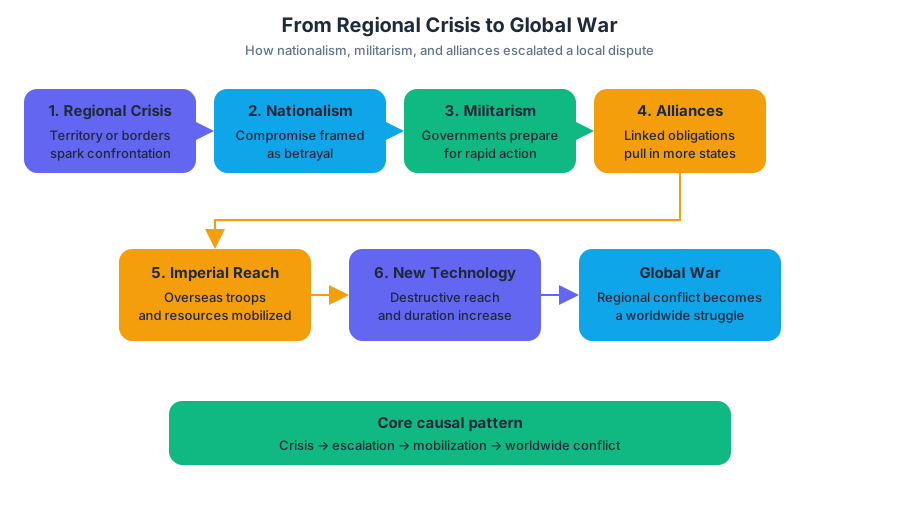
Worked causal example: A dispute that might otherwise have remained regional could become global through the following sequence:
- A territorial or regional conflict creates a crisis.
- Nationalist leaders portray compromise as betrayal.
- Militarized governments prepare for rapid action.
- Alliances pull additional states into the confrontation.
- Imperial powers mobilize resources and troops from overseas territories.
- New military technologies increase the war’s destructive reach and duration.
This is the required causal pattern identified in Unit 7: Learning Objective B and KC-6.2.IV.B.i: territorial and regional conflicts combined with a flawed alliance system and intense nationalism to escalate tensions into global conflict.
Colonial participation and imperial hypocrisy
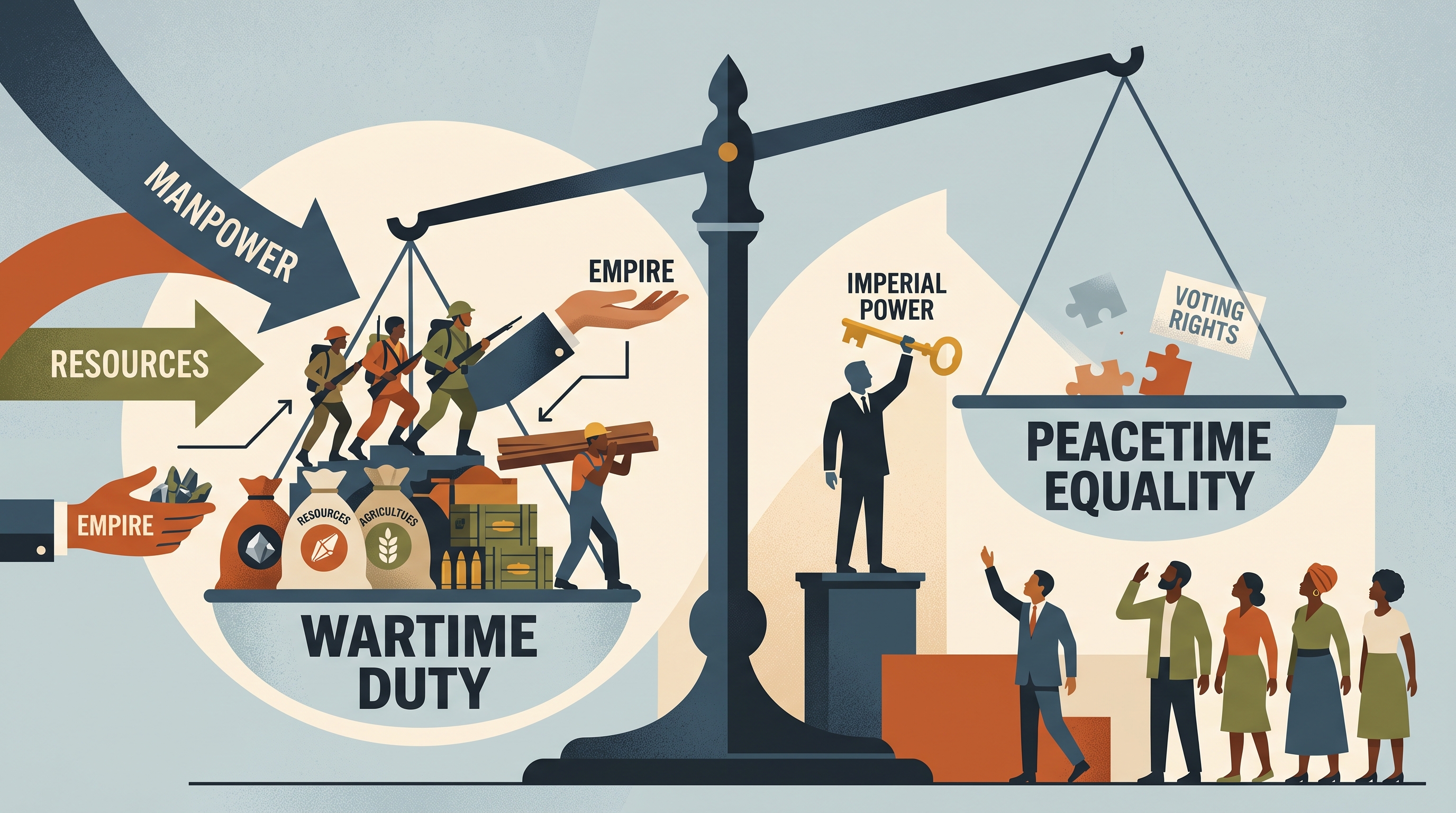
European empires did not fight World War I with European soldiers alone. Great Britain and France recruited colonial troops, while those same empires had previously used colonial forces to suppress revolts and expand imperial control. Colonial participation therefore exposed a contradiction: imperial governments demanded loyalty and sacrifice from colonial subjects without granting them equal political treatment.
John Chilembwe criticized this hypocrisy. His argument was not merely that colonial people were being asked to fight; it was that Europeans invoked shared duties during wartime while denying equality during peacetime. Colonial soldiers and workers could be treated as essential to imperial survival without being treated as equal members of the political community.
Misconception check — “The war was only European.” European governments directed much of the conflict, but the war depended on imperial manpower, resources, and territories. A global war can be global even when its principal decision-makers are concentrated in one region.
Technology, violence, and patriotism
Technology and innovation changed how humans adapted to modern conflict. Industrial production supplied armies on an unprecedented scale, while military technologies increased the speed, range, and destructive power of warfare. Technology did not determine political decisions by itself; governments chose how to organize and deploy it.
The passage also condemns patriotism when it becomes a justification for violence. That warning applies both to individual terrorists and to organized armies acting under orders: the scale of violence differs, but patriotic language can be used in both cases to turn killing into a supposed moral duty.
Key distinction: Patriotism is attachment to a political community; militarized nationalism turns that attachment into a demand for obedience, sacrifice, and sometimes violence.
The interwar economy: competing responses
The interwar period was not simply a pause between two wars. It was a period of economic crisis and political experimentation in which societies debated how much governments should manage production, employment, welfare, and national recovery.
The New Deal represented one response: the government intervened to address economic hardship and stabilize society. Fascist corporatist economics represented another: the state organized economic relationships among employers, workers, and professional groups under authoritarian political control. These systems differed in ideology and institutions, but both rejected the idea that governments should remain completely passive during severe economic disruption.
The League of Nations mandate system further complicated the interwar order. Former colonial territories were placed under external administration rather than receiving full independence, holding back self-determination. Western-educated independence and decolonization figures challenged this continued imperial control during and after the interwar period.
Aggressive militarism in Nazi Germany under Adolf Hitler contributed to the conditions leading to World War II. The connection is causal rather than automatic: economic and political instability created opportunities for authoritarian movements, while militarism and expansion converted domestic mobilization into international aggression.
Skill focus: reading evidence
The suggested skill for Topic 7.3 is 3.B: Identify the evidence used in a source to support an argument. For example, in a source by John Chilembwe, evidence supporting a criticism of imperial hypocrisy might include the contrast between colonial participation in wartime and unequal treatment in peacetime. Identifying that contrast is stronger than merely stating that Chilembwe “disliked imperialism.”
Retrieval check: Explain in two sentences how an alliance system could turn a regional conflict into a global war. Then identify one piece of evidence that would support John Chilembwe’s argument about colonial participation and unequal treatment.
Source Materials
- AP World History: Modern Course and Exam Description
- AP World History: Modern Course and Exam Description Clarifications and Corrections
- AP World History: Modern Course Overview
- AP World History: Modern Course at a Glance
- AP World History: Modern Course at a Glance Poster
- AP World History: Modern
- AP World History: Modern
- AP World History: Modern Sample Syllabus 1
- [a] Identify ONE way Asians resisted Western imperialism in the period circa 1800–1914. 1 point
- [a] Identify ONE way Asians resisted Western imperialism in the period circa 1800–1914.