From the free course AP World History: Modern on Lykke
5.3 Industrial Revolution Begins · 5.4 Industrialization Spreads from 1750 to 1900
Key concepts: Industrial Revolution · Industrial capitalism · Industrialization and change, continuity, and causation from 1750 to 1900 · First Industrial Revolution in England · Second Industrial Revolution · Urbanization · Factory labor and working-class family economies · Environmental effects of industrialization · Standards of living · Historical comparison and contextualization
The Industrial Revolution was the shift from hand production and household workshops toward mechanized production in factories, beginning in England during the period $c. 1750$ to $c.
5.3 Industrial Revolution Begins · 5.4 Industrialization Spreads from 1750 to 1900
The Industrial Revolution was the shift from hand production and household workshops toward mechanized production in factories, beginning in England during the period $c. 1750$ to $c. 1900$. Industrialization means the broader process by which societies adopted factories, new energy sources, wage labor, mechanized transportation, and industrial capitalism.
Investigative question: Why did industrialization begin in England, and why did its effects spread unevenly across the world?
5.3 — The Industrial Revolution Begins
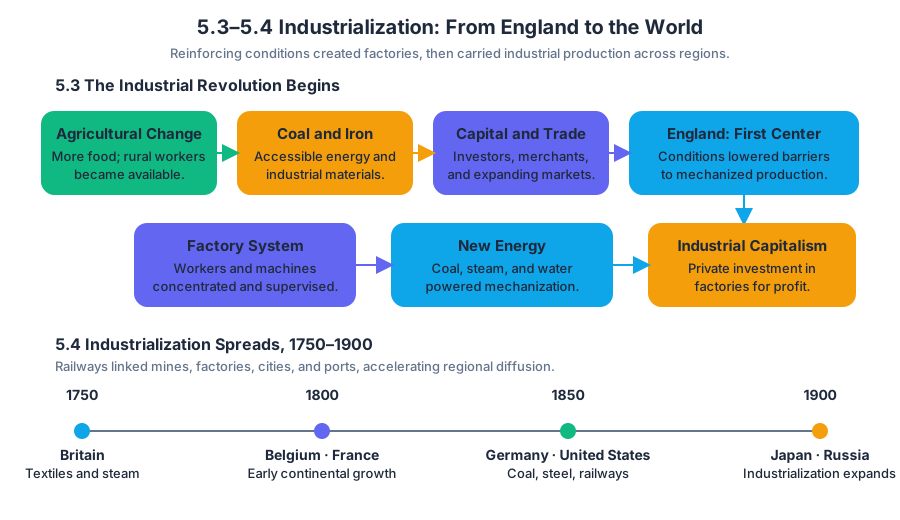
England became the first major center of industrialization because several developments reinforced one another. Agricultural changes increased food production and displaced some rural workers; England possessed accessible coal and iron; merchants and investors supplied capital; and expanding trade created markets for manufactured goods. These conditions did not make industrialization automatic, but together they lowered the barriers to mechanized production.
The early factory system reorganized work. Instead of producing textiles in scattered homes, owners concentrated workers and machines in factories, where labor could be supervised and production standardized. Coal, steam power, and water power supplied energy beyond the limits of human and animal labor, while railways later connected mines, factories, cities, and ports.
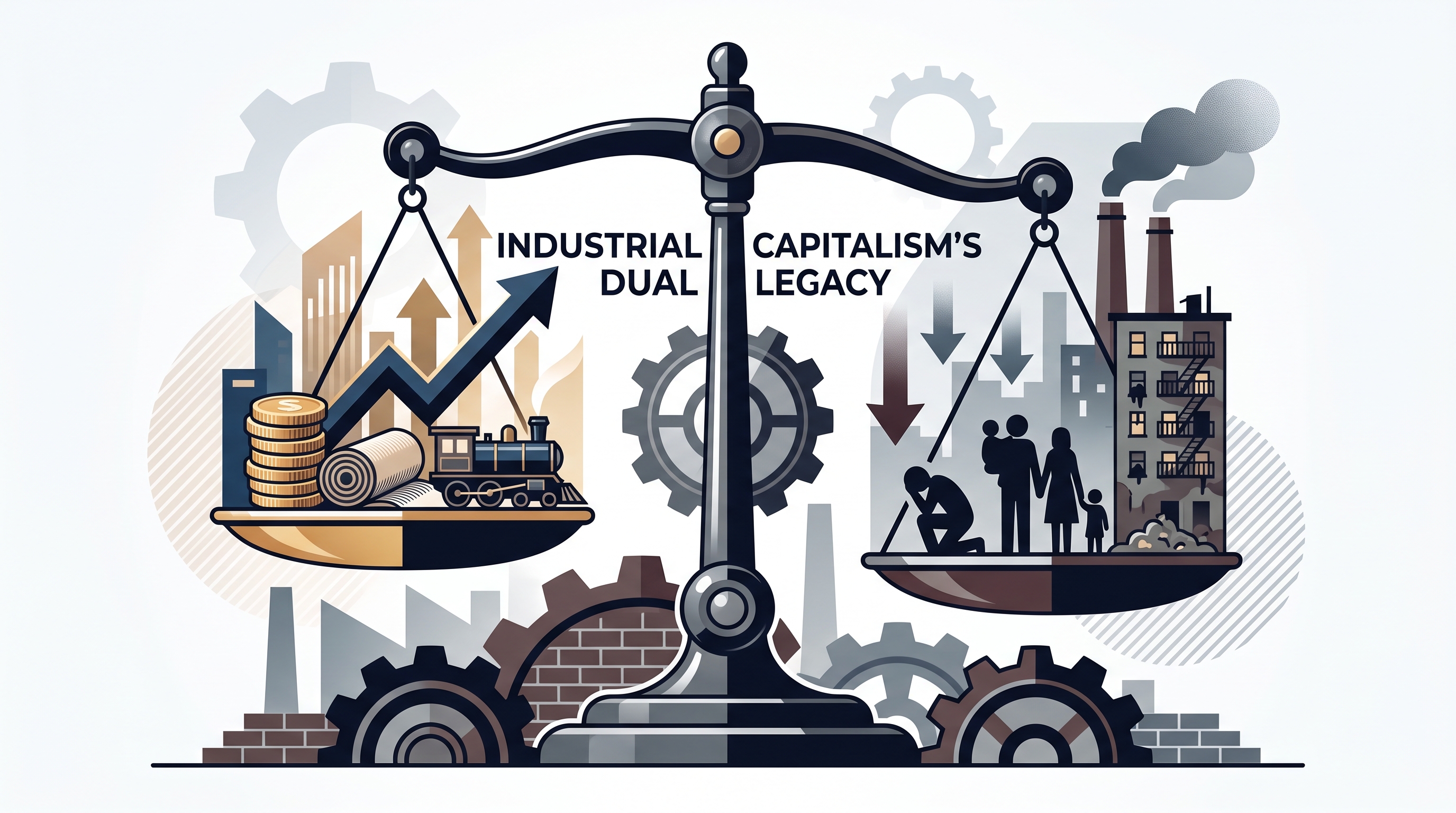
Industrial capitalism is an economic system in which private owners invest capital—the money and resources used to produce goods—in factories, machinery, and businesses in expectation of profit. It increased production and raised standards of living for some people, especially entrepreneurs and parts of the middle class, but benefits were uneven: many workers faced low wages, long hours, unsafe conditions, and unstable employment.
Labor, family income, and urbanization
Industrialization connected directly to urbanization, the growth of cities as people moved toward industrial employment. During the first Industrial Revolution in England, lower-class women and children worked in factories to supplement family income. Their wages could be essential to household survival, even as factory labor exposed them to dangerous machinery and harsh discipline.
Urban growth transformed environments as well as societies. Coal smoke polluted air, factories discharged waste, and crowded neighborhoods often lacked clean water and sanitation. At the same time, cities became centers of commerce, transportation, political organization, and new class identities, including a growing industrial working class and an expanding middle class.
Misconception check: Industrialization did not improve everyone’s life immediately. A strong historical explanation distinguishes long-term increases in production and income from the short-term poverty, exploitation, and environmental damage experienced by many workers.
5.4 — Industrialization Spreads, $1750$–$1900
Industrialization spread from England to parts of western Europe, North America, Russia, Japan, and other regions, but it did not follow one identical path. Some governments promoted railways and factories; some societies relied on foreign investment or imported machinery; and many regions remained primarily agricultural or became suppliers of raw materials to industrial economies.
The Second Industrial Revolution expanded industrial production during the later nineteenth century. Cheap steel, electricity, chemicals, and precision machinery supported larger factories and increased the production of consumer goods. Industrialization therefore changed not only how goods were made but also what ordinary people could purchase and how quickly goods could circulate.
A comparison clarifies the process:
| Feature | First Industrial Revolution | Second Industrial Revolution |
|---|---|---|
| Main setting | England, especially textile-producing regions | Germany, the United States, and other industrializing regions |
| Energy and materials | Coal, steam, and water power; iron | Electricity, chemicals, cheap steel, and precision machinery |
| Major effect | Factory production and mechanized textiles | Larger-scale industry and expanded consumer-goods production |
| Social result | Urban working class and factory labor | Mass production, expanding markets, and intensified urbanization |
Change, continuity, and causation
The required reasoning process for 5.3 Industrial Revolution Begins is Causation, especially Skill 1.B: Explain a historical concept, development, or process. To explain causation, connect conditions to outcomes rather than listing inventions: agricultural change and available coal helped England industrialize; factories then encouraged wage labor, urbanization, and environmental transformation.
The required reasoning process for 5.4 Industrialization Spreads in the Period from 1750 to 1900 is Continuity and Change, especially Skill 5.A: Identify patterns among or connections between historical developments and processes. Industrialization brought major change in production, transportation, cities, and class structure, but continuity remained: social inequality persisted, many people continued farming, and women and children still performed economically necessary labor.
A strong argument evaluates extent. For example: Industrialization substantially changed production and urban life from $1750$ to $1900$ by creating factories, wage labor, railways, and industrial cities; however, it did not eliminate rural economies or inequality, and its benefits in living standards were distributed unevenly.
For Skill 3.C: Compare the arguments or main ideas of two sources, compare what each source claims about industrialization, then explain why the difference matters. A factory owner might emphasize cheaper goods and rising output, while a worker might emphasize dangerous conditions and low wages. The strongest comparison identifies both perspectives and connects them to each source’s position, purpose, or historical situation.
Worked contextual example
Suppose a source praises the growth of English textile factories while another condemns factory labor. First, establish context: agricultural change and new energy systems helped create England’s factory economy. Then compare the arguments. The first source measures progress through production and consumer goods; the second measures it through workers’ health, family income, and safety. The defensible conclusion is not that one source is automatically “correct,” but that industrial capitalism produced unequal change: rising output and prosperity for some alongside exploitation and urban poverty for others.
Retrieval check: Name one cause of England’s early industrialization, one change produced by factories, and one continuity from $1750$ to $1900$. Then explain why “industrialization improved living standards” is incomplete without identifying which social groups benefited.
Source Materials
- AP World History: Modern Course and Exam Description
- AP World History: Modern Course and Exam Description Clarifications and Corrections
- AP World History: Modern Course Overview
- AP World History: Modern Course at a Glance
- AP World History: Modern Course at a Glance Poster
- AP World History: Modern
- AP World History: Modern
- AP World History: Modern Sample Syllabus 1