From the free course AP World History: Modern on Lykke
7.7 Conducting World War II · 7.8 Mass Atrocities After 1900
Key concepts: Conducting World War II · Mass atrocities after 1900 · The Holocaust · Genocide and ethnic violence · Xenophobic nationalism · Extremist groups gaining power · Colonial consequences of World War II · Armenians in the Ottoman Empire · Cambodia · Consequences of mass atrocities
World War II was conducted not only through armies and battlefields but also through air power, occupation, imperial conquest, and ideological persecution. The bombing of Pearl Harbor in December 1941 brought the United States directly into the war, while Japan’s invasions across Asia reshaped European colonial…
7.7 Conducting World War II · 7.8 Mass Atrocities After 1900
World War II was conducted not only through armies and battlefields but also through air power, occupation, imperial conquest, and ideological persecution. The bombing of Pearl Harbor in December 1941 brought the United States directly into the war, while Japan’s invasions across Asia reshaped European colonial rule in territories such as Vietnam and Indonesia.
Conducting World War II: War and Empire
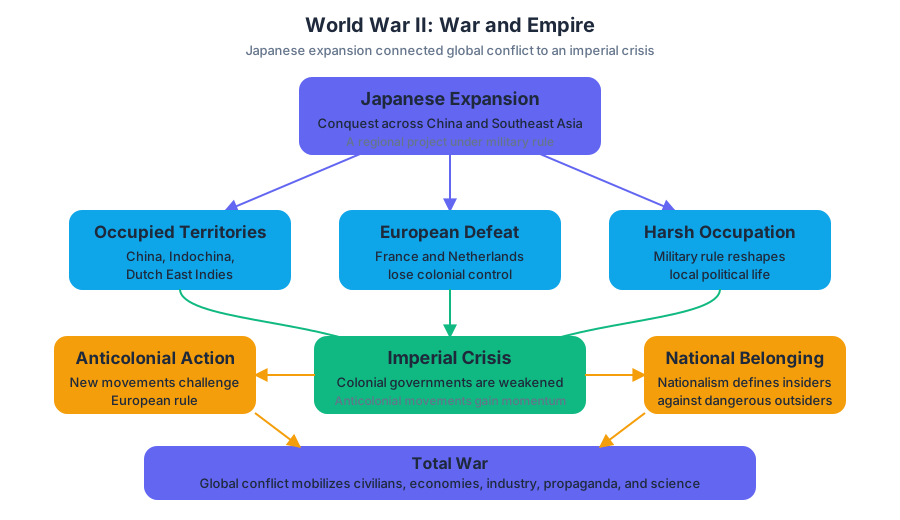
Japan’s military leaders presented expansion as a regional project, but Japanese conquest placed much of East and Southeast Asia under harsh occupation. Japan invaded territories including parts of China, French Indochina, and the Dutch East Indies. The conquest of France and the Netherlands weakened their ability to control overseas empires: French authority in Vietnam and Dutch authority in Indonesia were disrupted by Japanese victories.
The war therefore operated on two connected levels:
- Global military conflict: Axis and Allied states fought across Europe, North Africa, and Asia.
- Imperial crisis: European defeats weakened colonial governments and encouraged anticolonial movements.
- Ideological conflict: States mobilized populations through intense nationalism, often defining national belonging against supposedly dangerous outsiders.
- Total war: Governments directed economies, civilians, industry, propaganda, and scientific research toward victory.
A useful chain of reasoning is: Japanese expansion → European colonial defeat → weakened imperial authority → new political opportunities for Asian independence movements. This does not mean Japan liberated these territories; Japanese occupation replaced one form of imperial control with another. The same event could weaken European empires while producing severe violence for local populations.
Key distinction: A military victory over a colonial power is not automatically national liberation. Analyze who gained power, who lost power, and how occupying authorities treated civilians.
Xenophobic Nationalism and Extremist Power
Xenophobic nationalism is nationalism that defines the nation through hostility toward people portrayed as foreign, racially inferior, ethnically dangerous, or culturally disloyal. During World War II, states were motivated by this kind of exclusionary nationalism, especially when leaders claimed that national survival required removing or destroying alleged internal enemies.
The rise of extremist groups in power led to the attempted destruction of specific populations. This is the central historical development identified by KC-6.2.III.C. Extremist governments used laws, propaganda, police organizations, forced relocation, imprisonment, starvation, deportation, and mass killing to transform prejudice into state policy.
The Holocaust: From Exclusion to Destruction
The Holocaust was Nazi Germany’s systematic persecution and murder of Europe’s Jews during World War II. It is an example of a mass atrocity, meaning large-scale, organized violence against civilians or a targeted population. The Holocaust developed through stages rather than appearing suddenly: antisemitic propaganda and legal exclusion were followed by confiscation, segregation, forced displacement, ghettos, deportations, and industrialized mass murder.
The first signs mattered because they revealed how ordinary institutions could be redirected toward persecution. Identification requirements, exclusion from professions, attacks on businesses and synagogues, and the removal of civil rights made discrimination increasingly visible. Etty Hillesum, a Jewish Dutch writer, recorded the mounting danger while reflecting on fear, hatred, responsibility, and the effort to preserve inner humanity under persecution.
Hillesum’s reaction is historically important because it shows that victims were not merely statistics within a state process. Her writings reveal uncertainty, moral reflection, fear, and attempts to resist hatred psychologically even as Nazi persecution narrowed the possibilities for physical escape. Personal testimony helps historians examine how large political systems were experienced by individuals.
Genocide, Ethnic Violence, and Comparison
Genocide is the deliberate attempt to destroy a national, ethnic, racial, or religious group, in whole or in part. Ethnic violence is organized violence directed against people because of their ethnic identity; it may involve expulsion, massacres, forced assimilation, or other attacks without always pursuing complete physical destruction.
| Case | Historical setting | Analytical significance |
|---|---|---|
| Armenians in the Ottoman Empire | During and after World War I | Illustrates genocide or ethnic violence connected to wartime fear, nationalism, and state action |
| The Holocaust | Nazi-controlled Europe during World War II | Illustrates the attempted destruction of Europe’s Jews by an extremist state |
| Cambodia | Late 1970s | Illustrates mass atrocity under an extremist revolutionary regime |
| Tutsi in Rwanda | 1990s | Illustrates genocide fueled by ethnic classification and organized political violence |
| Ukraine in the Soviet Union | 1920s and 1930s | Illustrates mass suffering and state violence within an authoritarian system |
These cases should be connected, not treated as identical copies. The comparison question is: What mechanisms recur, and what conditions differ? Extremist ideology, state or militia organization, dehumanizing propaganda, and weakened protections for targeted groups may recur, while the political goals, social categories, and methods of violence vary.
Consequences of Mass Atrocities
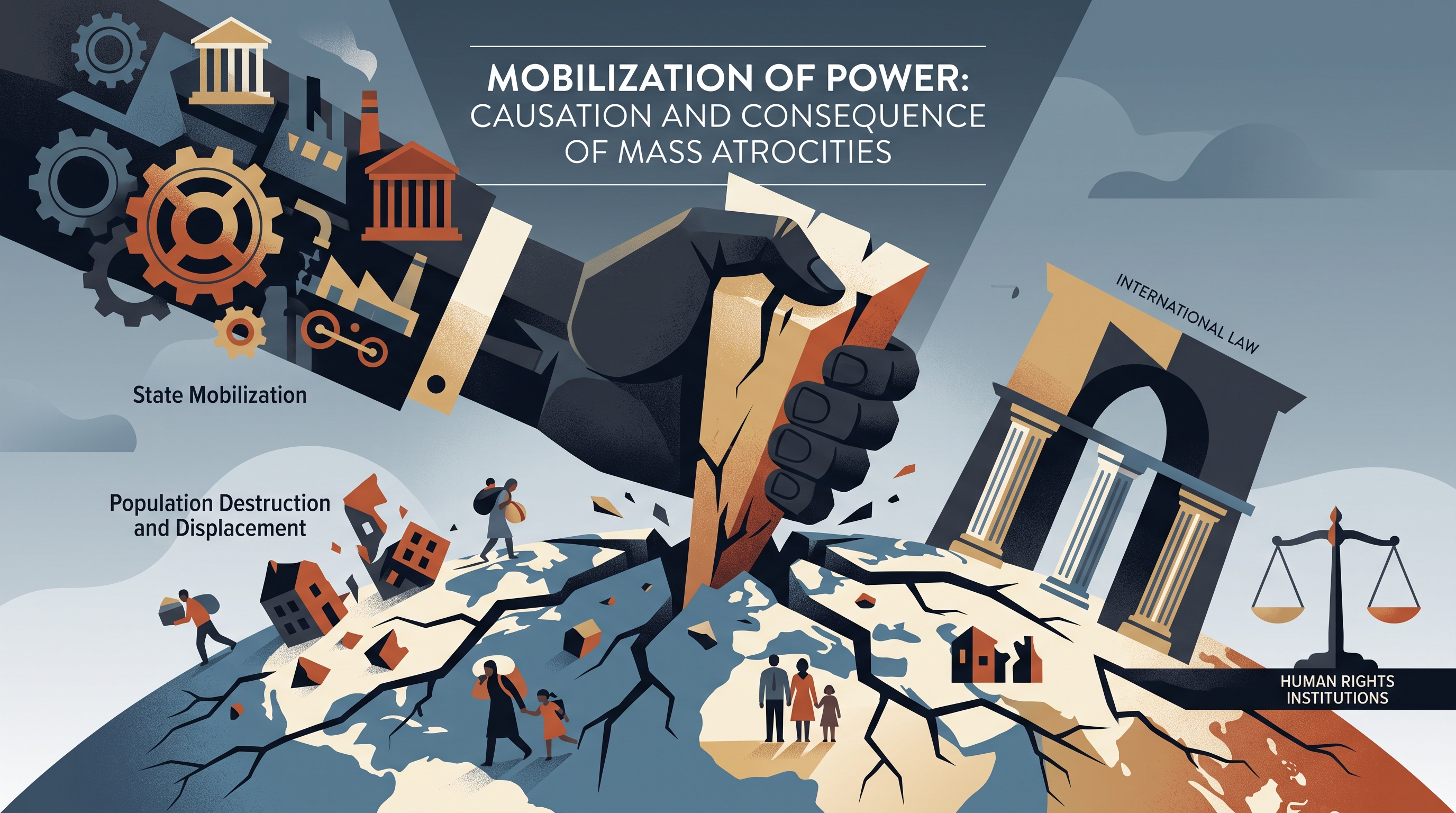
Under Unit 7: Learning Objective H, students must “Explain the various causes and consequences of mass atrocities in the period from 1900 to the present.” Consequences included enormous population loss, displaced survivors, destroyed communities, trauma across generations, altered borders, refugee crises, and demands for accountability. Mass atrocities also reshaped international politics by encouraging new legal concepts, human-rights institutions, and debates over state sovereignty.
A common misconception is that mass atrocities are caused only by ancient ethnic hatred. Historical evidence instead shows that political leaders and extremist organizations often construct or intensify identities, identify alleged enemies, and mobilize state power against them. Hatred can be present, but explaining causation requires tracing institutions, ideology, wartime conditions, propaganda, and organized action.
AP Skill 5.B — Making Connections: Explain how one historical development or process relates to another. For example, connect xenophobic nationalism to extremist rule, extremist rule to population destruction, and mass atrocities to postwar displacement and international responses.
Retrieval check: Explain one way World War II weakened European colonial authority, then identify one recurring mechanism linking the Holocaust with another listed case of genocide, ethnic violence, or mass atrocity. Distinguish the shared mechanism from the historical difference.
Source Materials
- AP World History: Modern Course and Exam Description
- AP World History: Modern Course and Exam Description Clarifications and Corrections
- AP World History: Modern Course Overview
- AP World History: Modern Course at a Glance
- AP World History: Modern Course at a Glance Poster
- AP World History: Modern
- AP World History: Modern
- AP World History: Modern Sample Syllabus 1