From the free course AP World History: Modern on Lykke
7.5 Unresolved Tensions After World War I · 7.6 Causes of World War II
Key concepts: Unresolved tensions after World War I · Causes of World War II · Point of view, purpose, historical situation, and audience · Continuity and change · Mexican Revolution · Russian Revolution · Imperialism · Territorial and regional conflicts · Alliance systems · Nationalism
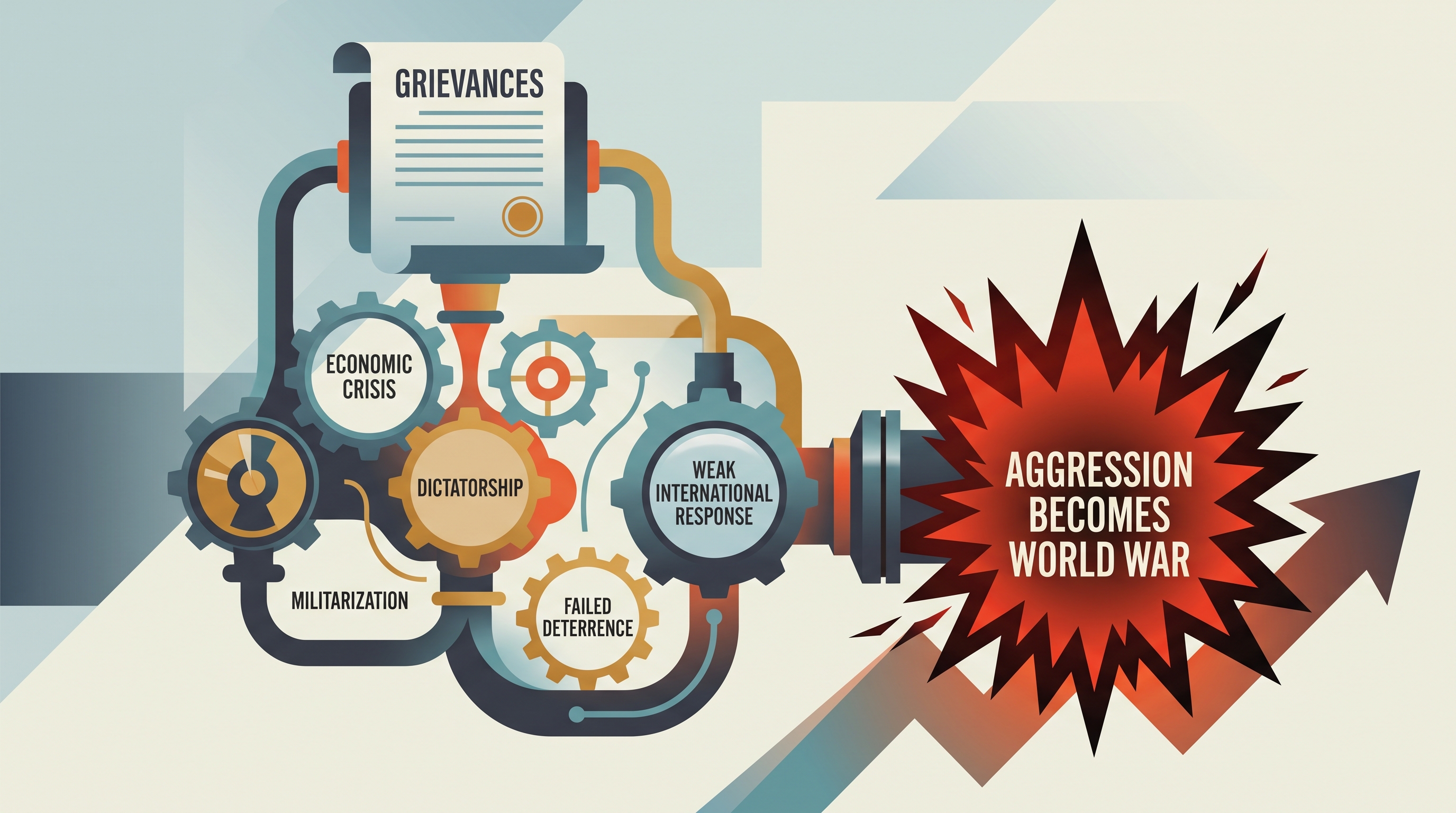
World War II did not begin from a single spark. It emerged when the unresolved political debts of World War I met economic crisis, imperial expansion, territorial disputes, weak international institutions, and aggressive nationalism.
7.5 Unresolved Tensions After World War I · 7.6 Causes of World War II
World War II did not begin from a single spark. It emerged when the unresolved political debts of World War I met economic crisis, imperial expansion, territorial disputes, weak international institutions, and aggressive nationalism. The central historical question is therefore: how did regional conflicts become a global war?
Key idea: Postwar settlements attempted to create order, but often produced new grievances or applied principles inconsistently.
The postwar settlement: peace without resolution
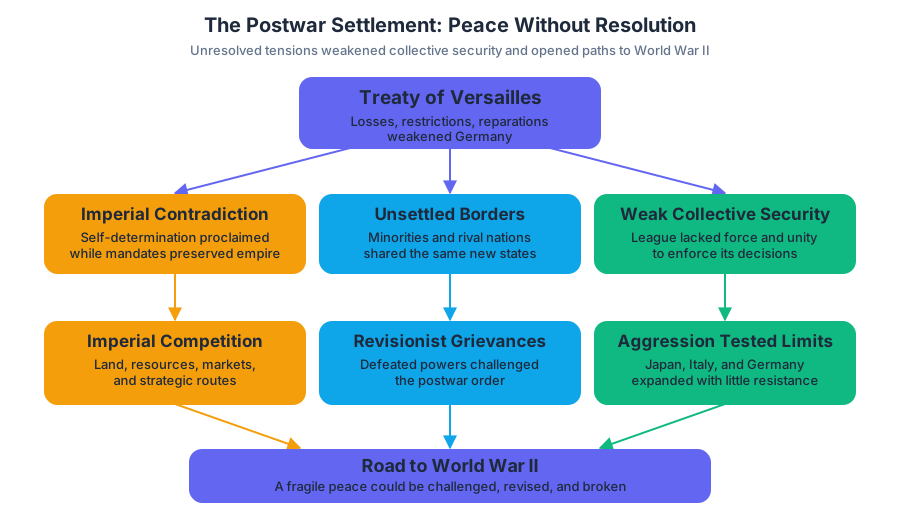
The Treaty of Versailles weakened Germany through territorial losses, military restrictions, and reparations. At the same time, the peace settlement transferred former German colonies to Great Britain and France through the League of Nations mandate system. This created a contradiction: European powers publicly endorsed national self-determination while continuing imperial control over much of Africa, the Middle East, and Asia.
New states and borders also left minorities and rival national groups inside the same political units. The League of Nations lacked an effective military force, and major powers did not consistently enforce its decisions. As a result, aggressive states could test the international system: Japan created Manchukuo in China, Italy invaded Ethiopia, and Germany remilitarized and expanded into neighboring territories.
Imperialism—the expansion of a state’s political, military, or economic control over other territories—contributed to conflict because industrial powers competed for land, resources, markets, and strategic routes. Japan’s proposed Greater East Asia Co-Prosperity Sphere, for example, presented Japanese expansion as regional liberation from Western imperialism but functioned as an empire designed to secure resources and political control.
From regional crisis to global conflict
Several forces reinforced one another:
- Competition for resources: Industrial and militarized states sought oil, coal, iron, rubber, food supplies, and colonial markets. Resource insecurity encouraged territorial expansion.
- Territorial and regional conflicts: Japan’s expansion in China, Germany’s demands in Europe, and Italy’s invasion of Ethiopia challenged the existing order in separate regions.
- A flawed alliance system: Agreements intended to deter aggression created opposing blocs and made local confrontations more dangerous. Once Germany, Italy, and Japan coordinated more closely, their actions appeared connected to a wider challenge.
- Intense nationalism: Governments portrayed compromise as weakness and territorial expansion as proof of national strength. Nationalist propaganda transformed disputes into tests of national honor.
- Imperial rivalry: Anti-imperial movements and colonial resistance exposed the hypocrisy of European claims to defend civilization and self-determination. The Indian National Congress and West African strikes and congresses challenged imperial rule, even when they did not directly cause World War II.
A useful causal chain is:
unresolved postwar grievances → economic and political instability → aggressive expansion → weak international response → emboldened dictatorships → alliance commitments and nationalism → global war
Continuity and change: Mexico and Russia
The Mexican Revolution and Russian Revolution both changed political authority by attacking old elites and promising social transformation. In Mexico, revolutionary governments weakened the power of large landowners and adopted reforms associated with land redistribution, labor rights, and national control over resources. In Russia, the Bolsheviks overthrew the tsarist order and created a communist state that abolished private aristocratic privilege while building a centralized one-party government.
Continuities remained important. Both revolutions relied on state power to impose order, and neither immediately eliminated hierarchy or coercion. The historical situation explains the difference in outcomes: Mexico’s revolution produced a nationalist state that retained a mixed economy, while Russia’s wartime collapse, class conflict, and imperial crisis enabled the Bolsheviks to pursue a more radical communist restructuring.
Reading sources as historical evidence
Point of view means the position or perspective from which a source speaks. Purpose means what the creator hoped to accomplish. Historical situation means the conditions surrounding the source’s creation, and audience means the people intended to read, hear, or see it.
Source analysis rule: A source is not automatically reliable or unreliable. Its value depends on the question being asked.
For example, a League of Nations report might describe mandates as international supervision designed to prepare territories for self-government. Its purpose and audience could encourage diplomatic language that minimizes exploitation. A speech by an anti-imperial organization might reveal colonial grievances more clearly, but its persuasive purpose could emphasize abuses and understate divisions within the resistance movement. Comparing both sources produces stronger analysis than accepting either as a complete account.
This is Skill 2.C: Explain the significance of a source’s point of view, purpose, historical situation, and/or audience, including how these might limit the use(s) of a source. It also requires comparison: identify a meaningful similarity or difference, then explain how the historical situation produced it.
Worked causal example
Suppose a document claims that territorial expansion will restore national greatness. First, identify its point of view: it likely reflects a nationalist government or supporter. Next, connect its purpose to persuasion and mobilization. Then place it in the historical situation of postwar grievances, economic insecurity, and perceived humiliation. Finally, explain its limitation: it may reveal how leaders justified expansion, but it cannot by itself prove that expansion benefited ordinary people or lacked opposition.
Skill 1.B: Explain a historical concept, development, or process means showing how and why imperialism, resources, territorial disputes, alliances, and nationalism interacted. Continuity and Change requires separating what changed from what persisted rather than claiming that a revolution or peace treaty transformed everything at once.
Misconception check
Misconception: “The Treaty of Versailles alone caused World War II.” The treaty created grievances, especially in Germany, but grievances became a world war only through later choices: economic crisis, dictatorship, militarization, expansion, failed deterrence, and the inability of international institutions to contain aggression.
Retrieval check: Explain one continuity and one change produced by the Mexican or Russian Revolution. Then complete the chain: territorial expansion + weak international response + nationalism = __________. Why would a source celebrating imperial expansion be useful—and limited—for understanding the causes of World War II?
Source Materials
- AP World History: Modern Course and Exam Description
- AP World History: Modern Course and Exam Description Clarifications and Corrections
- AP World History: Modern Course Overview
- AP World History: Modern Course at a Glance
- AP World History: Modern Course at a Glance Poster
- AP World History: Modern
- AP World History: Modern
- AP World History: Modern Sample Syllabus 1
- 1 point
- 1 point
- 1 point
- 1 point