From the free course AP World History: Modern on Lykke
9.7 Resistance to Globalization After 1900 · 9.8 Institutions Developing in a Globalized World
Key concepts: Globalization after 1900 · Resistance to globalization · Globalized culture · Global consumer culture · International institutions · Human rights · Global inequality · World Health Organization · Global commerce and brands · Historical contextualization
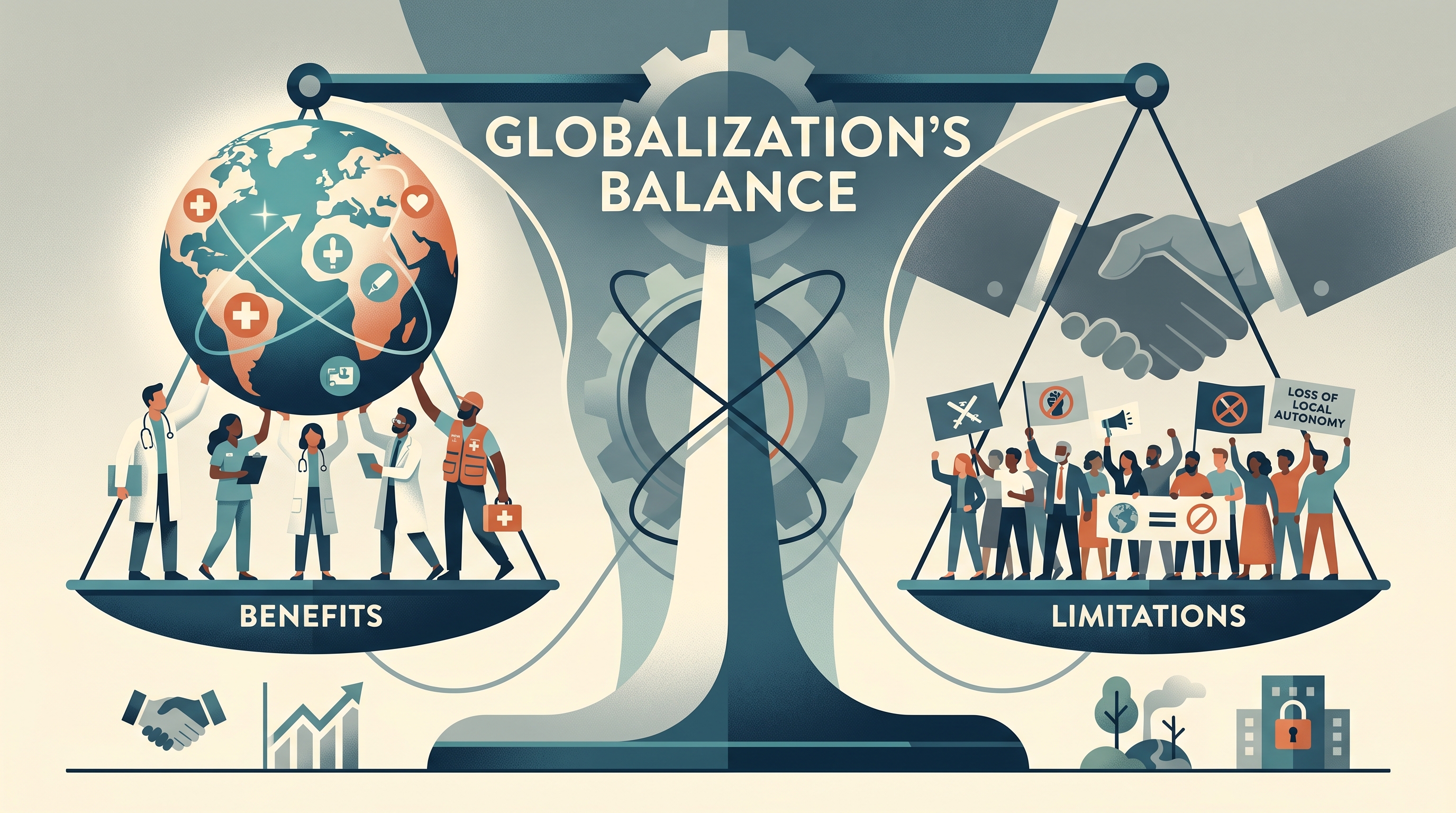
Globalization connected people across national borders, but connection did not produce universal agreement. The same networks that carried medicine, brands, media, and commerce also exposed unequal access to wealth and power—and created new targets for protest.
9.7 Resistance to Globalization After 1900 · 9.8 Institutions Developing in a Globalized World
Globalization connected people across national borders, but connection did not produce universal agreement. The same networks that carried medicine, brands, media, and commerce also exposed unequal access to wealth and power—and created new targets for protest.
Global consumer culture—and the backlash against it
Consumer culture is a social system in which people express identity, status, and belonging partly through the goods and services they purchase. After 1900, consumer culture became increasingly globalized and transcended national borders (KC-6.3.IV.iii). A shopper could encounter the same brand, entertainment style, or commercial message in multiple countries.
The process operated through several connected channels:
- online commerce expanded through companies such as Alibaba and eBay;
- global brands such as Toyota and Coca-Cola became recognizable across national markets;
- popular culture circulated through international media, sports, and entertainment;
- advertising linked consumption with ideas of modernity, success, and personal freedom.
This expansion did not mean that every society simply copied Western or American culture. Local consumers adapted global products to local tastes, while critics argued that commercial globalization weakened cultural traditions, encouraged materialism, or reproduced unequal economic relationships. Resistance therefore targeted both globalization itself and the perceived dominance of Western or American influence.
Key distinction: Globalization describes expanding cross-border connections; resistance to globalization describes political, cultural, or social responses that challenge the effects, values, or power relationships produced by those connections.
Why globalization generated protest
Globalization could increase awareness of human rights while simultaneously increasing awareness of inequality. International communication made it easier for people to learn about abuses, discrimination, poverty, or unequal access to technology. Yet the same global economy could concentrate wealth, expose workers to difficult conditions, and make communities feel that distant corporations or institutions had influence over local decisions.
This tension helps explain why protest movements emerged against globalization and Western or American cultural influence. Protesters might oppose foreign economic control, cultural homogenization, environmental damage, or policies associated with international organizations. Their criticism did not necessarily reject all international exchange; many movements demanded a different form of globalization—one that distributed benefits more fairly and respected local autonomy.
Worked contextual example: Imagine a community receiving a new multinational retail chain. The chain may lower prices and provide employment, but local shopkeepers may lose customers, profits may leave the region, and residents may view the chain’s advertising as an intrusion into local culture. To explain the historical development, connect the local protest to the broader twentieth-century growth of global consumer culture, transportation, communications, and multinational business. The protest is not evidence that globalization failed; it is evidence that globalization produced uneven consequences.
International institutions and unequal access to progress
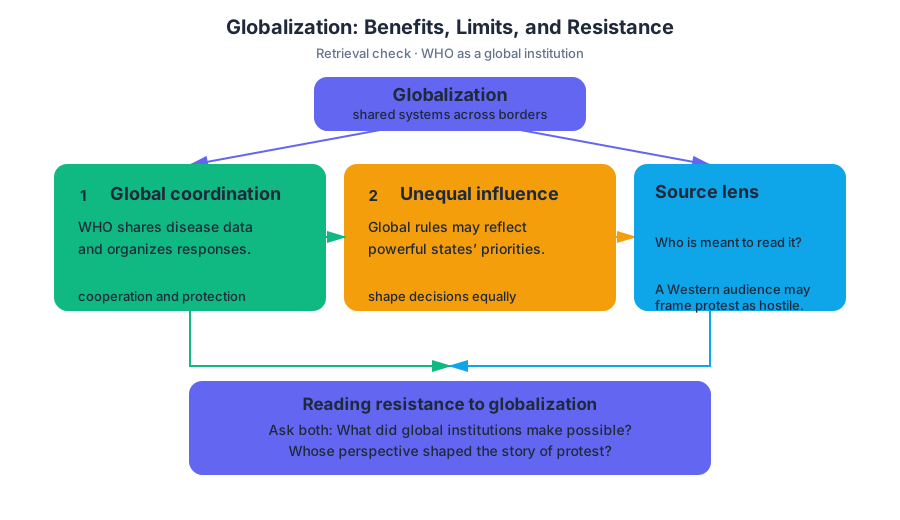
International institutions are organizations created by multiple states to address problems that cross national borders. In Topic 9.8, the World Health Organization illustrates how such institutions attempted to spread the benefits of innovations in medicine and public health to developing countries. These efforts reduced deaths from communicable diseases in many regions.
The example reveals both institutional possibility and limitation. Medical knowledge, antibiotics, vaccines, sanitation programs, and disease-control campaigns could travel internationally, but their success depended on funding, infrastructure, trained personnel, political cooperation, and public trust. A scientific innovation therefore did not automatically produce equal outcomes: institutions had to organize its delivery.
Human-rights language also became more influential in the globalized world. International communication and institutions helped publicize violations and gave activists vocabulary for demanding equality. At the same time, critics questioned whether powerful states applied human-rights principles consistently or used them to justify intervention and preserve influence.
AP historical thinking in action
Skill 2.C — Sourcing and Situation: To evaluate a source, identify its point of view, purpose, historical situation, and/or audience, then explain how those features affect its usefulness. A government advertisement praising international development may reveal official goals and optimism, but its purpose may lead it to minimize inequality or local resistance.
AP Skill 4.B — Contextualization: Explain how a specific historical development fits within a broader historical context. For example, place a protest against a foreign corporation within the wider context of post-1900 consumer globalization, expanding communications, international institutions, and unequal economic integration.
Common misconception: Resistance to globalization was not simply “opposition to modern technology.” Many protesters used global media, international networks, and digital communication to organize. Their objection was often directed at who controlled globalization, who benefited from it, and whose culture or rights were neglected.
Retrieval check
Explain, in two steps, how the World Health Organization demonstrates both a benefit and a limitation of globalization. Then identify one feature of a source—audience, purpose, point of view, or historical situation—that could shape how it portrays a protest against Western influence.
Source Materials
- AP World History: Modern Course and Exam Description
- AP World History: Modern Course and Exam Description Clarifications and Corrections
- AP World History: Modern Course Overview
- AP World History: Modern Course at a Glance
- AP World History: Modern Course at a Glance Poster
- AP World History: Modern
- AP World History: Modern
- AP World History: Modern Sample Syllabus 1