From the free course AP World History: Modern on Lykke
AP Practice 3
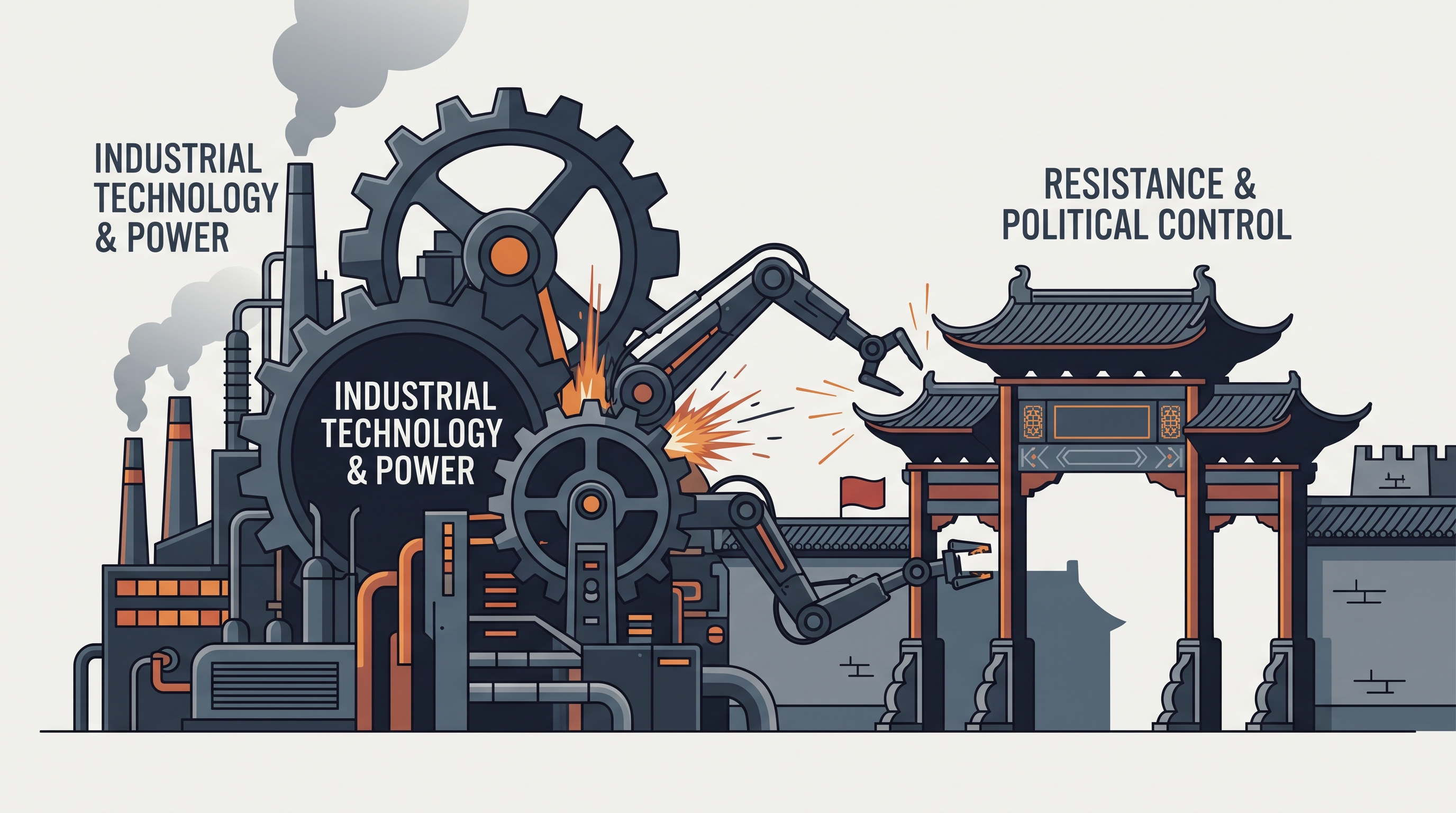
Industrialization gave European states new military and commercial tools, but those tools did not automatically produce complete control over China. Between 1839 and 1911, European powers used industrial advantages to reshape China’s economy, diplomacy, and territory, while Chinese officials and reformers responded…
AP Practice 3
Document-Based Question: Industrialization and Relations with China
Industrialization gave European states new military and commercial tools, but those tools did not automatically produce complete control over China. Between 1839 and 1911, European powers used industrial advantages to reshape China’s economy, diplomacy, and territory, while Chinese officials and reformers responded with resistance, selective adaptation, and attempts to strengthen the state.
Prompt: Evaluate the extent to which industrialization transformed relations between European powers and China in the period from 1839 to 1911.
Suggested timing: Spend approximately 15 minutes reading and planning, then 45 minutes writing. A strong response should develop a defensible thesis, establish historical context, use the documents as evidence, explain the significance of sourcing for at least three documents, add relevant evidence beyond the documents, and demonstrate a complex understanding of the historical development.
Historical situation
By 1839, Britain’s Industrial Revolution had produced steam-powered ships, mass-produced weapons, and expanding commercial networks. China, ruled by the Qing dynasty, remained a major economic and political power, but its government attempted to restrict foreign trade to controlled locations such as Guangzhou. British merchants responded to this limitation by selling opium from British-controlled India to Chinese consumers, creating both commercial profits and a serious social and political crisis.
Document set
| Document | Source and historical situation | Central idea |
|---|---|---|
| 1 | Commissioner Lin Zexu’s 1839 appeal to Queen Victoria | China condemns Britain’s opium trade as morally and politically destructive. |
| 2 | Treaty of Nanjing, 1842 | Britain gains commercial privileges, an indemnity, and control of Hong Kong after the First Opium War. |
| 3 | A British parliamentary defense of the war, 1840s | British leaders present the conflict as necessary to protect commerce and national honor. |
| 4 | A Qing official’s report on the Taiping Rebellion, 1850s | Foreign pressure and internal rebellion weaken Qing authority simultaneously. |
| 5 | A Japanese observation of China’s defeat by Japan, 1895 | China’s military weakness demonstrates the consequences of failing to modernize effectively. |
| 6 | A Chinese reformer’s argument for industrial and educational reform, 1890s | Some Chinese intellectuals advocate selective adoption of Western technology and institutions. |
| 7 | A description of the Boxer Uprising and foreign intervention, 1900 | Popular anti-foreign resistance confronts a coalition of industrial powers. |
How to read the documents
The documents do not merely provide facts; they reveal different perspectives on the same transformation. Lin Zexu emphasizes morality and Chinese sovereignty, while the British parliamentary defense emphasizes commerce and national power. The Treaty of Nanjing shows the concrete outcome of military conflict, whereas the reformer’s argument shows that Chinese responses were not limited to rejection.
A useful evidence chain is:
- Industrial capacity created unequal military power.
- Military victories produced unequal treaties and foreign privileges.
- Foreign pressure intensified internal Qing crises.
- Chinese responses ranged from resistance to reform.
- Industrialization transformed the relationship substantially, but did not eliminate Chinese agency or produce direct European colonization of all China.
Worked thesis and outline
Defensible thesis: Industrialization transformed European relations with China to a great extent by allowing European states to use superior weapons, steam transport, and global commercial networks to impose unequal treaties, expand foreign economic privileges, and intervene in Chinese affairs; however, the transformation was incomplete because Chinese officials resisted foreign demands, reformers selectively adopted industrial methods, and Qing institutions continued to govern most of China until the dynasty’s collapse in 1911.
This thesis earns the argument point because it makes a historically defensible claim, establishes a line of reasoning, and qualifies the extent of change. Its structure also creates three body sections: military and diplomatic change, economic and political consequences, and Chinese resistance and adaptation.
Model evidence reasoning
Military and diplomatic transformation: Documents 1, 2, and 3 show how industrialization changed the balance of power. Lin’s appeal demonstrates that Chinese officials viewed the opium trade as a threat to sovereignty, while the Treaty of Nanjing reveals that Britain converted military victory into concrete privileges. The British parliamentary defense is useful because its intended audience—lawmakers and the British public—encouraged the author to justify war as protection of commerce rather than describe it as imperial coercion.
Political and economic consequences: The Treaty of Nanjing transferred Hong Kong to Britain and opened additional Chinese ports to foreign trade. Document 4 can be connected to the Taiping Rebellion: Qing authorities faced internal rebellion while also confronting foreign military and economic pressure. This combination weakened the dynasty and made it more dependent on foreign loans, military expertise, and diplomatic concessions.
Resistance and adaptation: Documents 5, 6, and 7 demonstrate that Chinese responses were varied. The Japanese observation after 1895 highlights China’s military vulnerability, while the reformer argues that industrial technology and modern education could strengthen the state. The Boxer Uprising shows a different response: violent resistance to foreign influence. Together, these documents complicate the claim that industrialization simply “westernized” China.
Evidence beyond the documents
A response could add the Second Opium War, which led to the Treaty of Tianjin and expanded foreign access; the Sino-Japanese War of 1894–1895, which revealed China’s weakness against a recently modernized Japan; or the Self-Strengthening Movement, which attempted to adopt Western military technology while preserving Qing political traditions. The “spheres of influence” established by European powers and Japan also show that foreign control expanded without becoming a single unified colonial administration.
Rubric map
| Rubric criterion | What an examiner rewards | Where the model earns it |
|---|---|---|
| Thesis/claim | A defensible claim with a line of reasoning | Industrialization caused major change, but Chinese agency limited its extent. |
| Contextualization | Broader historical setting | Industrial Revolution, Qing trade restrictions, and the opium crisis. |
| Evidence from documents | Accurate use of at least four documents | Documents 1–7 are organized into analytical categories. |
| Evidence beyond documents | Specific relevant outside information | Second Opium War, Self-Strengthening Movement, and spheres of influence. |
| Sourcing and situation | Explains why sourcing matters for the argument | British parliamentary audience and Lin’s official position. |
| Complex understanding | Explains multiple perspectives, causes, or limits | Foreign domination is analyzed alongside resistance and selective reform. |
Misconception check
Misconception: “Industrialization caused Europeans to colonize all of China.” Industrialization produced coercive power and foreign privileges, but China was not governed as one European colony. European powers controlled ports, concessions, loans, and spheres of influence while the Qing government retained authority over much of the country.
Error-review routine
After writing, mark every document reference with D, every outside fact with O, every sourcing explanation with S, and every complexity move with C. If a paragraph has documents but no explanation of how they support the thesis, revise it from summary into reasoning: replace “Document 2 says Britain gained Hong Kong” with “The transfer of Hong Kong shows how industrial military power converted commercial conflict into territorial privilege.”
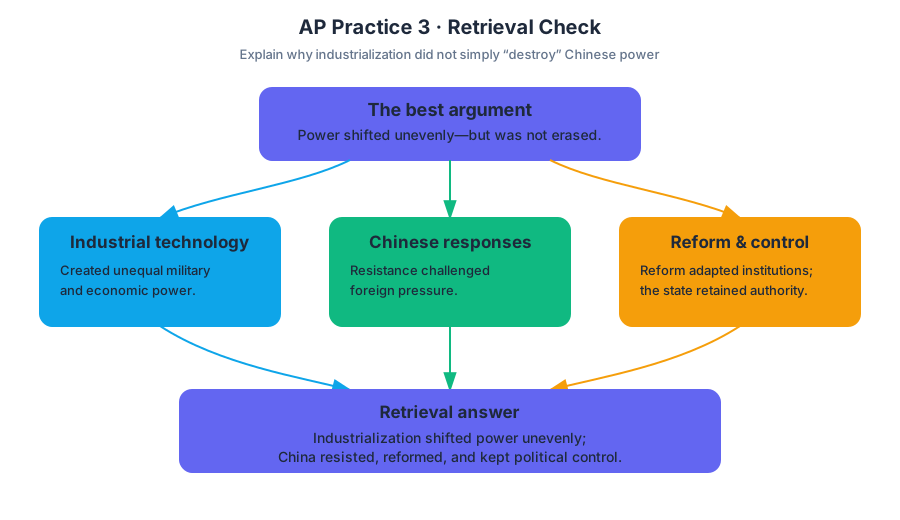
Retrieval check
In one sentence, explain why the best argument is not simply that industrialization “destroyed” Chinese power. A strong answer should mention both the unequal power created by industrial technology and the Chinese strategies of resistance, reform, and continued political control.
Source Materials
- AP World History: Modern Course and Exam Description
- AP World History: Modern Course and Exam Description Clarifications and Corrections
- AP World History: Modern Course Overview
- AP World History: Modern Course at a Glance
- AP World History: Modern Course at a Glance Poster
- AP World History: Modern
- AP World History: Modern
- AP World History: Modern Sample Syllabus 1
- AP World History Past Exam Questions — AP Central
- Khan Academy — AP World History: Modern
- Freeman-pedia — AP World History: Modern
- YouTube — Heimler's History