From the free course AP World History: Modern on Lykke
8.9 Causation in the Age of the Cold War and Decolonization
Key concepts: Causation in the context of the Cold War and decolonization · Post–World War II European economic struggles and the weakening of colonial empires · African anticolonial movements and the achievement of independence · The establishment of independent postcolonial states in Africa · The adoption of communist or socialist ideologies by some postcolonial African states · Cold War competition between communist and capitalist powers · Superpower support for African independence movements · Postcolonial control over economies and natural resources · The relationship between colonial economic policies and the goods colonies could produce, receive, import, or obtain · Environmental and economic factors contributing to anticolonial movements
After World War II, European empires weakened because the states that had ruled them were financially exhausted, militarily damaged, and increasingly unable to justify the cost of colonial control.
8.9 Causation in the Age of the Cold War and Decolonization
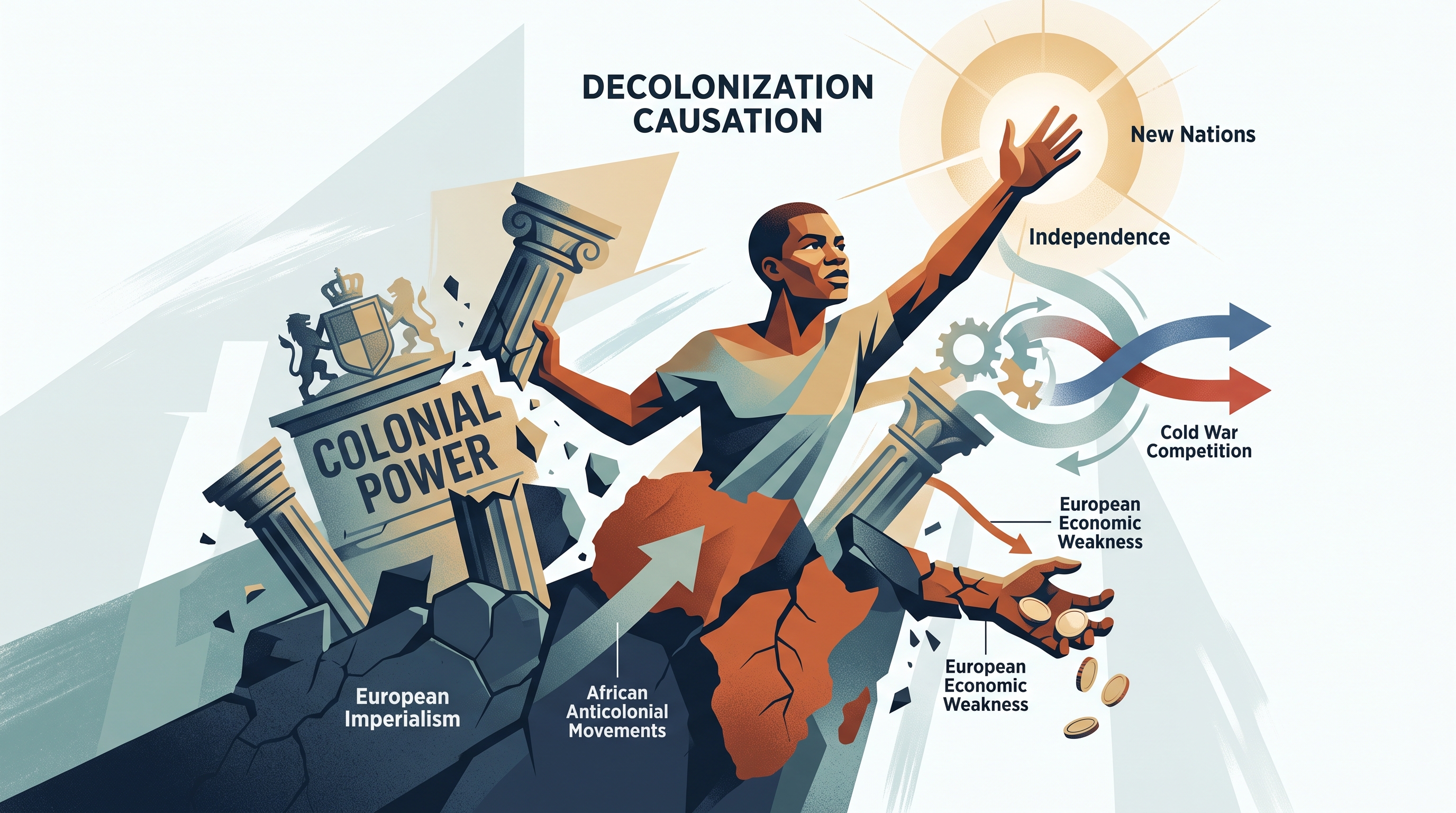
After World War II, European empires weakened because the states that had ruled them were financially exhausted, militarily damaged, and increasingly unable to justify the cost of colonial control. Anticolonial movements recognized this weakness, demanded political independence, and helped create a new map of independent postcolonial states across Africa.
Central causal claim: European weakness created an opening, but African political action, economic demands, environmental hardships, and Cold War competition determined how decolonization unfolded.
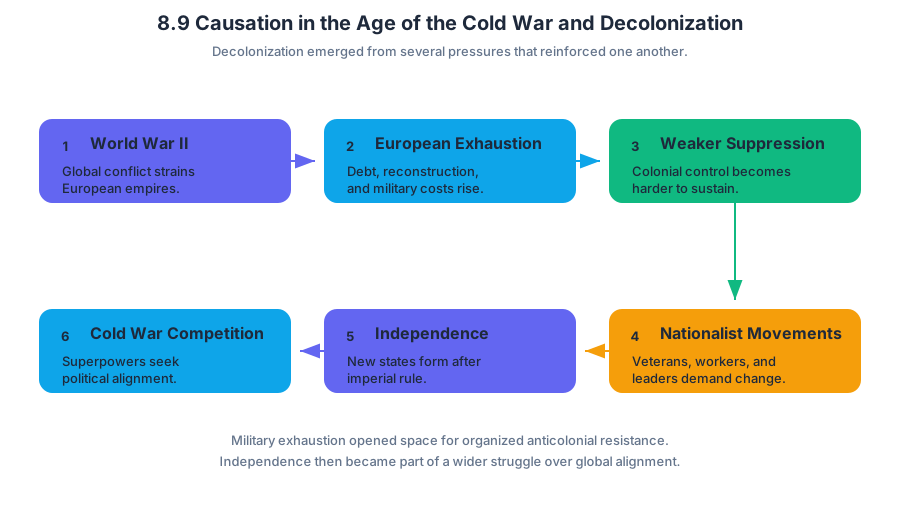
The causal chain of decolonization
Decolonization means the process by which colonies gained political independence from imperial powers. It was not caused by one event. Instead, several pressures reinforced one another:
World War II
   ↓
European financial and military exhaustion
   ↓
Weaker ability to suppress colonial resistance
   ↓
African nationalist and anticolonial movements
   ↓
Independence and postcolonial state formation
   ↓
Cold War competition over political and economic alignment
The two world wars damaged European economies and consumed enormous military resources. Even victorious powers such as Britain and France faced debts, reconstruction costs, and pressure to provide social services at home. Maintaining distant colonies required armies, administrators, transportation networks, and coercive institutions; after 1945, these costs became increasingly difficult to sustain.
At the same time, colonial subjects recognized that European power was not unlimited. African veterans who had served in world wars, educated political leaders, labor organizers, and nationalist movements used this contradiction—European claims to defend freedom while denying it in colonies—to demand self-government. International support for self-determination, including pressure associated with the United Nations, further weakened the legitimacy of empire.
Economic causes: independence as resource control
Political independence did not automatically produce economic independence. Colonial economies had usually been organized to extract particular products—such as minerals, cash crops, or other resources—for export. This structure influenced what colonies could produce, what manufactured goods they had to import, and who controlled their land, labor, trade, and natural resources.
For many African movements, independence therefore meant more than replacing a European governor with an African one. It meant gaining control over mines, agricultural production, taxation, trade, and national development. Environmental and economic hardships—such as difficult climates, resource exploitation, poverty, and unequal access to land or goods—also helped fuel opposition to colonial rule.
| Cause | How it encouraged decolonization |
|---|---|
| European economic weakness | Made imperial administration and military repression more expensive |
| Wartime losses | Reduced European military and political authority |
| Colonial economic systems | Encouraged demands for control over resources and production |
| Environmental hardship | Increased dissatisfaction with colonial conditions |
| African nationalism | Turned social grievances into organized independence movements |
| Cold War competition | Supplied money, weapons, training, or diplomatic support to movements and new states |
Cold War choices after independence
The Cold War added a second layer of causation. Newly independent African states emerged while the United States and Soviet Union competed for influence. Both superpowers presented their economic and political systems as models for newly sovereign nations, and competition between capitalist and communist powers led to financial and material support for some independence movements.
Some postcolonial African governments adopted communist or socialist ideologies because these systems appeared to offer tools for rapid development, national economic planning, and resistance to foreign economic control. Soviet support could also provide weapons, advisers, or diplomatic backing. This does not mean every socialist government simply acted as a Soviet puppet: African leaders often selected ideologies strategically to pursue sovereignty and reshape colonial economies.
A useful example is the relationship between political independence and economic policy in India. British economic policy had long shaped Indian production and trade; in the Cold War era, superpower influence affected the choices available to newly independent governments. The broader pattern was global: political sovereignty was difficult to protect when colonial trade systems, foreign investment, and strategic resources remained controlled from abroad.
Worked causal example: from weakness to independence
Suppose an explanation asks why many African states achieved independence after 1945. A strong chain of reasoning would proceed as follows:
- Identify the condition: World War II left European powers with severe financial and military burdens.
- Explain the mechanism: These burdens reduced their ability and willingness to pay for colonial administration and suppress rebellion.
- Identify the response: African nationalists, veterans, workers, and political organizations recognized the opening and demanded independence.
- Show the result: Colonial rule ended in many territories, producing independent postcolonial states.
- Add complexity: Cold War competition then influenced whether new governments received support from capitalist or communist powers and which economic ideologies they adopted.
Misconception check
Misconception: “Europe simply gave Africa independence because empire had become morally unpopular.” Moral criticism mattered, but causation must include material and political pressures: wartime exhaustion, the expense of colonial rule, organized African resistance, demands for resource control, and Cold War intervention.
Misconception: “Cold War influence caused decolonization by itself.” The Cold War amplified and redirected anticolonial struggles, but African movements and populations were active causes. Independence emerged from the interaction of European weakness, African political action, economic grievances, and superpower competition.
AP reasoning focus
This topic most directly develops Skill 5: Making Connections, especially 5.B: Explain the causes and effects of a historical development. A high-quality response distinguishes long-term conditions from immediate catalysts and connects each cause to a specific mechanism. It also uses Skill 4: Contextualization by placing African decolonization within the post–World War II weakening of European empires, and Skill 6: Argumentation by advancing a defensible claim about which causes mattered most.
Retrieval check: Explain how European economic weakness, African anticolonial movements, and Cold War competition formed a connected—not separate—causal process after 1945. Which factor created the opening, which actor exploited it, and which forces shaped the new states’ choices?
Source Materials
- AP World History: Modern Course and Exam Description
- AP World History: Modern Course and Exam Description Clarifications and Corrections
- AP World History: Modern Course Overview
- AP World History: Modern Course at a Glance
- AP World History: Modern Course at a Glance Poster
- AP World History: Modern
- AP World History: Modern
- AP World History: Modern Sample Syllabus 1
- [a] Identify ONE political factor in the period after 1945 that facilitated the establishment of independent postcolonial states in Africa.
- [a] Identify ONE political factor in the period after 1945 that facilitated the establishment of independent postcolonial states in Africa.