From the free course AP World History: Modern on Lykke
4.5 Maritime Empires Maintained and Developed · 4.6 Internal and External Challenges to State Power from 1450 to 1750
Key concepts: Governance and state power · Internal and external factors in state formation, expansion, and decline · Administrative institutions, policies, and procedures used to maintain order · Recruitment and use of bureaucratic elites and military professionals · Maritime empires · The Ottoman devshirme system · Salaried samurai in Japan · Ming China · Tokugawa Japan · The Protestant and Catholic reformations and the growth of Christianity
Explain and apply 4.5 Maritime Empires Maintained and Developed · 4.6 Internal and External Challenges to State Power from 1450 to 1750.
4.5 Maritime Empires Maintained and Developed · 4.6 Internal and External Challenges to State Power from 1450 to 1750
A state could possess powerful ships and still lose control on land. Between $1450$ and $1750$, rulers maintained authority by combining military force, administrative systems, religious legitimacy, taxation, and carefully managed trade. The central question is not simply which empire expanded, but how governments obtained, retained, and exercised power—and why that power sometimes weakened.
Governance (GOV): A variety of internal and external factors contribute to state formation, expansion, and decline. Governments maintain order through administrative institutions, policies, and procedures, and they obtain, retain, and exercise power in different ways and for different purposes.
Maritime power required administration
A maritime empire is a state whose influence depends significantly on oceanic trade, naval power, overseas ports, or commercial networks. European states established profitable trading posts in Africa and Asia, but maritime power was not exclusively European. Ming China is identified as a maritime empire established during this period, while Tokugawa Japan is discussed in relation to the way an Asian state responded to European-dominated long-distance trade.
European trading posts generated revenue for rulers and merchants, yet they also created cultural and economic disruption. Some Asian states therefore adopted restrictive or isolationist policies to limit European influence. Tokugawa Japan did not become completely disconnected from the world; rather, its government attempted to regulate foreign contact and preserve political control over exchange.
Misconception check — “isolation” means total closure: Restrictive policies usually meant controlled access, not perfect isolation. A government could limit foreign merchants, missionaries, and political influence while still permitting selected trade.
Centralized states depended on specialists
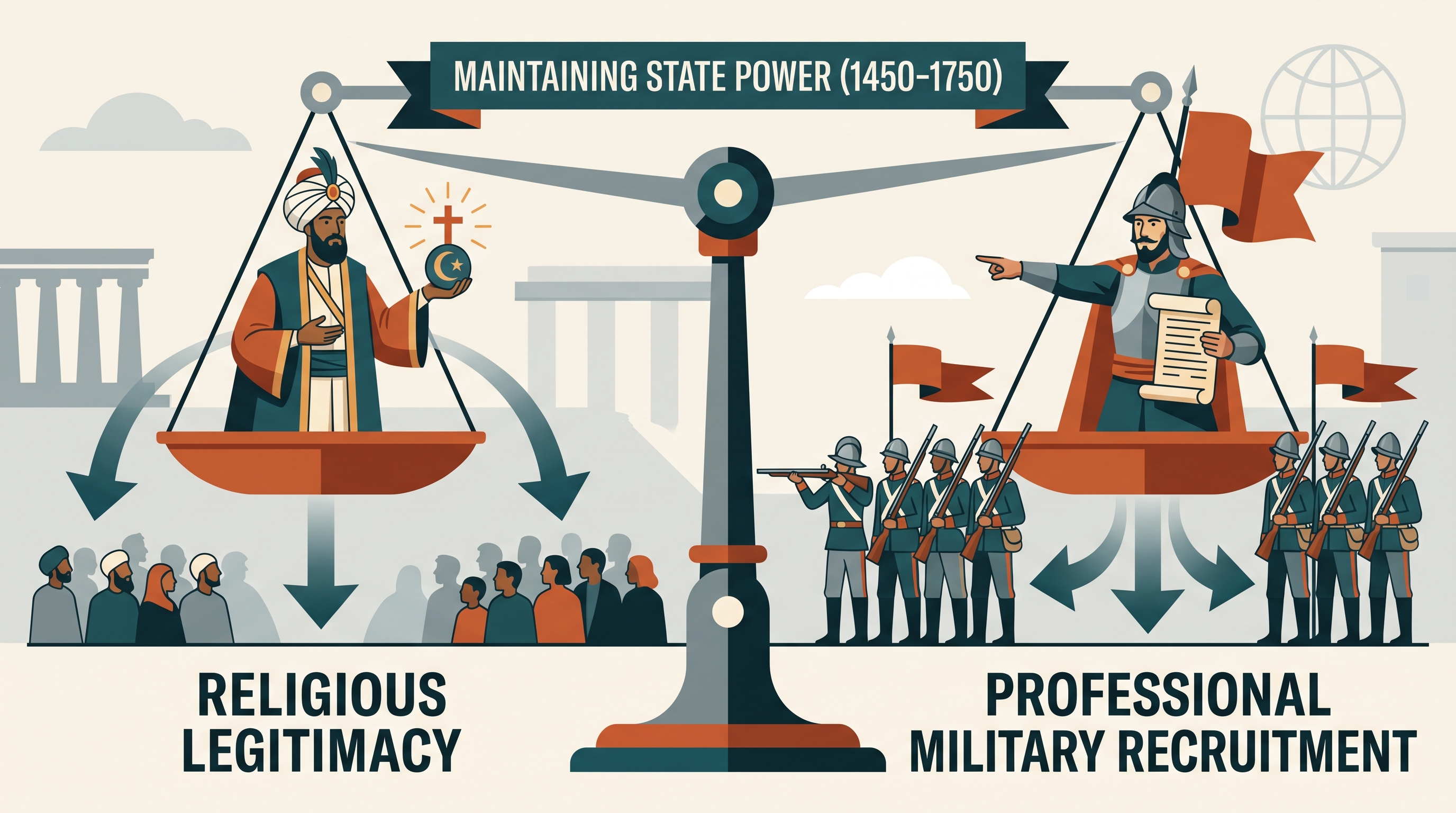
Rulers increasingly recruited bureaucratic elites, administrators who managed taxation and government, and military professionals, soldiers whose careers were organized around state service. These specialists helped rulers control populations and resources more consistently than personal loyalty alone could.
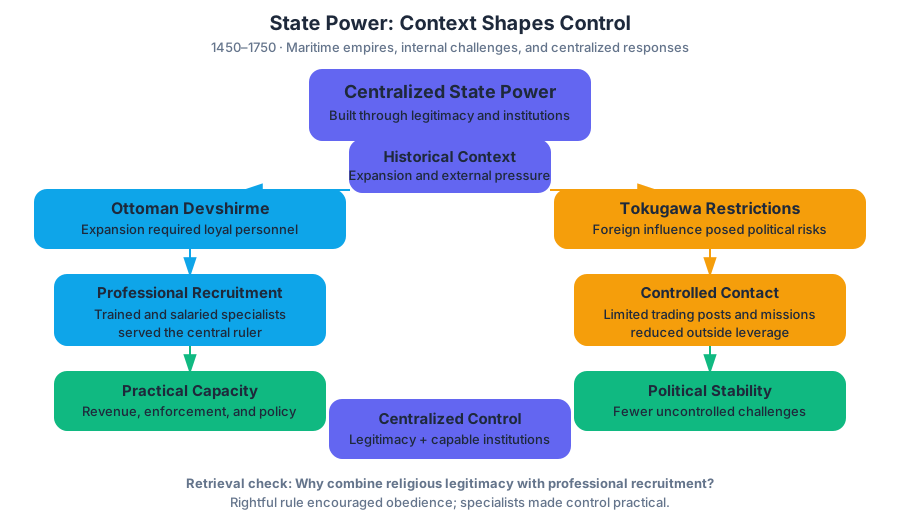
The Ottoman devshirme system illustrates this strategy. Christian boys from parts of the empire were recruited, converted to Islam, and trained for service in the Ottoman administrative or military establishment. Some became bureaucrats; others entered the elite Janissary corps. The system gave the sultan personnel whose careers and status depended directly on the central government.
Salaried samurai provide another example. In Tokugawa Japan, warrior professionals received stipends from their lords and served within a hierarchical political order. Their military identity was therefore connected to administration and state discipline, not merely to independent landholding.
Key distinction: A professional military is not simply a large army. It is a force whose recruitment, training, payment, and loyalty are organized by the state.
Revenue, legitimacy, and order worked together
States needed revenue to pay soldiers, maintain officials, build infrastructure, and expand. Rulers used tribute collection, tax farming, and innovative tax systems; examples include Ottoman tax farming, Mughal zamindar tax collection, Mexica tribute lists, and the Ming practice of collecting taxes in hard currency. These systems converted political control into material resources.
Power also required legitimacy, the belief that rule was rightful. Religious ideas, art, and monumental architecture communicated authority. The Protestant and Catholic reformations changed existing Christian traditions and contributed to Christianity’s continued growth, while rulers elsewhere used religious policies, imperial portraits, mausolea, mosques, and palaces to present government as sacred, orderly, and powerful.
Internal and external challenges could redirect states
State formation, expansion, and decline resulted from interacting pressures. Internally, rulers faced succession disputes, religious divisions, resistance from local elites, fiscal problems, and administrative overreach. Externally, states confronted rival empires, military competition, changing trade routes, and the disruptive arrival of European maritime powers.
The fragmentation of the Abbasid Caliphate demonstrates political change within the Islamic world: religious and cultural influence could persist even as centralized political authority weakened. Political fragmentation did not mean that a civilization disappeared; it meant that power was redistributed among competing states and rulers.
Reading power in a primary source
Bernal Díaz del Castillo’s description of Tenochtitlan can be read as evidence about how an observer interpreted state power. The city’s scale, organization, markets, monumental structures, and tribute relationships reveal a highly developed political center. At the same time, Díaz wrote as a Spanish participant in the conquest, so his purpose and perspective shaped what he emphasized.
Worked contextual example: If a passage praises Tenochtitlan’s grandeur but describes Mexica religious practices as shocking, contextualize both details together. The first reflects the city’s administrative and economic strength; the second reflects European Christian assumptions during Spanish conquest. A strong interpretation therefore uses the source both as evidence about Tenochtitlan and as evidence about the observer’s worldview.
Skill focus: Contextualization (4.A)
4.A — Identify and describe a historical context for a specific historical development or process. For the devshirme, relevant context includes Ottoman territorial expansion and the need for personnel loyal to the central ruler. For Tokugawa restrictions, relevant context includes European trading posts, missionary activity, and the political risks of uncontrolled foreign influence.
Retrieval check: Why could a ruler use both religious legitimacy and professional military recruitment? What internal problem did each address? A complete response should explain that religious ideas encouraged obedience by presenting rule as rightful, while trained and salaried specialists gave the government practical tools to collect revenue, enforce policy, and maintain centralized control.
Source Materials
- AP World History: Modern Course and Exam Description
- AP World History: Modern Course and Exam Description Clarifications and Corrections
- AP World History: Modern Course Overview
- AP World History: Modern Course at a Glance
- AP World History: Modern Course at a Glance Poster
- AP World History: Modern
- AP World History: Modern
- AP World History: Modern Sample Syllabus 1
- [a] Identify ONE method Europeans used to expand their empires in the Americas in the period circa 1450–1750.
- [a] Identify ONE method Europeans used to expand their empires in the Americas in the period circa 1450–1750.
- A Identify one technological or military factor that contributed to the expansion of Muslim empires such as the Ottoman, Safavid, or Mughal Empires during the period circa 1300 to 1600.
- A Identify one technological or military factor that contributed to the expansion of Muslim empires such as the Ottoman, Safavid, or Mughal Empires during the period circa 1300 to 1600.