From the free course AP World History: Modern on Lykke
3.1 Empires Expand · 3.2 Empires: Administration
Key concepts: Expanding European maritime empires · Resistance to European imperial expansion · Failure to modernize · European industrial power · Falling behind Europe industrially
Between 1450 and 1750, the Ottoman Empire faced a new kind of rival: European states that could project power across oceans, seize strategic ports, and connect military expansion to long-distance commerce.
3.1 Empires Expand · 3.2 Empires: Administration
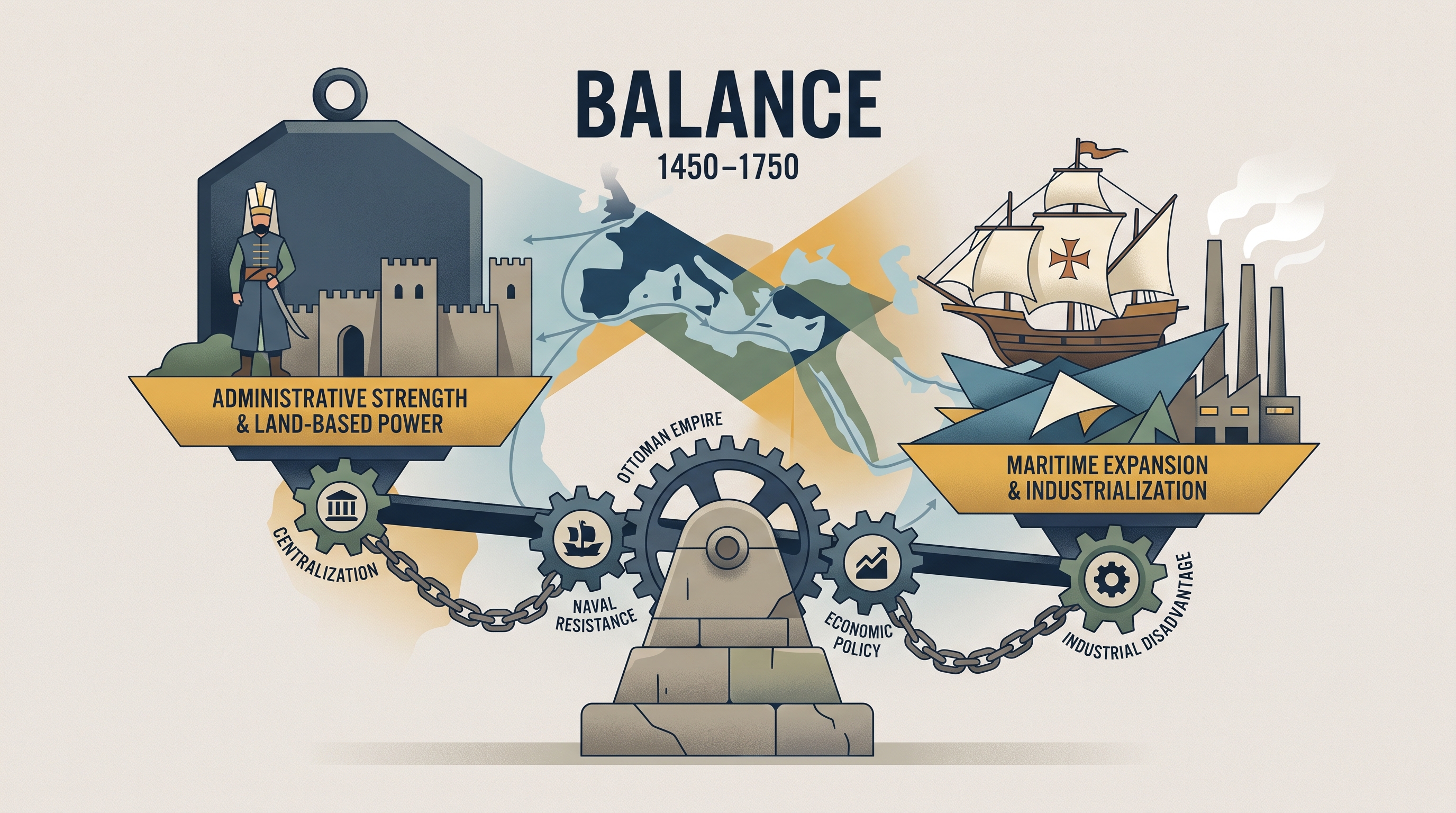
Between 1450 and 1750, the Ottoman Empire faced a new kind of rival: European states that could project power across oceans, seize strategic ports, and connect military expansion to long-distance commerce. The Ottomans successfully built a centralized land empire and resisted European intrusion in several regions, but their later inability to match Europe’s industrial transformation created a widening gap in weapons, finance, transportation, and naval power.
Investigative question: How could a powerful, well-administered empire resist European expansion in the early modern period yet eventually fall behind the European powers?
Ottoman expansion and centralized administration
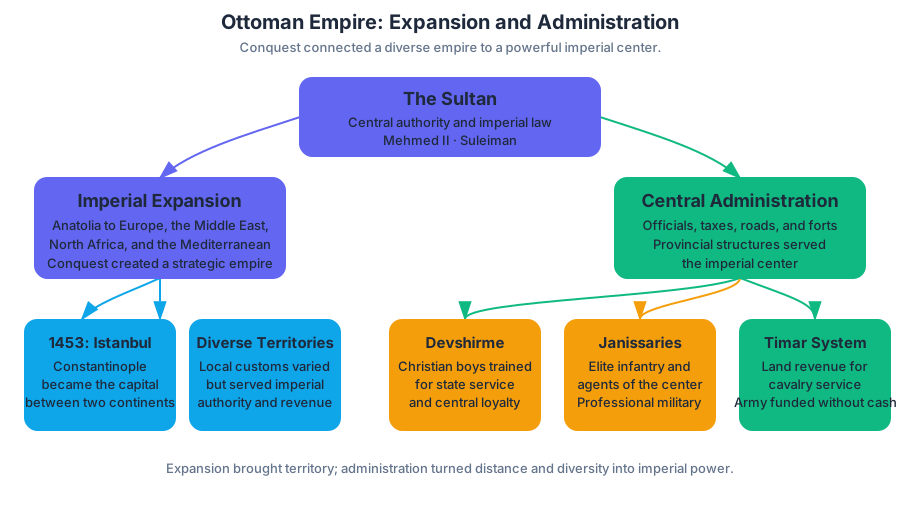
The Ottoman Empire expanded from Anatolia into southeastern Europe, the eastern Mediterranean, the Middle East, and North Africa. Its conquest of Constantinople in 1453 transformed the city into Istanbul, an imperial capital positioned between Europe and Asia. Under rulers such as Mehmed II and Suleiman the Magnificent, Ottoman authority rested on a strong central government, a professional military, and provincial officials who connected distant territories to the sultan.
The devshirme system recruited Christian boys from some Balkan communities, converted them to Islam, and trained many for state service. The most famous recipients became Janissaries, elite infantry soldiers and agents of the central government. The timar system assigned land-revenue rights to cavalrymen in exchange for military service, allowing the state to support an army without paying every soldier directly in cash.
These institutions helped the sultan prevent powerful nobles from becoming fully independent. Ottoman administrators collected taxes, enforced imperial law, maintained roads and fortifications, and governed a diverse population through provincial structures. Centralization did not mean that every region was governed identically; rather, it meant that local arrangements ultimately served the authority and fiscal needs of the imperial center.
European maritime empires challenge Ottoman power
European expansion operated differently from Ottoman land conquest. Portugal built a chain of fortified coastal positions after Vasco da Gama’s voyage around Africa, attempting to control Indian Ocean shipping through ports such as Goa, Hormuz, and Malacca. The Dutch later used the VOC, a chartered company with state-backed military powers, to dominate parts of the spice trade. England and France increasingly joined this competition.
The Portuguese strategy threatened Ottoman commercial and strategic interests because the Ottomans controlled important Red Sea, Egyptian, and Persian Gulf routes. Ottoman rulers responded with naval expeditions from the Red Sea, artillery, fortifications, and diplomacy. In 1538, an Ottoman fleet supported an unsuccessful attempt to drive the Portuguese from Diu, and Ottoman authorities cooperated with the sultanate of Aceh in Southeast Asia against Portuguese pressure. These efforts show that Ottoman resistance involved more than battlefield confrontation: it also used regional alliances, fortified ports, and control of overland connections.
| European method | Ottoman response | Historical significance |
|---|---|---|
| Armed merchant fleets and fortified ports | Naval expeditions and coastal fortifications | Commerce and warfare became tightly connected |
| Control of chokepoints such as Hormuz | Attempts to contest Red Sea and Persian Gulf access | Oceanic routes challenged older land-based trade systems |
| Alliances with local rulers | Diplomacy with regional powers such as Aceh | Resistance could be transregional rather than purely local |
| Commercial monopolies backed by states | Regulation and defense of imperial trade routes | States increasingly competed through both armies and economies |
Why resistance did not eliminate the long-term industrial gap
The Ottoman Empire did not simply “collapse” when Europeans arrived. It remained a major military and political power for centuries, and it continued to centralize administration and compete with European maritime empires. The deeper problem emerged later, when European states entered the Industrial Revolution—the shift toward mechanized production powered by coal, steam, and concentrated capital.
Industrialization multiplied military and economic capacity. Factories produced weapons, textiles, tools, and ships at increasingly large scales. Steam engines moved goods and troops more rapidly; industrial finance supplied governments and companies with investment capital; railroads and telegraphs improved coordination; and steam-powered ironclad navies could sustain operations far from home ports.
The Ottoman government attempted reforms, including military reorganization and the creation of new schools and industries. However, adapting an older imperial system was difficult. Military elites could resist changes that threatened their privileges, state finances were strained by war and debt, European manufactured goods undercut some local producers, and foreign commercial privileges limited Ottoman control over trade. The result was not an absence of modernization, but modernization that was slower and less comprehensive than Europe’s.
Worked example: explaining the Ottoman trajectory
Claim: Ottoman resistance succeeded in preserving imperial sovereignty for a time, but administrative centralization alone could not compensate for the industrial advantages developing in Europe.
Evidence: Ottoman naval expeditions, fortified ports, and alliances demonstrate active resistance to Portuguese expansion. Yet European mechanized production, steam transport, industrial finance, modern weapons, and steam-powered navies later increased European power at a faster rate.
Reasoning: The Ottoman system was highly effective for governing a large land empire, but its institutions were not redesigned quickly enough to compete with industrial economies. Thus, the same empire could be strong in the sixteenth century and increasingly disadvantaged by the nineteenth century.
Misconception check — “Ottoman decline began immediately after 1453.”
This is incorrect. Ottoman power expanded after 1453 and successfully resisted European challenges in several theaters. A stronger explanation distinguishes early modern resilience from the later failure to modernize rapidly enough, rather than treating all Ottoman history as uninterrupted decline.
AP historical reasoning in this topic
- Skill 1.B: Explain a historical concept, development, or process — connect centralization, maritime expansion, and industrialization as interacting processes.
- Skill 3.C: Explain how claims and evidence support, modify, or refute a source’s argument — test whether evidence shows Ottoman weakness, resilience, or both.
- Skill 4.B: Explain how a specific historical development or process is situated within a broader historical context — place Ottoman-European rivalry within the transition from land-based to oceanic and industrial power.
- Skill 5.C: Explain the significance of a similarity, difference, or continuity — compare Ottoman land-based administration with European maritime-commercial expansion.
- Skill 6.C: Use historical reasoning to explain relationships among pieces of historical evidence — link naval resistance, administrative structures, economic policy, and industrial disadvantage.
- Skill 6.D: Corroborate, qualify, or modify an argument using diverse evidence — argue that the Ottoman Empire was both a successful centralized empire and a state that later fell behind Europe industrially.
Retrieval check: Explain why Ottoman resistance to Portuguese expansion does not contradict the claim that the empire later fell behind Europe. Name one Ottoman administrative strength, one form of resistance, and two European industrial advantages.
Source Materials
- AP World History: Modern Course and Exam Description
- AP World History: Modern Course and Exam Description Clarifications and Corrections
- AP World History: Modern Course Overview
- AP World History: Modern Course at a Glance
- AP World History: Modern Course at a Glance Poster
- AP World History: Modern
- AP World History: Modern
- AP World History: Modern Sample Syllabus 1
- AP World History Past Exam Questions — AP Central
- Khan Academy — AP World History: Modern
- Freeman-pedia — AP World History: Modern
- YouTube — Heimler's History