From the free course AP World History: Modern on Lykke
8.1 Setting the Stage for the Cold War and Decolonization · 8.2 The Cold War
Key concepts: Cold War · Decolonization · Global balance of power · Self-government and nationalism · Revolutionary movements · Political and social order · Land-based empires · Military alliances · Collapse of the Soviet Union · Colonial metropole
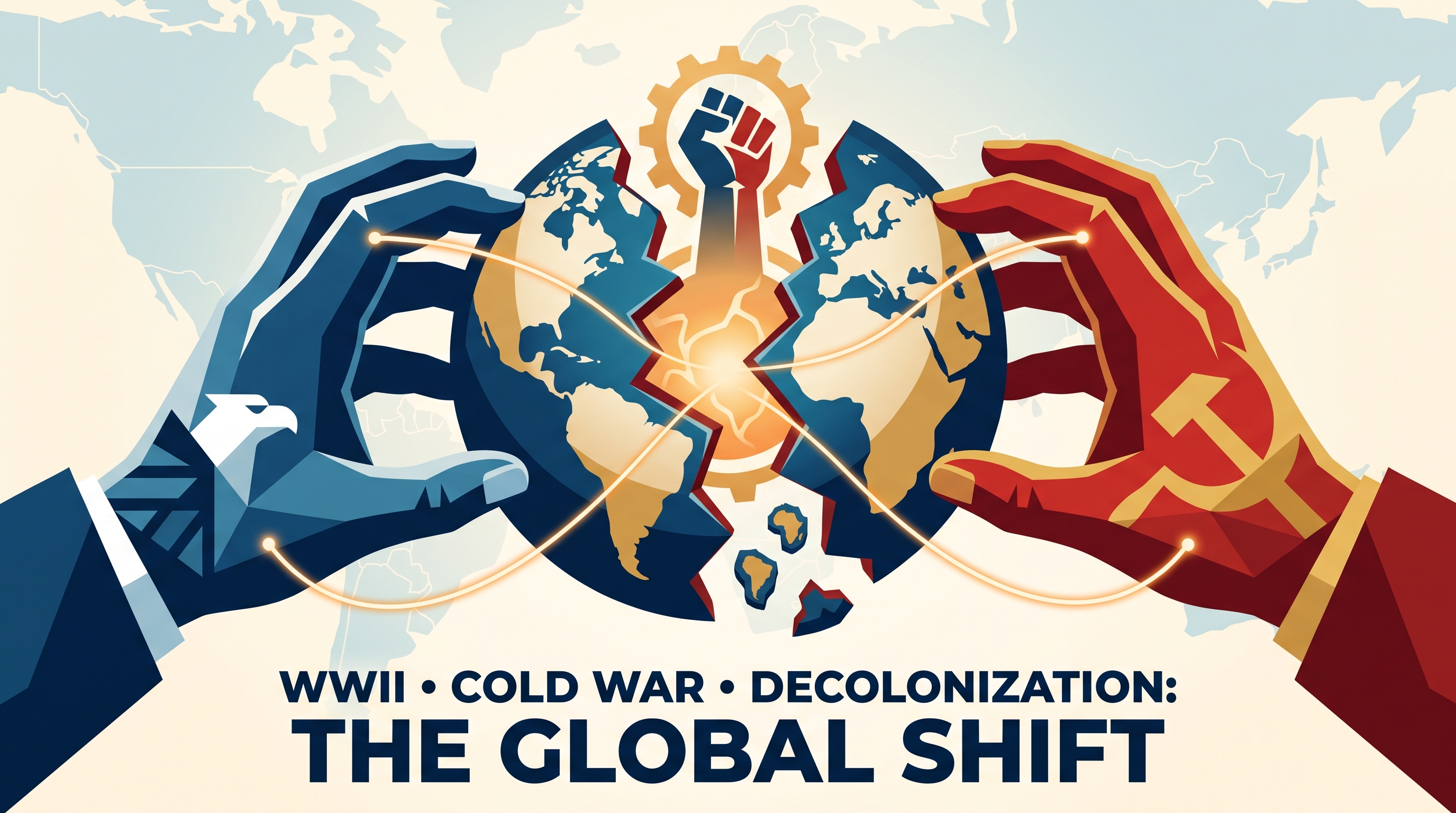
After 1945, the world was no longer organized around the old European imperial balance: World War II had weakened European empires, elevated the United States and Soviet Union, and intensified demands for national self-government.
8.1 Setting the Stage for the Cold War and Decolonization · 8.2 The Cold War
After 1945, the world was no longer organized around the old European imperial balance: World War II had weakened European empires, elevated the United States and Soviet Union, and intensified demands for national self-government. The result was a dual transformation: a geopolitical rivalry between superpowers and the political dissolution of empires.
Cold War: a prolonged competition between the United States and the Soviet Union that involved ideology, military alliances, economic influence, technology, and proxy conflicts, but generally avoided direct full-scale war between the two superpowers.
Decolonization: the process through which colonial territories gained formal political independence and created new states, often while retaining economic, military, or cultural ties to a former imperial metropole, the imperial center that had ruled them.
The global balance of power after 1945
World War I had already damaged confidence in empire, but its promises of self-determination were largely unfulfilled. European powers redrew borders and created some new states while continuing to rule much of Africa, the Middle East, and South Asia. Nationalist movements therefore encountered a sharp contradiction: European governments defended national sovereignty for some peoples while denying it to colonized populations.
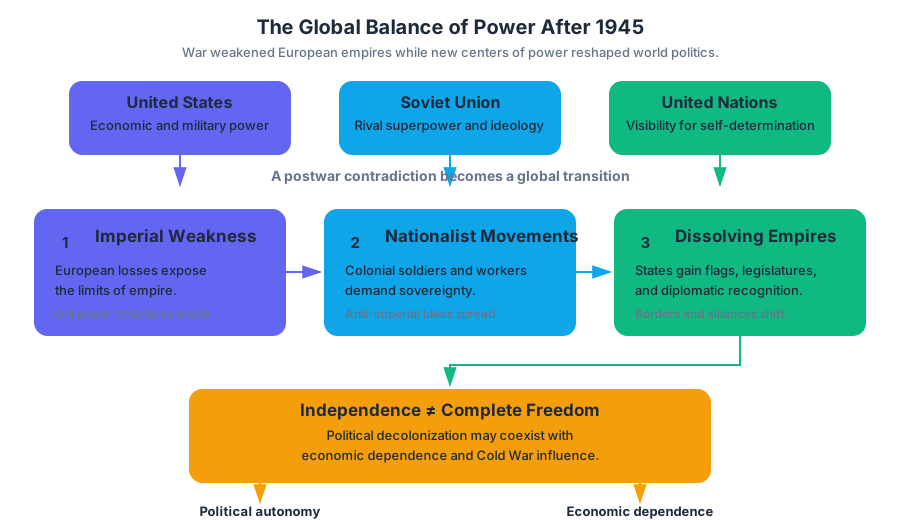
World War II made that contradiction harder to sustain. European states suffered enormous military and economic losses; colonial soldiers and workers gained political experience; and anti-imperialist ideas spread globally. The United States and Soviet Union emerged as the most powerful states, while the United Nations gave greater international visibility to claims based on self-determination.
The shift can be pictured as a three-stage chain:
European imperial weakness $\rightarrow$ stronger nationalist and anti-imperialist movements $\rightarrow$ dissolution of empires and restructuring of states
This does not mean that independence automatically produced complete freedom from foreign influence. A former colony might gain a flag, legislature, and diplomatic recognition while remaining dependent on foreign investment, trade patterns, military aid, or technical expertise. That continuing influence explains why political decolonization and economic decolonization did not always occur together.
Earlier crises of political and social order
The crises that shaped the twentieth century developed before the Cold War. The Ottoman, Qing, and Romanov empires illustrate how large land-based empires could face military pressure, nationalist opposition, fiscal weakness, and internal political crisis at the same time. Their decline showed that imperial governments could lose legitimacy when they could no longer maintain order or answer demands for reform.
The Mexican Revolution beginning in 1910 challenged an established political and social order. Opposition to the long rule of Porfirio Díaz joined demands involving land, labor, regional power, and national sovereignty. It demonstrates that revolutionary movements were not limited to Europe or to communist ideology: internal inequality and political exclusion could also produce revolutionary change.
The Russian Revolution of 1917 began in the crisis of the Romanov state and produced a revolutionary government claiming to replace capitalism with communism. It combined immediate pressures—war, food shortages, economic disruption, and loss of confidence in the monarchy—with a broader ideological challenge to existing political and social arrangements.
Key distinction: a revolutionary movement seeks fundamental change in political or social order; a nationalist movement seeks greater control by a people who define themselves as a nation. The two can overlap, but they are not identical.
Why the Cold War formed
The United States and Soviet Union had opposed political-economic visions: the United States generally defended liberal capitalism and pluralist political institutions, while the Soviet Union promoted communist rule and state-directed economic organization. Yet ideology alone did not cause the Cold War. Security fears, the future of Europe, control of occupied territories, nuclear weapons, and competition for global influence turned ideological difference into a worldwide rivalry.
The rivalry produced military alliances that divided much of the world into competing security systems. The United States and its partners created the North Atlantic Treaty Organization, or NATO, in 1949. The Soviet Union later organized the Warsaw Pact in 1955. These alliances made a conflict in one region potentially relevant to the security of an entire bloc.
Worked contextual example — Ghana, 1957: Ghana’s independence can be explained through multiple variables. British weakness after World War II reduced the capacity and willingness to preserve empire; African nationalism organized demands for self-government; veterans and political activists strengthened anticolonial leadership; and international discussion of self-determination increased pressure on European states. The best explanation is therefore not “Britain simply gave Ghana independence,” but a causal argument linking imperial decline, organized nationalism, and changing international expectations.
The Cold War’s changing endpoint
The Cold War eventually ended as Soviet power weakened. KC-6.2.IV.E identifies several connected causes: advances in U.S. military and technological development, the Soviet Union’s costly and failed invasion of Afghanistan, public discontent, and economic weakness in communist countries. These pressures contributed to the collapse of the Soviet Union, not merely to a change in diplomatic relations.
The Soviet collapse also reveals a final complication of decolonization and imperial dissolution: when an empire disappears, its influence may not disappear immediately. Former imperial centers can continue shaping trade, security arrangements, language, institutions, borders, and political elites. Decolonization therefore changed sovereignty while often preserving unequal relationships.
Skill in action: Contextualization 4.B
Contextualization (4.B) means explaining how a specific development fits within a broader historical setting. For a claim about post-1945 decolonization, a strong context would connect nineteenth-century imperialism and World War I’s unfulfilled promises of self-government to World War II’s weakening of European empires. A mere phrase such as “imperialism existed before” is not enough; the context must show how earlier developments shaped the later possibility of independence.
Misconception check
Misconception: “The Cold War was only a conflict between two European-style superpowers.” The United States and Soviet Union drove the rivalry, but its consequences reached newly independent states, revolutionary movements, and societies resisting colonial rule. Many governments pursued nonalignment rather than joining either bloc, and decolonization often became entangled with superpower competition without being caused entirely by it.
Retrieval check
Explain the relationship among World War II, decolonization, and the Cold War in two sentences. Then identify one reason the Mexican or Russian Revolution should be understood as a challenge to the existing political and social order rather than simply as a change of leaders.
Source Materials
- AP World History: Modern Course and Exam Description
- AP World History: Modern Course and Exam Description Clarifications and Corrections
- AP World History: Modern Course Overview
- AP World History: Modern Course at a Glance
- AP World History: Modern Course at a Glance Poster
- AP World History: Modern
- AP World History: Modern
- AP World History: Modern Sample Syllabus 1
- Figure — Sample Responses - SAQ 2 - Set 1 (p. 4)
- Figure — Sample Responses - SAQ 2 - Set 1 (p. 5)
- Figure — Sample Responses - SAQ 2 - Set 1 (p. 6)
- AP World History Past Exam Questions — AP Central