From the free course AP World History: Modern on Lykke
Course Framework, Skills and Reasoning Processes
Key concepts: Course framework alignment with college-level learning · Organization of content and skills into course units · Themes as cross-cutting concepts that build and spiral conceptual understanding · Historical thinking skills · Reasoning processes · Instructional approaches for developing historical thinking and reasoning · AP Course Audit and curriculum review · Progress Checks for assessing knowledge and skills · Alignment between classroom curriculum and AP Exam tasks · Unit planning and scaffolding
Historical study combines factual knowledge with disciplined actions: students must explain why developments occurred, evaluate evidence, connect regions, and construct defensible arguments. In AP World History: Modern, content knowledge matters because it gives students something meaningful to analyze—but the…
Course Framework, Skills and Reasoning Processes
Historical study combines factual knowledge with disciplined actions: students must explain why developments occurred, evaluate evidence, connect regions, and construct defensible arguments. In AP World History: Modern, content knowledge matters because it gives students something meaningful to analyze—but the course framework determines how that analysis happens.
Historical thinking skills are the actions students perform with historical information. Reasoning processes are the logical relationships they use to organize those actions, especially comparison, causation, and continuity and change.
How the framework is organized
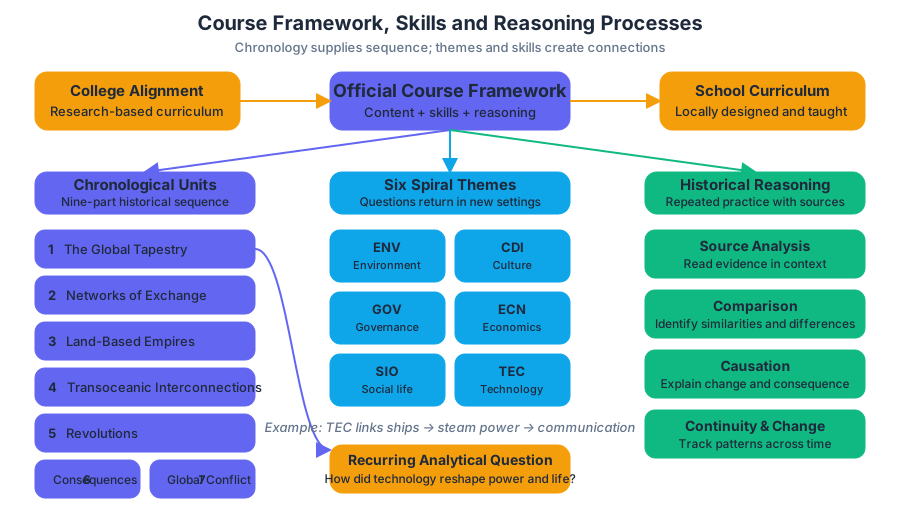
AP courses and exams use challenging, research-based curricula designed to align with introductory college courses. AP World History: Modern therefore combines a college-level world history textbook, diverse primary and secondary sources, thematic understanding, and repeated practice with historical reasoning. Schools design and implement their own curricula, but those curricula must develop the content understandings and skills described in the official course framework.
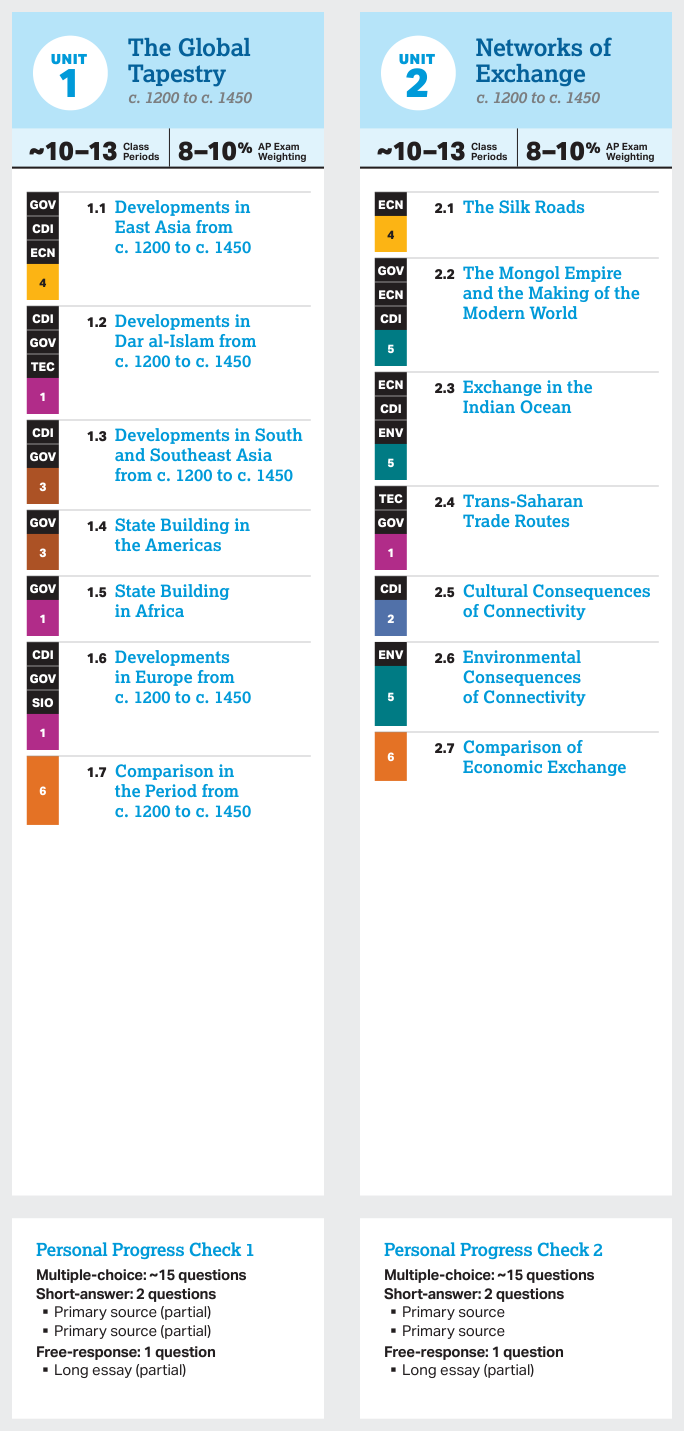
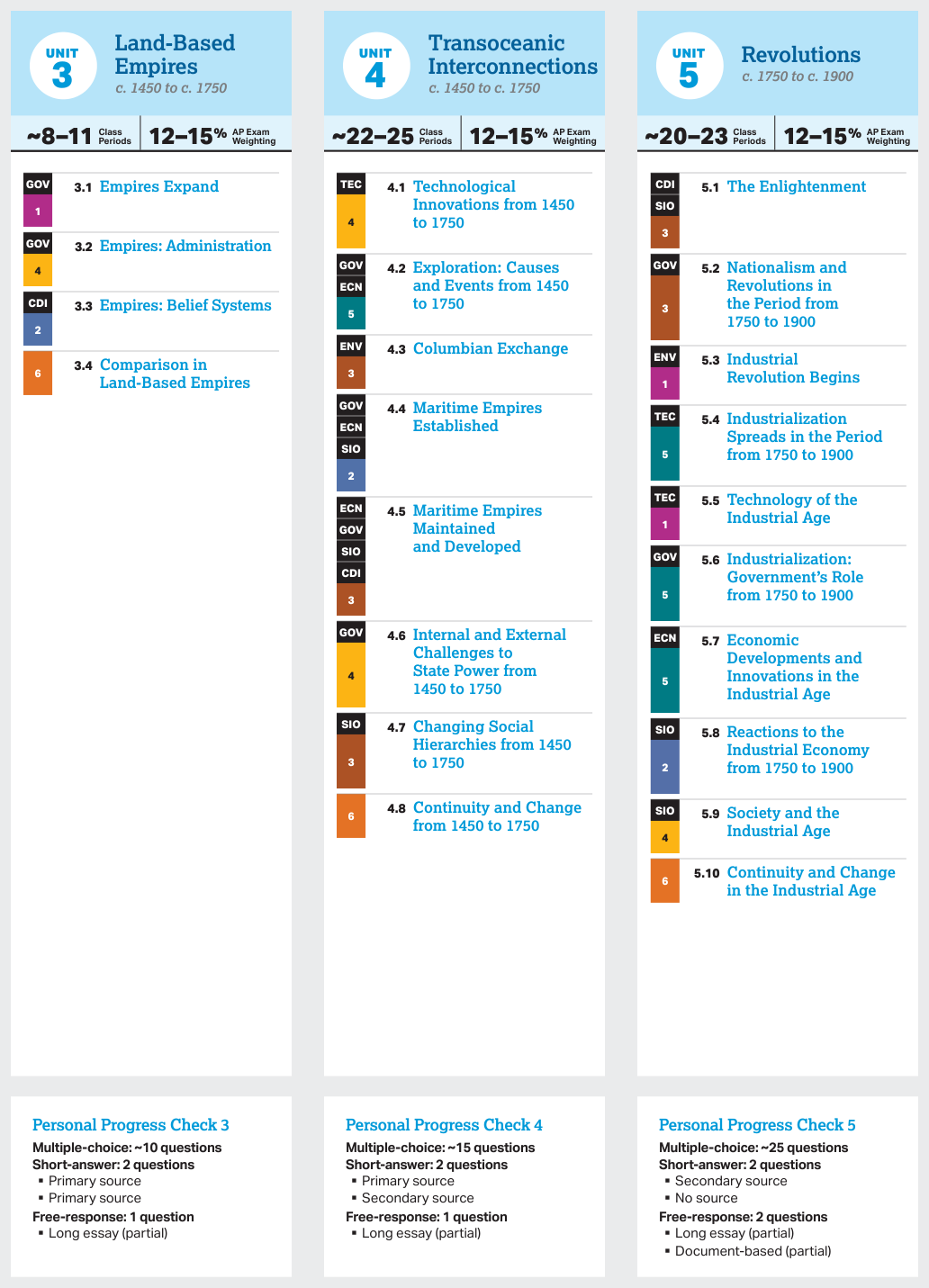
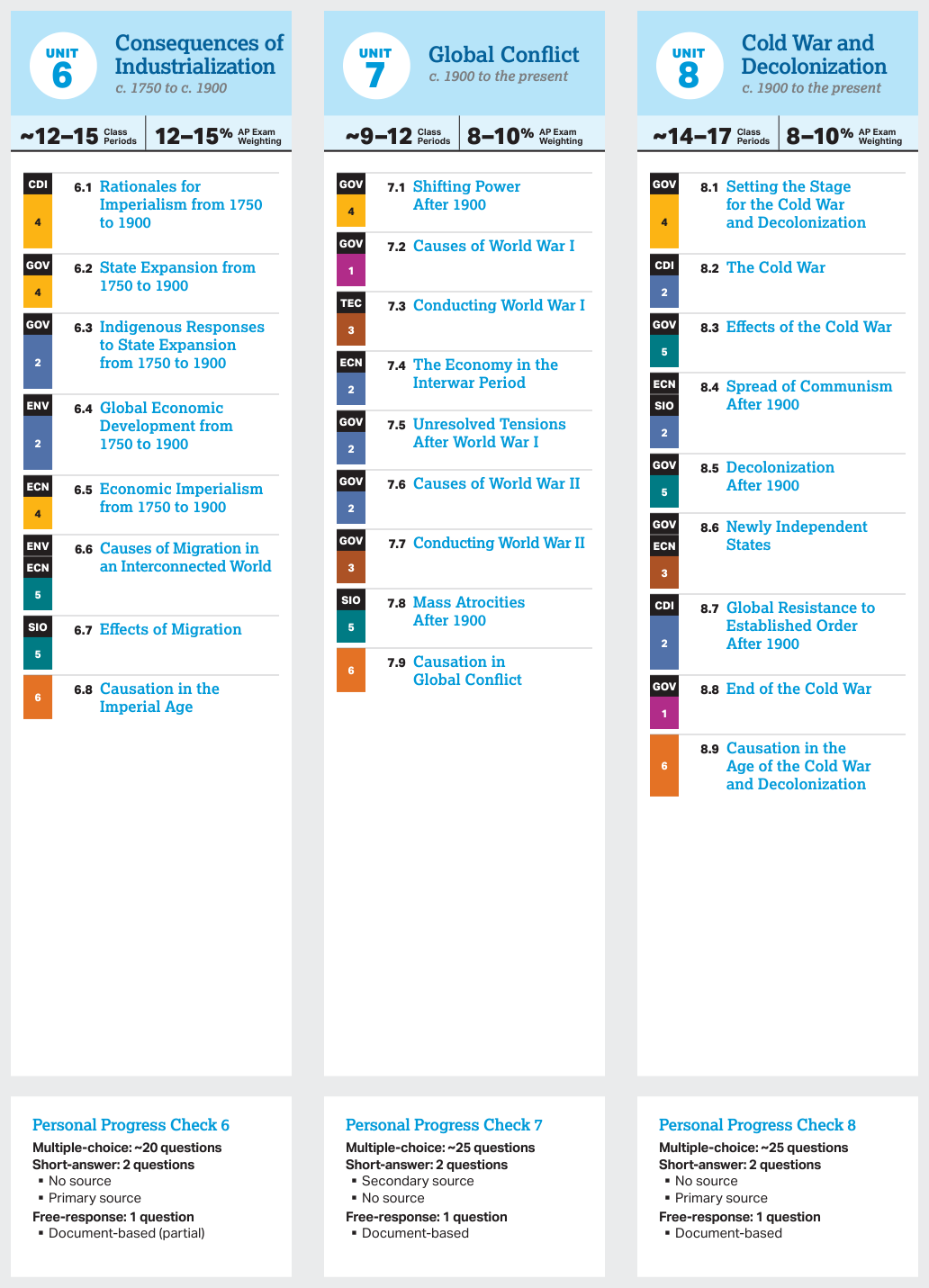
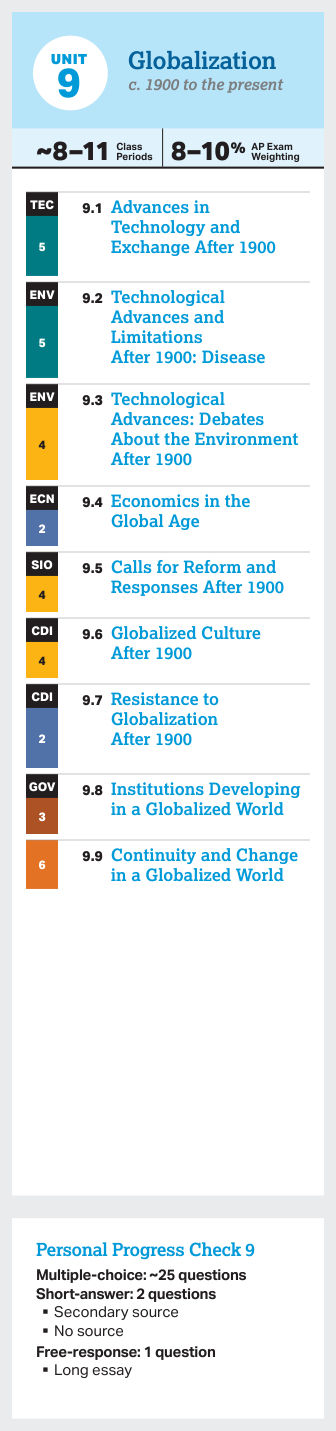
The framework organizes content into nine chronological units, moving from Unit 1: The Global Tapestry through Unit 9: Globalization. Chronology supplies the sequence; themes and skills create the connections. A student might study industrialization in Unit 5, imperialism in Unit 6, global conflict in Unit 7, and globalization in Unit 9—but the underlying questions about technology, governance, economic systems, social organization, culture, and the environment keep returning in new settings.
The six course themes are cross-cutting concepts that build understanding and spiral throughout the course:
- ENV — Humans and the Environment
- CDI — Cultural Developments and Interactions
- GOV — Governance
- ECN — Economic Systems
- SIO — Social Interactions and Organization
- TEC — Technology and Innovation
For example, TEC — Technology and Innovation can connect improved ship designs in Unit 4 to steam power in Unit 5 and communication technologies in Unit 9. The facts change, but the analytical question remains recognizable: How did a technological development alter power, exchange, or social life—and who benefited or suffered from that change?
The six historical thinking skills
Historical thinking skills describe what students should be able to do. They form the basis of tasks on AP history exams, so a successful response does more than identify a correct fact: it performs the relevant historical action.
| Code | Official skill name | What the historian does |
|---|---|---|
| 1 | Developments and Processes | Identifies and explains patterns, turning points, and relationships among historical developments. |
| 2 | Sourcing and Situation | Explains how a source’s point of view, purpose, audience, or historical situation affects its meaning or usefulness. |
| 3 | Claims and Evidence in Sources | Describes and evaluates claims made by sources and uses evidence to support, qualify, or challenge them. |
| 4 | Contextualization | Connects a historical development to broader events, conditions, or processes in the same period. |
| 5 | Making Connections | Connects developments through comparison, causation, or continuity and change. |
| 6 | Argumentation | Develops a defensible claim and supports it with relevant evidence and reasoning. |
Consider a merchant’s account describing trade across the Indian Ocean. Skill 2: Sourcing and Situation asks who wrote it, for whom, and under what circumstances. Skill 3: Claims and Evidence in Sources asks what the account actually claims and whether its details support that claim. Skill 4: Contextualization places the account within larger patterns of monsoon navigation, commercial exchange, and cultural interaction. Skill 6: Argumentation turns those observations into a defensible historical explanation.
Reasoning processes: the relationships between facts
The principal reasoning processes are comparison, causation, and continuity and change over time. Comparison asks what two societies or developments shared and how they differed. Causation distinguishes causes from consequences and weighs immediate factors against longer-term conditions. Continuity and change asks what persisted, what transformed, and why the balance shifted.
A weak comparison says, “Both empires used armies.” A stronger one explains that both expanded through military force but differed in administration: one might rely more heavily on local intermediaries, while another centralizes authority through officials, taxation, or religious legitimacy. The reasoning—not the number of examples—is what makes the connection historical.
Planning, teaching, and assessing skills
The Instructional Approaches section emphasizes two connected tasks: developing historical thinking skills and developing reasoning processes. Teachers can use each Unit at a Glance table to identify related topics, themes, skills, pacing, and assessments, then plan instruction that teaches content and its associated skill together rather than postponing skills until exam review.
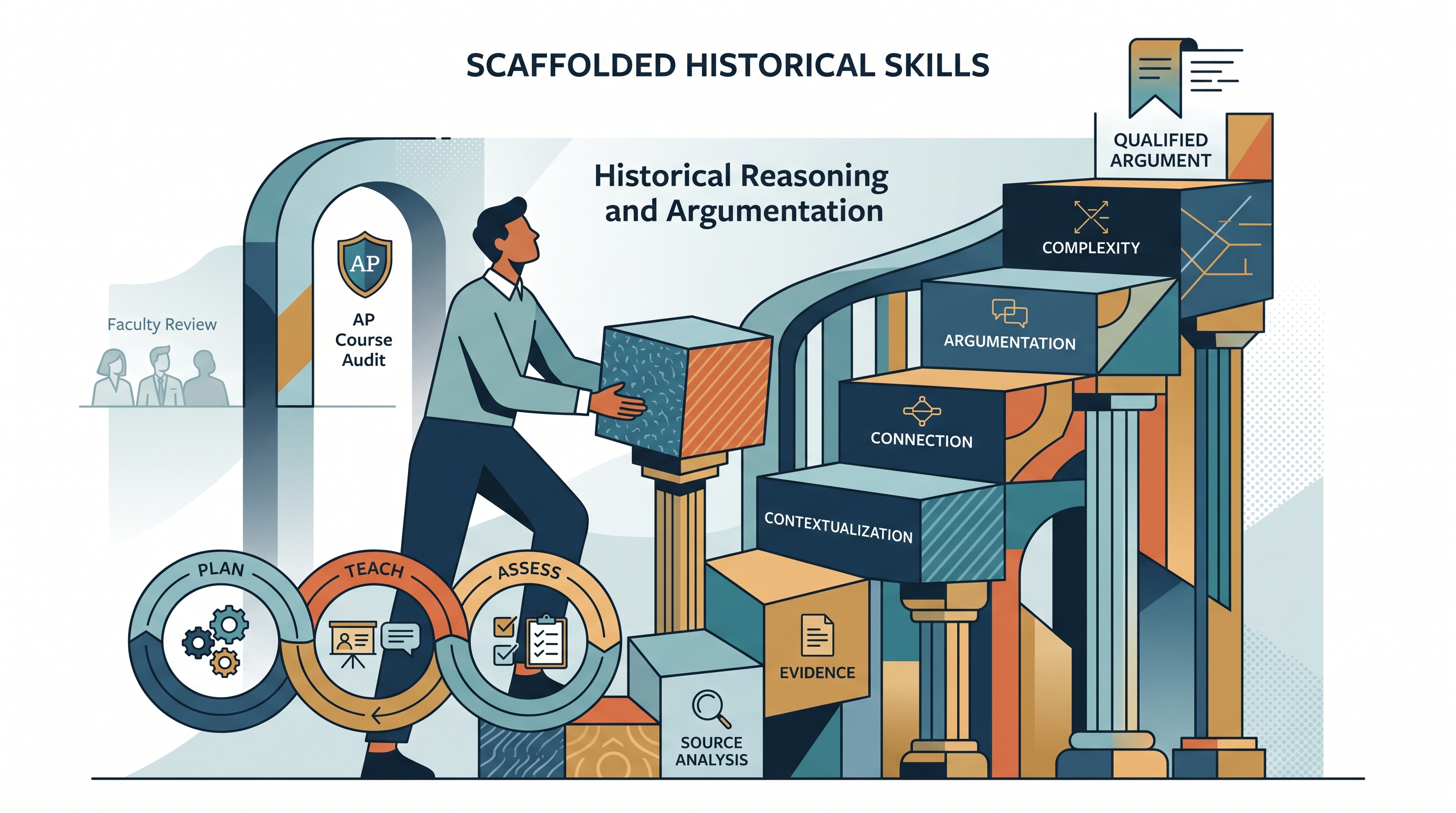
Scaffolding makes difficult historical work manageable. A teacher might first model sourcing a single document, then provide a checklist for students, then ask students to source unfamiliar documents independently. The same gradual release can support argumentation: identify a claim, select evidence, explain the evidence, and finally qualify the argument by acknowledging complexity or limits.
Instruction works best as a cycle:
- Plan: Use unit guides and Unit at a Glance tables to align required topics, themes, skills, scaffolds, and materials.
- Teach: Integrate content with source analysis, contextualization, connections, and argumentation.
- Assess: Use Progress Checks, including multiple-choice questions with rationales and free-response questions with scoring information; review results and address misunderstandings.
The AP Course Audit reviews teachers’ course materials through college faculty review. It checks for college-level resources, diverse historical sources, required course content and themes, and opportunities to develop all six historical thinking skills. In practice, the audit reinforces the central principle of the framework: rigorous historical knowledge and rigorous historical reasoning must be taught together.

Source Materials
- AP World History: Modern Course and Exam Description
- AP World History: Modern Course and Exam Description Clarifications and Corrections
- AP World History: Modern Course Overview
- AP World History: Modern Course at a Glance
- AP World History: Modern Course at a Glance Poster
- AP World History: Modern
- AP World History: Modern
- AP World History: Modern Sample Syllabus 1
- NOTE: Partial versions of the free-response questions are provided to prepare students for more complex, full questions that they will encounter on the AP Exam.
- V.1 | 23 © 2019 College Board
- © 2019 College Board V.1 | 24
- Figure — AP World History: Modern Course at a Glance (p. 4)