From the free course AP World History: Modern on Lykke
7.9 Causation in Global Conflict
Key concepts: Causation in Global Conflict · Contextualization · Evidence
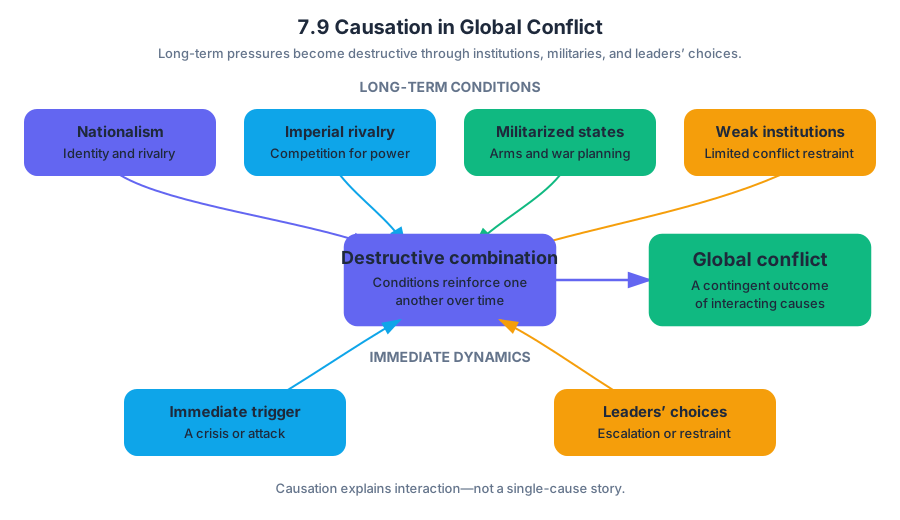
A global war rarely has a single cause: causation means explaining how several conditions, decisions, and developments combined to produce an outcome, while distinguishing long-term pressures from immediate triggers.
7.9 Causation in Global Conflict
A global war rarely has a single cause: causation means explaining how several conditions, decisions, and developments combined to produce an outcome, while distinguishing long-term pressures from immediate triggers. For twentieth-century conflicts, nationalism mattered greatly—but nationalism became globally destructive only when linked to imperial rivalry, militarized states, weak international institutions, and leaders’ choices.
Building a Causal Explanation
A useful causal explanation works like a chain rather than a list. Begin with the background conditions, identify the mechanism that connected those conditions to action, and then show the result. A mechanism is the process through which one factor produces an effect.
| Causal layer | Guiding question | Twentieth-century example |
|---|---|---|
| Long-term condition | What made conflict possible? | National rivalries, imperial competition, militarism |
| Intermediate development | What intensified the pressure? | Alliance systems, economic crisis, resentment over peace settlements |
| Immediate trigger | What set events in motion? | A crisis, invasion, assassination, or diplomatic breakdown |
| Human decision | Who converted pressure into policy? | Governments choosing mobilization, conquest, or appeasement |
| Outcome | What followed? | Regional conflict expanding into global war |
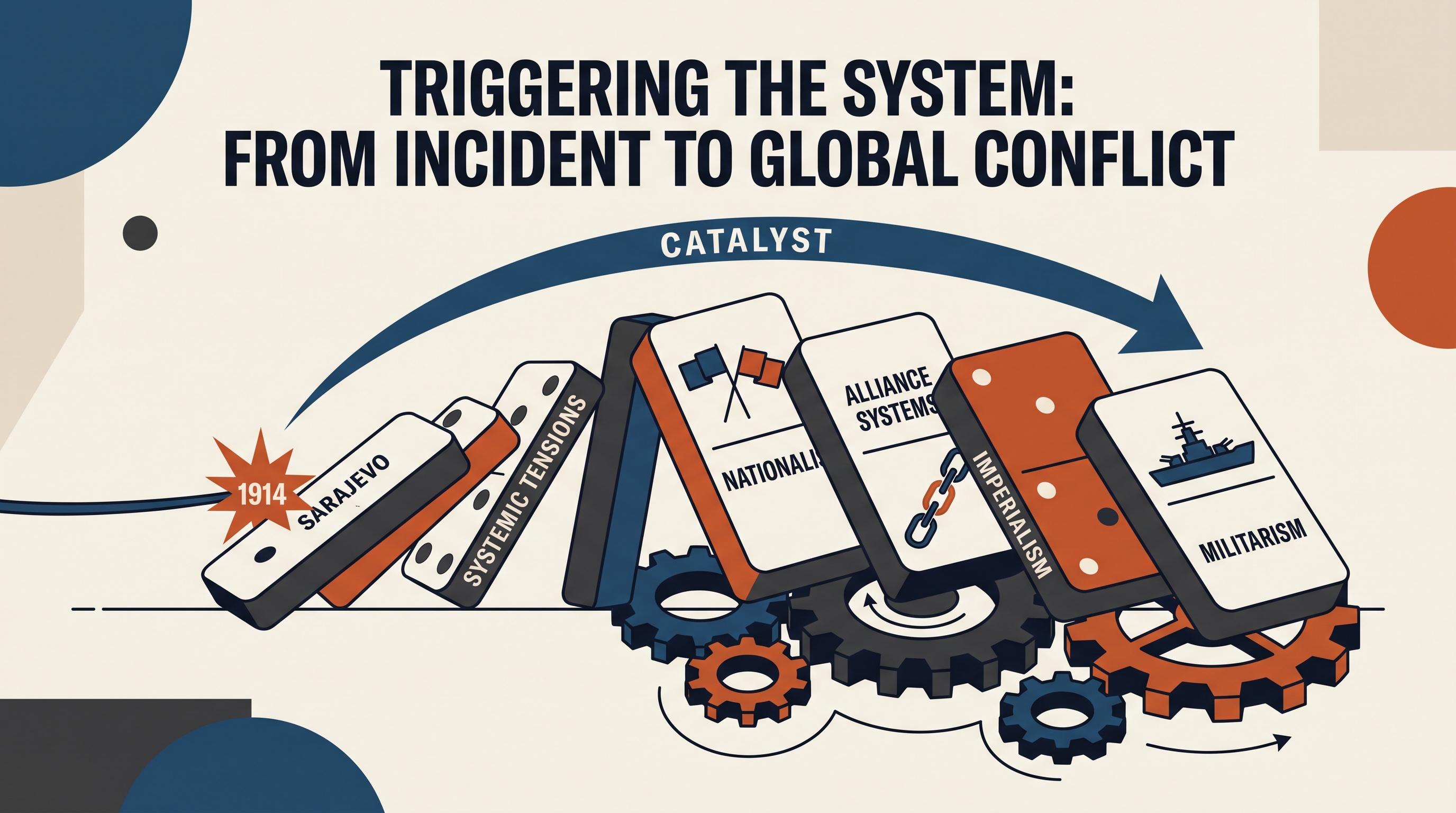
The same event can occupy different positions in different explanations. The assassination of Archduke Franz Ferdinand was an immediate trigger of World War I, but it did not by itself explain why a local crisis became a continental and then global war. Alliance commitments, nationalism, military planning, and imperial rivalries made escalation more likely.
Nationalism as a Factor in Global Conflict
Nationalism is the belief that a people identified as a nation should possess political loyalty, self-government, or a state of their own. It could unify populations against imperial rule, as in anticolonial movements, but it could also define belonging narrowly and portray neighboring peoples as threats.
In Europe before World War I, nationalist competition encouraged states to measure security through military strength and territorial influence. Serbian nationalism challenged Austro-Hungarian authority in the Balkans; German, French, Russian, and Austro-Hungarian rivalries made the region strategically sensitive. Nationalism therefore acted less like a solitary cause than an accelerant: it intensified existing rivalries and made compromise appear dishonorable or dangerous.
After World War I, nationalism remained powerful because peace settlements left many populations dissatisfied. The collapse of empires created new states but did not neatly match borders to national identities. In Germany, resentment over the postwar settlement combined with economic and political instability; in Italy and Japan, nationalist leaders associated national greatness with territorial expansion. These developments help explain why nationalism contributed to later conflict, but they do not prove that nationalism alone caused it.
Worked Causal Example: Nationalism and Twentieth-Century War
Prompt: Evaluate the extent to which nationalism contributed to global conflict in the twentieth century.
Step 1 — Contextualization (Skill 4: Contextualization): Establish a broader setting before the argument. The nineteenth-century spread of nationalism, imperial competition, and mass politics increased the importance of popular national identity. World War I then dismantled several empires and produced disputed borders, unresolved grievances, and new states.
Step 2 — Thesis and claim (Skill 6: Argumentation): Make a defensible judgment, not merely a statement of importance. A strong claim might argue that nationalism was a major contributing factor because it intensified pre-1914 rivalries and later encouraged expansionist politics, but that its effects depended on militarization, institutional weakness, and government decisions.
Step 3 — Evidence (Skill 3: Claims and Evidence in Sources): Use specific evidence and explain its relevance. Serbian nationalism helps demonstrate how national claims destabilized multinational empires. Nazi German racial nationalism shows how national identity could be fused with territorial expansion. Indian anticolonial nationalism provides a qualification: nationalism could also mobilize resistance to imperial rule rather than produce interstate war.
Step 4 — Causal reasoning (Skill 5: Making Connections): Explain the connection between evidence and outcome. Nationalist ideas encouraged leaders and populations to treat territorial compromise as a loss of national honor; military institutions and imperial ambitions then supplied the means and objectives for conflict. The argument becomes causal when it shows how nationalism altered decisions, not simply that nationalism existed.
Qualification: Crisis Does Not Produce War Automatically
A common misconception is mechanical causation: the belief that the Great Depression automatically caused World War II. Economic hardship created unemployment, social fear, and distrust of liberal governments, but it did not inevitably produce conquest. Regime choices, institutional weakness, ideological commitments, and specific decisions connected economic crisis to expansionist policy in some states and not others.
This qualification strengthens an argument. Compare countries affected by the Depression: some adopted authoritarian or militarist policies, while others preserved political institutions or pursued different responses. Therefore, the most precise explanation treats economic crisis as a condition that widened opportunities for radical leaders, not as a sufficient cause by itself.
Misconception Check
Key insight: A cause is not simply an event that came earlier. A historical cause must be connected to the outcome through a demonstrated process.
Do not write “nationalism caused World War I because nationalism existed before 1914.” Instead, explain that competing national claims intensified rivalries, encouraged military preparedness, and made a Balkan crisis more likely to escalate through alliance commitments. Then acknowledge limits: imperialism, militarism, diplomacy, and state decisions also mattered.
Retrieval Check
In three sentences, explain why the assassination at Sarajevo was a trigger rather than a complete explanation of World War I. Then name one piece of evidence showing that nationalism could produce either interstate conflict or anticolonial resistance, and identify the mechanism linking that evidence to its result.
Source Materials
- AP World History: Modern Course and Exam Description
- AP World History: Modern Course and Exam Description Clarifications and Corrections
- AP World History: Modern Course Overview
- AP World History: Modern Course at a Glance
- AP World History: Modern Course at a Glance Poster
- AP World History: Modern
- AP World History: Modern
- AP World History: Modern Sample Syllabus 1