From the free course AP World History: Modern on Lykke
9.3 Technological Advances: Debates About the Environment After 1900 · 9.4 Economics in the Global Age
Key concepts: Human adaptation and innovation · Technological advances after 1900 · Environmental change and human populations · Deforestation · Desertification · Air-quality decline · Greenhouse-gas emissions · Freshwater consumption and competition · Disease and medical/scientific developments · Government intervention in the economy
After 1900, technology made it possible for human beings to produce, travel, communicate, and consume on an unprecedented scale—but the same systems that increased comfort and security also transformed forests, farmland, air, water, and climate.
9.3 Technological Advances: Debates About the Environment After 1900 · 9.4 Economics in the Global Age
After 1900, technology made it possible for human beings to produce, travel, communicate, and consume on an unprecedented scale—but the same systems that increased comfort and security also transformed forests, farmland, air, water, and climate.
Innovation, adaptation, and unintended consequences
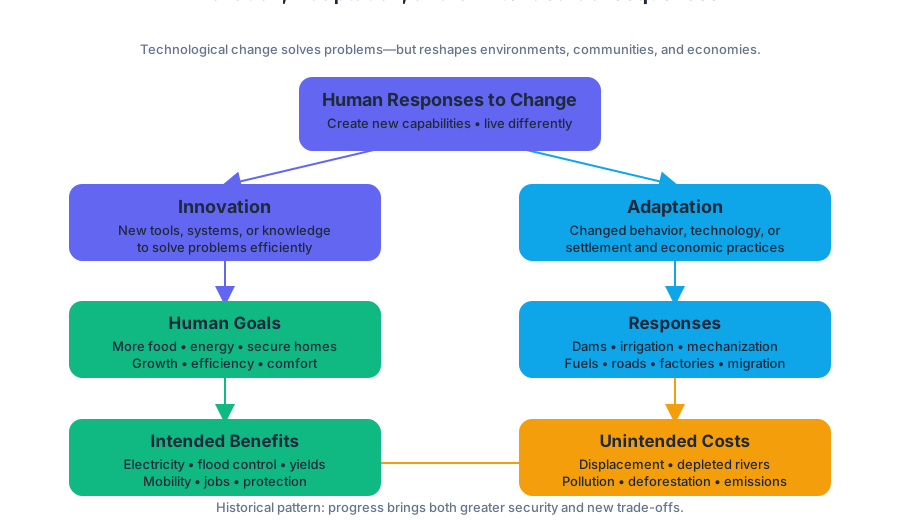
Human innovation is the creation or application of new tools, systems, or knowledge to solve problems or increase efficiency. Human adaptation is the way people or communities alter their behavior, technology, settlement patterns, or economic practices in response to changing conditions. Innovation asks, “What new capability can we create?” Adaptation asks, “How must we live differently because conditions have changed?”
A dam, for example, is an innovation that can generate electricity, control floods, and supply irrigation water. Farmers adapting to repeated drought might conserve water, plant drought-resistant crops, change planting schedules, or migrate toward more reliable farmland. Each response can reduce immediate pressure, but each also creates trade-offs: dams may displace communities, irrigation can exhaust rivers, and migration can intensify competition in receiving areas.
The central historical pattern is therefore not “technology is good” or “technology is bad.” Technological advances increased efficiency, comfort, and security while producing both intended and unintended consequences.
| Human goal | Technological or economic response | Environmental consequence |
|---|---|---|
| Produce more food | Irrigation, mechanization, high-yield crops | Freshwater depletion and soil stress |
| Expand settlements and industry | Roads, mines, factories, urban growth | Deforestation and air-quality decline |
| Increase energy supply | Coal, oil, gas, and electricity systems | Greenhouse-gas emissions and pollution |
| Protect communities from scarcity | Conservation, reforestation, migration | Adaptation, but also new competition over land and water |
Environmental change and human populations
The CED’s Learning Objective C requires students to explain the causes and effects of environmental changes from 1900 to the present. KC-6.1.II.A identifies deforestation, desertification, declining air quality, and increased consumption of freshwater as processes that intensified competition over resources.
Deforestation is the large-scale removal of forests, often for agriculture, mining, fuel, roads, or settlement. Desertification is the degradation of productive land in dry regions until it becomes less capable of supporting crops, animals, or human populations. Air-quality decline results when industrial emissions, vehicle exhaust, smoke, and other pollutants accumulate in the atmosphere.
These changes affected populations by altering where people could safely live and earn a living. Drought combined with degraded farmland could push rural families toward cities or across borders; shrinking water supplies could encourage communities to build conservation systems or compete with neighboring regions. Population movement was therefore not only a political or economic phenomenon—it could also be an adaptation to environmental pressure.
Worked example: Imagine a farming region experiencing declining rainfall. First, repeated drought reduces harvests. Second, farmers respond through water storage, irrigation, drought-resistant crops, or reduced livestock herds. Third, if these adaptations cannot keep pace with environmental stress, some households migrate to cities. Finally, urban growth increases demand for housing, food, and water, shifting the original environmental problem into a new location. This chain demonstrates causation rather than merely listing “drought” and “migration.”
Greenhouse gases and the climate debate
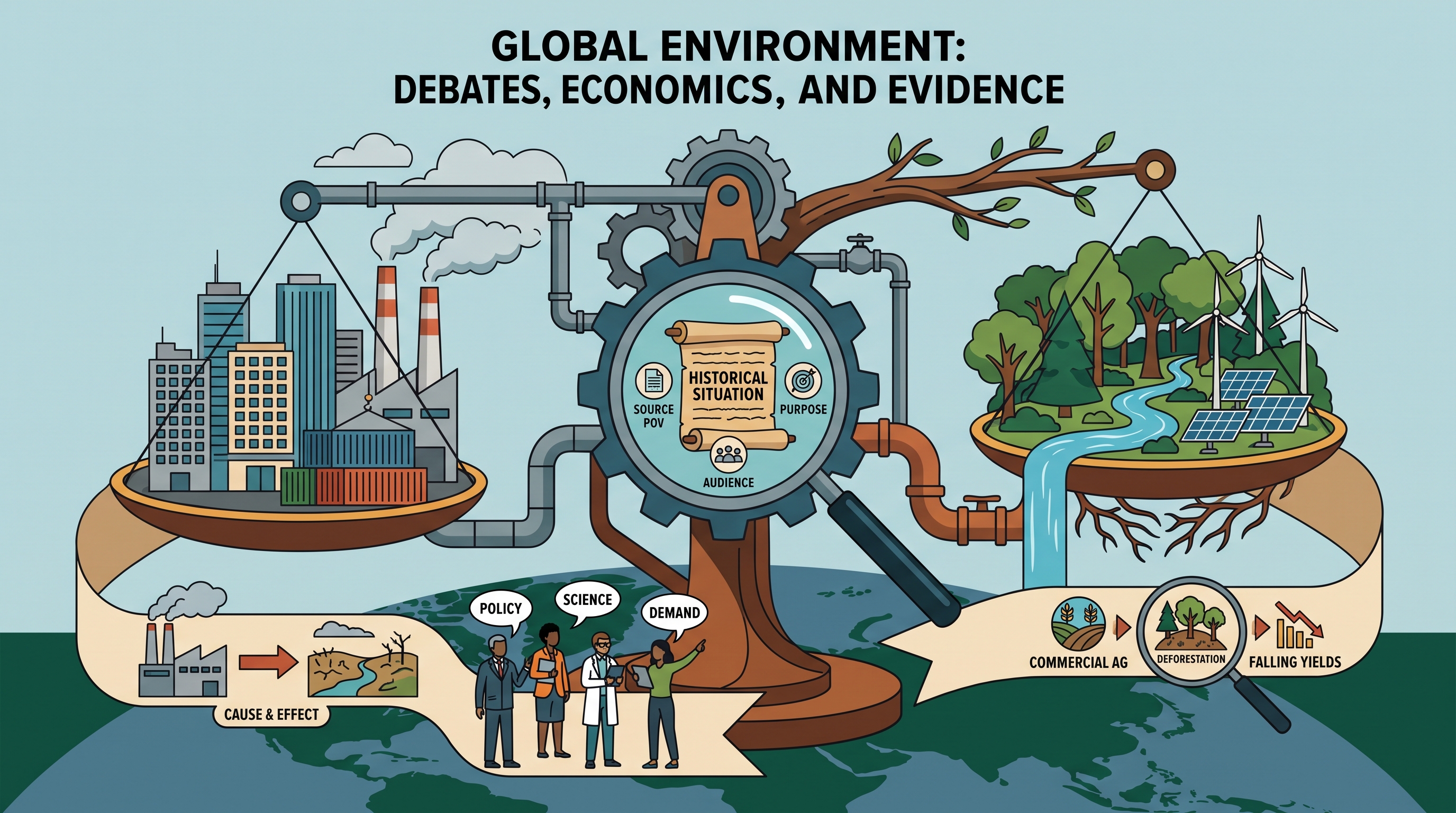
KC-6.1.II.B states that the release of greenhouse gases and pollutants contributed to debates about the nature and causes of climate change. Industrialization, transportation, electricity generation, and mass consumption released substances that altered atmospheric conditions. The historical debate involved both scientific questions—what was changing and why—and political questions about responsibility, regulation, economic growth, and unequal effects.
A common misconception is that environmental change began only when governments formally recognized climate change. In reality, deforestation, pollution, soil degradation, and freshwater competition developed over time; later scientific and political debates interpreted, measured, and contested those changes.
Economics in the Global Age
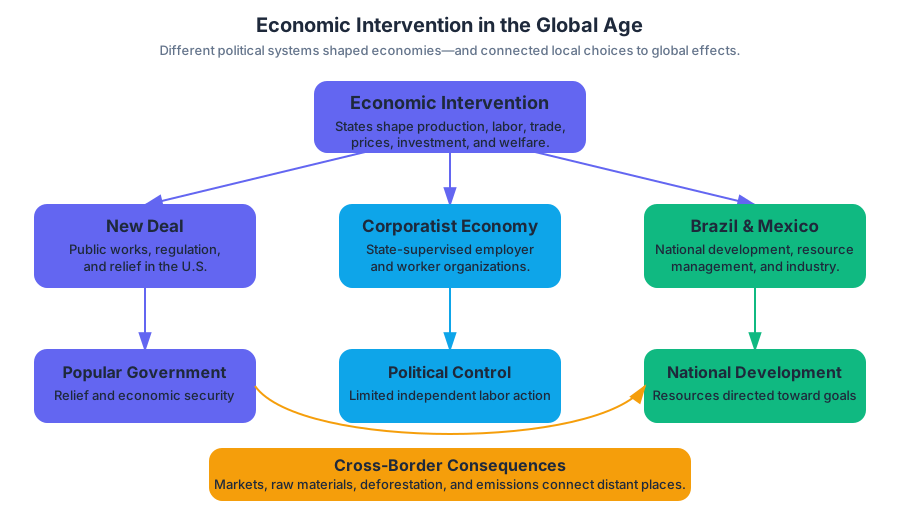
Economic intervention occurs when governments shape production, labor, trade, prices, investment, or social welfare rather than leaving economic activity entirely to private actors. The New Deal in the United States illustrates intervention through public works, regulation, and relief during the Great Depression. Fascist states developed corporatist economies, in which governments organized employers and workers into state-supervised bodies while limiting independent labor action.
Governments with strong popular support in Brazil and Mexico also illustrate intervention in the economy. Their governments used state authority to promote national development, manage resources, and pursue social or industrial goals. These cases show that government involvement was not limited to one ideology: democratic, authoritarian, and populist governments could all intervene, although they justified and organized that intervention differently.
The global age connected environmental and economic decisions across borders. Industrial production could depend on distant raw materials; international markets could encourage deforestation or resource extraction; and pollution or greenhouse-gas emissions could create effects far beyond the place where goods were produced.
AP historical reasoning in action
Use Skill 4: Contextualization, especially 4.B Explain how a specific historical development or process is situated within a broader historical context, by connecting environmental change to industrialization, urbanization, population growth, imperial legacies, and global consumption.
Use Skill 5: Making Connections, including 5.B Explain how a historical development or process relates to another historical development or process, to connect economic intervention with environmental policy, or migration with drought and land degradation. For source-based work, Skill 2: Sourcing and Situation—including 2.C Explain the significance of a source’s point of view, purpose, historical situation, or audience—helps reveal why a government, scientist, corporation, or activist represented environmental change in a particular way. Skill 1: Developments and Processes, Skill 3: Claims and Evidence in Sources, and Skill 6: Argumentation support identifying change over time, using evidence, and defending a historically precise claim.
Misconception check: Government intervention does not automatically mean socialism, and economic growth does not automatically produce identical environmental results everywhere. The stronger historical explanation identifies the policy, the actors who supported it, the problem it addressed, and its intended and unintended consequences.
Retrieval check: A region loses forest cover, suffers soil degradation, and experiences falling crop yields. Name one cause, one human adaptation, one limit or trade-off of that adaptation, and one broader global development that could intensify the problem. A strong answer might connect commercial agriculture to deforestation, drought-resistant crops to adaptation, groundwater depletion to its limits, and global demand for agricultural commodities to the wider context.

Source Materials
- AP World History: Modern Course and Exam Description
- AP World History: Modern Course and Exam Description Clarifications and Corrections
- AP World History: Modern Course Overview
- AP World History: Modern Course at a Glance
- AP World History: Modern Course at a Glance Poster
- AP World History: Modern
- AP World History: Modern
- AP World History: Modern Sample Syllabus 1
- About the Advanced Placement Program® (AP®)