From the free course AP World History: Modern on Lykke
AP Practice 4
A Document-Based Question (DBQ) asks you to build a historical argument from a set of sources while adding relevant knowledge beyond those sources. The strongest response does not summarize six documents one by one; it uses documents as evidence inside an argument about change, causation, comparison, or continuity.
The task: connectivity and state power, c. 1200–c. 1750
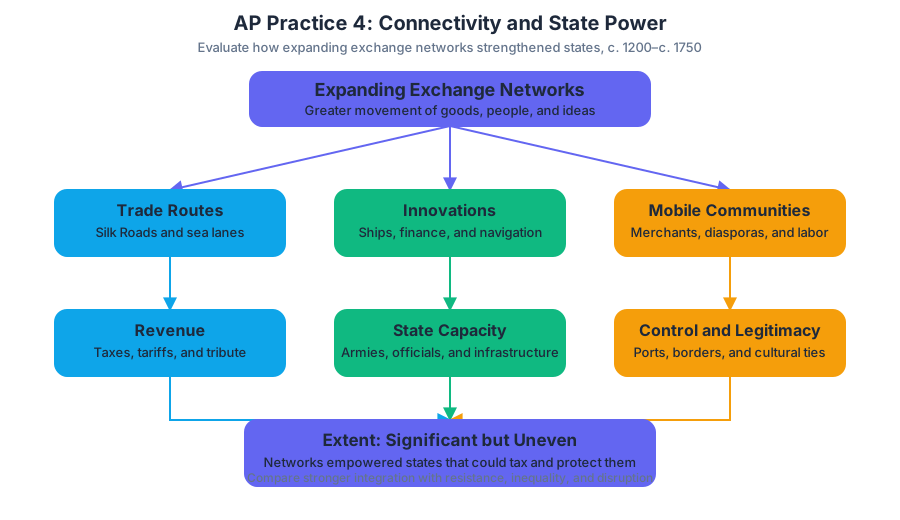
Prompt: Evaluate the extent to which expanding networks of exchange strengthened states between c. 1200 and c. 1750.
This is an original, unofficial practice question. It draws on the course themes of Developments and Processes, Sourcing and Situation, Claims and Evidence in Sources, Contextualization, comparison, causation, continuity, and change, and Argumentation. The question also invites analysis through the PIECES themes: Politics, Innovation, Environment, Cultural Developments and Interactions, Economic Systems, and Social Interactions and Organization.
What the prompt is really asking
The key phrase is “the extent to which.” You must make a judgment, not merely list examples. A defensible argument might claim that exchange networks generally strengthened states by increasing tax revenue, improving military mobility, and expanding administrative reach—but that the same connectivity could also spread disease, empower rivals, or expose states to destabilizing pressures.
Before reading the sources, establish a time-and-place frame:
- Earlier context: Long-distance exchange existed before 1200, including the Silk Roads, Indian Ocean routes, and trans-Saharan trade.
- Period developments: Mongol rule connected much of Eurasia; cities and commercial communities expanded; states gained access to new technologies, luxury goods, and tax opportunities.
- Possible limitation: Connectivity did not automatically produce centralized government. Some states benefited from trade while others faced epidemics, rebellion, or competition.
Practice source set
| Document | Source and central idea | Most useful analytical move |
|---|---|---|
| 1 | A Yuan official describes improved roads, relay stations, and protected merchants across Mongol territories. | Explain how infrastructure increased imperial control. |
| 2 | A Swahili coastal merchant records the importance of monsoon winds and Indian Ocean ports. | Connect commerce to the power of port cities and rulers. |
| 3 | A Mamluk administrator discusses customs duties collected from caravans and ships. | Analyze trade as a fiscal resource. |
| 4 | A European traveler describes the wealth of West African rulers linked to gold and trans-Saharan commerce. | Use economic evidence to explain state authority. |
| 5 | A medical writer describes the devastation caused by plague moving along trade routes. | Qualify the argument: connectivity could weaken states. |
| 6 | A ruler’s decree restricts foreign merchants and religious activity in a major capital. | Analyze state attempts to manage cultural and economic exchange. |
The documents above are intentionally summarized rather than reproduced from historical texts. On an actual DBQ, identify what each source says, then ask: Who created it? For what purpose? In what historical situation? For which audience?
Worked planning: from documents to argument
A weak plan organizes by document order: “Document 1 says this; Document 2 says that.” A stronger plan organizes by reasoning:
- Fiscal and administrative strengthening: Documents 1, 3, and 4.
- Commercial and urban power: Document 2.
- Limits and dangers of connectivity: Documents 5 and 6.
A defensible thesis could read:
Expanding exchange networks strengthened states to a considerable extent between c. 1200 and c. 1750 because rulers used protected routes, port cities, and customs systems to collect revenue and extend authority; however, connectivity also created vulnerabilities, especially when disease spread or rulers struggled to control foreign merchants and cultural influences.
This thesis earns the argument point because it answers the extent question, establishes a line of reasoning, and includes a qualification. It does not simply repeat the prompt or claim that trade was “important.”
Worked paragraph with document analysis
States often converted commercial movement into administrative power. The Yuan official’s emphasis on roads and relay stations suggests that the Mongol government did more than permit trade: it built systems that made movement legible and controllable. Because the official served the ruling administration, his purpose was likely to present imperial infrastructure as evidence of effective government; this perspective makes the document especially useful for showing how the Mongols justified centralized rule. The Mamluk administrator’s attention to customs duties provides a different kind of evidence: rulers benefited financially when merchants crossed their territories. Together, the documents show a chain of causation—protected routes increased commercial activity, commercial activity generated taxes, and taxes supported government and military institutions.
Notice the difference between using evidence and merely mentioning it. The paragraph identifies Documents 1 and 3, explains their content, connects them to the claim, and analyzes the official’s point of view. That is the reasoning examiners reward.
Sourcing moves that matter
For at least two documents, explain why the author’s situation, purpose, audience, or point of view matters:
- Point of view: A Yuan official may emphasize order because his position depends on imperial administration.
- Purpose: A ruler’s decree restricting merchants may be designed to defend political authority rather than neutrally describe society.
- Historical situation: A plague account must be read in the context of intensified Afro-Eurasian connections and the movement of people, animals, and pathogens.
- Audience: A travel account intended for readers far from West Africa may exaggerate wealth or present unfamiliar rulers through European assumptions.
A common misconception is that sourcing means attaching a label: “This is biased.” Every historical source has a perspective. The required move is to explain how that perspective affects the evidence’s meaning or usefulness.
Evidence beyond the documents
Relevant outside evidence could include Mali’s taxation of trans-Saharan commerce, Mongol protection of Eurasian routes, the spread of the Black Death, or the growth of Indian Ocean port cities such as Kilwa. To count as outside evidence, the example must be specific and connected to the argument; writing “trade made countries rich” is too vague.
Scoring map and timing
| Rubric target | What your response must do |
|---|---|
| Thesis/claim | Make a defensible judgment answering the prompt. |
| Contextualization | Explain a broader development before, during, or around the period. |
| Evidence from documents | Use at least three documents to support the argument; stronger work uses at least four. |
| Evidence beyond documents | Supply one specific relevant historical example. |
| Sourcing | Explain how the situation, purpose, audience, or point of view matters for at least two documents. |
| Complexity | Show a meaningful qualification, contradiction, comparison, or interaction among factors. |
Use approximately 15 minutes to read and plan and 45 minutes to write. Spend the planning time grouping documents, writing a one-sentence thesis, selecting outside evidence, and marking two sourcing opportunities. During revision, ask whether every body paragraph proves part of the thesis rather than merely describing a source.
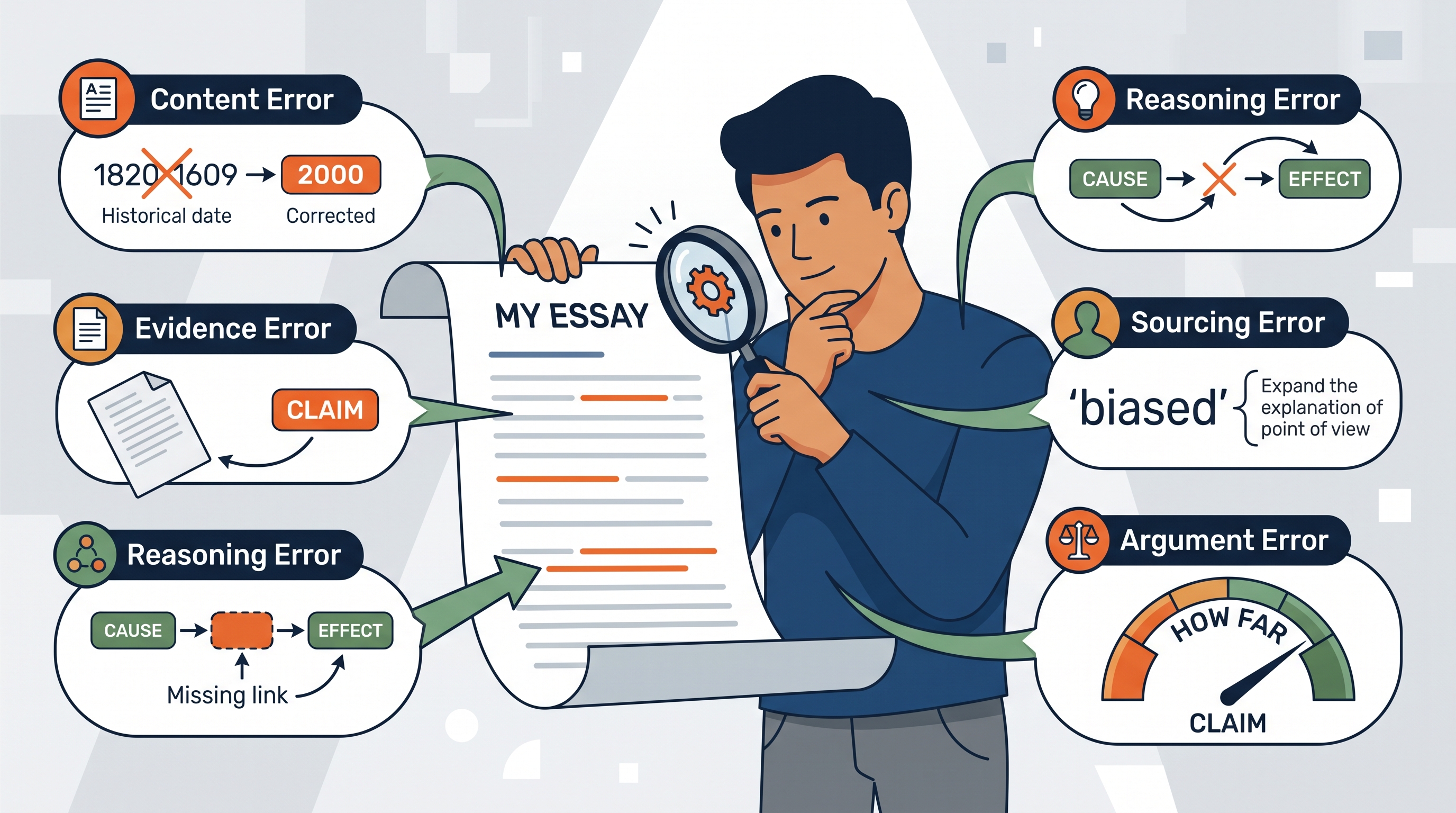
Error-review routine
After writing, classify each weakness:
- Content error: a date, place, ruler, or process is inaccurate.
- Evidence error: a document is mentioned but not tied to a claim.
- Reasoning error: the paragraph describes effects without explaining causation.
- Sourcing error: “biased” appears without explaining why the perspective matters.
- Argument error: the essay never answers how far the claim is true.
Retrieval check: If a response uses Documents 1, 3, 4, and 5 but never explains an author’s purpose or point of view, which rubric target is missing? What one sentence could add it?
Answer: The sourcing target is missing. A useful sentence would explain that the Yuan official’s administrative position encouraged him to portray imperial infrastructure as proof of effective Mongol rule.
Source Materials
- AP World History: Modern Course and Exam Description
- AP World History: Modern Course and Exam Description Clarifications and Corrections
- AP World History: Modern Course Overview
- AP World History: Modern Course at a Glance
- AP World History: Modern Course at a Glance Poster
- AP World History: Modern
- AP World History: Modern
- AP World History: Modern Sample Syllabus 1
- AP World History Past Exam Questions — AP Central
- Khan Academy — AP World History: Modern
- Freeman-pedia — AP World History: Modern
- YouTube — Heimler's History