From the free course AP World History: Modern on Lykke
4.7 Changing Social Hierarchies from 1450 to 1750 · 4.8 Continuity and Change from 1450 to 1750
Key concepts: Changing social hierarchies from 1450 to 1750 · Continuity and change over time · Social interactions and organization · Cultural developments and interactions · Demographic change in Africa · Trade in enslaved persons · Differential treatment of social and religious groups · Religious encounters and their political, social, and cultural effects · Global economic interconnections · State policies limiting European political influence
Explain and apply 4.7 Changing Social Hierarchies from 1450 to 1750 · 4.8 Continuity and Change from 1450 to 1750.
4.7 Changing Social Hierarchies from 1450 to 1750 · 4.8 Continuity and Change from 1450 to 1750
Between 1450 and 1750, expanding trade did not simply erase older social hierarchies. Instead, new wealth, coerced labor systems, religious policies, and demographic upheavals rearranged some groups while preserving others. The central question is: when global connections intensified, who gained status, who lost power, and which social patterns endured?
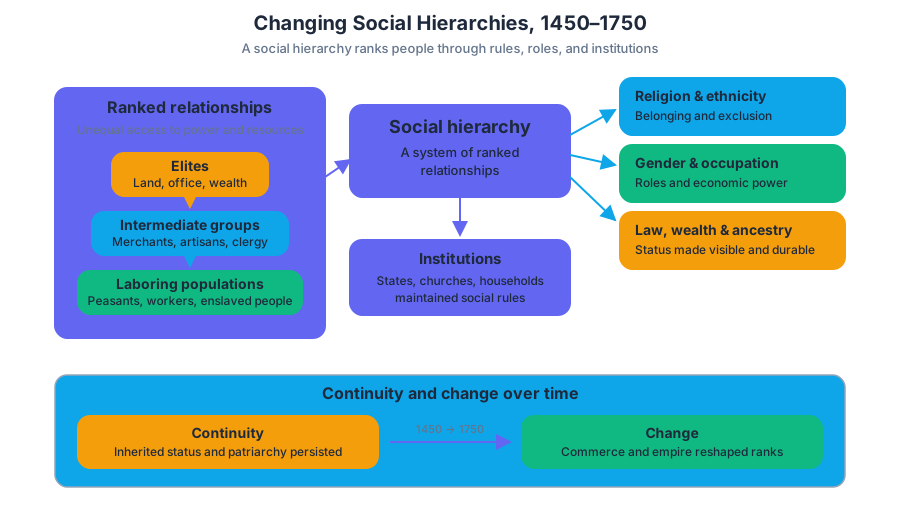
A social hierarchy is a system of ranked relationships
A social hierarchy ranks people according to categories such as religion, ethnicity, gender, occupation, legal status, wealth, or ancestry. The AP theme Social Interactions and Organization (SIO) asks how societies grouped their members and how the rules governing those groups shaped political, economic, and cultural institutions.
Unit 4: Learning Objective M requires explaining how social categories, roles, and practices were maintained or changed over time. Unit 4: Learning Objective J adds the relationship between political, economic, and cultural forces and society. For Topic 4.8, continuity and change over time means making a precise argument: identify what persisted, identify what shifted, and explain why.
The Atlantic slave trade transformed African societies
The trade in enslaved persons produced major demographic changes in Africa. European merchants and African states participated in an Atlantic system that forcibly transported millions of Africans to the Americas. This removal disproportionately affected young adults, especially men in many regions, producing gender imbalances, disrupting family structures, and encouraging some communities to reorganize marriage, inheritance, and labor.
The consequences varied across Africa. Some rulers gained firearms, luxury goods, or political leverage by participating in the trade, while other societies suffered raids, warfare, population loss, and political instability. The key causal chain is:
European and American demand for labor → expansion of slave trading → forced migration from Africa → demographic imbalance and family restructuring → altered political and social organization.
Misconception check: The Atlantic slave trade did not merely “move workers.” It changed the age and gender composition of African communities and reshaped kinship, political authority, and regional security.
Status changed in the Americas, but hierarchy persisted
In the Americas, European colonization created new racial and legal categories. Spanish and Portuguese colonies developed caste systems that ranked peninsulares, creoles, mixed-race groups, Indigenous peoples, and Africans differently. These categories could affect taxation, officeholding, marriage, labor, and legal rights. At the same time, older Indigenous hierarchies and community structures often survived beneath or alongside colonial rule.
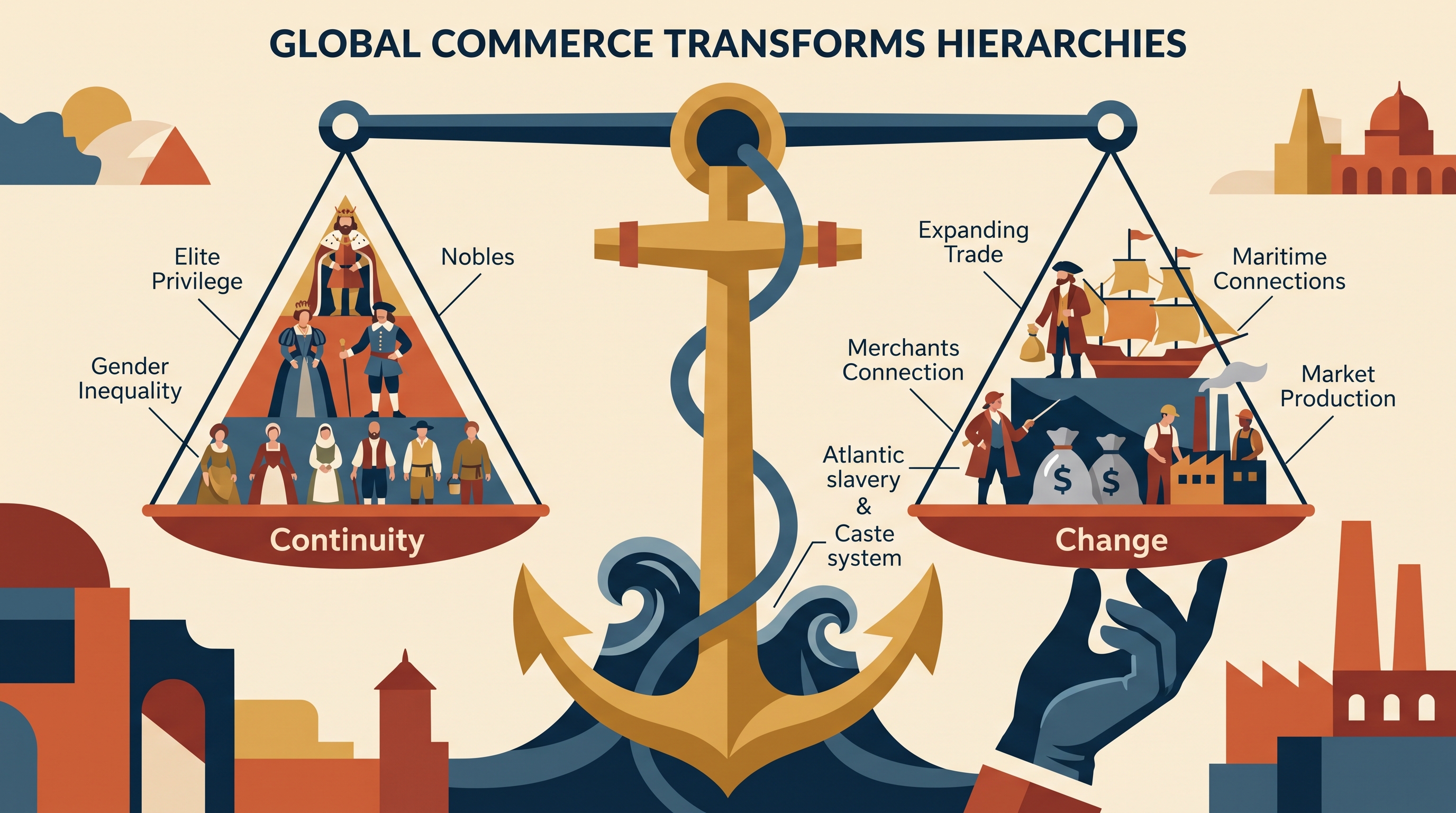
This is a classic continuity-and-change pattern: European conquest changed political power and introduced racial classification, but societies did not become socially equal. Gender inequality, elite privilege, and coerced labor persisted, even as the identities used to justify hierarchy changed.
Religious encounters produced different outcomes
Religious interaction depended on local political conditions. European missionaries often sought to convert Indigenous peoples in the Americas, while states in Asia and Africa sometimes restricted missionary activity to protect political autonomy or established religious traditions. In China, the Jesuit Matteo Ricci used knowledge of mathematics and astronomy to gain access to elite circles, creating a religious encounter that involved accommodation with Confucian traditions rather than immediate mass conversion.
The expulsion of Jews from Spain in 1492 illustrates differential treatment—the unequal treatment of a group based on religious identity. Spanish rulers promoted Catholic uniformity and expelled Jews who refused conversion. Yet expelled Jewish communities carried commercial expertise, languages, and connections into the Ottoman Empire and elsewhere. Persecution therefore produced both social exclusion and wider cultural circulation.
States also limited European influence. Tokugawa Japan restricted foreign merchants and Christian missionaries, while China regulated European access through controlled trading arrangements. These policies did not mean Asian or African societies were isolated; they meant governments attempted to manage contact on their own terms.
Silver connected American mines to Asian markets
American silver from mines such as Potosí and Japanese silver entered expanding global trade networks. European monopoly companies, including the Dutch East India Company and the English East India Company, used silver to purchase Asian textiles, spices, tea, porcelain, and other goods. Because China demanded payment in silver, American bullion often moved across the Pacific through the Manila trade and ultimately entered Chinese markets.
This system reveals both global integration and regional continuity. Long-established Afro-Eurasian markets continued to flourish; European merchants entered those markets but did not replace them. Rising demand intensified the work of peasants and artisans producing food and consumer goods. Commercial growth therefore strengthened states and merchants while increasing labor demands on ordinary people.
How to write the historical argument
For Skill 1: Developments and Processes, trace the process from expanding trade to social restructuring. For Skill 4: Contextualization, place Atlantic slavery, caste systems, and silver flows within the larger expansion of maritime connections. For Skill 5: Making Connections, compare two regions or distinguish continuity from change. For Skill 6: Argumentation, turn evidence into a defensible claim rather than listing examples. Skill 3: Claims and Evidence in Sources matters when a passage reveals a ruler’s policy, a missionary’s purpose, or a merchant’s perspective.
Worked example: A strong continuity-and-change claim might argue that global commerce transformed labor and status by expanding slavery, caste categories, and market production, but older religious distinctions, elite privilege, gender inequality, and regional markets persisted. The explanation links evidence to causes: changing demand created new institutions, while governments and communities adapted existing hierarchies rather than abandoning them.
Retrieval check: Explain one demographic effect of the Atlantic slave trade in Africa, one reason China attracted American silver, and one example of a state limiting European influence. Then identify one continuity and one change in social hierarchy between 1450 and 1750.
Source Materials
- AP World History: Modern Course and Exam Description
- AP World History: Modern Course and Exam Description Clarifications and Corrections
- AP World History: Modern Course Overview
- AP World History: Modern Course at a Glance
- AP World History: Modern Course at a Glance Poster
- AP World History: Modern
- AP World History: Modern
- AP World History: Modern Sample Syllabus 1