From the free course AP World History: Modern on Lykke
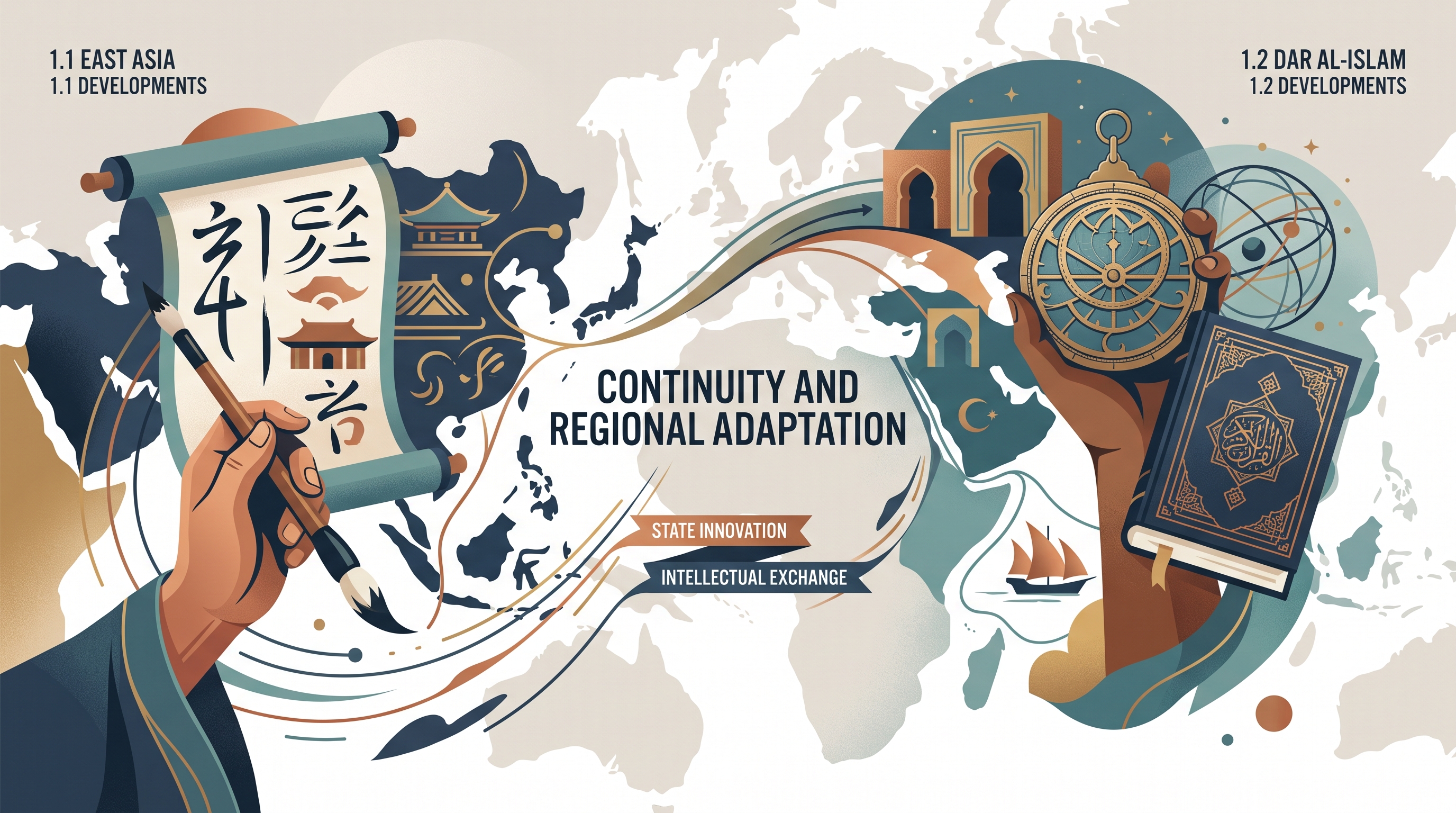
1.1 Developments in East Asia · 1.2 Developments in Dar al-Islam
Key concepts: Developments in East Asia · Developments in Dar al-Islam · Chinese cultural traditions and their effects on East Asia · Intellectual innovation in Dar al-Islam · Rise of Islamic states · Cultural developments and interactions · Spread of Hinduism and Buddhism into Southeast Asia · Fragmentation of the Abbasid Caliphate · Turkic-dominated Islamic political entities · Continuity, innovation, and cultural transfers
Between approximately $1200$ and $1450$, two large cultural worlds changed through a similar process: older traditions remained powerful, but they were repeatedly adapted to new political and social conditions.
1.1 Developments in East Asia · 1.2 Developments in Dar al-Islam
Between approximately $1200$ and $1450$, two large cultural worlds changed through a similar process: older traditions remained powerful, but they were repeatedly adapted to new political and social conditions. In East Asia, Chinese traditions shaped neighboring societies without making them identical to China. In Dar al-Islam—the interconnected lands where Islam formed a major religious and cultural framework—political fragmentation produced new states while intellectual exchange continued across Afro-Eurasia.
Chinese traditions beyond China
The Tang and Song dynasties provided the most important political and cultural context for East Asia. Chinese influence traveled through government institutions, education, literature, religious practice, and family ideals. Filial piety, the expectation that children respect and support parents and ancestors, reinforced family hierarchy and helped connect household discipline to broader political obedience.
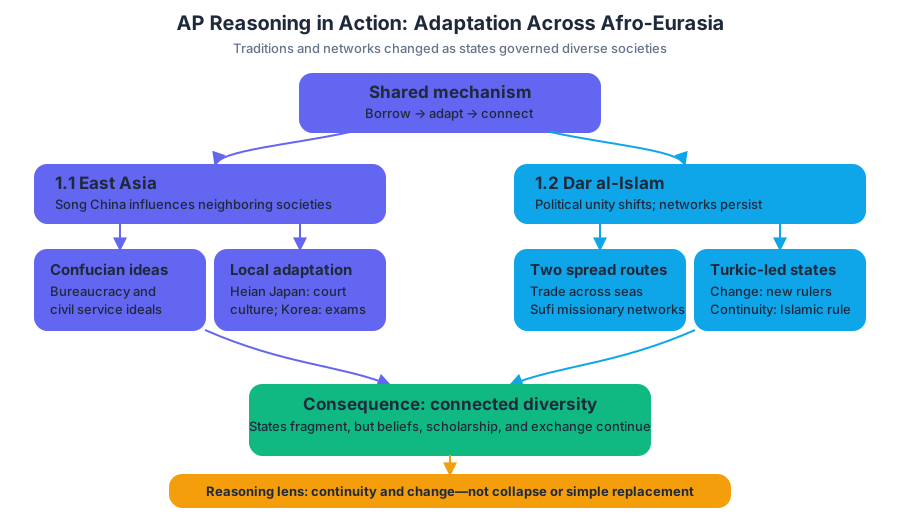
KC-3.1.III.D.i identifies the continuity of Chinese cultural traditions and their influence on neighboring regions. Korea adopted Chinese-style bureaucratic and scholarly practices while maintaining its own political identity. In Heian Japan, Chinese literary and scholarly traditions influenced court culture, writing, and administration, but Japanese elites selectively adapted them rather than simply copying China.
Confucian traditions also shaped gender expectations. They emphasized respect for women within the family while often requiring women’s deference to male relatives. This combination matters: “respect” did not necessarily mean equality. Neo-Confucianism—an intellectual revival and reinterpretation of Confucian teachings—strengthened family hierarchy and social discipline, while Buddhism continued to shape Asian societies through multiple branches, schools, and practices, including Theravada, Mahayana, and Tibetan Buddhism (KC-3.1.III.D.ii).
Key distinction: Cultural influence is not the same as political control. Korea and Japan could borrow Chinese institutions and ideas while remaining independent states.
Worked example — explaining change and continuity: Suppose a prompt asks why Chinese traditions affected both Korea and Japan but produced different outcomes. Begin with the shared cause: China’s prestige, written traditions, and bureaucratic model made its institutions attractive. Then show different effects: Korea adopted more direct Confucian and bureaucratic patterns, while Japan adapted Chinese learning to a distinct court and political system. The strongest explanation connects shared cultural influence to local adaptation.
The fragmentation and rise of Islamic states
The Abbasid Caliphate once symbolized a broad Islamic political order, but its authority fragmented over time. As central control weakened, new Islamic political entities emerged, most of them dominated by Turkic peoples (KC-3.2.I). Nomadic Turkic groups maintained military and political dominance in the Middle East and Central Asia because their mobile cavalry forces could conquer territory and because rulers recruited Turkic soldiers and commanders into state service.
The rise of Islamic states resulted from more than conquest. KC-3.1.III.A emphasizes military expansion, but Islam also spread through merchants, missionaries, and Sufis—Muslim mystics whose teachers and networks attracted converts. New states therefore combined continuity with innovation: they preserved Islamic beliefs, law, and political legitimacy while incorporating Turkic military leadership, Persian administrative traditions, and local customs.
Islam, Judaism, and Christianity continued to shape societies in Africa and Asia (KC-3.1.III.D.iii). Dar al-Islam was not a single uniform society; it was a connected cultural zone containing diverse languages, ethnic groups, political systems, and interpretations of religious practice. Interaction among these communities helped states govern plural populations and connected distant intellectual centers.
Intellectual innovation in Dar al-Islam
States and empires in Dar al-Islam encouraged significant intellectual innovations and transfers. Scholars preserved, translated, criticized, and extended knowledge from Greek, Persian, Indian, and other traditions. Advances associated with mathematics, medicine, astronomy, and philosophy moved through scholarly and commercial networks, making Dar al-Islam a major zone of intellectual exchange (Unit 1: Learning Objective F; KC-3.2.II.A.i).
The causal chain is precise: political and economic centers supported scholars; scholars gathered and translated texts; institutions and networks circulated ideas; those ideas improved calculation, medical understanding, navigation, and administration. Intellectual innovation was therefore not isolated “genius”—it depended on patronage, cities, libraries, and cross-cultural contact.
AP reasoning in action
This topic most directly develops Skill 1: Developments and Processes by tracing how traditions or states changed over time; Skill 3: Claims and Evidence in Sources by using examples such as Heian Japan, Korea, Turkic-led states, and Sufi networks; Skill 4: Contextualization by connecting the Song and Abbasid settings to wider Afro-Eurasian exchange; and Skill 5: Making Connections through comparison, causation, and continuity and change. A successful response does not merely list facts: it explains a mechanism and its consequences.
Misconception check: “The Abbasid collapse ended Islamic civilization.” Incorrect. Political unity declined, but cultural and intellectual activity continued through new, diverse states. Fragmentation changed who governed; it did not erase the networks, beliefs, scholarship, or interactions that connected Dar al-Islam.
Retrieval check: Name one Chinese tradition that influenced East Asia, one way local societies adapted it, and two routes through which Islam spread. Then explain in one sentence why the rise of Turkic-led states represents both continuity and change.
Source Materials
- AP World History: Modern Course and Exam Description
- AP World History: Modern Course and Exam Description Clarifications and Corrections
- AP World History: Modern Course Overview
- AP World History: Modern Course at a Glance
- AP World History: Modern Course at a Glance Poster
- AP World History: Modern
- AP World History: Modern
- AP World History: Modern Sample Syllabus 1
- [a] Identify ONE likely political purpose of the image. 1 point
- [a] Identify ONE likely political purpose of the image.
- AP World History Past Exam Questions — AP Central
- Khan Academy — AP World History: Modern