From the free course AP World History: Modern on Lykke
AP Practice 6
A strong Long Essay Question (LEQ) response does more than name events. It makes a defensible claim, places that claim in a wider historical setting, supports it with specific evidence, and explains why the evidence proves the argument.
AP Practice 6
Long Essay Question: Explaining Historical Change
A strong Long Essay Question (LEQ) response does more than name events. It makes a defensible claim, places that claim in a wider historical setting, supports it with specific evidence, and explains why the evidence proves the argument. The central historical move is turning a list of facts into a chain of reasoning.
Core principle: An LEQ is an argument about history, not a memory dump.
Original Practice Prompt
Evaluate the extent to which the expansion of long-distance exchange networks from c. 1200 to c. 1750 changed cultural interactions among societies in Afro-Eurasia.
You may use the Silk Roads, the Mongol Empire, the Indian Ocean network, the spread of Islam, the transmission of technologies, or other historically relevant examples.
What the prompt is really asking
The phrase “evaluate the extent” requires a qualified judgment. You must decide whether exchange networks caused major, moderate, or limited cultural change—and then explain both the changes and the continuities that justify your judgment.
| Prompt component | Question to ask yourself | Useful direction |
|---|---|---|
| Evaluate | What is your overall judgment? | Make a claim, not merely a description. |
| Extent | How large or important was the change? | Weigh change against continuity. |
| Changed | What was different by c. 1750? | Identify consequences over time. |
| Cultural interactions | How did societies influence one another? | Discuss religion, language, technology, art, or knowledge. |
| Afro-Eurasia | Where must your evidence come from? | Use connected regions rather than one society alone. |
Worked Reasoning
Step 1: Build the historical context
Before c. 1200, Afro-Eurasian societies already exchanged goods, beliefs, technologies, and knowledge through regional routes. The rise of powerful states, expanding cities, improved transportation, and organized commercial communities increased the scale and regularity of those contacts after c. 1200.
This contextualization works because it does not begin with an isolated event. It establishes a broader setting: cultural interaction existed before the period, but expanding networks made interaction more sustained and geographically extensive.
Step 2: Select evidence that proves a pattern
Use evidence from more than one network or region:
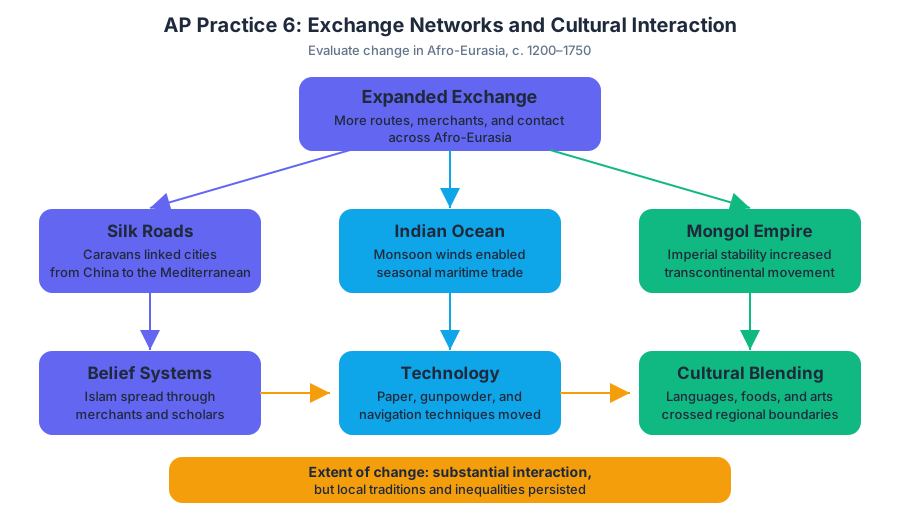
- Silk Roads: merchants, missionaries, and travelers connected East Asia, Central Asia, the Middle East, and Europe.
- Mongol Empire: political consolidation across much of Eurasia made travel and communication more secure in many areas.
- Indian Ocean network: merchants carried Islam, languages, artistic styles, and commercial practices between East Africa, the Middle East, South Asia, and Southeast Asia.
- Islam: existing Islamic traditions spread into new communities through trade and migration, while adapting to local cultures.
- Technology and knowledge: paper-making, navigational knowledge, scientific learning, and artistic forms circulated across cultural boundaries.
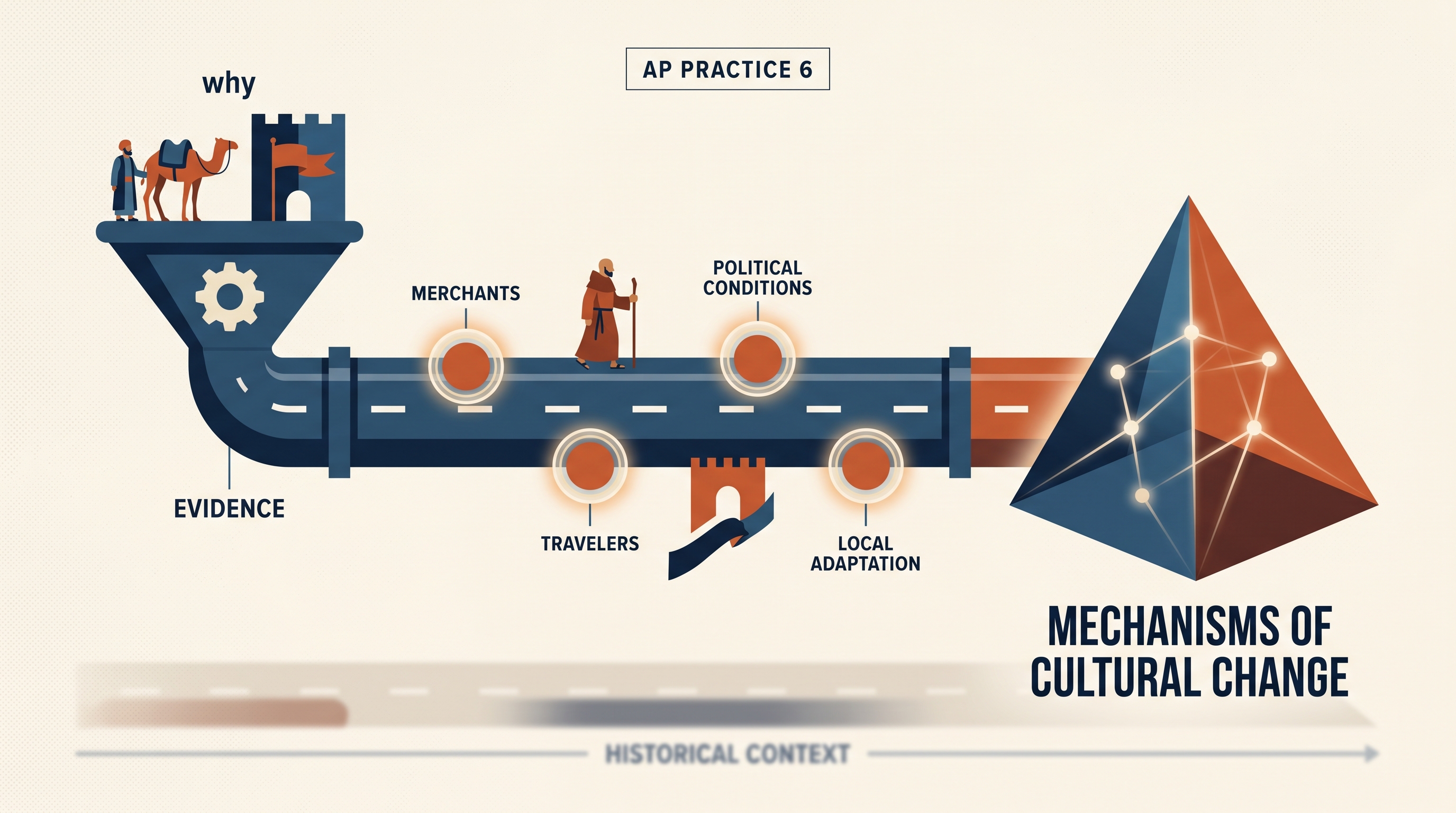
The evidence is strongest when paired with explanation. For example, saying “Islam spread through the Indian Ocean” identifies evidence; explaining that merchants and Muslim trading communities helped establish Islam in port cities, where it blended with local traditions, demonstrates historical reasoning.
Step 3: Construct a defensible thesis
Model thesis: Long-distance exchange networks changed cultural interactions across Afro-Eurasia to a substantial extent from c. 1200 to c. 1750 because they expanded the movement of religions, technologies, and artistic traditions across regions; however, the change was not complete because local societies adapted imported beliefs and practices rather than abandoning existing cultural identities.
This thesis earns its force from three features: it makes a clear judgment—substantial extent; it identifies categories of change—religion, technology, and art; and it includes a qualification—local continuity and adaptation.
A High-Scoring Response Blueprint
Paragraph 1: Context and thesis
Begin with preexisting regional exchange, then explain why networks expanded after c. 1200. End with the thesis so the reader knows the argument that the essay will prove.
Paragraph 2: Religious interaction
Argue that exchange networks transformed cultural interaction by spreading Islam beyond its original centers. Use the Indian Ocean and transregional merchants as evidence, then explain the mechanism: commercial communities created repeated contact, religious institutions supported those communities, and local societies incorporated Islam in regionally distinct ways.
Paragraph 3: Knowledge and technology
Explain that the movement of paper-making, navigational knowledge, and scientific learning connected intellectual traditions. The Mongol Empire can serve as a political condition that facilitated travel and communication across Eurasia, while the Silk Roads demonstrate the routes through which knowledge moved.
Paragraph 4: Continuity and qualification
Show that connectivity did not erase cultural difference. Local societies selected, adapted, and reinterpreted outside influences. This qualification turns the essay from a simple “exchange caused change” narrative into a more precise argument about selective cultural transformation.
Rubric-Aligned Scoring
| Criterion | What the examiner rewards | How this response addresses it |
|---|---|---|
| Thesis/Claim | A historically defensible answer to the prompt | Judges change as substantial but incomplete. |
| Contextualization | Relevant broader developments before, during, or after the period | Establishes earlier regional exchange and expanding networks. |
| Evidence | Specific examples used to support the argument | Uses the Silk Roads, Mongol Empire, Indian Ocean, Islam, and technology. |
| Analysis and Reasoning | Explains causation, comparison, continuity, or change | Shows how networks produced interaction and why local adaptation persisted. |
| Complexity | Demonstrates a nuanced understanding | Explains both transformation and continuity rather than treating cultural exchange as uniform. |
The key AP skills are Skill 1: Developments and Processes, because the response traces expanding networks over time; Skill 3: Claims and Evidence in Sources, when evidence is used to support an argument; Skill 4: Contextualization, through the wider Afro-Eurasian setting; Skill 5: Making connections through comparison, causation, continuity, and change, especially causation and continuity; and Skill 6: Argumentation, through the thesis and organized reasoning.
Timing and Error Review
Reserve approximately five minutes to plan, twenty-five minutes to write, and five minutes to revise. During revision, underline the thesis, circle specific evidence, and mark every sentence that explains how or why the evidence supports the claim.
Common misconception check
Misconception: “Cultural diffusion means one culture replaces another.”
Correction: Historical exchange usually produces adaptation. Islam, technologies, artistic traditions, and knowledge could spread widely while taking different forms in different societies.
Retrieval check
In one sentence, explain why “the Silk Roads spread ideas” is weaker than “the Silk Roads spread ideas through merchants, travelers, and political conditions that increased contact, producing cultural change while leaving room for local adaptation.” The second statement identifies evidence, explains a mechanism, and qualifies the historical result—the essential moves of an LEQ.
Source Materials
- AP World History: Modern Course and Exam Description
- AP World History: Modern Course and Exam Description Clarifications and Corrections
- AP World History: Modern Course Overview
- AP World History: Modern Course at a Glance
- AP World History: Modern Course at a Glance Poster
- AP World History: Modern
- AP World History: Modern
- AP World History: Modern Sample Syllabus 1
- AP World History Past Exam Questions — AP Central
- Khan Academy — AP World History: Modern
- Freeman-pedia — AP World History: Modern
- YouTube — Heimler's History